

Microsoft’s decision to move the Windows & Devices lead to report directly to CEO Satya Nadella marks more than a personnel shuffle — it is a structural signal that Windows, Surface, and core client engineering are being re-elevated inside Microsoft’s leadership stack at a moment when the platform is recalibrating around quality, AI integration, and developer trust.
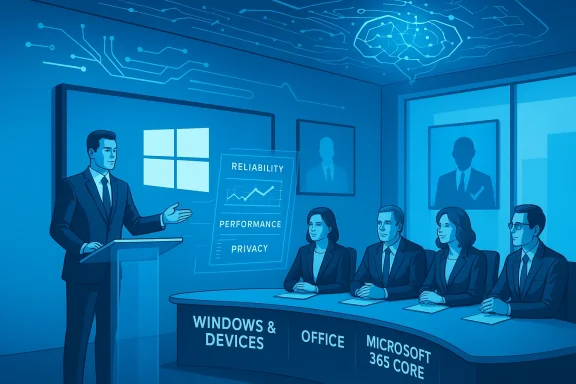
The change follows the announced retirement of Rajesh Jha, long-time head of the Experiences & Devices group, and the elevation of four senior leaders — including Pavan Davuluri, who now heads Windows & Devices — to executive vice president roles reporting directly to Nadella. This redistribution moves what had been mid-level reporting under Jha to CEO-level attention and aligns major product areas (Windows, Office/LinkedIn, Microsoft 365 Core, and Business & Industry Copilot) under executives with direct access to the company’s top decision maker.
This change arrives at a pivotal operational moment for Windows. Internally and publicly, leadership has acknowledged a need to shift the platform from feature-first experimentation toward reliability, performance, and restoring user trust — a focus that shaped recent product messaging and roadmap adjustments.
But structure alone will not ensure success. The company must translate visibility into disciplined operating rhythms, clear decision ownership, measurable quality programs, and patient product stewardship. For Windows users, OEMs, and enterprise customers, the next 6–12 months will reveal whether this change becomes the inflection point Microsoft needs — or another reshuffle that merely rearranges the deck chairs.
The signals so far — internal reorganizations, commitments to focus on fundamentals, and elevated leadership lines — are promising. What remains to be proven is execution: the measurable improvement in reliability, the timeliness of fixes, and the balance Microsoft strikes between accelerating AI innovation and protecting the everyday experience that billions depend on.
Source: Windows Central Windows & Devices boss now reports directly to Microsoft CEO Satya Nadella
 Background
The change follows the announced retirement of Rajesh Jha, long-time head of the Experiences & Devices group, and the elevation of four senior leaders — including Pavan Davuluri, who now heads Windows & Devices — to executive vice president roles reporting directly to Nadella. This redistribution moves what had been mid-level reporting under Jha to CEO-level attention and aligns major product areas (Windows, Office/LinkedIn, Microsoft 365 Core, and Business & Industry Copilot) under executives with direct access to the company’s top decision maker.This change arrives at a pivotal operational moment for Windows. Internally and publicly, leadership has acknowledged a need to shift the platform from feature-first experimentation toward reliability, performance, and restoring user trust — a focus that shaped recent product messaging and roadmap adjustments.
What changed, precisely
The personnel moves
- Rajesh Jha announced his retirement after a long tenure leading Experiences & Devices; he plans to transition out and remain in an advisory capacity during the transition period. Leadership intends to finalize the cascade of organizational details before fiscal year boundaries.
- Four leaders were promoted to executive vice president roles and will report directly to Satya Nadella:
- Pavan Davuluri — Windows & Devices
- Ryan Roslanksky — Office and LinkedIn
- Perry Clarke — Microsoft 365 Core
- Charles Lamanna — Business and Industry Copilot
The structural implication
Elevating multiple product leads to report directly to the CEO is functionally equivalent to flattening a management layer for those businesses. It creates:- Faster escalation paths for cross-cutting issues that affect strategy, partnerships, and major engineering investments.
- Clearer decision ownership with executive accountability sitting adjacent to the CEO rather than two levels removed.
- Greater visibility for Windows and related products in company-wide resource discussions and investor narratives.
Why this matters for Windows and Surface
For a product as foundational as Windows, reporting lines are not mere HR trivia — they shape priorities, resource allocation, and how quickly engineering can respond to platform-wide problems.A seat at the leadership table
Windows has, at times over the last decade, felt sidelined as Microsoft’s ultra-successful cloud and enterprise businesses expanded. Giving Windows & Devices direct access to Nadella is a clear corrective: it reinstates a direct channel for product issues, quality concerns, and strategic direction to reach the CEO without intermediate filtering. That matters for:- Prioritizing reliability fixes over headline AI demos.
- Advocating for engineering headcount and platform investments that might otherwise flow to other orgs.
- Ensuring OEM and partner relationships are coordinated at the executive level.
Quality, trust, and the Windows roadmap
Windows engineering has publicly committed to a year focused on fundamentals — performance, reliability, and restoring trust — rather than being an always-on showcase for rapidly experimental AI features. Elevating the Windows lead into Nadella’s direct reporting chain increases the chance this refocused mandate is acted upon at scale. Several internal commentaries and discussion threads corroborate that leadership is redirecting the organization to fix systemic pain points across Windows in the current fiscal period.The “Agentic OS” and unified engineering
Microsoft has reportedly been consolidating Windows engineering — bringing core OS, client UI, security, and data engineering closer together under Davuluri — as part of an AI-first vision often described internally as an “Agentic OS.” That consolidation suggests a single, accountable leader for platform-level AI integration, security, and perf optimization, which can reduce friction between teams that historically lived in different silos.Strengths and opportunities
These structural moves create several immediate opportunities for Microsoft and for Windows users.- Faster, clearer decisions: Direct reporting shortens approval cycles for strategic initiatives and reduces the risk of misaligned incentives between product and platform teams. That’s crucial when prioritizing system-level work such as kernel improvements, security hardening, and telemetric fixes that require cross-team coordination.
- Strategic re-centering on platform quality: With leadership signaling a pivot to fundamentals, Windows can reallocate engineering effort toward consistent UX fixes and reliability improvements — efforts that yield compound returns in user satisfaction and enterprise stability.
- Stronger cross-product alignment: Bringing Office, Microsoft 365 Core, Copilot, and Windows leadership into equivalent executive tiers reduces friction in product integrations (for example, Copilot experiences across Windows and Microsoft 365) and helps present coherent customer narratives around productivity, AI, and security.
- Improved visibility for OEM and channel concerns: When the Windows lead reports directly to the CEO, OEM relationships and platform-dependency issues gain path-to-resolution faster, which can improve device readiness and ecosystem stability.
Risks and potential downsides
Elevating product leads to report to the CEO also introduces risks that leadership will need to manage proactively.1. Over-centralization and CEO bandwidth
Putting multiple major product lines directly under Nadella increases the number of complex issues that land on the CEO’s lap. While Nadella’s hands-on technical leadership is a strength, an influx of day-to-day operational escalations can undermine strategic focus if not carefully gated. This can be mitigated by:- Clear delegation agreements that specify decision thresholds.
- Well-defined operating rhythms and escalation criteria between EVPs and the CEO.
2. Diffused accountability if not paired with strong operational processes
Removing a layer of management can lead to faster escalations — but it can also create ambiguity about who owns end-to-end outcomes. Without explicit role definitions and investment in program management, engineering may see conflicting priorities from different EVPs or mission creep into adjacent areas.3. Cultural friction during consolidation
Reconsolidating teams that were split across organizations for years introduces cultural integration challenges. Different teams have different engineering practices, release cadences, and success metrics; realignment requires intentional orchestration, cross-training, and careful retention strategies. Some internal discussions indicate that reunification is underway but will require months of cadence alignment to be fully effective.4. User trust vs. AI ambition tension
Microsoft’s commercial success with Copilot and AI features creates pressure to surface AI capabilities quickly across Windows for competitive positioning. But the adoption cost is real: rapid AI-driven feature rollouts that surface instability risk eroding trust. The company faces a trade-off: maintain rapid innovation or slow down to restore reliability. The new reporting structure can help arbitrate that trade-off — but only if leadership chooses quality over short-term feature optics.What this means for Windows users, IT admins, and partners
For consumers and power users
- Expect a stronger emphasis on quality-of-experience fixes: smaller, higher-value UX improvements, visible perf gains, and more measured feature rollouts.
- Copilot and AI-driven features will likely remain strategic priorities but may be introduced more cautiously on the surface to avoid undermining platform stability.
For enterprise IT
- A Windows lead with direct CEO access makes it easier for enterprise priorities — security, manageability, update reliability — to be elevated and resourced appropriately.
- IT procurement and lifecycle planning may see better coordination with Microsoft’s engineering cadence as OS-level decisions receive stronger executive sponsorship.
For OEMs and hardware partners
- Faster executive-level engagement should help resolve device readiness and driver/signing issues more rapidly.
- OEMs should watch for clearer roadmaps and potentially more deliberate timing for major platform changes that affect manufacturing pipelines.
Tactical signals to watch in the next 6–12 months
To evaluate whether this leadership change is substantive and not merely cosmetic, watch for the following concrete signs:- Updated operating cadences and decision documents — internal memoranda or public-facing communication that outline new reporting protocols and decision ownership will indicate meaningful structural change.
- Resource reallocation toward platform fundamentals — measurable increases in headcount, test coverage, or release-window prioritization for reliability and perf patches rather than new feature teams.
- Fewer high-risk feature rollouts and more phased, telemetry-backed pilots — a move away from aggressive broad-surface AI experiments toward guarded releases that prove stability before wide exposure.
- OEM and enterprise feedback loops that shorten time-to-resolution — evidence that longstanding device or update issues are being resolved more quickly through executive engagement.
- Public statements or investor commentary that cites Windows progress explicitly — CEO and CFO remarks in earnings calls that link Windows stability and user satisfaction to revenue or strategic health.
Deeper analysis: how this fits into Microsoft’s broader strategy
Windows as an engineering backbone for AI
Microsoft now views Windows not just as a GUI for apps but as a strategic runtime for AI-infused experiences. The consolidation of platform teams under Davuluri and the elevation of Copilot and Microsoft 365 Core leaders to Nadella’s direct org suggest an architectural strategy: make Windows the reliable surface layer for cloud-powered intelligence while treating Copilot and Microsoft 365 as the application-level orchestration. This vertical alignment reduces friction between platform capabilities (e.g., on-device models, telemetry, memory management) and productivity features that depend on them.Investor and market optics
For investors, a Windows leader who reports to the CEO signals that management treats the platform as strategically important — not a legacy product to be managed at arm’s length. In an era when Microsoft’s cloud and AI efforts drive valuations, making Windows central again can be framed as preserving a long-term moat: control of the primary OS layer across billions of devices. Microsoft’s recent public numbers on Windows 11 adoption and related platform metrics will be watched closely in subsequent earnings cycles to see whether the leadership change corresponds to improved metrics.Balancing speed and stewardship
Microsoft’s success over the last decade has often hinged on its ability to combine cloud scale with disciplined product stewardship. The current reorg offers a chance to reassert stewardship, but it requires disciplined trade-offs. If Nadella actively enforces prioritization of quality before feature velocity, Microsoft can preserve the commercial upside of AI while protecting platform trust. If not, the company risks repeating cycles of feature-driven user frustration that ultimately slow adoption and damage brand equity.Practical recommendations for Microsoft
If Microsoft wants this change to be more than symbolic, the company should:- Publish clear decision-ownership guidelines that outline which decisions require CEO involvement and which are delegated to EVPs. This will protect CEO bandwidth and speed up execution.
- Fund and measure a platform-quality program with explicit KPIs (boot time, update failure rate, crash rates, telemetry-based satisfaction scores) and public progress updates to rebuild trust.
- Invest in cross-team integration programs that harmonize release cadences, testing frameworks, and dependency management across previously split orgs. Expect months of cultural and process work here.
- Adopt a staged rollout model for AI features with pre-flight enterprise pilots and opt-in consumer previews that collect telemetry for stability before broad deployment. This reduces default-experience risk while allowing innovation to continue.
What could go wrong — worst-case scenarios
- Executive overload: If too many operational problems escalate to the CEO, strategic focus on long-term engineering investments could suffer.
- Unfinished integration: If the reunified engineering teams fail to harmonize tools and metrics, the company could see duplicated effort and missed SLAs.
- Mixed messaging: If public PR emphasizes AI-first features while engineering is still working to stabilize the platform, customer confusion and criticism may intensify.
- Slow response to enterprise needs: Without explicit pipelines for enterprise feedback, Microsoft risks losing credibility with IT and channel partners who value stability and predictability.
Readiness checklist for administrators and partners
If you manage Windows fleets or partner on device hardware, use the next 12 months to:- Audit your update policies and ensure you have rollback plans for feature updates.
- Validate driver-signing and Secure Boot expectations in test environments ahead of major Windows releases.
- Engage Microsoft through partner channels to get visibility into the new operating rhythms and beta programs.
- Monitor telemetry and performance KPIs post-update; feed structured bug reports to Microsoft with repro steps and logs.
- Treat Copilot and AI features as optional opt-ins in enterprise deployments until defensive metrics stabilize.
Conclusion
Microsoft’s leadership reshuffle — notably moving Windows & Devices to report directly to Satya Nadella — is a consequential organizational signal. It restores a seat at the executive table for Windows, reunifies key engineering responsibilities under a single leader, and aligns Windows more directly with the company’s AI and productivity strategies. The move offers a real opportunity to correct course: to prioritize stability, rebuild user trust, and deliver integrated AI experiences without sacrificing platform health.But structure alone will not ensure success. The company must translate visibility into disciplined operating rhythms, clear decision ownership, measurable quality programs, and patient product stewardship. For Windows users, OEMs, and enterprise customers, the next 6–12 months will reveal whether this change becomes the inflection point Microsoft needs — or another reshuffle that merely rearranges the deck chairs.
The signals so far — internal reorganizations, commitments to focus on fundamentals, and elevated leadership lines — are promising. What remains to be proven is execution: the measurable improvement in reliability, the timeliness of fixes, and the balance Microsoft strikes between accelerating AI innovation and protecting the everyday experience that billions depend on.
Source: Windows Central Windows & Devices boss now reports directly to Microsoft CEO Satya Nadella
