

Microsoft’s latest push to embed third‑party defenses directly into Microsoft Entra marks a pragmatic shift: identity protection is no longer just about adding conditional access or MFA — it’s about delivering layered, partner‑driven defenses at the points where attackers interact with identities, and doing so inside the Entra admin experience for faster adoption.
Microsoft Entra has evolved from a simple cloud directory into a broader identity platform that aims to secure the entire identity lifecycle — from sign-up and credential issuance to recovery and access entitlement. Recent announcements expand that platform by adding native partner integrations that let organizations attach proven security services directly into Entra flows rather than stitching them together through bespoke integrations and separate procurement processes.
That evolution addresses a common operational pain point: enterprise teams routinely delay or compromise on identity protections because vendor onboarding, contracts, and integration work introduce friction. Microsoft’s new approach — discover, purchase, and deploy within the Entra portal and the Microsoft Security Store — is specifically designed to collapse that friction and accelerate real‑world deployment of layered controls.
Key operational benefits:
The model’s strengths lie in speed, layered coverage, and governance alignment; its risks center on privacy, availability, and potential vendor dependencies. To get the most value, organizations should pilot carefully, insist on strong contractual protections for sensitive data, integrate proofing attestations into policy engines, and continuously measure user‑facing outcomes. When managed deliberately, these integrations can materially raise the cost for attackers and reduce the most common identity‑driven breach vectors — while keeping legitimate users moving through secure, friction‑calibrated paths.
Source: Petri IT Knowledgebase Microsoft Entra Adds Native Partner Integrations
 Background
Microsoft Entra has evolved from a simple cloud directory into a broader identity platform that aims to secure the entire identity lifecycle — from sign-up and credential issuance to recovery and access entitlement. Recent announcements expand that platform by adding native partner integrations that let organizations attach proven security services directly into Entra flows rather than stitching them together through bespoke integrations and separate procurement processes.That evolution addresses a common operational pain point: enterprise teams routinely delay or compromise on identity protections because vendor onboarding, contracts, and integration work introduce friction. Microsoft’s new approach — discover, purchase, and deploy within the Entra portal and the Microsoft Security Store — is specifically designed to collapse that friction and accelerate real‑world deployment of layered controls.
What Microsoft announced (overview)
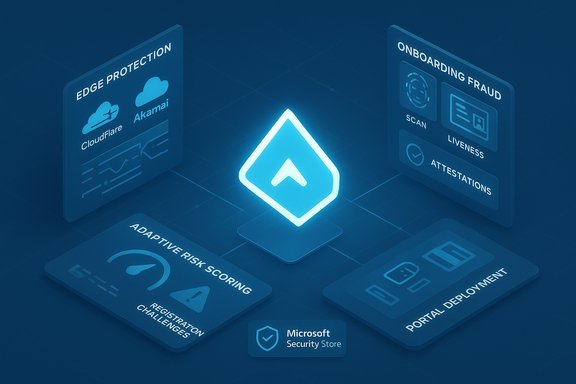
Microsoft’s announcement groups the native integrations into three practical categories:- Edge WAF and bot mitigation — integration with Cloudflare and Akamai to apply WAF protections and bot filtering at the edge, blocking volumetric and application attacks before traffic reaches Azure Front Door or the Entra External ID tenant.
- Sign-up fraud prevention and adaptive challenges — Arkose Labs and HUMAN Security integrated into user registration and onboarding flows to detect automated account creation and apply risk‑based step‑ups.
- Identity proofing and biometric verification — support for government‑issued ID checks and biometric face matching from Au10tix, IDEMIA, and TrueCredential (LexisNexis) to upgrade account recovery, access package approvals, and passkey registration workflows.
Why this matters: the identity attack surface and practical benefits
The identity attack surface has widened: credential stuffing, automated account creation, synthetic identity fraud, and sophisticated application‑layer attacks now precede many breaches. Microsoft’s integrated partner model targets these threats at the earliest possible point.Key operational benefits:
- Faster deployment — security teams can discover, buy, and deploy partner protections within minutes using the Security Store, reducing project timelines that previously took weeks or months.
- Layered defense at the right layers — edge WAFs and bot management stop attacks before they reach Entra, while proofing and challenge flows reduce successful account‑creation fraud and improve recovery assurance.
- Reduced integration complexity — removing the need for custom proxies or bespoke connectors lowers engineering overhead and decreases the chance of misconfiguration.
- Improved user experience — risk‑based screening aims to keep legitimate users on a frictionless path while challenging high‑risk requests, preserving conversion for sign‑ups and onboarding.
Deep dive: Partner capabilities and where they plug in
Edge protection: Cloudflare and Akamai (WAF + DDoS + bot filtering)
Cloudflare and Akamai are being positioned to protect Entra workloads at the edge — upstream of Azure Front Door and Entra External ID. That placement enables organizations to:- Block volumetric DDoS and network attacks before they consume Azure ingress capacity.
- Apply rule sets that enforce OWASP Top 10 protections and block injection or logic‑flaw attempts.
- Use advanced bot detection to prevent automated account takeover and credential‑stuffing traffic from ever reaching identity endpoints.
Sign-up fraud prevention: Arkose Labs and HUMAN Security
Arkose Labs and HUMAN provide risk‑based screening and adaptive challenge workflows that sit inside the registration and onboarding steps. Their role includes:- Real‑time bot vs. human classification using behavioral, device, and network signals.
- Adaptive challenge flows where high‑risk agents receive interactive or stepped challenges to separate humans from bots without imposing global friction.
- Blocking large‑scale fake account creation campaigns that feed later credential abuse or social‑engineering attacks.
Identity proofing and biometrics: Au10tix, IDEMIA, TrueCredential
Identity proofing integrations focus on high‑assurance identity events: account recovery, access package approvals, and initial credential issuance. The partner tools offer:- Government‑ID document verification with OCR and document authenticity checks.
- Biometric face matching and liveness detection to bind documents to real persons.
- Attestation tokens or signed claims that Entra can consume to elevate assurance levels for recovery and access decisions.
How the in‑portal experience works
Microsoft’s stated goal is to let administrators manage discovery, procurement, and deployment inside the Entra console and the Microsoft Security Store. Practical mechanics include:- Search the Security Store for certified partner solutions and view product descriptions and deployment guides inside the Entra admin experience.
- Purchase or subscribe through the same store mechanism, avoiding separate vendor procurement cycles.
- Deploy the integration using guided in‑product workflows that automatically configure relevant hooks — e.g., routing registration traffic to a partner’s challenge engine or wiring an identity‑proofing attestations endpoint into Entra’s recovery logic.
Implementation guidance — recommended rollout steps
Practical steps for security teams implementing the new Entra partner integrations:- Start with a scoped pilot: apply partner controls to a small, non‑critical user cohort or a single application to validate UX and false‑positive rates.
- Review telemetry and tuning: partner proofs and bot mitigation engines require threshold tuning to balance security and user conversion. Monitor challenge success rates, false refusals, and help‑desk tickets.
- Integrate with conditional access: consume attestations from identity proofing as claims in conditional access policies to raise assurance only where necessary.
- Require signed attestations, not raw images: ensure the integration returns machine‑readable attestations or proofs rather than storing biometric images in tenant controls.
- Contract for portability and SLAs: insist on data portability, documented retention policies, incident reporting timeframes, and clear SLAs for availability.
Strengths: what this approach gets right
- Seamless procurement to deployment lowers organizational friction, increasing the odds that advanced protections actually reach production.
- Layered protection treats identity attacks as multi‑stage problems and defends each stage: edge, onboarding, proofing, and recovery.
- Vendor specialization — using best‑of‑breed providers for WAF, bot mitigation, and proofing is more effective than relying on generic, single‑vendor controls.
- Operational governance — bringing partner solutions into Entra’s admin surface makes protections auditable and manageable with existing identity governance workflows.
Risks, limitations, and caveats
While the integrated model is compelling, it introduces material risks that organizations must manage.Privacy and biometric data handling
Identity proofing vendors process sensitive personal data and biometrics. Even if integrations return attestations rather than raw images, contractual and technical controls must ensure:- Clear retention limits and deletion guarantees.
- Restrictions on cross‑tenant or cross‑jurisdictional reuse of biometric data.
- Independent audits and breach notification clauses.
False accepts versus false rejects
Biometric and behavioral systems involve trade‑offs. Lowering thresholds improves conversion but increases false acceptance risk; raising thresholds reduces fraud at the cost of legitimate user friction. Practical deployments require representative pilots and ongoing monitoring to avoid exclusionary outcomes.Vendor lock‑in and portability
Relying on a small set of proofing partners may complicate future migrations or multi‑jurisdiction operations. Contracts should include portability clauses and machine‑readable attestations to avoid vendor‑tied data models.Availability and SLAs
Placing critical controls (e.g., sign‑up verification) behind external vendors creates availability dependencies. Ensure fallback flows and resilient configurations (circuit breakers, local caching of decisions, emergency bypass with high‑assurance manual reviews).Unverifiable marketing claims
Some vendor or platform messaging about “instant protection” or “100% fraud prevention” should be treated cautiously. These are aspirational; real‑world efficacy is use‑case and population dependent. When encountering specific quantitative claims, validate them through pilot data and ask for independent testing evidence. Unverifiable claims should be flagged and tested before wide rollout.Cross‑validation and verification notes
To ensure accuracy and avoid reliance on a single narrative, the core claims about partner integrations and the Security Store model were cross‑checked against multiple independent items in the available files:- The description of edge integrations and partner WAF usage is documented in recent Entra updates and Microsoft‑adjacent coverage of Security Store and agent integrations.
- The identity‑proofing partners (Au10tix, IDEMIA, TrueCredential) and their role in Verified ID and recovery flows are discussed across multiple documents highlighting Microsoft’s Verified ID expansion and launch partners.
Practical recommendations for Windows and enterprise admins
- Prioritize risk: begin with high‑value onboarding and recovery flows where fraudulent account creation or social‑engineering carries the largest business impact.
- Run A/B pilots: measure conversion impact and false‑positive rates before global rollout; tune thresholds and challenge logic iteratively.
- Contract defensively: insist on portability, retention limits, breach notification guarantees, and independent security testing from proofing vendors.
- Integrate attestations into conditional access: treat proofing outputs as claims that can be consumed by policy, rather than as isolated boolean signals.
- Maintain fallback and incident playbooks: design manual verification workflows for when vendor systems are unavailable or produce unexpected outcomes.
What to watch next
Microsoft signals that the Security Store and partner catalog are expanding, with further integrations and agentic protections planned to cover more parts of the identity journey. Organizations should monitor announcements for:- Additional proofing vendors and geographic coverage updates.
- New partner agents in the Microsoft Security Store that bring verticalized or specialized identity protections.
- Governance tooling that ties partner agent lifecycles to Entra’s identity governance, audit, and telemetry surfaces.
Conclusion
Embedding partner defenses natively into Microsoft Entra is a practical and welcome step toward reducing friction and improving the effectiveness of identity protections. By combining edge WAF and bot mitigation, risk‑based registration defenses, and high‑assurance identity proofing — all discoverable and deployable through the Entra console and Security Store — Microsoft is reducing the operational barriers that have historically slowed deployment of best‑of‑breed controls.The model’s strengths lie in speed, layered coverage, and governance alignment; its risks center on privacy, availability, and potential vendor dependencies. To get the most value, organizations should pilot carefully, insist on strong contractual protections for sensitive data, integrate proofing attestations into policy engines, and continuously measure user‑facing outcomes. When managed deliberately, these integrations can materially raise the cost for attackers and reduce the most common identity‑driven breach vectors — while keeping legitimate users moving through secure, friction‑calibrated paths.
Source: Petri IT Knowledgebase Microsoft Entra Adds Native Partner Integrations
