

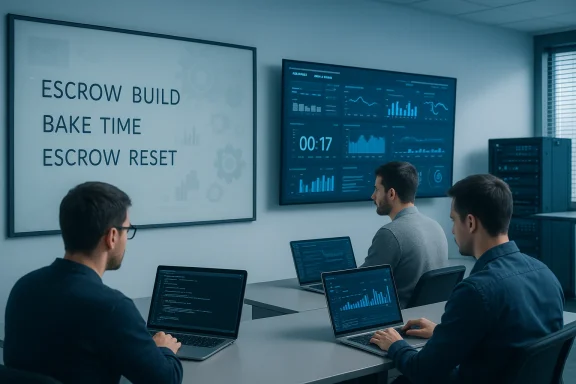
Microsoft’s internal vocabulary for shipping software — words like escrow build, bake time, and escrow reset — isn’t just corporate theater; it’s shorthand that encodes a careful, repeatable quality‑assurance workflow used to move code from engineers’ machines into customers’ hands. Recent commentary from long‑time Microsoft engineer Raymond Chen decodes that Microspeak and clarifies what release teams mean when they say a build has been “placed into escrow” and is being “baked,” while reporting from industry outlets has amplified the conversation for a wider audience.
Microsoft’s use of the term escrow build—a build selected by release management and put into a no‑change observation period before release—was recently explained by Raymond Chen on his Old New Thing blog. Chen describes escrow as “the phase before the completion of the RTM milestone where the product accepts no changes while its behavior is closely observed to ensure that it meets release criteria,” and he ties that to the related term bake, which he defines as using time and real‑world usage to build confidence in code changes.
Technology press coverage summarized Chen’s explanation and framed the vocabulary as part of Microsoft’s quirky internal jargon; Windows Central used Chen’s piece to illustrate how the language of release management evolved inside Microsoft and to show how the terms map to practical QA steps.
Those short definitions hide a surprisingly sophisticated set of practices. Escrow builds, bake time, and the possibility of an escrow reset are not mere buzzwords — they represent an engineered lifecycle stage that balances two competing objectives: shipping value to customers on schedule, and stopping any last‑minute, high‑risk changes that could reverse months of stabilization work.
This observation period typically includes:
What gets measured during bake time varies by product but generally includes:
This mechanism formalizes what many development organizations do informally: a stop‑and‑assess decision point before committing to mass‑distribution. Formalizing it reduces ambiguity and gives the release organization authority to require fixes or to delay shipping when reliability is at risk.
That history matters: escrow is not a novel gimmick but an institutionalized control point evolved to manage multi‑component, multi‑configuration releases at scale. When hundreds of teams contribute to a single downstream product, a disciplined final stabilization phase helps coordinate the last mile.
Adopting the spirit of escrow and bake — not necessarily the jargon — can help any organization move from ad‑hoc drop‑and‑pray releases to a deliberate, measurable release pipeline that protects users and preserves hard‑won engineering momentum.
Source: Windows Central https://www.windowscentral.com/microsoft/microsoft-invented-escrow-builds-to-launch-functional-apps/
 Background / Overview
Microsoft’s use of the term escrow build—a build selected by release management and put into a no‑change observation period before release—was recently explained by Raymond Chen on his Old New Thing blog. Chen describes escrow as “the phase before the completion of the RTM milestone where the product accepts no changes while its behavior is closely observed to ensure that it meets release criteria,” and he ties that to the related term bake, which he defines as using time and real‑world usage to build confidence in code changes.Technology press coverage summarized Chen’s explanation and framed the vocabulary as part of Microsoft’s quirky internal jargon; Windows Central used Chen’s piece to illustrate how the language of release management evolved inside Microsoft and to show how the terms map to practical QA steps.
Those short definitions hide a surprisingly sophisticated set of practices. Escrow builds, bake time, and the possibility of an escrow reset are not mere buzzwords — they represent an engineered lifecycle stage that balances two competing objectives: shipping value to customers on schedule, and stopping any last‑minute, high‑risk changes that could reverse months of stabilization work.
What Microsoft Means by “Escrow Build” and “Bake Time”
The escrow build: a freeze with observation
At its core, an escrow build is a chosen candidate for release that is intentionally frozen for functional changes and then observed under controlled conditions. The freeze is not merely symbolic: the goal is to stop feature churn and ensure stability so that the release team can gather reliable data about the build’s quality and behavior in environments that resemble real usage. Raymond Chen’s write‑up makes this explicit: escrow is the point where “the product accepts no changes while its behavior is closely observed to ensure that it meets release criteria.”This observation period typically includes:
- concerted internal testing cycles,
- extended self‑host usage (running the build inside Microsoft on production‑like systems),
- telemetry monitoring for regressions or new failure modes, and
- manual verification of critical scenarios.
Bake time: building confidence with time and usage
Bake time is the natural companion to escrow: while escrow freezes changes, bake time is the interval during which confidence in the build is earned. Bake implies slow, measured exposure to a variety of workloads and user behaviors rather than one‑off tests. Chen summarized bake as “(of a code change) to build confidence by observing its behavior over a period of time,” which captures the central idea: trust is not declared, it is earned through exposure and monitoring.What gets measured during bake time varies by product but generally includes:
- crash rates and exception telemetry,
- performance regressions in key scenarios,
- security or privacy red flags,
- install/uninstall integrity, and
- high‑impact bug occurrence rates across different configurations.
The Escrow Reset: When Bake Time Goes Bad
The workflow is intentionally iterative. When a serious bug surfaces during bake time, release teams do not blindly proceed. Instead they conduct an assessment: how often the issue occurs, which classes of users it affects, severity, and whether viable workarounds exist. If the bug is severe enough to justify a change, the team declares an escrow reset, accepts the fix, and selects a new escrow build for another round of bake time. Chen described this cycle as repeating until the product can pass escrow without escrow events, at which point the build moves on to manufacturing.This mechanism formalizes what many development organizations do informally: a stop‑and‑assess decision point before committing to mass‑distribution. Formalizing it reduces ambiguity and gives the release organization authority to require fixes or to delay shipping when reliability is at risk.
Historical Context: Escrow Builds Aren’t New
While recent coverage has highlighted the terminology, the idea of an escrow stage in the Microsoft release pipeline has historical precedent. The Windows Vista and Windows 7 development timelines, for instance, referenced escrow or RTM‑escrow builds, where the product entered a final stabilization phase before RTM (Release To Manufacturing). Those historical uses show the escrow concept has been part of Microsoft’s release playbook for years and used in large, complex product rollouts.That history matters: escrow is not a novel gimmick but an institutionalized control point evolved to manage multi‑component, multi‑configuration releases at scale. When hundreds of teams contribute to a single downstream product, a disciplined final stabilization phase helps coordinate the last mile.
Why Microspeak Matters: Communication, Culture, and Control
Microsoft’s internal vocabulary — Microspeak — is more than corporate slang. It performs several pragmatic functions in an engineering organization:- Conciseness: short phrases compress complex operational constructs into a single term that all stakeholders understand.
- Authority: declaring a build as escrow gives release management an explicit handoff point that is respected by engineering and program teams.
- Risk signaling: terms like on fire or escrow reset carry immediate urgency and set expectations for triage and escalation.
- Process alignment: shared vocabulary synchronizes actions across distributed teams, from telemetry engineers to marketing and manufacturing.
Benefits: Why a Formal Escrow/Bake Stage Works
For large platform vendors and enterprise software teams, the escrow phase delivers several clear benefits:- Stability by design: freezing code changes reduces last‑minute regressions and the integration risk that occurs when multiple patches are applied at the same time.
- Measurable confidence: bake time creates a time window to gather telemetry, which converts anecdotal judgements into measurable evidence.
- Controlled remediation: escrow resets provide a structured way to accept fixes without undermining the stabilization process.
- Cross‑team coordination: by making escrow a milestone, the organization ensures QA, documentation, manufacturing, and PR are aligned on the release state.
- Customer protection: the approach prevents situations where rushed shipping introduces high‑impact failures for a broad user base.
Risks and Limitations: The Hidden Costs of Bake Time
No process is without tradeoffs. The escrow/bake model has inherent costs and potential downsides:- Time pressure and schedule slippage: treating bake as a gating function can push release dates when escrow events occur. For businesses with fixed launch windows, this can conflict with market pressures.
- False confidence: bake time is powerful, but limited load cases or insufficient telemetry coverage can produce a false sense of security. Bake needs representative exposure; otherwise it can miss edge cases that only appear after broad public adoption.
- Decision bottlenecks: the authority to reset escrow or accept exceptions needs clear criteria. Without them, decisions can be politicized or delayed.
- Over‑rigidity: small, low‑risk bug fixes might be deferred unnecessarily if organizations interpret escrow too strictly; conversely, loosening escrow rules can undermine its value.
- Communication gap with external stakeholders: internal jargon can frustrate partners and customers if not translated into clear external milestones and support timelines.
How Escrow Practices Map to Modern Release Engineering
Many modern release engineering practices map naturally to escrow and bake concepts, making them relevant beyond Microsoft:- Feature flags and progressive rollouts let teams emulate bake behavior by incrementally exposing changes to subsets of users.
- Canary and ring‑based releases implement staged bake time, moving from internal rings (self‑host) to broader rings before general availability.
- Observability and SLOs provide the telemetry backbone for bake: good signals and error‑budget logic make bake decisions defensible.
- Automated gating and CI/CD can codify the escrow freeze for code paths that impact specific subsystems, ensuring compliance without manual bottlenecks.
Practical Recommendations for Teams Adopting an Escrow‑Style Process
If your team is considering introducing an escrow/bake phase, these pragmatic steps will help avoid common pitfalls:- Define clear measurement criteria before freeze. Specify the telemetry signals, acceptable thresholds, and the timeframe required for bake.
- Create an escrow decision playbook. Include roles, who can declare an escrow reset, and what remediation timelines look like.
- Use representative self‑host and pre‑production environments. Bake time is only as useful as the fidelity of the environments and traffic patterns you observe.
- Instrument aggressively. Broad telemetry and user metrics reduce ambiguity when assessing whether a build meets release criteria.
- Communicate externally. Translate Microspeak for partners, customers, and documentation so stakeholders understand what escrow means for delivery dates and support.
- Pair escrow with progressive delivery. When possible, combine escrow freeze for core components with feature flags or layered rollouts for extensible parts of your product.
How This Affects Different Stakeholders
Developers and engineering managers
Escrow changes expectations: last‑minute feature drops are discouraged, and engineers must prioritize robustness. That can improve long‑term code quality, but teams must also accept that some fixes require triage against release criteria and that expedited patches will be rare and tightly controlled.QA and telemetry teams
Baked builds put QA and telemetry front and center. These teams must have clear SLAs for evaluating builds and the automation to surface relevant regressions quickly. Good observability is what turns bake into an evidence‑based process.Product and program managers
Escrow forces product teams to be realistic about scope locks and release commitments. Public messaging must reflect the escrow milestone — customers react poorly to changing release dates without clear rationale.Customers and partners
For enterprise customers and ISVs, escrow builds are a reassuring signal: the product you depend on has passed a defined, observed stabilization stage. But it also means you may need to plan for manufacturing/GA dates rather than ad‑hoc patches.How Microsoft’s Microspeak Compares to Other Industry Approaches
Large vendors often converge on similar stabilization patterns even if the vocabulary differs:- Some vendors use release candidates and gold masters with similar freeze semantics.
- Cloud providers use progressive rollouts, canaries, and feature flags heavily, with shorter bake windows but continuous validation in production.
- Open source projects sometimes rely on freeze windows and release managers who gate commits in the final stabilization period.
Critical Analysis: Strengths, Blind Spots, and What to Watch For
Strengths
- Disciplined risk management: Escrow and bake time institutionalize a conservative decision point that prevents avoidable wide‑scale failures.
- Evidence‑based go/no‑go: Bake time tied to telemetry makes the release decision less subjective.
- Cross‑functional alignment: The escrow milestone is a clear anchor for engineering, QA, legal, manufacturing, and marketing.
Blind spots
- Potential for bureaucratic delay: Without well‑defined criteria, escrow can become a bureaucratic gate that delays even high‑value fixes.
- Dependence on observability quality: Insufficient telemetry or poor signal design can hide important failures during bake.
- Risk of narrow bake environments: Self‑host or internal usage may fail to replicate real‑world diversity of hardware, locales, and third‑party interactions.
What to watch for
- How release teams define acceptable thresholds for bake metrics. Ambiguous thresholds mean ambiguous outcomes.
- Whether teams retain flexibility for critical fixes without undermining escrow discipline. The right balance is a small, governed exception process.
- Whether organizations externalize Microspeak clearly to partners and customers; lack of clarity breeds distrust.
Final Takeaways for IT Pros and Power Users
- If you manage deployments or integrations with Microsoft products, treat escrow announcements as meaningful engineering milestones rather than PR spin — they indicate a genuine stabilization phase where fewer breaking changes are likely.
- For developers building on top of Microsoft platforms, expect a formal cadence: feature windows close earlier, and final fixes are tightly controlled during escrow. Plan releases and compatibility tests accordingly.
- For end users and admins, understand that an escrow reset that delays a release is usually a reliability or security‑driven decision — inconvenient perhaps, but intended to protect the larger installed base.
Conclusion
Escrow builds and bake time are not clever marketing words; they are pragmatic process elements that encode how a large engineering organization reduces risk at the last mile of software release. Raymond Chen’s exposition clarifies important details: escrow is a code‑freeze observation phase, bake is time used to build confidence, and escrow resets are the structured way of handling serious issues that arise during that window. These mechanisms offer a repeatable, evidence‑based path to shipping safer software, provided teams pair them with robust telemetry, clear decision criteria, and transparent communication.Adopting the spirit of escrow and bake — not necessarily the jargon — can help any organization move from ad‑hoc drop‑and‑pray releases to a deliberate, measurable release pipeline that protects users and preserves hard‑won engineering momentum.
Source: Windows Central https://www.windowscentral.com/microsoft/microsoft-invented-escrow-builds-to-launch-functional-apps/