

Microsoft’s latest push to reassure European customers — promising that EU customer data “stays in Europe” — is a major public-relations and engineering milestone, but it does not erase legal, architectural, or operational trade-offs that organisations and regulators must still confront.
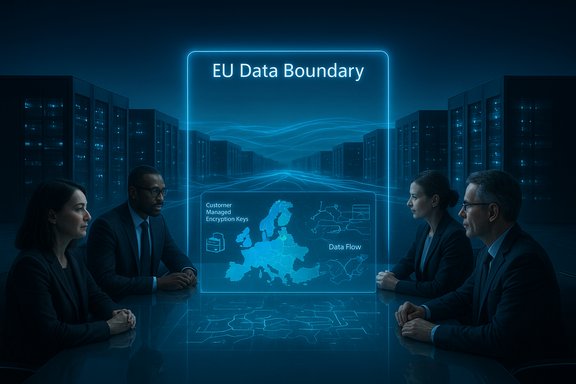
Microsoft’s multi-year effort to deliver stronger European data residency and sovereignty controls has culminated in a suite of interlocking initiatives: the EU Data Boundary for the Microsoft Cloud, new European digital commitments (including a legal digital resilience pledge), an expanded sovereign cloud portfolio and investments that materially increase European datacentre capacity. These moves are aimed at defusing rising political pressure on transatlantic data flows and answering demands from European governments, regulated industries and large enterprises for tighter control over where data is stored, processed and who can access it.
Technically, the programme promises to keep core commercial and public-sector customer data — and, in later phases, certain categories of personal and support data — inside the EU and European Free Trade Association (EFTA) regions. Contractually and organisationally, Microsoft has introduced new commitments: a European board overseeing datacentre operations, a European Digital Resilience pledge baked into government contracts, and promises to litigate if a third country order attempts to halt cloud operations in Europe.
These developments arrive against a turbulent legal and political backdrop. European courts and regulators have repeatedly signalled that location alone is an insufficient guarantee of data protection; jurisdiction and legal reach matter. At the same time, EU policymakers are pressing for digital sovereignty by promoting European cloud alternatives and regulatory guardrails. Microsoft’s strategy is deliberately comprehensive — technical controls, contractual guarantees and local governance — but the details of how those three pillars interact will determine how effective the promise really is.
However, sovereignty is not a single technical switch that can be turned on; it is a legal and operational posture sustained by contracts, controls, and independent verification. Microsoft’s commitments reduce but do not eliminate the fundamental tension between territorial data protection and the extraterritorial reach of foreign legal regimes. The remaining risk is legal and jurisdictional, not only technical.
European customers should therefore adopt a pragmatic, layered approach: accept and use the new residency and sovereignty tools, but combine them with strong contractual protections, customer-managed cryptography, independent audits, and architectural choices that preserve mobility and resilience. Procurement teams and security architects must treat “data stays in Europe” as an important control — not a complete guarantee.
Source: Computing UK https://www.computing.co.uk/news/2025/cloud/microsoft-pledges-eu-data-to-stay-in-europe/
 Background / Overview
Microsoft’s multi-year effort to deliver stronger European data residency and sovereignty controls has culminated in a suite of interlocking initiatives: the EU Data Boundary for the Microsoft Cloud, new European digital commitments (including a legal digital resilience pledge), an expanded sovereign cloud portfolio and investments that materially increase European datacentre capacity. These moves are aimed at defusing rising political pressure on transatlantic data flows and answering demands from European governments, regulated industries and large enterprises for tighter control over where data is stored, processed and who can access it.Technically, the programme promises to keep core commercial and public-sector customer data — and, in later phases, certain categories of personal and support data — inside the EU and European Free Trade Association (EFTA) regions. Contractually and organisationally, Microsoft has introduced new commitments: a European board overseeing datacentre operations, a European Digital Resilience pledge baked into government contracts, and promises to litigate if a third country order attempts to halt cloud operations in Europe.
These developments arrive against a turbulent legal and political backdrop. European courts and regulators have repeatedly signalled that location alone is an insufficient guarantee of data protection; jurisdiction and legal reach matter. At the same time, EU policymakers are pressing for digital sovereignty by promoting European cloud alternatives and regulatory guardrails. Microsoft’s strategy is deliberately comprehensive — technical controls, contractual guarantees and local governance — but the details of how those three pillars interact will determine how effective the promise really is.
What Microsoft is offering: the concrete components
EU Data Boundary and timeline
- A phased engineering programme to keep specified categories of data and processing within EU/EFTA datacentres.
- The rollout was staged: initial core-service residency, later expansion to include pseudonymized personal data, and follow-on work to localise professional support data and logs for many services.
- Microsoft describes the boundary as applying to Microsoft 365, Dynamics 365, Power Platform and “most Azure services,” with some Azure capabilities requiring additional customer configuration or action.
Sovereign cloud options
- A spectrum of offerings from public-region controls (EU Data Boundary) to Microsoft Cloud for Sovereignty, Sovereign Public Cloud, and Sovereign Private Cloud solutions.
- Azure Local and Microsoft 365 Local (hybrid and disconnected operation modes) aimed at regulated or air-gapped environments.
Governance and contractual commitments
- A European board of directors to oversee datacentre operations and compliance under European law.
- A Digital Resilience Commitment in contracts with national governments and the European Commission guaranteeing Microsoft will contest orders that would suspend cloud operations in Europe and promising compensation if the company discloses data in violation of EU law.
- Expanded transparency and documentation designed to help customers understand data flows and transfer patterns.
Infrastructure and investment pledges
- Significant capital deployment across Europe: a major expansion of datacentre capacity (Microsoft has set a multi-year target to increase capacity by a large percentage and double capacity between set years).
- Partnerships with local cloud providers and channel partners to deliver hybrid sovereignty solutions and to broaden in-country processing and support.
Why this matters now: the political and regulatory context
Europe’s political debate about data sovereignty is driven by several forces:- Repeated legal friction over transatlantic data transfers — courts and data protection authorities have questioned whether U.S. law sufficiently protects EU citizens’ rights.
- Governments and regulators under pressure to reduce dependence on non‑EU providers for sensitive infrastructure following geopolitical tensions.
- The rapid diffusion of AI and cloud-native services increases the number of workloads where jurisdictional clarity is essential for compliance, procurement and national security.
Strengths: what Microsoft has done right
- Comprehensive engineering effort. Building an EU Data Boundary across wide swathes of Microsoft’s cloud services is technically non-trivial; completing a phased rollout that extends beyond basic storage to include some categories of log and support data shows substantial engineering investment and operational change.
- Layered approach. Rather than a single fix, Microsoft combines technical controls (data residency, customer-managed keys), contractual commitments (digital resilience clauses, compensation promises) and organizational changes (a European board). That layered strategy aligns with best practice for complex sovereignty risks.
- Customer control features. Options such as customer-managed encryption keys, regionalised processing for AI workloads, localised Copilot interactions and Azure Local / Microsoft 365 Local provide customers with technical levers to reduce attack surface and limit cross-border visibility.
- Transparency and documentation. Improved data-flow documentation and public descriptions of what is and isn’t covered by the EU Data Boundary give procurement teams a starting point for assessments.
- Investment in capacity and partners. Doubling down on in-region datacentres and partnering with local providers improves latency, resilience and the ability to meet local procurement rules or certification regimes.
Risks, omissions and the hard limits of "data stays in Europe"
Microsoft’s announcements are substantial, but there are real limits and potential gaps purchasers must recognise.Jurisdictional reality: law trumps location
Physical location is not the same as jurisdictional protection. U.S. statutes (for example, the CLOUD Act) can, under certain circumstances, require a U.S.-based company to disclose data — even if that data is held overseas. Microsoft’s public position is to resist and litigate lawful access attempts inconsistent with EU law, and to compensate customers in case of unlawful disclosure. However, contractual promises and litigation strategies can be lengthy and uncertain remedies once a lawful order is properly issued. In short, residency reduces but does not nullify legal risk.Scope and coverage caveats
- The EU Data Boundary applies to large swathes of Microsoft’s commercial stack, but not every Azure service automatically. Customers may need to take additional steps or accept limitations for certain PaaS/IaaS components.
- Some processing deemed necessary for global security operations or threat response may still involve transfers outside the EU with safeguards. Microsoft states such transfers are limited and documented, but the need for occasional cross-border processing remains.
- Pseudonymized data is included in some phases, but pseudonymization is not equivalent to irreversible anonymisation — it still carries re-identification risk if combined with other data.
Operational complexity and verification
- Implementing these sovereignty features requires procurement, legal and technical teams to coordinate on contract clauses, key management (BYOK/HSM strategy), logging, and auditing.
- Customers must verify Microsoft’s claims through independent audit, contractual right-to-audit provisions and operational testing. Promises of a European board or new governance are meaningful but require follow through and transparent reporting.
AI-specific concerns
- AI services introduce new data residency and training-data questions: will conversational prompts, telemetry or model training data ever leave the EU boundary? Microsoft has extended in‑country processing for some Copilot interactions, but broad AI platform behaviour and model updates need careful scrutiny.
- Differential telemetry and diagnostics used to improve models can create cross-border flows; customers must confirm which telemetry is collected, for what purpose, and whether it is covered by the boundary.
Dependence and lock-in trade-offs
- Retaining data in-region while continuing to use a single hyperscaler still means business dependence on that vendor’s platform and operational maturity. Sovereignty features may mitigate regulatory risk, but not all customers will be comfortable with commercial concentration in a single non‑EU vendor.
- Local partnerships and hybrid offerings reduce this somewhat, but they do not create an immediate alternative to multi-provider strategies.
Practical checklist: what European organisations should demand and verify
- Review contractual language
- Ensure the European Digital Resilience Commitment (or equivalent) is explicitly included in the contract or Data Processing Addendum (DPA).
- Obtain explicit wording that defines which data categories are covered by the EU Data Boundary and which services require additional action.
- Confirm cryptographic controls
- Require customer-managed keys with HSMs located in the EU, and the right to rotate and revoke keys without Microsoft access.
- Ask for details on key escrow and backup procedures, including any cross-border key handling.
- Insist on independent audit and transparency
- Require third-party audit evidence (SOC/ISO or bespoke audits), plus the right to on-site or remote verification for key sovereignty controls.
- Request technical documentation of data flows, logs and telemetry, and mechanisms for real-time monitoring.
- Validate AI and telemetry policies
- Get contractual clarity on whether customer prompts, telemetry and model training inputs are processed or stored outside the EU.
- Where possible, require in-country processing or an option to disable cloud model training for sensitive workloads.
- Plan for incident response and business continuity
- Confirm Microsoft’s escalation processes and local incident-response capabilities, and verify any contingency plans (for example, code escrow in a neutral country) that Microsoft proposes to enact in extreme scenarios.
- Architect for layered protection
- Use end-to-end encryption for highly sensitive data and minimise plaintext exposure in cloud services.
- Where appropriate, combine on-premises or sovereign-private-cloud deployments with the public regional boundary.
- Maintain a multi-vendor strategy
- Avoid single-provider lock-in for mission-critical, sovereignty‑sensitive workloads. Use hybrid, multi-cloud and open standards to preserve mobility.
What the EU and regulators will watch for
European authorities will evaluate claims on three fronts: legal enforceability, technical fidelity, and market effects.- Legal enforceability: regulators will scrutinise whether Microsoft’s contractual commitments provide real remedies and redress for EU citizens and public bodies.
- Technical fidelity: independent audits and technical probes will test whether data truly stays within the EU for the full lifecycle — including backup, logs, metadata and support artefacts.
- Market competition: policymakers concerned about strategic autonomy will ask whether U.S. hyperscalers’ new sovereign features entrench their market dominance or whether they promote a viable, diverse European cloud ecosystem.
Real-world scenarios: where the promise helps — and where it falls short
- Helpful scenario: A national health service runs patient records on Microsoft Cloud services that honour resident processing, customer-managed keys and a contractual promise to contest extraterritorial orders. Risk is materially reduced for regulatory compliance and procurement.
- Problematic scenario: A telecom company running cross-border analytics needs global threat-intel and fraud detection that relies on aggregated logs. Even with residency controls, law-enforcement or intelligence requests could still create legal ambiguity if the vendor is subject to third-country lawful access powers.
- Edge case: A regulated defence contractor requires absolute non‑U.S. jurisdiction for certain codebases. Microsoft’s local governance and code-escrow in a neutral country provide business continuity assurances, but absolute jurisdictional isolation is only achieved with physically separate suppliers and customer-controlled encryption keys.
Competitive and ecosystem implications
Microsoft’s program forces a market-wide shift. Hyperscalers are now expected to offer sovereignty primitives. That changes the procurement calculus:- European cloud and sovereign providers face intensified pressure to prove they offer not just location, but organizational independence and legal insulation.
- Hyperscalers’ investments in regional capacity and local partnerships will make it easier for enterprises to choose in-region services — but that may also stifle investment in independent European cloud champions if buyers prioritize immediate scale and feature parity.
- Public procurement rules may need updating to reflect the new technical options and differentiate genuine sovereignty solutions from marketing claims.
Verdict: significant progress — but not a final fix
Microsoft’s pledges and engineering work represent a substantive step forward for European data control: more datacentres, concrete residency features, and new contractual commitments are meaningful and will materially reduce many routine risks. For many organisations — public bodies, regulated firms and large enterprises — these capabilities will be enough to proceed with cloud modernisation while meeting compliance requirements.However, sovereignty is not a single technical switch that can be turned on; it is a legal and operational posture sustained by contracts, controls, and independent verification. Microsoft’s commitments reduce but do not eliminate the fundamental tension between territorial data protection and the extraterritorial reach of foreign legal regimes. The remaining risk is legal and jurisdictional, not only technical.
European customers should therefore adopt a pragmatic, layered approach: accept and use the new residency and sovereignty tools, but combine them with strong contractual protections, customer-managed cryptography, independent audits, and architectural choices that preserve mobility and resilience. Procurement teams and security architects must treat “data stays in Europe” as an important control — not a complete guarantee.
Final recommendations for IT leaders and procurement teams
- Treat Microsoft’s EU-residency promises as a material improvement and negotiate for stronger contract terms where necessary.
- Insist on customer-managed keys and clear, auditable documentation of all cross-border transfers and exceptions.
- Ask for proof: independent audits, operational transparency and rights to technical validation.
- Maintain hybrid / multi-cloud architectures for sovereignty-sensitive workloads to avoid lock-in.
- Document escalation and continuity plans that would take effect if geopolitical or legal developments threaten cloud operations.
Source: Computing UK https://www.computing.co.uk/news/2025/cloud/microsoft-pledges-eu-data-to-stay-in-europe/
