

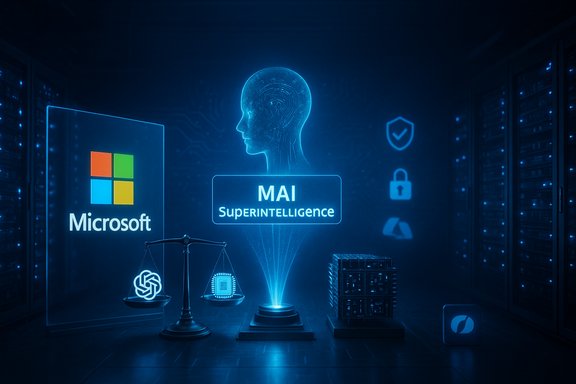
Microsoft’s public pivot from a deep, exclusive dependency on OpenAI to an explicitly dual-track strategy — one that preserves partnership but frees Microsoft to build its own frontier models — is now official and consequential for Windows users, enterprise customers, and the broader cloud market. Mustafa Suleyman, Microsoft’s AI chief, told Business Insider that a freshly organized unit called Microsoft AI Superintelligence (MAI Superintelligence) will pursue “world‑class, frontier‑grade research” in‑house, a shift made possible by a renegotiated deal with OpenAI that removes prior contractual limits on Microsoft’s ability to pursue artificial general intelligence (AGI).
The Microsoft–OpenAI relationship has evolved from a strategic $1 billion investment into one of the central axes of the commercial AI era. For years Microsoft relied on OpenAI’s frontier models to power Copilot, Bing Chat, and many Azure integrations while providing cloud compute and investment. The partnership’s formerly strict terms contained an “AGI clause” that, as widely reported, could limit Microsoft’s access to certain OpenAI capabilities and even bar Microsoft from developing its own AGI using OpenAI IP unless specific conditions were met — a legal architecture that effectively tethered Microsoft’s frontier ambitions until late in the decade. That framework has now been materially revised. The recapitalization of OpenAI into a public benefit structure and the accompanying definitive agreement with Microsoft introduce new governance and IP guardrails: an independent expert panel to verify any claim that OpenAI has achieved AGI, extended IP and exclusivity windows for Microsoft through the early 2030s, and explicit language permitting Microsoft to pursue AGI projects “alone or in partnership with third parties.” Public reports also place Microsoft’s stake in the recapitalized entity at roughly 27% (about $135 billion on an as‑converted basis) and include large, multi‑year Azure commitments from OpenAI. These contractual changes are the single most important structural shift enabling Microsoft’s announcement: they convert Microsoft from a near‑exclusive downstream partner into a company that can now pursue first‑party frontier research without being permanently boxed out by a unilateral OpenAI AGI declaration. That legal clearance is what Suleyman and his new MAI organization emphasize when they talk about the company becoming “self‑sufficient in AI.”
Microsoft’s new independence is real, but its success will depend less on rhetoric and more on engineering discipline, transparent governance, and the hard work of aligning powerful systems to human needs.
Source: Windows Report Report: Mustafa Suleyman Says Microsoft Now Free to Chase AGI
 Background / Overview
The Microsoft–OpenAI relationship has evolved from a strategic $1 billion investment into one of the central axes of the commercial AI era. For years Microsoft relied on OpenAI’s frontier models to power Copilot, Bing Chat, and many Azure integrations while providing cloud compute and investment. The partnership’s formerly strict terms contained an “AGI clause” that, as widely reported, could limit Microsoft’s access to certain OpenAI capabilities and even bar Microsoft from developing its own AGI using OpenAI IP unless specific conditions were met — a legal architecture that effectively tethered Microsoft’s frontier ambitions until late in the decade. That framework has now been materially revised. The recapitalization of OpenAI into a public benefit structure and the accompanying definitive agreement with Microsoft introduce new governance and IP guardrails: an independent expert panel to verify any claim that OpenAI has achieved AGI, extended IP and exclusivity windows for Microsoft through the early 2030s, and explicit language permitting Microsoft to pursue AGI projects “alone or in partnership with third parties.” Public reports also place Microsoft’s stake in the recapitalized entity at roughly 27% (about $135 billion on an as‑converted basis) and include large, multi‑year Azure commitments from OpenAI. These contractual changes are the single most important structural shift enabling Microsoft’s announcement: they convert Microsoft from a near‑exclusive downstream partner into a company that can now pursue first‑party frontier research without being permanently boxed out by a unilateral OpenAI AGI declaration. That legal clearance is what Suleyman and his new MAI organization emphasize when they talk about the company becoming “self‑sufficient in AI.” What Suleyman Said — The New Public Signal
In his Business Insider interview, Mustafa Suleyman set the tone: Microsoft will invest heavily in training its own large‑scale models, design custom silicon, and expand compute capacity — while framing the effort as a humanist approach to advanced AI. Suleyman repeatedly stressed safety and alignment, positioning MAI Superintelligence as a research and product organization that will build domain‑focused, high‑capability systems designed to remain controllable and to serve human goals. Suleyman’s public remarks are backed by organizational moves: Microsoft has restructured internal AI leadership, recruited senior talent from Google/DeepMind, and added roles devoted to responsible AI. A leaked org chart and reporting confirm hires including Trevor Callaghan (formerly of DeepMind/Google) as a vice president responsible for Responsible AI, along with multiple ex‑Google and DeepMind engineers and product leaders who are now embedded under Suleyman’s remit. Those hires reinforce the message that Microsoft intends both depth (research) and breadth (productization).Why This Matters: Strategic and Product Implications
Microsoft’s move is consequential across three dimensions: product strategy, cloud economics, and industry governance.Product strategy — Copilot, Windows, and the right to optimize
- Microsoft’s long‑running product advantage has been its distribution into Windows, Microsoft 365, GitHub, and enterprise channels. Holding a firmer in‑house research capability gives Microsoft options to reduce latency, control costs, and advance privacy and data‑sovereignty guarantees for workloads that demand them.
- Building MAI models natively could let Microsoft tailor capabilities specifically for Copilot experiences in Windows and Office — lowering inference costs and delivering lower‑latency, higher‑integrity AI experiences at scale. That will matter for enterprise customers who care about latency, auditability, and legal exposure.
Cloud economics — Azure vs. multicloud compute
- The new OpenAI structure removes Microsoft’s absolute exclusivity as a compute provider while preserving deep commercial ties. OpenAI’s recapitalization is reported to include very large Azure purchase commitments, but Microsoft no longer enjoys a veto over OpenAI’s multi‑cloud compute choices. That creates both risk and optionality for Azure.
- To mitigate future exposure, Microsoft’s county‑scale compute buildout and investment in custom AI silicon (and partnerships with NVIDIA and others) are pragmatically aimed at insulating its product stack from supply bottlenecks and third‑party price pressure.
Governance and public policy — who certifies AGI?
- Perhaps the most novel change is the insertion of an independent expert panel to verify any AGI claim before contractual AGI‑triggered changes take effect. This converts a previously ambiguous, board‑centric trigger into an adjudicative process — but one that raises its own governance questions about panel composition, standards, and enforceability. The devil will be in the charter and appointment rules.
Technical Roadmap and the Limits of Public Claims
Microsoft’s public roadmap includes three major technical pillars: training first‑party frontier models, building or partnering for custom AI silicon, and massively scaling compute infrastructure.- Training: Microsoft says MAI‑models will be trained at frontier scale and used across Copilot and other products. There are early public claims that MAI pre‑release models were trained using substantial H100 fleets (figures like ~15,000 H100 GPUs have been mentioned in internal summaries), though such numbers should be treated cautiously until third‑party benchmarks are published. Microsoft’s approach reportedly mixes mixture‑of‑experts (MoE) and other parameter‑efficient strategies to chase frontier performance with fewer resources.
- Silicon: Suleyman explicitly referenced custom chips and augmenting NVIDIA partnerships with in‑house silicon efforts. That’s consistent with an industry‑wide trend — where leaders invest in accelerator design to optimize TCO (total cost of ownership) for sustained training runs and to secure supply chain levers. Expect Microsoft to invest billions over multiple years if it wants true silicon-level independence.
- Compute: Microsoft’s ambition to own more of the compute stack will require expanded hyperscale datacenter deployments, power agreements, and logistics that rival NVIDIA’s own cloud‑scale customers. Public filings and reporting indicate multi‑year Azure consumption commitments tied to the recapitalization; those commitments serve as a predictable demand tail for Azure while Microsoft simultaneously bolsters capacity for first‑party training.
Safety, Alignment, and the “Humanist” Framing
Suleyman’s framing of MAI as pursuing “humanist superintelligence” or HSI—systems that are superhuman in specific domains yet explicitly constrained—signals a deliberate rhetorical and governance posture. The narrative aims to differentiate Microsoft’s approach from a headline‑style “race” while signaling seriousness about alignment: interpretability, containment, and human control are core selling points. But two tensions remain:- Building higher capability systems inherently increases novel risk surfaces. Greater capability can create new failure modes that are harder to anticipate, so “doing alignment” at scale is a nontrivial engineering and governance challenge.
- Corporate incentives — revenue, market share, and product delivery — will push tradeoffs between speed and safety. The creation of a VP of Responsible AI and investment in an ethics and safety corps are positive signals, but history shows organizational norms and performance pressure can erode guardrails without strong, independent accountability.
Competitive Landscape: How the Market Reacts
Microsoft’s move places it explicitly into the same strategic bracket as Google, Meta, Anthropic, and xAI. A few dynamics to watch:- Talent competition intensifies. Microsoft’s hiring from Google/DeepMind and other rivals is a clear indicator that the company is prepared to pay market premiums for frontier researchers and product leaders.
- Multi‑cloud competition for OpenAI workloads increases Azure’s need to retain differentiation: price, performance, and product integrations (Copilot, Windows) will be the defensive levers Microsoft uses to keep customers tied to its stack.
- Regulatory scrutiny and public policy pressure will follow. When frontier models and corporate stakes reach many tens or hundreds of billions, regulators and governments will scrutinize governance, export control, and national security implications, especially where specialized hardware and cross‑border compute are involved.
Strengths and Risks — A Balanced Assessment
Notable strengths
- Distribution: Microsoft’s product reach (Windows, Microsoft 365, Azure, GitHub) gives it an unequaled channel to operationalize MAI research at global scale.
- Capital and Infra: The company’s balance sheet and existing Azure footprint provide a credible base to invest in both compute and bespoke silicon.
- Talent and Leadership: Hiring experienced leaders and researchers — including multiple ex‑DeepMind/Google hires — accelerates Microsoft’s ability to close expertise gaps quickly.
Significant risks
- Governance gap: The independent expert panel concept is promising but under‑specified. Who sits on the panel, how membership is chosen, and what standards it applies will determine whether this is meaningful governance or just a procedural gloss.
- Unchecked competition: Rival labs may push faster with fewer safety constraints, creating an external pressure for Microsoft to accelerate in ways that compromise its “humanist” framing.
- Operational scale: Delivering frontier models in‑house at scale is materially different from integrating third‑party models. Microsoft must master specialized engineering disciplines (power infrastructure, cooling, supply chain, accelerator design) that can be time‑consuming and capital intensive.
Practical Guidance for Windows and Enterprise Users
- Strengthen identity and access controls now: future agentic capabilities will act with privileges, so least‑privilege defaults and robust role separation are essential.
- Prepare for new audit and logging requirements: organizations should expect more granular tracing of AI-driven decisions and build pipelines that record model inputs, outputs, and decision contexts.
- Treat AGI talk as strategic signal, not an immediate product roadmap: near‑term benefits will be improved productivity features — smarter code completion, advanced search, domain assistants — rather than sudden, universal AGI switches.
What Still Needs Verification
Several high‑impact numeric and contractual claims remain insensitive to ordinary journalistic confirmation because they are embedded in corporate agreements or technical claims not fully disclosed publicly. These include:- Exact GPU counts, model parameter budgets, and training regimens for MAI models (some internal summaries mention 15,000 H100s for preview models, but independent benchmarks are not yet public).
- Precise legal text of the AGI verification mechanism and the expert panel’s charter — until those are published or leaked in full, many contractual inferences remain based on summaries reported by multiple outlets rather than primary source inspection.
- Long‑term compute purchase accounting mechanics (the headline $250 billion Azure commitment has been widely reported, but its timing, invoicing, and revenue recognition nuances are contractual details that matter for financial modeling).
Conclusion — A New Chapter, Not a Finished Story
Microsoft’s new freedom to pursue AGI independently marks a strategic inflection point: it rewrites the legal and organizational constraints that previously made Microsoft a near‑exclusive, downstream partner to OpenAI. The formation of a MAI Superintelligence organization under Mustafa Suleyman, sizable recruitment from rivals, and public commitments to train first‑party models and build silicon all signal that Microsoft intends to be a first‑class contender in frontier AI research — but with a distinct, humanist framing that emphasizes alignment, containment, and product integration. This pivot strengthens Microsoft’s options and reduces its operational dependence on any single external model provider — but it also adds complexity and new sources of risk. The industry will now watch three things closely: the composition and authority of the AGI verification panel; empirical, third‑party benchmarks of MAI models; and how Microsoft balances speed with the rigorous safety engineering needed when systems approach frontier capability. For Windows users and enterprise customers, expect a steady flow of capability upgrades anchored in Microsoft’s own stack — but also a growing imperative to harden governance, identity, and monitoring as these systems become more integral to work and infrastructure.Microsoft’s new independence is real, but its success will depend less on rhetoric and more on engineering discipline, transparent governance, and the hard work of aligning powerful systems to human needs.
Source: Windows Report Report: Mustafa Suleyman Says Microsoft Now Free to Chase AGI
