

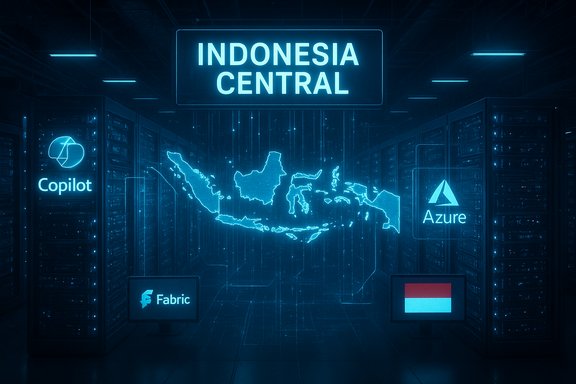
Six months after opening its first Indonesian cloud region, Microsoft confirmed today that a broader set of cloud and AI services — including GPU‑accelerated VMs, Microsoft 365 Copilot residency, GitHub Copilot support, and Microsoft Fabric — are now live in the Indonesia Central region, underlining an aggressive push to enable locally hosted, production‑grade AI and data workloads across government, finance, telco and large enterprise customers.
Microsoft’s November 25 announcement formalizes a steady rollout that began with the Indonesia Central region’s initial availability earlier this year and builds on a previously announced US$1.7 billion investment to expand cloud and AI infrastructure, ecosystem development and skilling in Indonesia through 2028. The new deployments focus on three concrete capabilities that matter to enterprise architects and CIOs: local AI infrastructure (GPU VM SKUs for training and inference), resident productivity and collaboration services (Microsoft 365 Copilot and data residency options), and a unified data+AI platform (Microsoft Fabric) — all intended to help organisations move from AI experiments to production at scale. This feature examines the announcement in depth: what’s available today, how this changes technical choices for Indonesian organisations, where the practical advantages are strongest, what remains unclear or risky, and the concrete next steps IT leaders should take when evaluating Azure for AI workloads.
For organisations that take a methodical, measured approach, Indonesia Central will be a powerful option: it offers the performance, residency and integration advantages needed to move AI projects out of labs and into mission‑critical applications — provided those organisations confirm capacity, governance and operational readiness before committing long‑lived workloads.
Appendix: Quick reference to key public claims (verify with account team for operational details)
Source: Microsoft Source Microsoft Expands AI Infrastructure and Cloud Services in Indonesia, Empowering More Organizations to Innovate Locally - Source Asia
 Background / Overview
Microsoft’s November 25 announcement formalizes a steady rollout that began with the Indonesia Central region’s initial availability earlier this year and builds on a previously announced US$1.7 billion investment to expand cloud and AI infrastructure, ecosystem development and skilling in Indonesia through 2028. The new deployments focus on three concrete capabilities that matter to enterprise architects and CIOs: local AI infrastructure (GPU VM SKUs for training and inference), resident productivity and collaboration services (Microsoft 365 Copilot and data residency options), and a unified data+AI platform (Microsoft Fabric) — all intended to help organisations move from AI experiments to production at scale. This feature examines the announcement in depth: what’s available today, how this changes technical choices for Indonesian organisations, where the practical advantages are strongest, what remains unclear or risky, and the concrete next steps IT leaders should take when evaluating Azure for AI workloads.What Microsoft said is now available in Indonesia Central
New AI‑ready VM SKUs and GPU capacity
Microsoft’s announcement lists AI infrastructure additions — notably the NVadsA10_v5 and NCads_H100_v5 VM families — as being available locally in the Indonesia Central region to support training, inference and high‑performance compute workloads. The NCads_H100_v5 series is documented on Microsoft Learn as a purpose‑built family using NVIDIA H100 NVL GPUs for applied AI training and batch inference workloads, and Azure region trackers report the Indonesia Central region as generally available with three availability zones. Independent cloud SKU trackers and VM listing services also show various A10_v5‑based SKUs being offered in indonesiacentral. Taken together, these references corroborate Microsoft’s claim that GPU‑accelerated VMs aimed at both inference and heavier training workloads are now part of the local service inventory. Important technical caveat: Microsoft’s announcement does not publish an explicit per‑region GPU count, power footprint, or MW capacity. That means while the SKUs are listed as available, organisations requiring deterministic capacity for large model training (multi‑node H100 clusters, sustained teraflop-days, or guaranteed GPU counts) should confirm capacity and quota availability with Microsoft account teams before scheduling large training runs. This is consistent with prior region rollouts where SKU availability is staged and inventory evolves over months.Microsoft 365 Copilot, GitHub Copilot and data residency
Microsoft said Microsoft 365 Copilot will be available locally (data‑at‑rest residency and ADR options) in Indonesia Central, enabling organisations to use Copilot functionality while keeping selected Microsoft 365 data within Indonesian borders. Microsoft’s product blogs and community documentation confirm Microsoft 365 and its Advanced Data Residency (ADR) add‑ons are offered in the new region, and Multi‑Geo capabilities for Microsoft 365 are being extended to support customers with mixed residency needs. Meanwhile, GitHub Copilot remains Microsoft’s global developer AI assistant and is widely adopted by local developer teams. These moves close an important gap for enterprises that must reconcile automation and generative productivity with local regulatory and compliance requirements.Microsoft Fabric general availability in Indonesia
The Cloud & AI Innovation Summit also highlighted the general availability of Microsoft Fabric in Indonesia — the unified, AI‑powered data platform that brings Data Lake, Data Engineering, Data Integration, Data Science, Data Warehousing, Real‑time Intelligence and Power BI together with Copilot built‑in. Fabric reduces the friction of connecting, preparing and governing enterprise data for AI scenarios, and the company framed it as a key accelerant for data‑driven apps and RAG (retrieval augmented generation) patterns. Microsoft’s product narrative positions Fabric as a platform to shorten time to insight and to standardise governance across the data estate.Customer and ecosystem signals
Microsoft named several early adopters using Indonesia Central — including Petrosea, Vale Indonesia and tiket.com — with tiket.com publicly cited for a conversational travel assistant built on Azure OpenAI Service that demonstrates agentic AI customer flows (rebooking, notifications, refunds) running on local infrastructure. Microsoft also emphasised ecosystem events and skilling: a second year of its Microsoft Elevate Indonesian skilling program (over 1.2 million participants trained to date) and a planned GitHub Universe Jakarta event on December 3, 2025 to galvanise developer communities.Why this matters: practical benefits for Indonesian organisations
1. Data residency, sovereignty and compliance become simpler
For regulated sectors — finance, health, public sector — the biggest non‑technical inhibitor for adopting cloud AI is cross‑border data movement and ambiguous residency guarantees. Having Microsoft 365 (with ADR), Azure core services and GPU‑accelerated compute onshore reduces legal and procurement friction for production deployments that process personal data or regulated records. This is a material governance win for national and enterprise decision makers.2. Latency and user‑experience improvements for inference
Inference workloads often require sub‑100ms round‑trip times. Local inference endpoints reduce latency for citizen services, real‑time recommendation engines and interactive Copilot integrations handed to employees and customers. This matters for customer‑facing agents (e.g., tiket.com’s travel assistant) where responsiveness directly affects conversion and satisfaction.3. Integrated stack that reduces integration friction
Microsoft’s combination of Azure compute, Microsoft 365 Copilot, GitHub Copilot, Fabric and Azure OpenAI Service gives customers a coherent platform that simplifies identity, governance and deployment from prototype to production. For organisations already invested in Microsoft infrastructure, the integration reduces operational complexity and accelerates time to value.4. Local talent pipeline and skilling programs
Microsoft’s Elevate/elevAIte programs — which Microsoft states have reached more than 1.2 million participants in Indonesia and now aim to certify 500,000 AI talents by 2026 — are designed to close the talent gap for AI operations and application development. This supply‑side investment is paired with the region’s infrastructure expansion and should help firms hire people who understand both cloud ops and AI product requirements. However, training scale is not the same as placement guarantees; employers should still plan for hiring friction and competency validation.Critical analysis — strengths, gaps and risks
Strengths
- End‑to‑end platform: Microsoft’s stack covers compute, data, developer tools and productivity, which reduces friction for enterprises to go from PoC to production within a single vendor ecosystem. Fabric’s unified approach to data and Copilot integration can materially lower engineering overhead for RAG and agentic AI use cases.
- Localised Copilot and data residency: Providing Microsoft 365 Copilot with ADR and Multi‑Geo configurability in Indonesia Central aligns AI productivity features with regulatory needs, making generative AI adoption less risky from a compliance standpoint.
- Visible early customers and developer events: Having local customers (Petrosea, Vale Indonesia, tiket.com) and a GitHub Universe Jakarta event signals Microsoft’s intent to build a local partner and developer ecosystem rather than only exporting services. This helps cultivate use cases and reference deployments.
Open questions and measurable gaps
- Capacity transparency and SKU parity: New regions frequently reach service parity over time. While Microsoft lists NVadsA10_v5 and NCads_H100_v5 SKUs as available, there is no published MW capacity, per‑region GPU inventory, or guaranteed GPU counts for large distributed training. That gap matters for organisations planning sustained, large‑scale model training. Practical mitigation: confirm quotas, reservation and capacity purchase options with your Microsoft account team and ask for written service commitments for high‑importance workloads.
- Energy, water and sustainability pressures: Hyperscale datacentres consume significant power and sometimes require water for cooling. Microsoft has described efficiency and closed‑loop cooling approaches in other rollouts, but local energy mix, grid reliability and refresh cycles materially affect real operational carbon intensity and cost. Independent verification of sustainability claims and an understanding of local grid contracts remain essential.
- Supply‑chain and geopolitical risk: High‑end accelerators (H100 and variants) are subject to global supply dynamics and export controls that can constrain delivery to new regions. Expect rollout cadence to be influenced by global GPU supply and by Microsoft’s prioritisation among regions.
- Operational maturity of ecosystem partners: Local managed services partners, systems integrators and telcos are necessary to realise large migration programs. The readiness and experience of local partners differ by country; procurement teams should assess partner SLAs, prior deliverables and integration experience for mission‑critical AI workloads.
Risks for practitioners and business owners
- Assuming day‑one parity: Do not assume every Azure service, SDK, managed PaaS offering or GPU SKU is immediately available at scale in a new region. Plan for phased migrations, pilot validations, and fallback strategies to other regions where required SKUs are proven and available.
- Cost unpredictability for inference: Agentic AI and Copilot integrations can produce variable inference costs. Forecasting and governance (rate limits, caching, offloading to cheaper SKUs for non‑critical workloads) must be part of budget planning.
- Model provenance and governance: Generative AI introduces data‑lineage and explainability challenges. Organisations must combine technical governance (prompt filtering, RAG chunk audits, access controls) and policy controls (legal, HR, customer disclosures) before rolling Copilot broadly. Fabric’s governance tooling helps, but human processes are still required.
How to evaluate Microsoft Indonesia Central for your workloads — a practical checklist
- Confirm SKU and quota availability
- Ask your Microsoft account or partner for an explicit service inventory for indonesiacentral: exact VM sizes, GPU counts per availability zone, current available quota and reservation products.
- Validate data residency and compliance controls
- Review ADR and Multi‑Geo applicability for the exact Microsoft 365 features you need (Exchange, SharePoint, Teams, Copilot data residency). Request contractual residency assurances and audit options.
- Pilot realistic workloads
- Deploy an end‑to‑end pilot with representative inference traffic, dataset sizes, and failover scenarios across zones. Measure latency, throughput and operational cost.
- Model cost governance
- Implement monitoring for inference token usage, model selection, and RAG retrieval costs; set hard budget alerts and rate limits for agentic workflows.
- Design for hybrid and multi‑region resilience
- Use Availability Zones and a tested cross‑region failover plan for critical services. Keep a multi‑region evacuation plan if quotas are exhausted or supply constraints arise.
- Engage the partner ecosystem early
- Evaluate local SIs and managed service providers for fabric implementations, data governance and MLOps. Confirm their track record on Azure, Fabric, and OpenAI integrations.
- Request sustainability and operations metrics
- For large cloud commitments, request energy mix, water use effectiveness, and operational emissions reporting for specific facilities to include in your vendor evaluation.
Short to medium‑term outlook and what to watch
- Watch for Microsoft to publish a detailed service parity and SKU supply timeline for Indonesia Central. This will be the clearest indicator that the region can support multi‑node, large‑model training at scale. Until Microsoft publishes such specifics, plan on phased migrations and maintain follow‑through with account teams.
- Monitor official Azure product pages and Microsoft Learn for NCads_H100_v5 and NVadsA10_v5 region availability notices; these pages are the canonical technical references for VM specs and supported use cases.
- Track local ecosystem growth — managed service offerings for Fabric, dedicated ExpressRoute provisioning windows, and local telco partnerships that can provide private, high‑bandwidth connectivity. These are the practical enablers of production readiness for latency‑sensitive AI apps.
- Validate whether Microsoft’s skilling pipeline translates to hiring outcomes for operating and maintaining AI services. Training throughput is promising, but HR leaders should require placement and competency evidence before relying on these pipelines as the sole source of hiring.
Conclusion — what Indonesian IT leaders should internalise
Microsoft’s latest roll‑out in Indonesia Central is a major inflection point: it materially reduces the barriers to deploying AI‑native applications in Indonesia by combining local GPU‑accelerated compute, resident productivity AI, and a unified data platform. That combination makes it significantly easier for organisations to develop, test and operate agentic and RAG‑based systems that must comply with local data laws and deliver low‑latency user experiences. At the same time, prudent technical and procurement disciplines remain essential. New regions typically reach full capacity and feature parity over time; supply constraints for high‑end accelerators, energy and water dependencies, vendor partner maturity, and cost governance for inference workloads are real, measurable risks. The practical path is therefore staged: run production pilots, lock down quotas and capacity SLAs where critical, enforce cost and model governance, and use local skilling programs as part of a broader talent strategy.For organisations that take a methodical, measured approach, Indonesia Central will be a powerful option: it offers the performance, residency and integration advantages needed to move AI projects out of labs and into mission‑critical applications — provided those organisations confirm capacity, governance and operational readiness before committing long‑lived workloads.
Appendix: Quick reference to key public claims (verify with account team for operational details)
- Microsoft announced availability of additional cloud and AI services in Indonesia Central on November 25, 2025.
- Microsoft confirmed Microsoft 365 and ADR offerings for Indonesia Central and Multi‑Geo support updates earlier in 2025.
- NCads_H100_v5 family is an Azure VM series documented for H100 NVL GPUs suitable for applied AI training and batch inference.
- External reporting and Microsoft corporate materials confirm a US$1.7 billion investment commitment in Indonesia for 2024–2028 to develop cloud and AI capacity.
- Microsoft Elevate (formerly elevAIte) reports more than 1.2 million Indonesians reached and a target to certify 500,000 AI talents by 2026. Verify placement and certification breakdowns with program materials.
Source: Microsoft Source Microsoft Expands AI Infrastructure and Cloud Services in Indonesia, Empowering More Organizations to Innovate Locally - Source Asia
