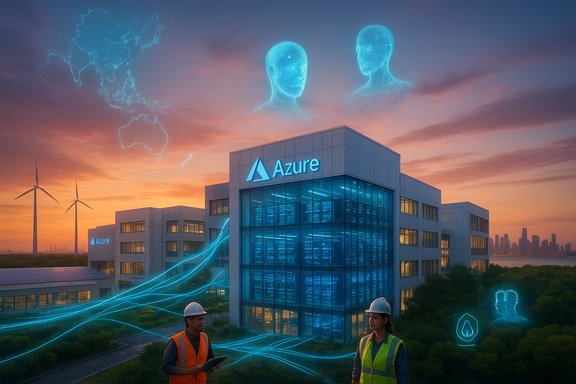
Microsoft confirmed plans for a second in‑country Azure cloud region in Malaysia — branded Southeast Asia 3 and set for Johor Bahru — a move the company says will expand capacity for AI workloads, tie into Azure’s global backbone, and extend a US$2.2 billion Malaysia investment that began in 2024.
Microsoft’s Malaysia strategy has three clear elements: deploy physical cloud capacity inside the country, pair infrastructure with national skilling and innovation programs, and design the footprint to be AI‑ready (GPU‑dense, multi‑AZ architectures). The company formally announced a US$2.2 billion investment package for Malaysia in May 2024 and launched the first in‑country region, Malaysia West, in May 2025; Malaysia West comprises three hyperscale data centres serving Greater Kuala Lumpur. Southeast Asia 3 — the new Johor Bahru region announced during Microsoft’s AI Tour event in Kuala Lumpur — is presented as the next “next‑generation cloud region” to support advanced workloads across Southeast Asia, accelerate AI adoption, and provide redundancy and scale for local customers. Microsoft positions Southeast Asia 3 as complementary to Malaysia West and as part of Azure’s broader global fabric of regions. Why Johor Bahru? The rationale is strategic geography and capacity economics: Johor sits across the causeway from Singapore — historically the APAC connectivity hub — and offers larger land parcels and a lower capex profile than Singapore while keeping low‑latency connectivity to Singaporean PoPs. That “spillover” effect from Singapore is a recurring theme in data‑centre site selection across ASEAN.
If the announced technical designs and community commitments are followed by transparent, third‑party‑verifiable results — published capacity milestones, independent sustainability reports, and demonstrable local hiring outcomes — Johor could become a meaningful hub for Southeast Asia’s next wave of AI services. Until then, organizations should plan prudently, test early, and demand clear timelines and verification for the components that matter most to production AI deployments.
Source: Developing Telecoms Microsoft gears up for second cloud region in Malaysia
 Background / Overview
Microsoft’s Malaysia strategy has three clear elements: deploy physical cloud capacity inside the country, pair infrastructure with national skilling and innovation programs, and design the footprint to be AI‑ready (GPU‑dense, multi‑AZ architectures). The company formally announced a US$2.2 billion investment package for Malaysia in May 2024 and launched the first in‑country region, Malaysia West, in May 2025; Malaysia West comprises three hyperscale data centres serving Greater Kuala Lumpur. Southeast Asia 3 — the new Johor Bahru region announced during Microsoft’s AI Tour event in Kuala Lumpur — is presented as the next “next‑generation cloud region” to support advanced workloads across Southeast Asia, accelerate AI adoption, and provide redundancy and scale for local customers. Microsoft positions Southeast Asia 3 as complementary to Malaysia West and as part of Azure’s broader global fabric of regions. Why Johor Bahru? The rationale is strategic geography and capacity economics: Johor sits across the causeway from Singapore — historically the APAC connectivity hub — and offers larger land parcels and a lower capex profile than Singapore while keeping low‑latency connectivity to Singaporean PoPs. That “spillover” effect from Singapore is a recurring theme in data‑centre site selection across ASEAN. What Microsoft announced — the facts, clarified
- The company labelled the new site Southeast Asia 3 and located it in Johor Bahru. Microsoft described it as a next‑generation region tailored for scalable AI adoption and advanced workloads.
- The Southeast Asia 3 region will be connected to Microsoft’s global Azure backbone of subsea and terrestrial fiber, consistent with Microsoft’s multi‑region networking approach.
- Microsoft reiterated its earlier US$2.2 billion commitment to Malaysia (announced May 2024), which bundles infrastructure with skilling, public‑private partnerships, and national AI initiatives.
- Malaysia West (the first onshore region) opened for business in May 2025 and comprises three availability zones / hyperscale data centres in Greater Kuala Lumpur. Independent reporting confirmed the Malaysia West datacentres came online in mid‑2025.
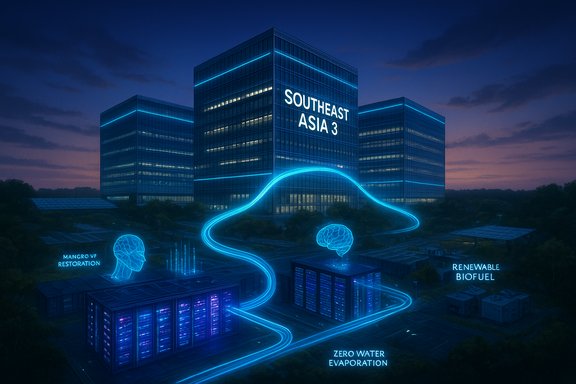
- Microsoft highlighted sustainability and resilience features for Southeast Asia 3: a closed‑loop chip‑level liquid cooling approach that aims for zero‑water evaporation under normal operation, and backup generators designed to run on renewable biofuel to reduce net carbon emissions from emergency power. Microsoft says these designs eliminate the need for continuous fresh water for evaporative cooling. These are design claims at announcement time and will require operational evidence and disclosures to verify lifecycle impacts.
- Community and ecosystem initiatives were announced alongside the infrastructure plans, including commitments to datacentre skills programs, entrepreneurship resources, clean water projects, and mangrove restoration. Microsoft is bundling the Johor datacentre announcement with broader skilling programs such as AIForMYFuture and BINA AI Malaysia. Microsoft reports more than 734,000 Malaysians trained through AI skilling efforts to date.
Technical posture: what “AI‑ready” really implies
Microsoft and other hyperscalers use the term AI‑ready to signal infrastructure built to host GPU‑dense training and low‑latency inference. For architects and CTOs, that usually entails:- Multi‑Availability‑Zone architecture for zone‑resilient services and higher SLAs.
- High‑density rack layouts provisioned for GPU/accelerator families and the power/thermal envelopes needed for them.
- High‑throughput network fabric and PoPs for low‑latency interconnect, and private backbone connectivity for data replication and model artifact movement.
- Modern storage and caching layers to sustain the I/O required by model training.
- Staged service parity — not every VM SKU, GPU family or managed service arrives on day one; accelerated SKUs and some PaaS offerings are often phased in.
Sustainability claims — promise versus practical reality
Microsoft’s headline design choices for Johor attempt to address two hyperscaler pain points in Southeast Asia: water usage for evaporative cooling and emissions from diesel backup generation.- Closed‑loop, chip‑level liquid cooling that targets zero‑water evaporation is a legitimate technical approach to reduce freshwater withdrawals versus traditional evaporative towers. If implemented comprehensively across campus operations, the approach can materially lower operational water consumption. Microsoft states the system circulates coolant between chips and chillers in a sealed loop, eliminating evaporative losses.
- Backup generators designed for renewable biofuel are a lower‑carbon alternative to diesel in certain operating scenarios, but the net carbon benefit depends on the feedstock, lifecycle emissions of the biofuel, availability of sustainably sourced fuel at scale, and how frequently generators run. Claims of reduced “net carbon emissions” from biofuel require disclosure of fuel type, sourcing, combustion efficiency and offsetting practices to be independently verifiable.
- Closed‑loop liquid cooling reduces freshwater use but does not eliminate embodied carbon in materials, nor does it remove the grid carbon intensity that powers the datacentre when drawing electricity. The full lifecycle environmental impact must include construction emissions, embodied materials, and the eventual disposal/recycling footprint.
- Backup generation is an emergency measure. If local grids are unreliable and generators operate frequently, emissions benefits from biofuel depend heavily on fuel supply chains and substitution assumptions.
- Independent measurement and transparency (scope 1/2/3 disclosures, third‑party verification) are essential for these sustainability commitments to be credible.
Economic and social impact — measured claims and open questions
Microsoft frames the Johor region within a broader national impact narrative: large capital investment, skilling programs, and ecosystem development.- The US$2.2 billion figure is a formal Microsoft commitment tied to cloud and AI investments in Malaysia; government and media outlets have widely reported the amount and the expected job and revenue multipliers. These projections often combine direct capital spend with modeled downstream economic effects.
- Skilling targets such as AIForMYFuture (aiming to skill 800,000 Malaysians by end‑2025) are measurable outputs. Microsoft reports 734,000+ trained as of the most recent announcement; those headline numbers are significant but require deeper inspection to understand placement rates, quality of training, and alignment with actual hiring.
- Economic multipliers and job creation figures published by vendors are useful for context but are projections rather than audited outcomes. Independent verification via government employment statistics or third‑party studies will be the truer test of impact.
- The translation from training certificates to sustainable career pathways depends on local demand for datacentre ops, cloud engineering, AI product development, and the capacity of the private sector to absorb newly trained talent.
Strategic implications for enterprises and the APAC cloud market
- Latency and data‑residency options expand. Johor as a second Malaysian region increases options for regulated industries (financial services, healthcare, public sector) to keep data in country and build lower‑latency inference endpoints.
- Competitive dynamics intensify. Microsoft’s Johor play increases pressure on other hyperscalers and regional providers (AWS, Google Cloud, Alibaba Cloud, local telco clouds) to accelerate their own capacity builds. The result is more choice but also more complexity for vendor selection and procurement strategies.
- Multi‑region resilience improves — but not automatically. Additional regions reduce single‑region risk for customers that architect for cross‑region replication and multi‑AZ failover, but customers must still plan for service parity lags and staged inventory rollouts when moving critical workloads.
- Supply chain and export controls remain a real constraint for GPU supply. Availability of high‑end accelerators (for large model training) is subject to global vendor capacity, export controls and logistics; those constraints can delay the effective usable capacity of any new region.
Practical playbook for IT leaders (test, validate, migrate)
- Map workloads by residency and latency needs:
- Classify which apps must remain in‑country for compliance, which benefit from lower latency, and which can remain region‑agnostic.
- Pilot before scale:
- Run a non‑critical inference endpoint or analytics job as a pilot in the new region to validate performance and integration.
- Confirm SKU and capacity availability:
- Obtain explicit timelines for GPU families, VM SKUs and managed services required for your projects; expect phased arrivals.
- Use private connectivity:
- Plan ExpressRoute/private peering for predictable performance and to avoid public internet variability.
- Architect for multi‑zone and multi‑region failover:
- Exploit availability zones where offered and design cross‑region backups for disaster recovery.
- Validate sustainability and TCO assumptions:
- Model energy tariffs, renewable procurement timing, and capacity to estimate long‑term costs; ensure you account for embodied carbon if sustainability is material to procurement.
- Lock governance and compliance early:
- Ensure encryption, key management, logging, and data classification meet all local regulatory requirements before migration.
- Confirm partner readiness:
- Verify local managed services and systems integrator availability in Johor to cover ops, monitoring and incident response.
Risks and red flags to watch
- Staged service parity: Early launch phases often do not include the full catalog of accelerator SKUs and PaaS features. Don’t assume parity day‑one.
- Energy and grid constraints: Datacentres consume large amounts of electricity. Local grid upgrades, PPAs for renewables, and pricing volatility materially affect TCO and sustainability. Monitor state energy plans and Microsoft’s renewable procurement disclosures.
- Supply chain and export controls: GPU and switch shortages, as well as geopolitical export restrictions, can constrain how quickly a region achieves full AI capacity. Plan model training pipelines considering potential SKU limitations.
- Environmental lifecycle tradeoffs: Liquid cooling reduces freshwater draw but lifecycle embodied emissions (construction, materials, decommissioning) still matter. Seek transparent lifecycle analysis if sustainability claims are part of procurement decisions.
- Political and permitting risk: Land, zoning, coastal protections (mangroves) and community acceptance can slow campus builds. Microsoft’s community and restoration pledges are intended to reduce friction but require long‑term community engagement.
What to watch next (milestones and measurable signals)
- SKU availability pages and GPU capacity guarantees published by Microsoft — these will tell you which accelerators and VM SKUs are supported and when.
- Construction and permitting milestones in Johor (zoning approvals, ground‑breaking, campus build updates) — these move announcements into reality.
- Independent sustainability disclosures (scope 1/2/3 emissions, third‑party verification) for the Johor campus and Microsoft’s broader Malaysia operations — necessary to validate water and carbon claims.
- Local labor market absorption metrics — placement rates of trained talent from AIForMYFuture and Datacentre Foundations programs into relevant roles. These will determine whether the headline skilling numbers translate into systemic capability.
Balanced assessment — strengths and caution
Notable strengths- Integrated stack: Microsoft offers a unified platform that spans infrastructure (Azure), productivity (Microsoft 365 residency options), developer tooling (GitHub) and enterprise identity — a sticky proposition for large enterprises looking for consolidated vendors.
- AI‑first design: Planning for GPU density, three availability zones, and high‑throughput networking aligns infrastructure with modern AI workload requirements.
- Ecosystem approach: Pairing capital with skilling, public‑private partnerships and local community projects reduces friction and accelerates ecosystem development. Microsoft’s AIForMYFuture and BINA AI Malaysia programs are central to this strategy.
- Execution risk: Announcements must translate into delivered capacity, SKU parity and service inventories. Historically, new regions reach full parity over months, not days.
- Energy and sustainability uncertainty: The net environmental benefit of closed‑loop cooling and biofuel‑powered backup generation depends on local grid decarbonization, fuel sourcing, and transparent lifecycle accounting.
- Supply chain constraints: Global GPU supply and export rules can delay the arrival of specific accelerators required for large‑scale model training.
- Economic projections vs. outcomes: Job and GDP uplift figures are modeled; independent verification from government statistics and third‑party studies will be necessary to validate long‑term impact.
Conclusion
Microsoft’s decision to deploy a second in‑country Azure region in Malaysia — Southeast Asia 3 in Johor Bahru — is a consequential step in the company’s regional cloud and AI expansion. The announcement reinforces Microsoft’s strategy: couple onshore AI‑capable infrastructure with skilling and ecosystem programs to accelerate local adoption of advanced workloads. For Malaysian enterprises and regional customers, the new region promises lower latency, improved data‑residency options and a clearer path to scale AI projects locally. At the same time, the practical benefits depend on execution: real‑world SKU availability, measured sustainability outcomes, grid and supply‑chain realities, and the translation of training programs into durable talent pools. IT leaders should treat Johor as a promising and strategically important option, but adopt a staged migration plan: validate service inventories, confirm GPU and VM SKU timelines with Microsoft, pilot in the new region, and design for multi‑zone and multi‑region resilience.If the announced technical designs and community commitments are followed by transparent, third‑party‑verifiable results — published capacity milestones, independent sustainability reports, and demonstrable local hiring outcomes — Johor could become a meaningful hub for Southeast Asia’s next wave of AI services. Until then, organizations should plan prudently, test early, and demand clear timelines and verification for the components that matter most to production AI deployments.
Source: Developing Telecoms Microsoft gears up for second cloud region in Malaysia