

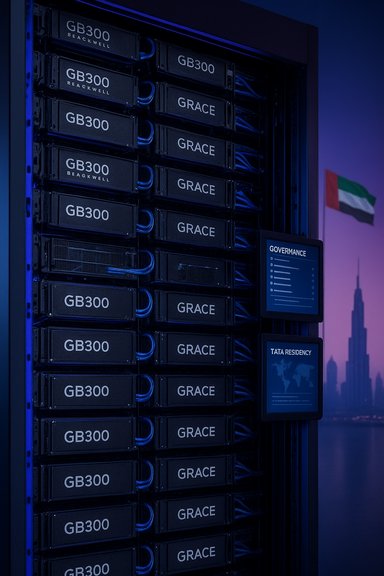
Microsoft will ship more than 60,000 of NVIDIA’s newest AI accelerators — including the GB300 “Blackwell” class GPUs — to data centers in the United Arab Emirates after the U.S. Commerce Department approved export licenses with what Microsoft describes as “stringent safeguards.” The approvals, issued in September, form part of a broader Microsoft program that the company says will invest roughly $15.2 billion in UAE cloud and AI infrastructure and enable in‑country processing of productivity Copilot features for qualified UAE organizations.
The headline — tens of thousands of frontier GPUs bound for the UAE — lands where three fast‑moving forces intersect: hyperscaler infrastructure scale‑up, U.S. export‑control policy for high‑end AI hardware, and Gulf states’ aggressive push to become AI hubs via capital and partnership. Microsoft says the new licenses allow it to ship the equivalent compute capacity of roughly 60,400 A100 GPUs by using NVIDIA’s more advanced GB300 Blackwell systems, on top of an earlier accumulation of about 21,500 A100‑equivalent chips already in the UAE under previous approvals. The company frames the move as a set of technical and economic commitments to the UAE, including local product processing and skilling programs. That same flow of hardware has immediate geopolitical resonance. The transaction comes amid public rhetoric by senior U.S. officials — including a televised statement by President Donald Trump limiting export of “the most advanced” chips — even as the Commerce Department, on a case‑by‑case basis, has evidently granted licenses when paired with intergovernmental assurances and operational safeguards. Reporters and analysts have linked the approvals to diplomatic and commercial arrangements between Washington and Abu Dhabi, including a very large UAE pledge to invest in U.S. energy and AI projects — a factor that U.S. decision‑makers appear to have weighed. Independent coverage and Microsoft’s own statements all emphasize the licensed exports were conditioned on security controls. For WindowsForum readers and IT decision‑makers, the practical result is straightforward: a top‑tier, rack‑scale AI compute class — the GB300/Blackwell family — will be available in a new regional market, enabling lower‑latency, high‑memory inference and production deployment patterns that previously required routing work to other geographies. That technical capacity unlocks new product choices for local enterprises, government agencies and regulated customers while raising governance and operational questions that deserve careful scrutiny.
Key architectural points that change how clouds deliver AI:
The tradeoff is clear: capability versus control. Market actors and governments will keep negotiating that boundary. Hyperscalers will keep building data‑center “AI factories,” hardware vendors will keep supplying denser accelerators, and national governments will keep balancing strategic partnership against proliferation risk. Organizations that adopt a posture of demanding verifiable governance, insisting on portability and accounting for operational realities will be best positioned to capture the benefits while containing the risks.
The arrival of GB300‑class racks in the UAE is therefore both a technical milestone and a policy test. It promises tangible benefits for developers, enterprises and public bodies that need in‑region, reasoning‑class AI compute — but it also demands a commensurate investment in transparency, independent attestation and contractual controls to ensure those benefits do not come at the cost of unchecked dual‑use proliferation or lock‑in.
Source: Tech in Asia https://www.techinasia.com/news/microsoft-to-ship-60000-nvidia-ai-chips-to-uae/
 Background and overview
The headline — tens of thousands of frontier GPUs bound for the UAE — lands where three fast‑moving forces intersect: hyperscaler infrastructure scale‑up, U.S. export‑control policy for high‑end AI hardware, and Gulf states’ aggressive push to become AI hubs via capital and partnership. Microsoft says the new licenses allow it to ship the equivalent compute capacity of roughly 60,400 A100 GPUs by using NVIDIA’s more advanced GB300 Blackwell systems, on top of an earlier accumulation of about 21,500 A100‑equivalent chips already in the UAE under previous approvals. The company frames the move as a set of technical and economic commitments to the UAE, including local product processing and skilling programs. That same flow of hardware has immediate geopolitical resonance. The transaction comes amid public rhetoric by senior U.S. officials — including a televised statement by President Donald Trump limiting export of “the most advanced” chips — even as the Commerce Department, on a case‑by‑case basis, has evidently granted licenses when paired with intergovernmental assurances and operational safeguards. Reporters and analysts have linked the approvals to diplomatic and commercial arrangements between Washington and Abu Dhabi, including a very large UAE pledge to invest in U.S. energy and AI projects — a factor that U.S. decision‑makers appear to have weighed. Independent coverage and Microsoft’s own statements all emphasize the licensed exports were conditioned on security controls. For WindowsForum readers and IT decision‑makers, the practical result is straightforward: a top‑tier, rack‑scale AI compute class — the GB300/Blackwell family — will be available in a new regional market, enabling lower‑latency, high‑memory inference and production deployment patterns that previously required routing work to other geographies. That technical capacity unlocks new product choices for local enterprises, government agencies and regulated customers while raising governance and operational questions that deserve careful scrutiny.Why the GB300 (Blackwell) platform matters
What GB300 is — rack-first design and the shift to reasoning‑class infrastructure
The GB300 family (marketed by NVIDIA as Blackwell Ultra) is not just another GPU generation: it represents a rack‑scale engineering model purpose‑built for reasoning‑class inference — low‑latency, memory‑heavy workloads that power long‑context LLMs, multi‑step agents, and large multimodal systems.Key architectural points that change how clouds deliver AI:
- A single NVL72 rack bundles 72 Blackwell Ultra GPUs together with 36 Grace‑family CPUs, presenting a pooled “fast memory” envelope measured in tens of terabytes per rack and extremely high NVLink/NVSwitch intra‑rack bandwidth.
- The rack‑first approach treats the rack as the accelerator; intra‑rack fabrics and high‑speed InfiniBand stitching between racks minimize cross‑host synchronization overhead and enable much larger models to be served at lower latency.
Verified technical claims
NVIDIA’s product information and independent infrastructure reporting corroborate vendor claims about GB300’s rack composition (72 GPUs, paired Grace CPUs), high pooled memory, and significance for inference workloads. Practical vendor figures — pooled fast memory roughly in the 30–40 TB per rack range and NVLink fabrics delivering dozens to hundreds of TB/s in aggregate intra‑rack bandwidth — are consistently reported in vendor and press materials. These specifications are technical and vendor‑supplied, and while they are public and authoritative, some performance metrics (e.g., exaFLOPS numbers under specific AI precisions) depend on sparsity assumptions and other measurement choices; treat extreme aggregate performance claims as vendor benchmarks rather than independent third‑party verifications.What Microsoft said and the timeline
Microsoft’s corporate statement summarizes the public facts: licenses approved in September permit shipping the equivalent of roughly 60,400 A100 GPUs using GB300‑class systems, and the company has anchored these authorizations inside a wider $15.2 billion investment plan for the UAE. Microsoft emphasizes that the approvals include strict technical, physical and personnel safeguards and that these GB300 systems will be used to host models from OpenAI, Anthropic, Microsoft and qualified open‑source providers. The company also frames the investment as enabling in‑country processing for Microsoft 365 Copilot for qualified customers, lowering barriers for regulated organizations. Independent outlets — the Associated Press and Reuters among them — reported the same core facts: Commerce Department‑issued licenses, the inclusion of GB300 hardware, the scale of the planned shipments (>60,000 chips), and the broader investment context. Those reports also note the licenses came under the current administration and included assurances and operational constraints intended to prevent unauthorized transfer or misuse. Some outlets report Microsoft said the chips had not yet been delivered at the time of the announcement and would arrive in the “coming months” as capacity is commissioned. A cautionary note on quantities: Microsoft expresses the figure as the equivalent of a certain number of A100 chips. That conversion is useful for legacy comparisons but conflates different generations and architectures. GB300 Blackwell GPUs are materially different in memory and topology from A100 and H100 chips; treat these “A100‑equivalent” numbers as a conversational metric rather than a literal, per‑chip one‑to‑one mapping.Geopolitics, export controls and accountability
The policy tension
This transaction illustrates the limits of blanket political statements versus the pragmatics of export control regimes. Public commentary by the U.S. president emphasizing a reluctance to allow the export of the “most advanced” chips contrasts with the Commerce Department’s case‑by‑case licensing practice that can authorize transfers when they are accompanied by safeguards and allied‑nation assurances. Export controls are designed to be flexible tools — they can deny or license exports depending on assessed risk and mitigation measures — and this case underlines that nuance.Risk vectors and governance safeguards
High‑end accelerators are inherently dual‑use — their capabilities accelerate benign enterprise AI and research and they can also enable surveillance, signals processing and military applications. The licenses reportedly include rules around physical access, personnel vetting and software controls, but once compute capacity is live the software and models that run on it complicate enforcement. In practical terms, governance needs continuous monitoring, independent attestation, and enforceable contractual controls that bind operators and customers. Without these, the dual‑use risk remains a live and hard‑to‑mitigate problem.The UAE factor: investment leverage and strategic alignment
Reports connect the approval to a much larger UAE pledge to invest in U.S. projects (reported at roughly $1.4 trillion across a decade) and to the UAE’s broader effort to position itself as a global AI hub. The diplomatic and economic backdrop — significant Emirati capital commitments, local partners such as G42, and high‑level diplomatic engagement — likely influenced the pragmatic risk calculus at U.S. agencies. That said, large stated pledges and memoranda of intent are not the same as binding contracts and can vary in scope and deliverability; treat the $1.4 trillion figure as a headline political lever rather than an independently audited capital flow.Operational implications for enterprises and cloud customers
What this enables in‑region
- Lower latency, better UX for interactive Copilot and real‑time inference workloads hosted in UAE regions.
- Data residency and regulatory alignment for governments and regulated industries that require in‑country processing and audit trails.
- Access to reasoning‑class features (long contexts, larger KV caches) without cross‑border egress or performance penalties.
What IT architects must verify before migrating workloads
- Confirm availability of specific VM SKUs (ND GB300 v6 or equivalent) and their placement controls. Don’t assume every Azure region gets every GB300 SKU at day one.
- Demand topology‑aware SLAs: GB300’s performance depends on rack affinity and fabric locality; require contractual placement guarantees and predictable performance metrics.
- Validate auditable governance: independent third‑party audits, SOC/Security attestations, and explicit contractual clauses around model export, training, telemetry and emergency support across borders.
- Assess operational cost and sustainability: GB300 racks are power‑dense and liquid‑cooled; ensure real‑world TCO models include power, cooling, and potential carbon accounting.
Vendor lock‑in and portability concerns
Rack‑scale designs change orchestration models: when performance depends on a rack as the logical accelerator, moving workloads between vendors or regions may require more than VM image portability. Businesses should insist on model portability, export‑safe packaging, and documented migration plans to avoid being bound to a single vendor topology for mission‑critical services.Risks and downsides
Dual‑use and proliferation risk
Even with the Commerce Department’s safeguards, the long tail of software — the models, datasets and orchestration layers — is difficult to police. A licensed rack in‑region can be repurposed or misconfigured; controls must include continuous monitoring, strict identity and access management, and transparent audit trails to reduce the chance of misuse. Policymakers should press for stronger, standardized attestation frameworks tied to licenses.Supply‑chain concentration and vendor dominance
The concentration of frontier‑class GPU supply around a handful of suppliers creates systemic risk: if a small number of vendors or providers control most of the available GB300‑class inventory, pricing, availability and geopolitical leverage follow. Microsoft’s move underscores how hyperscalers are willing to coordinate closely with hardware vendors and host governments to secure capacity — a rational business choice that nonetheless amplifies market concentration risk.Energy, cooling and facility engineering
GB300 racks are extremely power‑dense and commonly liquid‑cooled; the operational profile differs from general‑purpose server farms. Enterprises and governments must make realistic allowances for facility upgrades, steady power availability, and sustainable cooling strategies. Underestimating these will degrade performance and raise TCO unexpectedly.Political and reputational risk
Partnering with regional entities tied to state capital or complex geopolitical alignments (e.g., G42 and its previous affiliations) creates reputational and compliance overhead. Organizations should explicitly document due diligence, KYC, and contractual safeguards that preserve auditability and restrict unauthorized model or data exports.Practical recommendations for IT leaders and policymakers
- Require independent, third‑party audits and the publication of non‑sensitive executive summaries of those audits to provide public reassurance where national‑security sensitivities allow.
- Negotiate placement, topology and performance SLAs that reflect rack‑scale realities; demand measurable KPIs for latency, throughput and failure‑mode behavior.
- Insist on data portability and model packaging clauses that keep enterprise options open and avoid proprietary lock‑in tied to a single rack topology.
- Embed continuous monitoring and forensics into contracts (including telemetry, KYC, and identity vetting) to ensure traceability of who runs what models on in‑country capacity.
- Factor energy, cooling and compliance costs into migration ROI. Liquid cooling, power provisioning and specialized maintenance materially change TCO assumptions.
- For policymakers, push for clearer, standardized export‑control attestation frameworks so future licensing decisions are transparent, auditable and consistent across allied governments.
Strengths and opportunities
- Rapid capability diffusion — bringing GB300 class racks to the UAE lowers barriers for local innovators, reducing latency for advanced AI services and enabling new products that require large context windows.
- Sovereign processing options — product‑level in‑country Copilot processing can unblock public‑sector procurement where data residency is a requirement. That’s a pragmatic enabler for regulated industries.
- Skills and ecosystem building — Microsoft ties the compute investment to skilling and local partnerships, which can accelerate talent development and commercial R&D clusters when executed transparently.
What remains unverifiable or needs watchful corroboration
- The exact mechanics of the safeguards attached to the Commerce Department licenses (what telemetry is required, how personnel access is restricted, and what monitoring pipelines exist) are not fully public; those operational controls are critical to assess actual risk and should be made available in redacted, auditable form where national security concerns permit. This is a caveat: the public press and company statements summarize safeguards, but independent audit evidence is limited in the public record.
- The headline $1.4 trillion pledge by the UAE has been widely reported and used as diplomatic leverage, but the commitment’s structure and binding nature vary; treat it as a strategic political factor rather than a guaranteed cashflow without further public accounting.
Final analysis — why this matters for WindowsForum readers
Microsoft’s announcement is a milestone in the ongoing reshaping of AI infrastructure economics and geopolitics. For practitioners, it signals that frontier inference capacity will be available in more jurisdictions under controlled conditions, enabling new product form factors, lower latency services and sovereign processing options. For policymakers and corporate security teams, it underscores the need for enforceable, auditable safeguards that go beyond paper pledges: once a rack is live, software and models determine use.The tradeoff is clear: capability versus control. Market actors and governments will keep negotiating that boundary. Hyperscalers will keep building data‑center “AI factories,” hardware vendors will keep supplying denser accelerators, and national governments will keep balancing strategic partnership against proliferation risk. Organizations that adopt a posture of demanding verifiable governance, insisting on portability and accounting for operational realities will be best positioned to capture the benefits while containing the risks.
The arrival of GB300‑class racks in the UAE is therefore both a technical milestone and a policy test. It promises tangible benefits for developers, enterprises and public bodies that need in‑region, reasoning‑class AI compute — but it also demands a commensurate investment in transparency, independent attestation and contractual controls to ensure those benefits do not come at the cost of unchecked dual‑use proliferation or lock‑in.
Source: Tech in Asia https://www.techinasia.com/news/microsoft-to-ship-60000-nvidia-ai-chips-to-uae/
