

Microsoft’s pitch that a “free cloud migration assessment” makes hybrid cloud easier to sell to enterprises is not new — but the story behind the offer matters more than the headline. What began as a simple assessment tool has grown into a full-stack commercial and technical funnel that pairs automated discovery and TCO modelling with funded delivery, partner incentives, and Microsoft-led engineering assistance. That evolution makes the free assessment both more useful and more consequential for enterprise strategy: it lowers the barrier to migration while steering outcomes toward Azure-centric hybrid and modernization patterns.
Enterprises that treat the assessment as a structured evaluation step — verify outputs, model long‑term economics, and insist on operational handover — will get the best of both worlds: the speed and clarity that assessments bring, combined with control over long‑term outcomes. Industry forecasts and analyst commentary make clear that hybrid is the default destination for most organizations; Microsoft’s assessment programs simply make one particular hybrid path easier to evaluate and pursue. The prudent enterprise will use the free assessment to inform, not to decide, and will keep competitive multicloud options in the procurement lens as migration choices are turned into commitments.
Microsoft’s assessment offerings have matured from a single free tool into an orchestrated push that ties discovery, funding, and delivery into a single customer journey — powerful if used wisely, risky if accepted without the discipline of verification and long‑term planning.
Source: BetaNews https://betanews.com/article/microsoft-cloud-migration-assessment/]
 Background
The genesis: a free assessment to start a conversation
Microsoft first framed a “free cloud migration assessment” as a way to help datacenter-heavy enterprises evaluate moving workloads to Azure. The original pitch focused on discovery, sizing, and a simple cost comparison: give Microsoft information about your environment and you’ll get an estimate of what moving to Azure — or adopting a hybrid model — would cost and what the likely benefits could be. That simple line of value remains at the core of the program, but the mechanics and incentives around it have become far more sophisticated over time.How the tooling matured: Azure Migrate to Azure Expert Assessment
The single assessment tool evolved into a broader suite around Azure Migrate — Microsoft’s central hub for discovery, assessment and migration — and more recently into orchestrated programs such as Azure Expert Assessment and the consolidated Azure Accelerate portfolio. Azure Migrate provides inventory, dependency mapping, right‑sizing recommendations, and cost modelling; Microsoft says the Server Assessment and related components are available without an extra licensing fee, while partner tools and downstream compute costs remain chargeable. The newer Azure Expert Assessment pairs customers with certified Azure experts for guided, automated assessments and a customized report, often bundled with vouchers or credits for later consumption.What the “free” cloud migration assessment actually delivers
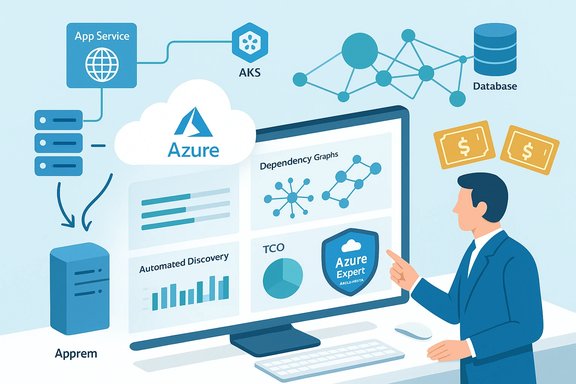
Enterprises evaluating migration are being offered a specific set of deliverables — not magic.- Automated discovery and dependency mapping. Tools scan VMs, physical servers, and databases to produce inventories and service graphs that reveal application dependencies.
- Rightsizing and TCO modelling. The assessment outputs recommended VM sizes, target Azure SKUs, and comparative cost estimates (one‑time migration effort vs steady‑state cloud spend).
- Migration pathway recommendations. Based on technical fit, recommendations range from rehosting (lift‑and‑shift) to refactor/modernize targets like Azure App Service or AKS.
- Security and governance baseline checks. Landing zone and Well‑Architected Framework checks are typically included to ensure a production‑grade posture is achievable.
- Expert briefings and deliverables. When combined with Azure Expert Assessment or partner programs, customers receive a written report, implementation roadmap, and sometimes vouchers or credit incentives for pilot work.
Why Microsoft is selling hybrid cloud to enterprises
Two practical forces shape Microsoft’s push:- Customer reality: the hybrid majority. Independent market research and analyst forecasts make a consistent point: hybrid and multicloud patterns are the de facto enterprise model. Analysts project very high penetration of hybrid cloud strategies in the coming years, with organizations citing data sovereignty, legacy application constraints, and gradual modernization as reasons to keep a mixed estate. Major analyst houses have quantified this trend as a dominant direction for enterprise IT.
- Commercial logic: incentives and consumption. Helping customers migrate — and giving partners tools, credits and even Microsoft engineering resources to get workloads running — accelerates Azure consumption. Those consumption patterns have long-term commercial value for Microsoft and add revenue predictability for partners who align their services to Azure pathways. The free assessment is the low-friction entry point into this funnel.
Strengths: why enterprises get value from a free assessment
- Lowered discovery friction. Discovery and dependency mapping are the most time-consuming and technical parts of migration planning. Automating those steps produces concrete, actionable data for architects and procurement teams.
- Faster business cases. Cost modeling and rightsizing reduce guesswork in TCO conversations. Finance teams can compare steady‑state monthly spend versus legacy datacenter OpEx/CapEx quickly.
- Vendor-assisted pilots reduce risk. When the assessment is paired with funded technical assistance (vouchers, credits, or Microsoft Factory-style delivery), proof-of-concept projects can be executed with reduced upfront cost and timeline.
- Industry‑specific roadmaps. Assessment outputs increasingly include modernization recommendations tied to vertical workloads (e.g., SQL Server modernization, VDI/desktop virtualization, SAP, HPC), making the migration plan more credible for line-of-business stakeholders.
Risks, caveats and hidden trade-offs
A free assessment removes the initial friction, but several important caveats mean organizations should proceed cautiously.1. “Free” does not equal free forever
The assessment itself may cost nothing, but migration and steady‑state cloud consumption are not free. Migration can reveal hidden re‑engineering work, licensing changes, and ongoing operational costs such as networking, storage snapshots, or data egress. Organizations must model steady‑state spending and not rely exclusively on promotional credits. Microsoft and partner funding often have eligibility rules and time/bandwidth limits — a “zero‑cost” deployment assistance model typically requires qualification. Treat Microsoft‑funded help as an accelerator, not as an indefinite cost cure.2. Eligibility, regional limits and scope constraints
Many of the delivery benefits (for example, Microsoft-led Factory assistance or high partner payout tiers) are conditional on region, workload type, consumption thresholds, and repeatability. Complex or bespoke legacy systems, mainframes, or heavily regulated workloads can fall outside “standard” program scopes and require bespoke engineering — often at normal commercial rates. Do not assume the full suite of funded services applies to every workload.3. Vendor lock‑in and long‑term cost trajectory
Migration pathways that favor managed PaaS services can increase reliance on Azure-specific features and may complicate future moves to other clouds. Short-term incentives (credits, free migration assistance) can mask the long-term vendor dependency and steady‑state cost profile. Steady-state optimization (Reserved Instances, Saving Plans, Azure Hybrid Benefit) is essential to avoid sticker shock once promotional credits expire. Independent cost forecasting and multi-cloud comparison are prudent.4. Complexity remains: data gravity, dependencies, and compliance
Automated tooling improves discovery, but it cannot erase the engineering work required to refactor stateful systems, address network performance requirements, or resolve complex licensing entanglements (especially around per‑core or per‑socket database and middleware licenses). Data sovereignty and regulatory compliance still require architecture and contract work that assessments alone do not deliver. Analyst commentary highlights that data synchronization and governance are among the top hybrid-cloud challenges for enterprises adopting AI and distributed workloads.How to treat Microsoft’s free assessment as a rigorous procurement and technical step
Enterprises should approach the free migration assessment like any other vendor engagement: instrumented, scoped, and governed.- Validate eligibility and scope up front. Confirm what the assessment covers, what you receive at the end (raw data, report, actionable IaC templates), and what follow-on funded delivery exists and under which conditions.
- Run discovery and do independent sanity checks. Use Azure Migrate to create the inventory and then validate with a secondary tool or sample manual checks — dependency mapping and business-critical service owners should confirm the results.
- Model steady‑state economics (not just lift costs). Build conservative and optimistic TCO scenarios that include egress, long‑term storage, reserved instance commitments, licensing, and operations labor. Don’t bank on promotional credits to be a permanent discount.
- Require deliverables that preserve ownership. Insist on IaC templates, documented runbooks, asset inventories, and a documented handover plan from any Microsoft or partner engagement. This ensures your team retains operational control after the pilot ends.
- Pilot, measure, and iterate. Start with a small, representative pilot that measures performance, security posture, cost, and recovery SLAs. Only then scale migration waves. Use the pilot metrics to refine the business case.
Technical verification: checking the claims
- Is Azure Migrate free to use? Microsoft documents and product pages state Azure Migrate tooling is available without an additional license fee; you may incur costs for partner tools or for Azure compute and storage consumed during discovery or migration testing. Azure’s product documentation confirms the Server Assessment and related capabilities are provided without a separate cost, while downstream resource consumption is billed via Azure subscription.
- Does Microsoft offer a human‑led “free” assessment? Azure Expert Assessment is described by Microsoft as a no‑cost option that pairs customers with certified Azure experts for a guided assessment, automated tooling setup, data collection and a personalized report. The program may include vouchers for follow-on offers. Evaluate eligibility and availability in your region.
- Is hybrid cloud adoption really mainstream? Analyst forecasts show strong adoption of hybrid and multicloud approaches. Gartner forecasts that the majority of organizations will adopt hybrid cloud strategies in the next several years, a finding echoed by IDC and other analysts — underscoring the market rationale for Microsoft’s push. These analyst views also highlight practical issues: data synchronization, governance, and multicloud interop are pressing challenges.
Market and competitive implications
Microsoft’s approach — combining free tooling, expert assessments, and funded delivery — compresses the sales cycle and aligns partner economics to Azure consumption. That model creates both market momentum for Azure and new dynamics for system integrators and ISV partners: partners can extend their addressable market by pairing their services with Microsoft’s funded programs, but they must also manage the handover, governance, and long‑term optimization work that remains after the initial acceleration phase. Analysts note that buyers increasingly expect hybrid and multicloud parity from vendors; this trend favors providers who can demonstrate interoperability, governance tooling and clear cost-of-ownership narratives.Practical checklist for IT leaders (summary)
- Confirm scope and eligibility for any “free” assessment or funded delivery.
- Run Azure Migrate discovery, then validate results with a secondary tool or manual checks.
- Build two TCO scenarios: conservative and optimistic; include steady‑state license and egress costs.
- Require handover artifacts: IaC, runbooks, inventories and cost‑monitoring dashboards.
- Pilot a representative workload (3–6 weeks) and measure technical and business KPIs before large‑scale migration.
- Negotiate SLAs and post‑migration support; treat promotional credits as one‑time accelerants, not ongoing subsidies.
Final assessment
Microsoft’s free cloud migration assessment is not merely a marketing brochure; it’s an engineered entry point into a broader migration and modernization funnel that marries automated tooling, human expertise, and financial incentives. For many enterprises, that combination removes previously immovable barriers: it accelerates discovery, reduces early stage risk, and makes a credible business case by producing actionable TCO and technical roadmaps. At the same time, the offer is not a panacea. Hidden costs, eligibility constraints, and long-term dependency risks demand disciplined governance and independent validation.Enterprises that treat the assessment as a structured evaluation step — verify outputs, model long‑term economics, and insist on operational handover — will get the best of both worlds: the speed and clarity that assessments bring, combined with control over long‑term outcomes. Industry forecasts and analyst commentary make clear that hybrid is the default destination for most organizations; Microsoft’s assessment programs simply make one particular hybrid path easier to evaluate and pursue. The prudent enterprise will use the free assessment to inform, not to decide, and will keep competitive multicloud options in the procurement lens as migration choices are turned into commitments.
Microsoft’s assessment offerings have matured from a single free tool into an orchestrated push that ties discovery, funding, and delivery into a single customer journey — powerful if used wisely, risky if accepted without the discipline of verification and long‑term planning.
Source: BetaNews https://betanews.com/article/microsoft-cloud-migration-assessment/]
