

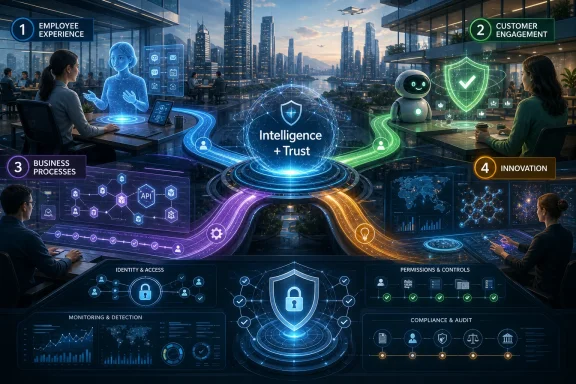
That framing matters because it captures the tension now facing nearly every organization that spent the last two years experimenting with generative AI. The demos worked. The pilots impressed executives. The productivity anecdotes accumulated. But the enterprise balance sheet has been slower to move, and Microsoft’s “Frontier Transformation” language is an attempt to turn AI from a departmental novelty into a managed corporate capability.
Microsoft’s New AI Pitch Starts Where The Pilot Phase Runs Out
The most important thing about Microsoft’s four-path framework is not the number four. It is the admission embedded inside it: AI experimentation has produced real activity, but not always real transformation.
That distinction has become unavoidable. Many companies now have chatbots, Copilot trials, internal knowledge assistants, and AI-assisted coding projects. Far fewer have redesigned their core workflows around AI, changed how decisions are made, or built repeatable systems for measuring value across departments. Microsoft’s post speaks directly to that gap, arguing that “Frontier Transformation” begins when AI is embedded into the flow of work rather than bolted onto individual tasks.
This is familiar Microsoft territory. The company has spent decades selling enterprises on platform shifts that begin as tools and end as architecture. Windows Server, Active Directory, SharePoint, Azure, Teams, and Microsoft 365 all followed some version of the same arc: first adoption, then dependency, then governance. AI is now being pushed through that same funnel.
The difference is that AI does not behave like a normal productivity application. A word processor does what the user tells it. A spreadsheet calculates what the user defines. An AI agent interprets, infers, summarizes, retrieves, recommends, and sometimes acts. That makes the business case potentially larger, but also messier, because the system’s usefulness depends on data quality, process design, identity controls, permissions, and trust.
Microsoft’s thesis is that value arrives when those pieces are deliberately connected. That is a reasonable argument. It is also conveniently aligned with Microsoft’s commercial advantage: the company owns the productivity suite, the identity layer, the cloud platform, the security stack, the low-code tools, the developer tooling, and increasingly the agent framework.
The Four Paths Are Really Four Pressure Points
Microsoft presents the four paths as routes to business value: enriching employee experiences, reinventing customer engagement, reshaping business processes, and bending the curve on innovation. Read plainly, they are also the four places where enterprise AI either proves itself or becomes another expensive platform promise.
Employee experience is the easiest path to understand because it maps directly to the first wave of generative AI adoption. Workers spend too much time searching for documents, reconstructing meeting context, writing status updates, summarizing long threads, and translating organizational memory into action. AI can plausibly reduce that friction, particularly inside companies where Microsoft 365 already holds the emails, chats, files, meetings, and calendars that define daily work.
But this path is also where the limits of generic AI become obvious. A workplace assistant that summarizes a meeting is useful. A workplace assistant that understands the difference between a contractual commitment, a half-formed idea, and a politically delicate disagreement is much more valuable. That requires more than model access; it requires business context, permissions, clean knowledge stores, and a culture that does not confuse AI fluency with judgment.
Customer engagement is the second pressure point, and it is where AI’s promise collides with brand risk. Microsoft cites Alaska Airlines’ natural-language destination discovery experience, saying it delivered 90 percent user satisfaction and reduced planning time by 75 percent. That is the kind of metric business leaders like because it joins customer delight to operational efficiency, at least in theory.
Yet customer-facing AI is unforgiving. A bad internal summary wastes time; a bad customer interaction can cost trust, trigger regulatory complaints, or push a buyer to a competitor. The organizations that succeed here will not simply replace call-center scripts with chatbots. They will use AI to triage intent, retrieve context, personalize service, and escalate gracefully when human expertise is needed.
Business processes are where Microsoft’s argument becomes more ambitious. The company is no longer talking only about saving employees a few minutes at a time. It is arguing that AI can redesign workflows end to end, reducing handoffs, accelerating analysis, and scaling work without scaling headcount in the same proportion.
That is the frontier every CFO cares about. It is also the frontier every sysadmin and IT architect should scrutinize closely. Once AI becomes part of a business process rather than an optional assistant, it inherits the expectations of business-critical software: uptime, auditability, access control, rollback procedures, data retention, compliance, and operational support.
Innovation is the fourth path, and perhaps the most nebulous. Microsoft’s example of Space Intelligence using Microsoft AI capabilities to speed large-scale forest mapping by 75 percent is compelling because it points beyond office productivity. AI can integrate distributed datasets, analyze unstructured media, and help specialists test ideas faster than traditional methods allow.
Still, “innovation” has always been the softest word in enterprise technology marketing. Every platform claims to accelerate it. What makes AI different is that it can compress the distance between information and prototype. The danger is that organizations mistake more prototypes for better strategy.
Intelligence Plus Trust Is A Sales Slogan With A Real Architecture Problem Underneath
Microsoft’s post repeatedly returns to two words: intelligence and trust. The phrase is polished, but the underlying issue is concrete. Enterprise AI systems need enough intelligence to produce useful outputs and enough trust to be deployed safely at scale.
That may sound obvious, but it is the crux of the AI adoption problem. Most companies do not lack enthusiasm. They lack a dependable way to connect models to business data without leaking sensitive information, violating permissions, hallucinating critical facts, or creating a shadow automation layer no one can govern.
For WindowsForum readers, this is where the conversation becomes operational rather than abstract. AI value depends on the unglamorous machinery of identity, access management, endpoint security, data classification, logging, retention, and policy enforcement. If those foundations are weak, AI will expose the weakness faster than almost any previous technology wave.
This is especially true inside Microsoft-heavy environments. Copilot-style systems are only as safe as the permissions they inherit. If years of SharePoint sprawl, Teams oversharing, abandoned groups, stale guest access, and poorly labeled files have created a messy data estate, AI can make that mess searchable, summarizable, and actionable. That is both the value proposition and the threat model.
Microsoft knows this. Its “trust” language is not just reputation management; it is a recognition that AI adoption runs through security teams. Business leaders may buy the promise of faster work, but CISOs and administrators will determine how much of that promise survives contact with real enterprise controls.
The uncomfortable truth is that AI readiness is now partly a referendum on IT hygiene. Organizations that invested in identity discipline, data governance, endpoint management, and cloud security are better positioned to scale AI. Organizations that treated those chores as back-office maintenance will find that AI makes old compromises newly visible.
The Employee Experience Path Is Where AI Looks Most Like Windows Itself
The employee experience story is the one Microsoft can tell most naturally because it resembles the original promise of Windows: put a common interface over complex computing so more people can get more work done. In the AI era, the interface is conversational, contextual, and increasingly agentic.
That matters because most employees do not want another dashboard. They want the answer, the draft, the next step, the missing file, the relevant expert, or the explanation of why a process is stuck. AI becomes useful when it reduces the distance between intent and execution.
Microsoft’s strength is that it already sits inside the workday. Outlook, Teams, Word, Excel, PowerPoint, SharePoint, OneDrive, Dynamics, GitHub, and Azure DevOps are not side channels for many organizations; they are the workplace. Embedding AI there is different from asking employees to visit a separate tool and manually paste context into it.
But the employee path also contains a cultural risk. If AI is sold only as a productivity booster, workers will reasonably hear it as a demand to do more with less. If it is implemented without process redesign, employees may end up reviewing AI output on top of their existing workload, creating a new layer of invisible labor.
The better version is more structural. AI should remove low-value coordination work, expose knowledge that was previously trapped in silos, and help employees make decisions with better context. That requires leaders to ask not just where AI can save time, but where work has become unnecessarily fragmented.
There is also a skills question. The first wave of AI training focused heavily on prompting. The next wave will need to focus on verification, workflow design, data stewardship, and knowing when not to automate. The employee experience improves only if humans remain responsible for judgment while machines absorb repeatable cognitive overhead.
Customer Engagement Is The Most Visible Test Of Whether AI Can Be Trusted
Customer engagement is where companies will be tempted to move too quickly. The economics are seductive: faster responses, fewer queues, more personalization, and lower service costs. Microsoft’s Alaska Airlines example shows the upside of using natural language to make discovery and booking feel less like database filtering and more like conversation.
The best customer-facing AI will not merely answer questions. It will understand context across channels, know when a customer is frustrated, recognize when a request carries legal or financial implications, and hand the interaction to a human with the relevant history intact. That is a far more complex system than a chatbot widget on a support page.
This is where Microsoft’s platform approach may have real pull. Customer engagement touches CRM data, identity, service histories, knowledge bases, communications platforms, analytics, and compliance controls. If AI is to operate across those systems, integration becomes the hard part.
But the stakes differ sharply from internal productivity. Customers do not grade on a curve because the system is powered by AI. They expect the company to know what it is doing. A hallucinated policy answer, a mishandled refund, or a confident but wrong recommendation can damage trust quickly.
That is why the most successful deployments will probably be hybrid for longer than vendors imply. AI can handle routine requests, draft responses, summarize account history, and recommend next actions. Humans will still matter most where ambiguity, emotion, liability, or high-value relationships enter the picture.
The broader lesson is that customer AI should be measured by outcomes, not deflection alone. Reducing call volume is not the same as improving service. If customers leave faster because they are satisfied, that is progress. If they leave faster because the system made escalation painful, the metric is lying.
Process Reinvention Is Where The Real Money Is, And Where The Risk Compounds
Microsoft’s third path, reshaping business processes, is the one most likely to determine whether enterprise AI becomes a durable investment or a budget hangover. Individual productivity gains are useful, but process redesign is where large organizations can find compounding returns.
Consider the difference between helping an analyst summarize documents and changing the entire analysis workflow. In the first case, AI speeds up a task. In the second, AI may ingest source material, extract patterns, flag anomalies, draft recommendations, route approvals, update systems of record, and create an audit trail. That is not a better assistant; it is a different operating model.
This is also where the “agent” conversation becomes unavoidable. Once AI systems can take actions across applications, they begin to resemble junior process workers with API access. That creates enormous potential, especially in finance, procurement, HR, IT service management, sales operations, and software development.
It also creates a new class of failure. A bad generated paragraph can be edited. A bad automated action can create downstream consequences before anyone notices. Enterprise AI therefore needs guardrails that are more like transaction controls than writing suggestions.
For IT departments, this shifts the work from deployment to orchestration. The question is not simply which AI tool to approve. It is how to define permissions, constrain actions, monitor behavior, validate outputs, and integrate AI activity into existing incident response and compliance processes.
There is a temptation to treat AI governance as a committee exercise. That will not be enough. Governance has to be technical, observable, and enforceable. If an AI agent can read sensitive data, trigger workflows, or alter records, administrators need to know who authorized it, what it accessed, what it changed, and how to stop it.
Innovation Needs Better Inputs, Not Just Faster Outputs
The fourth path, innovation, is the one most likely to inspire executive speeches. AI can help teams explore more ideas, analyze more data, generate more designs, simulate more possibilities, and move from concept to prototype faster. That is real.
But innovation does not fail only because people lack ideas. It fails because organizations cannot choose, fund, test, scale, or kill ideas effectively. AI can accelerate discovery, but it can also accelerate noise.
The Space Intelligence example is useful because it grounds the claim in a specific kind of work: large-scale forest mapping. When AI reduces the time needed to analyze vast datasets by 75 percent, the value is not merely that a team worked faster. It is that work previously constrained by time and scale becomes more feasible.
That is the strongest version of AI-enabled innovation. It expands the boundary of what an organization can attempt. In scientific, environmental, industrial, medical, and engineering contexts, AI’s ability to process unstructured and distributed data may matter more than its ability to draft emails.
Enterprises should be careful, however, not to confuse generative output with invention. A model can produce variations endlessly. The scarce resource becomes discernment: which ideas align with strategy, which are technically plausible, which are safe, which customers actually need, and which deserve operational investment.
This is why Microsoft’s emphasis on business outcomes is important. AI innovation should not be measured by the number of experiments launched. It should be measured by the rate at which experiments become validated capabilities, products, services, or decisions that change performance.
The Hidden Message Is That AI Value Belongs To The Prepared
Microsoft’s blog is written for business decision makers, but its implications land heavily on IT. The organizations most likely to benefit from Frontier Transformation are not necessarily those with the biggest AI budgets. They are the ones with the cleanest foundations.
That means data that can be found and trusted. It means identity systems that reflect reality. It means access controls that are current, not inherited from a reorganization five years ago. It means business processes documented well enough to be redesigned. It means security teams involved early rather than summoned after a pilot becomes politically untouchable.
This is not glamorous work, but it is the work that determines whether AI scales. A company cannot safely automate a process it does not understand. It cannot personalize customer engagement from fragmented records. It cannot empower employees with institutional knowledge if that knowledge is duplicated, stale, mislabeled, or locked inside departmental silos.
The phrase “Frontier Transformation” may sound like marketing, but the maturity model behind it is recognizable. First, companies experiment. Then they standardize. Then they integrate. Then they govern. Finally, if the technology proves useful enough, they reorganize around it.
Microsoft is trying to pull customers toward the later stages of that model. That is partly because the company believes AI will reshape business. It is also because later-stage adoption consumes more cloud, more security, more data services, more consulting, more licenses, and more platform dependency.
Those two things can be true at the same time. Microsoft’s incentives do not invalidate the argument. They do mean customers should evaluate the framework with clear eyes.
The Frontier Firm Will Be Built By Administrators Before It Is Celebrated By Executives
For all the executive language in Microsoft’s post, the practical burden of Frontier Transformation will fall on people who rarely appear in transformation decks. Administrators, architects, developers, security engineers, data owners, compliance leads, and support teams will decide what AI can actually do inside the enterprise.
They will be the ones asked to connect systems that were never designed for conversational automation. They will be the ones cleaning permissions before Copilot exposes overshared files. They will be the ones explaining why a proof of concept cannot become production without logging, retention, testing, and rollback. They will be the ones balancing user enthusiasm against regulatory reality.
This is why WindowsForum’s audience should pay attention to Microsoft’s language now. When vendors shift from productivity to transformation, the implementation expectations change. A tool trial can be informal. A transformed business process cannot.
There is also a labor-market implication. The valuable IT professional in this phase is not merely the person who knows how to enable an AI feature. It is the person who understands the business process, the data boundary, the security model, and the failure mode. AI may automate tasks, but it raises the premium on systems thinking.
The most effective organizations will likely treat AI projects less like software rollouts and more like operational redesign. They will start with a business outcome, map the workflow, identify the data, define the controls, select the model or tool, test with users, measure results, and iterate. That sounds slower than “turn it on,” but it is faster than cleaning up a failed deployment later.
Microsoft’s four paths are useful if they force that discipline. They are dangerous if they become a new vocabulary for old habits: buying technology first and discovering the business case afterward.
The Four Paths Narrow To One Hard Test
Microsoft’s framework gives leaders a tidy way to discuss AI value, but the real test is whether organizations can turn scattered wins into repeatable capability. The companies that do this well will be boring in the right ways: governed, measured, integrated, and clear about where human judgment remains essential.
- AI will create the most durable value when it is redesigned into workflows, not sprinkled across isolated tasks.
- Employee-facing AI depends on clean knowledge, sensible permissions, and a culture that rewards verification rather than blind acceleration.
- Customer-facing AI should be measured by satisfaction and resolution quality, not just reduced wait times or lower service volume.
- Process automation with agents requires auditability, rollback, identity controls, and operational monitoring from the start.
- Innovation gains will matter most where AI expands what teams can analyze, test, or build, rather than merely producing more ideas.
- Microsoft’s “intelligence and trust” message is marketing language, but it points to a real enterprise requirement: AI needs both business context and enforceable governance.
Microsoft’s “Frontier Transformation” push is best understood as the company’s attempt to define the post-pilot era before customers define it for themselves. The framework is self-serving in the way all platform strategies are self-serving, but it is not empty. If AI is going to matter beyond demos, it has to leave the sandbox and enter the machinery of work. The next phase will not be won by the organization with the most pilots, the flashiest chatbot, or the broadest license agreement; it will be won by the one that can make AI useful, governed, measurable, and trusted enough to become ordinary infrastructure.
References
- 4 paths to Frontier Transformation: From AI experimentation to real business value Microsoft · 2026-06-18T16:10:08.060511