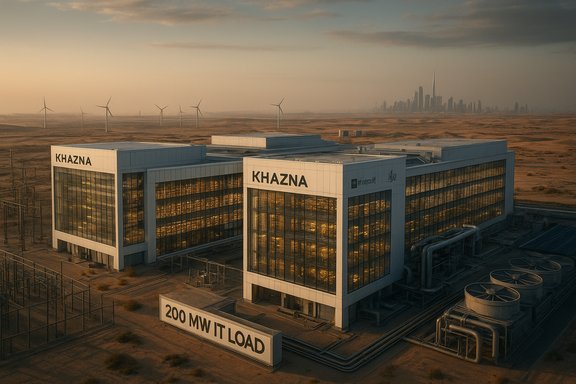
Microsoft and Abu Dhabi’s G42 have committed to a 200-megawatt expansion of data‑center capacity in the United Arab Emirates — to be built and operated through G42’s Khazna Data Centers subsidiary — a move the partners say will come online in phases beginning before the end of 2026 and that sits inside Microsoft’s broader, $15.2 billion UAE investment program through 2029.
Over the past two years the UAE has pursued an explicit strategy to become a regional and global hub for artificial intelligence and cloud services. Major public- and private-sector investments have focused on building local compute capacity, attracting hyperscale cloud partners, and creating governance and skills programs designed to enable sovereign hosting for regulated industries.
Microsoft’s announcement is the latest, and most concrete, expression of that strategy: the company has publicly framed a multi‑year program of capital and operating spending in the UAE totaling $15.2 billion across 2023–2029, with roughly $7.3 billion already invested by the end of 2025 and $7.9 billion earmarked for 2026–2029. Those numbers were confirmed directly by Microsoft’s corporate statement and replicated by independent reporting. At the same time, U.S. export licensing actions have enabled Microsoft to stage very large quantities of high‑end Nvidia accelerator capacity inside UAE facilities — an essential material underpinning for an “AI‑first” data‑center program. Public reporting and Microsoft’s account indicate prior authorizations equated to the compute capacity of roughly 21,500 A100‑class GPUs, and more recent approvals cover additional GB/Blackwell‑class systems that Microsoft says amount to the equivalent of tens of thousands more A100s. These GPU licensing details underpin how the planned 200 MW of power will translate into usable AI compute.
However, operational delivery — not headlines — will determine whether the program realizes its promise. Enterprise buyers should treat Microsoft’s product‑residency statements as promising but conditional, and insist on contractual auditability, portability, and firmed energy and resiliency commitments before signing long‑term agreements tied to this capacity. The GPU numbers and A100‑equivalent tallies are useful for scale context, but they should be interpreted as proxies for performance rather than literal hardware inventories.
Source: TechInformed Microsoft, G42 announce 200-megawatt UAE data center expansion - TechInformed
 Background
Over the past two years the UAE has pursued an explicit strategy to become a regional and global hub for artificial intelligence and cloud services. Major public- and private-sector investments have focused on building local compute capacity, attracting hyperscale cloud partners, and creating governance and skills programs designed to enable sovereign hosting for regulated industries.Microsoft’s announcement is the latest, and most concrete, expression of that strategy: the company has publicly framed a multi‑year program of capital and operating spending in the UAE totaling $15.2 billion across 2023–2029, with roughly $7.3 billion already invested by the end of 2025 and $7.9 billion earmarked for 2026–2029. Those numbers were confirmed directly by Microsoft’s corporate statement and replicated by independent reporting. At the same time, U.S. export licensing actions have enabled Microsoft to stage very large quantities of high‑end Nvidia accelerator capacity inside UAE facilities — an essential material underpinning for an “AI‑first” data‑center program. Public reporting and Microsoft’s account indicate prior authorizations equated to the compute capacity of roughly 21,500 A100‑class GPUs, and more recent approvals cover additional GB/Blackwell‑class systems that Microsoft says amount to the equivalent of tens of thousands more A100s. These GPU licensing details underpin how the planned 200 MW of power will translate into usable AI compute.
What the announcement actually says
The headline facts
- Capacity: 200 megawatts (MW) of additional IT‑load capacity in the UAE, to be delivered through Khazna Data Centers, a subsidiary of G42.
- Timeline: Initial capacity is expected to begin coming online before the end of 2026.
- Investment context: The capacity expansion is part of Microsoft’s wider $15.2 billion commitment to the UAE through 2029, with $7.3 billion spent by year‑end 2025 and $7.9 billion planned for 2026–2029.
- Hardware/export controls: U.S. Commerce Department export licenses have allowed Microsoft to deploy advanced Nvidia accelerator families (GB/Blackwell and earlier A100/H100 equivalents) in the UAE; Microsoft publicly reported deploying the equivalent of ~21,500 A100‑class units so far and cited further authorizations that expand that footprint. Independent outlets report approvals covering shipments that Microsoft and analysts characterize as equivalent to tens of thousands more A100‑class GPUs.
What was not disclosed (and what remains open)
- Exact site locations for the new capacity were not revealed.
- Capital expenditure (capex) breakdown for the 200 MW build — total project spend, capex per MW, and financing structure — were not provided.
- Detailed energy sourcing and firming contracts (e.g., firmed renewables, PPAs, onsite generation) were not published alongside the announcement.
Technical anatomy: what 200 MW means in practice
Translating megawatts to usable AI compute
A data‑center announcement quoting 200 MW generally refers to IT load — the electrical capacity available to run servers, accelerators, storage and networking inside the data halls. This is different from a site’s total electrical footprint (which also includes facility losses, cooling, and redundancy). Practically speaking:- Modern AI‑dense racks often draw 10 kW–40 kW+ per rack, depending on whether they house multi‑GPU nodes, liquid cooling, or specialized systems.
- At a conservative 10 kW per rack assumption, 200 MW of IT load could theoretically support ~20,000 racks; at higher per‑rack densities used for Blackwell/GB‑class accelerators, the number of racks is lower but each rack delivers far greater inferencing and training capacity.
The GPU layer: Blackwell / GB‑class vs A100 / H100
The recent export approvals and Microsoft’s own disclosures indicate deployment of newer GB/Blackwell family systems in addition to earlier A100/H100‑class gear. Key differences:- Power & density: GB‑class racks (Blackwell Ultra/GB300 variants) are typically much more power‑dense than A100 generations. That increases the facility’s per‑rack cooling and distribution demands but yields greater per‑rack performance.
- Performance implications: One GB300 rack can substitute for many A100 nodes in training throughput or inference throughput depending on topology; therefore, GPU counts presented as “A100 equivalents” should be treated as a performance proxy rather than a literal inventory. This distinction matters for cost, energy, and thermal engineering.
Cooling, PUE and energy implications
High‑density AI racks drive facilities toward liquid cooling (direct-to-chip or immersion) to achieve competitive Power Usage Effectiveness (PUE) and to keep operational costs reasonable. A 200 MW IT allocation implies:- significant substation upgrades and redundancy feeds,
- likely adoption of liquid cooling at scale,
- multi‑year energy contracts (PPAs, renewables plus firming or storage) to meet reliability and sustainability commitments.
Khazna, G42 and Microsoft: roles and relationships
Khazna Data Centers is G42’s hyperscale wholesale data‑center arm and will be the delivery vehicle for this expansion. The announcement formalizes a deeper operating relationship between Microsoft and G42 that builds on Microsoft’s prior $1.5 billion equity investment in G42 and accompanying collaboration frameworks. That local partnership model serves multiple purposes:- Provides a domestic operator and contracting counterparty for local governments and regulated customers.
- Enables Microsoft to deliver Azure‑grade services while meeting sovereign hosting and compliance requirements.
- Helps reconcile hyperscaler platform control with national concerns about data residency and governance.
Strategic implications
For Microsoft
- Market positioning: The expansion strengthens Azure’s proposition in the Gulf for customers who require local residency, audited governance, and low latency for AI services like Microsoft 365 Copilot. Microsoft has explicitly tied part of the UAE commitment to product‑level residency assurances that enable qualified customers to keep Copilot processing in‑country.
- Supply chain and policy win: Securing U.S. export licenses for frontier accelerators is politically and operationally significant. It allows Microsoft to deliver frontier AI compute outside the U.S. while framing the move within a controlled, assurance‑based model.
For the UAE
- AI sovereignty and ecosystem: The new capacity materially increases in‑country compute headroom, which helps attract research labs, startups and regulated enterprises that cannot move sensitive workloads offshore. The physical presence of high‑end GPUs reduces latency and regulatory friction for in‑country AI services.
- Economic and skills potential: Microsoft’s skilling commitments tied to the investment (including multi‑year training targets) aim to seed the workforce needed to operate and build services on top of the new infrastructure.
Geopolitical and export‑control dimensions
The authorization to place Blackwell‑class hardware in the UAE sets a precedent for how advanced AI accelerators can be exported under conditional regimes. This is a diplomatic as much as a technical act: the U.S. considered national‑security trade‑offs before permitting the shipments, and the licenses define operational guardrails that will shape future cross‑border compute flows.Commercial and operational impacts for enterprises and IT teams
For Windows‑centric enterprises and Azure customers the announcement changes procurement and architecture choices in several concrete ways:- Sovereign hosting becomes actionable: Organizations operating in finance, healthcare, energy and government can more credibly procure in‑country Copilot and inference services with onshore processing guarantees. Contractual and eligibility details will determine practical reach.
- Hybrid AI patterns: Expect hybrid topologies where sensitive data ingress remains on‑premises or in local clouds, while GPU‑heavy training and large‑context inference burst into Khazna/Azure capacity.
- Procurement checklist changes: Buyers should demand explicit audit rights, portability guarantees, incident response SLAs, and energy‑sourcing commitments before signing long‑term purchase agreements tied to local capacity.
- Inventory workloads that require onshore processing and map them to Microsoft’s product‑residency timelines.
- Insert auditability, data portability, and vendor‑exit clauses into contractual RFPs and MOUs.
- Require transparent energy and sustainability commitments (PPAs, delivery milestones) for any capacity-dependent pricing.
- Harden multi‑region failover and backup strategies — sovereign hosting reduces legal friction but does not eliminate service outage risk.
Risks, unknowns and cautionary points
- Timeline uncertainty: Public statements place initial capacity coming online before the end of 2026, but delivery depends on substations, transformer builds, supply chains for cooled racks, and GPU shipments. Treat the timeline as conditional and phased.
- GPU‑equivalent arithmetic is an approximation: Microsoft and media outlets report GPU inventories and “A100‑equivalent” figures as shorthand. These equivalencies are useful proxies but do not precisely map to training throughput or inference capacity for a given workload. Performance depends on interconnect topology, memory pooling, and model parallelism; treat the raw counts as illustrative rather than definitive. Flagged as an approximation and not an absolute inventory.
- Governance and transparency concerns: The effectiveness of the intergovernmental assurance frameworks and any binding oversight mechanisms will be judged by third‑party audits, breach disclosures, and the specificity of contractual audit rights — none of which were released in full at announcement time. Without independent, verifiable audit trails, public trust in “sovereign” assurances will remain conditional.
- Concentration and vendor lock‑in: Deep integration between a sovereign operator (G42/Khazna) and a single hyperscaler (Microsoft) concentrates risk. Buyers should negotiate portability, evacuation and contingency options to avoid being locked into a single supply chain or vendor.
- Energy and sustainability delivery risk: Promises of renewable supply or low-carbon operation require contractually firmed delivery dates and public carbon‑intensity metrics at the facility level. Absent those, sustainability claims remain aspirational.
What to watch next (signals that will validate progress)
- Publication of site permits, PPA contracts, or grid interconnection agreements indicating the utility timelines and firmed energy supply.
- Third‑party audit summaries or redacted compliance attestations showing export‑control and hardware custody processes for licensed accelerators.
- Microsoft product announcements that convert infrastructure into product guarantees (for example, formal availability dates for in‑country Microsoft 365 Copilot processing for qualified UAE customers).
- Public disclosures of capex breakdowns or Khazna financial filings that illuminate the cost per MW and financing structure.
- Independent coverage of hardware racking and commissioning (photos, customs filings, or lease notices) that corroborate compute arrival timelines.
Strengths and strategic value — a critical assessment
- Scale and capability: A 200 MW commitment is a genuine, material step toward making the UAE a competitive AI infrastructure hub. The power envelope is large enough to host thousands of GPU‑dense racks when deployed with modern cooling, giving local researchers, enterprises and public agencies access to frontier compute.
- Integrated strategy: Pairing compute with product residency commitments, skilling programs, and a Responsible AI institutional layer is a sophisticated play that recognizes regulation and skills are as crucial as raw FLOPS.
- Policy precedent: The export licensing approvals are strategically important: they show how frontier hardware can flow to trusted partners under conditional frameworks, which could become a template for allied nations seeking onshore compute without breaching export constraints.
- Opaque operational detail: The lack of public, granular capex, site and governance documentation reduces the ability of customers and external observers to validate claims. Independent auditability is key to converting a program into durable trust.
- Execution complexity: Building hyperscale AI‑capable halls, securing energy at scale, and integrating very high density GPU hardware is technically non‑trivial; any slippage in one area (power, cooling, supply chain) will cascade into delays.
Bottom line for WindowsForum readers and IT decision‑makers
Microsoft and G42’s 200 MW data‑center expansion through Khazna Data Centers is a major, credible commitment that materially shifts the AI infrastructure landscape in the Gulf. It makes in‑country, Azure‑grade AI hosting more attainable for regulated customers and signals a new operational model where hyperscalers deploy frontier hardware under intergovernmental assurance frameworks.However, operational delivery — not headlines — will determine whether the program realizes its promise. Enterprise buyers should treat Microsoft’s product‑residency statements as promising but conditional, and insist on contractual auditability, portability, and firmed energy and resiliency commitments before signing long‑term agreements tied to this capacity. The GPU numbers and A100‑equivalent tallies are useful for scale context, but they should be interpreted as proxies for performance rather than literal hardware inventories.
Conclusion
This 200 MW expansion anchors Microsoft’s $15.2 billion UAE program in a tangible infrastructure commitment and marks another step in the geopolitically complex, technically exacting race to localize frontier AI compute. The announcement combines engineering ambition, diplomatic negotiation over export controls, and a coordinated push to pair capacity with governance and skills investments. For enterprises and IT leaders, the practical takeaway is straightforward: the capacity will create new possibilities for sovereign AI services — but procurement teams must demand the transparency, contractual protections and technical detail necessary to convert those possibilities into operational reality.Source: TechInformed Microsoft, G42 announce 200-megawatt UAE data center expansion - TechInformed