

The most consequential leadership shake-up in Microsoft’s gaming business in nearly a decade landed this week: veteran Xbox chief Phil Spencer is retiring after 38 years, Xbox president Sarah Bond is leaving the company, Matt Booty has been promoted to Executive Vice President and Chief Content Officer, and Asha Sharma — until now president of Microsoft’s CoreAI product organization — will become CEO of Microsoft Gaming.
Phil Spencer’s exit closes a long chapter in which he remade Microsoft into a dominant, acquisitive player in games. Under Spencer, Microsoft completed major deals (Mojang, ZeniMax/Bethesda, and the acquisition of Activision Blizzard), expanded Xbox Game Studios into a sprawling multi‑studio operation, and bet heavily on cross‑device and cloud gaming. His tenure also coincided with turbulent industry cycles: studios closed or consolidated, thousands of jobs were cut across recently acquired teams, and Xbox hardware and content revenues have faced declines in recent quarters.
This transition is more than personnel change; it is a strategic inflection. Microsoft is now marrying an experienced studio operator (Matt Booty) with a senior executive steeped in product, operations, and AI (Asha Sharma). The move raises immediate questions about creative stewardship, the role of generative AI in game creation, console commitment versus device‑agnostic ambitions, and how Microsoft will balance craft, scale, and shareholder expectations going forward.
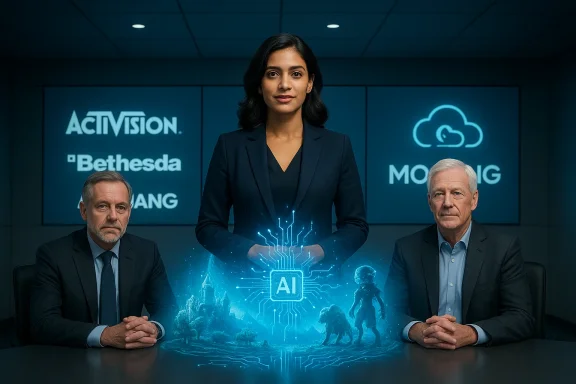
However, Sharma’s lack of a traditional gaming pedigree is an immediate flashpoint in the community and inside studios. Game development is a craft-driven, multidisciplinary endeavor where creative leadership, publisher‑studio relationships, and an appreciation for the long timelines of AAA production matter. Entrusting a portfolio that includes Activision, Bethesda, id Software, Obsidian, Ninja Theory, and Mojang to someone whose career largely spans AI product and consumer ops will put a microscope on how Microsoft defines stewardship versus platform strategy.
It’s worth noting that the quote is verifiable in the memos and public reporting, but the real test will be how policy, tooling, and incentives at Microsoft change under Sharma. A leader can commit to craftsmanship in words while still instituting operational metrics and tooling that favor efficiency. That is the nuance the industry will watch closely.
Booty’s public message emphasized support for teams and indicated no immediate studio reorganizations — a deliberate olive branch to creators. But his remit will be more complex: coordinating with Sharma’s platform and product priorities, aligning first‑party release cadence with Game Pass and cross‑device ambitions, and defending creative quality when financial pressure to monetize and extract value from IP intensifies.
Microsoft itself has published research and tools aimed at bringing generative models into game creation. The Xbox‑sponsored Muse model is positioned as a creative augment: a system trained to understand 3D worlds and player actions that Microsoft says can help ideation, prototyping, and even preserve classic titles. But Muse’s debut also provoked an intense developer backlash and critical coverage warning that such tools can be used primarily to reduce labor costs and hollow out craft, even if Microsoft emphasizes augmentation. That debate is now front and center.
This isn’t just public relations: disclosure frameworks, provenance metadata, and audit trails for AI‑generated assets will become practical necessities. Studios that embrace transparent workflows — human review checkpoints, provenance tags, and clear labeling — will likely fare better with regulators and players. Microsoft already leans publicly into Responsible AI principles; the industry will watch whether those principles translate into operational rules inside Microsoft Gaming.
But the risk is real: unchecked efficiency drives, opaque monetization, and heavy reliance on automation will erode trust with creators and players. Activision’s recent AI disclosure and the developer backlash to Microsoft’s own Muse reveal how quickly community goodwill can dry up when technology outpaces thoughtful policy.
In the months ahead, watch the signals. The future of Xbox — and the living experiment that is AI in games — will be decided as much by decisions made in budget meetings and design reviews as by any executive memo.
Source: PC Gamer New Xbox boss promises no 'soulless AI slop' after moving over from Microsoft's CoreAI products division
 Background
Phil Spencer’s exit closes a long chapter in which he remade Microsoft into a dominant, acquisitive player in games. Under Spencer, Microsoft completed major deals (Mojang, ZeniMax/Bethesda, and the acquisition of Activision Blizzard), expanded Xbox Game Studios into a sprawling multi‑studio operation, and bet heavily on cross‑device and cloud gaming. His tenure also coincided with turbulent industry cycles: studios closed or consolidated, thousands of jobs were cut across recently acquired teams, and Xbox hardware and content revenues have faced declines in recent quarters.This transition is more than personnel change; it is a strategic inflection. Microsoft is now marrying an experienced studio operator (Matt Booty) with a senior executive steeped in product, operations, and AI (Asha Sharma). The move raises immediate questions about creative stewardship, the role of generative AI in game creation, console commitment versus device‑agnostic ambitions, and how Microsoft will balance craft, scale, and shareholder expectations going forward.
What the announcement actually says
- Phil Spencer will retire after nearly four decades at Microsoft and remain in an advisory capacity through the summer to help the handoff.
- Asha Sharma, previously president of Microsoft’s CoreAI products, is appointed CEO of Microsoft Gaming. She joined Microsoft from Instacart and has held senior product and operations roles at Meta and other consumer platforms prior to her AI leadership at Microsoft.
- Matt Booty — a long‑time Microsoft and Xbox studio executive — is promoted to EVP and Chief Content Officer, responsible for the studios and creative output.
- Sarah Bond, who had been widely viewed inside Xbox as a potential successor to Spencer, has resigned from Microsoft.
Asha Sharma: profile and why the hire matters
From CoreAI to Xbox: skills, blind spots, and expectations
Asha Sharma arrives with a background in consumer product, operations, and AI product leadership rather than a CV of shipped AAA games. That profile explains both the excitement and skepticism the appointment has prompted. Her operational and product experience — building large-scale consumer services and CoreAI product strategies — is likely attractive to Satya Nadella’s Microsoft because the company is betting heavily on AI as a platform-level advantage.However, Sharma’s lack of a traditional gaming pedigree is an immediate flashpoint in the community and inside studios. Game development is a craft-driven, multidisciplinary endeavor where creative leadership, publisher‑studio relationships, and an appreciation for the long timelines of AAA production matter. Entrusting a portfolio that includes Activision, Bethesda, id Software, Obsidian, Ninja Theory, and Mojang to someone whose career largely spans AI product and consumer ops will put a microscope on how Microsoft defines stewardship versus platform strategy.
Her public pledge: no “soulless AI slop”
In her letter to employees Sharma wrote that “we will not chase short‑term efficiency or flood our ecosystem with soulless AI slop,” and emphasized that “games are and always will be art, crafted by humans.” She framed a commitment to great games — unforgettable characters, emotional stories, creative excellence — while also promising tools and platforms to enable creators and players. Those lines are an explicit attempt to reassure developers and players that AI will be used thoughtfully, not as a blunt cost‑cutting instrument.It’s worth noting that the quote is verifiable in the memos and public reporting, but the real test will be how policy, tooling, and incentives at Microsoft change under Sharma. A leader can commit to craftsmanship in words while still instituting operational metrics and tooling that favor efficiency. That is the nuance the industry will watch closely.
Matt Booty: the creative anchor
Matt Booty’s elevation to Chief Content Officer is Microsoft’s clearest signal that creative ownership of franchises and studio relationships will remain in experienced hands. Booty has run Xbox Game Studios for years and has navigated titles across scale, platforms, and the thorny integration of recently acquired teams. His new role gives him explicit responsibility for series stewardship, studio support, and the content pipeline. That should reassure many developers who worry that an AI‑native executive would prioritize systems over stories.Booty’s public message emphasized support for teams and indicated no immediate studio reorganizations — a deliberate olive branch to creators. But his remit will be more complex: coordinating with Sharma’s platform and product priorities, aligning first‑party release cadence with Game Pass and cross‑device ambitions, and defending creative quality when financial pressure to monetize and extract value from IP intensifies.
Why AI is the central subtext (and why it scares people)
Microsoft’s AI bets are enormous — and public
Microsoft has funneled billions into AI partnerships, infrastructure, and productization. The company’s messaging from the top — including CEO Satya Nadella’s recent exhortation to “get beyond the arguments of slop vs. sophistication” — makes clear that the firm views AI as the next, dominant platform wave and is determined to operationalize it across its ecosystem. That larger corporate posture explains why an AI product leader is now heading Xbox: Microsoft sees gaming as both a content engine and a use case for its AI stack.AI in games already exists — and controversies have followed
You don’t need imagination to see why developers and players are nervous: major publishers have already used generative AI inside live, high‑value franchises. Activision publicly acknowledged that “some in‑game assets” for Call of Duty were developed with generative AI tools, a disclosure driven in part by platform policies that require AI disclosures. That confirmation — and the community backlash over visible artifacts and perceived sloppy work — is a concrete example of what Sharma called “AI slop.”Microsoft itself has published research and tools aimed at bringing generative models into game creation. The Xbox‑sponsored Muse model is positioned as a creative augment: a system trained to understand 3D worlds and player actions that Microsoft says can help ideation, prototyping, and even preserve classic titles. But Muse’s debut also provoked an intense developer backlash and critical coverage warning that such tools can be used primarily to reduce labor costs and hollow out craft, even if Microsoft emphasizes augmentation. That debate is now front and center.
The strategic balancing act Microsoft now faces
Microsoft’s immediate strategic task is a classic one: reconcile three competing priorities and align them under new leadership.- Preserve and grow creative excellence: protect studio autonomy, fund risky projects, and maintain the prestige of flagship franchises.
- Exploit platform and AI leverage: use Microsoft’s cloud, AI, and distribution (Game Pass, Xbox ecosystem, Azure) to improve discovery, tools, and monetization.
- Deliver shareholder value: the acquisitions and AI investments come with financial pressure to increase returns and lower operating friction.
What to watch next — concrete signals that will show how this plays out
These are practical, verifiable indicators that will reveal if Microsoft’s stated commitments to craftsmanship hold up or if AI optimization becomes the dominant force.- Hiring and org structure: who reports to Sharma versus Booty; whether the AI/product teams sit inside platform groups with authority over studio toolchains. Evidence: org charts, internal memos, and subsequent leadership appointments.
- Studio autonomy and governance: whether studios retain decision rights on AI use, art pipelines, and monetization (for example, who can greenlight an AI‑generated cosmetic). Evidence: public developer statements, internal policies, and Game Pass/GDC comments.
- Investment cadence in first‑party content vs. tooling: budgets for new AAA productions and sequels versus money and headcount diverted into AI tooling and automation. Evidence: Microsoft financial disclosures and studio hiring/layoff patterns.
- Transparency and consumer policy: how Microsoft implements disclosures for AI‑created assets and how it communicates with players about provenance and quality control. Evidence: store disclosures, policy pages, and PR guidance.
- Product signals: whether future marketing emphasizes generative elements (AI companions, procedurally expanded content) as feature selling points, or whether messaging centers on human stories and handcrafted experiences. Evidence: trailers, GDC talks, and Xbox Showcase content.
Risk analysis: what can go wrong
- Erosion of trust with players and creators: visible, low‑quality AI artifacts in paid products — or opaque use of AI for monetized cosmetics — will quickly erode goodwill. Activision’s AI disclosure controversy is a warning example; Microsoft cannot afford large‑scale consumer backlash in AAA titles.
- Creative talent flight: if studios feel their craft is being devalued or that AI is replacing core roles, senior creative talent may leave. The industry has already seen waves of layoffs and closures; repeated signals that AI replaces rather than empowers could accelerate brain drain.
- Short‑termism driven by operational KPIs: product leaders often optimize for efficiency metrics (cycle time, cost per asset, live‑ops revenue). If those metrics outweigh creative KPIs (critical acclaim, narrative depth), Microsoft risks producing profitable but forgettable games. Sharma’s wording explicitly tries to push back on this tendency, but incentives will matter more than words.
- IP and legal exposure: generative tools trained on proprietary or third‑party assets create intellectual property and licensing risks; regulators and content owners are increasingly scrutinizing these models. Microsoft will need rigorous provenance, licensing frameworks, and legal guardrails. Evidence of this debate is visible in broader industry discussions around AI training data.
Opportunities and strengths: what the new pairing could unlock
- Faster prototyping and preservation: models like Muse could accelerate early prototyping, letting teams iterate ideas quickly and reduce upfront risk. Microsoft also argues these systems can help preserve legacy games and bring them to new devices — an important commercial and cultural opportunity given Microsoft’s deep back catalog.
- Platform advantage and scale: Microsoft controls cloud infrastructure (Azure), developer services, and distribution (Game Pass). Integrating AI tooling into that stack could create a differentiated developer experience that improves discovery, personalization, and long‑tail monetization. If handled with care, it could create better tools without undermining artistry.
- Business model flexibility: with Game Pass and cross‑device ambitions, Microsoft can afford to experiment with new types of interactive experiences and micro‑monetization models that smaller publishers cannot. A CEO with platform and operations experience could optimize those experiments responsibly.
- A dual leadership that checks itself: pairing an experienced studios leader (Booty) with a platform/AI leader (Sharma) can create a natural internal tension that, if constructively managed, forces better trade‑offs between craft and scale. The leadership test will be whether governance mechanisms preserve creative rights.
Regulation, disclosure, and the public conversation
The Activision disclosure episode is a reminder that public platforms and regulators are moving toward mandatory transparency about AI content. Steam’s requirement that developers disclose AI usage in game pages forced at least one high‑profile admission, and lawmakers and consumer groups are now examining AI use in entertainment and monetized content. Microsoft will have to navigate consumer expectations, regulatory pressure, and internal product goals — and the company’s wider posture toward AI (including Satya Nadella’s public defense of AI’s future) makes it a particularly political choice.This isn’t just public relations: disclosure frameworks, provenance metadata, and audit trails for AI‑generated assets will become practical necessities. Studios that embrace transparent workflows — human review checkpoints, provenance tags, and clear labeling — will likely fare better with regulators and players. Microsoft already leans publicly into Responsible AI principles; the industry will watch whether those principles translate into operational rules inside Microsoft Gaming.
How developers and players should respond
- Demand clarity and governance: developers should push for written studio policies that define when and how AI can be used, who signs off on AI‑created assets, and how credits and compensation are handled. Players should expect transparent labeling on paid content.
- Evaluate tooling critically: early adoption of generative tools can improve speed, but teams should validate outputs against craft standards and not treat AI prototypes as finished work. Tools should be evaluated for provenance, editability, and safety.
- Watch budgets and headcounts: the most telling signals will be funding decisions and hiring patterns. If headcount reductions coincide with AI rollout and cost‑savings targets, that’s a red flag. Conversely, increases in R&D and creative hiring alongside tooling investments would be a healthier sign.
Verdict: cautious optimism, conditional on governance
Asha Sharma’s arrival marks a deliberate strategic choice by Microsoft: double down on AI and product architecture at the company’s intersection with culture and creativity. Her promise to avoid “soulless AI slop” is a necessary rhetorical safeguard, but words will mean little without governance, budgetary choices, and studio autonomy. Matt Booty’s promotion is an essential counterweight that preserves a direct line of creative accountability. If Microsoft’s new leadership can combine platform innovation with credible protections for craft, the company could produce new kinds of experiences that expand what games can be.But the risk is real: unchecked efficiency drives, opaque monetization, and heavy reliance on automation will erode trust with creators and players. Activision’s recent AI disclosure and the developer backlash to Microsoft’s own Muse reveal how quickly community goodwill can dry up when technology outpaces thoughtful policy.
Final takeaways — what to monitor over the next 12 months
- Concrete governance documents from Microsoft Gaming that define studio decision rights and AI usage policies.
- Studio budgets and hiring trends: are resources flowing to content creation or automation?
- Public product examples: whether Microsoft markets AI as an augmentation tool for creators or as a feature baked into consumer‑facing, monetized experiences.
- Disclosure practices on store pages and in patch notes for AI‑assisted assets — will Microsoft adopt industry‑leading transparency or default to vague language?
- Developer sentiment and departures: whether senior creative leads stay, and whether developer groups secure formal protections.
In the months ahead, watch the signals. The future of Xbox — and the living experiment that is AI in games — will be decided as much by decisions made in budget meetings and design reviews as by any executive memo.
Source: PC Gamer New Xbox boss promises no 'soulless AI slop' after moving over from Microsoft's CoreAI products division
