

Microsoft revealed HoloLens on January 21, 2015, at its Windows 10 press event in Redmond, presenting an untethered see-through augmented-reality headset built around Windows Holographic, onboard sensors, a CPU, GPU, and a custom Holographic Processing Unit. The demo was not merely a hardware surprise; it was Microsoft trying to recast Windows as an operating system for the room, not just the screen. That ambition explains both the excitement and the unease around the announcement. HoloLens looked like the future, but it also exposed how much of that future still depended on Microsoft making developers believe in a platform before consumers could buy the device.
The most important thing about HoloLens was not that Microsoft had built an augmented-reality headset. It was that Microsoft introduced the headset as a Windows story.
At a Windows 10 event, the natural expectation was a familiar parade of Start menu fixes, tablet-mode compromises, app-platform promises, and perhaps a few conciliatory gestures after the Windows 8 era. Microsoft delivered those things, but then it swerved into a category that still sounded like science fiction. HoloLens was pitched as a computer, not an accessory, and Windows Holographic was pitched as a native part of Windows 10 rather than a laboratory side project.
That framing mattered. Virtual reality at the time was largely being discussed as an immersive entertainment medium, with Oculus occupying the imagination of gamers and developers. Google Glass had already shown how awkward wearable computing could become when social acceptance, usefulness, and industrial design failed to line up. Magic Leap was teasing a cinematic dream but had not yet placed a product in the hands of ordinary developers.
Microsoft’s move was different because it tried to make augmented reality feel inevitable by attaching it to Windows. The company was effectively saying that spatial computing would not need to wait for a new operating system, a new developer culture, or a new computing metaphor invented elsewhere. It would arrive as an extension of the Windows platform.
That was bold, and maybe too bold. But it was also the kind of platform gamble Microsoft had to make. After missing the smartphone platform shift, Microsoft could not afford to treat the next possible computing interface as something to be watched from the sidelines.
An untethered AR headset has to solve several problems at once. It must understand the room, track the user’s head, place virtual objects convincingly into physical space, render graphics with low enough latency to avoid nausea or disorientation, and do all of that within the thermal and battery limits of something worn on a human head. That is not a minor engineering constraint. It is the product.
Microsoft’s answer was the Holographic Processing Unit, or HPU, a custom coprocessor intended to handle sensor fusion and environmental understanding. The HPU was the quiet admission that ordinary PC architecture was not enough. If a headset is going to map reality continuously, it needs dedicated silicon built around that job.
That choice foreshadowed much of the next decade of computing hardware. Apple, Google, Meta, and others would all lean harder into custom chips for machine learning, sensor processing, imaging, and low-power local intelligence. HoloLens was not only a headset announcement; it was an early public sign that ambient computing would be shaped by specialized processors as much as by operating systems.
The irony is that HoloLens was introduced as part of Windows 10, but its most interesting idea was not desktop Windows at all. It was Windows escaping the desktop by relying on a hardware stack that looked nothing like a conventional PC.
But product language is rarely a physics lecture. “Augmented reality” already carried baggage by 2015. It evoked phone screens, QR markers, novelty demos, and half-working overlays that looked impressive in concept videos and underwhelming in everyday use. “Holographic” gave Microsoft a way to describe the same general ambition without dragging along the category’s disappointments.
That does not make the term harmless. When a company invokes holograms, it invites users to imagine Star Wars chessboards, volumetric projections, and digital objects everyone in the room can see. HoloLens did not do that. The illusion existed for the wearer, and only within the headset’s technical limits.
Still, the linguistic gamble was understandable. Microsoft needed a word that told mainstream viewers this was not VR and not Glass. “Holographic” was imprecise, but it pointed toward the product’s desired emotional effect: digital things appearing to occupy physical space.
This is where HoloLens was at its most Microsoft and least Microsoft at the same time. The company that had spent decades making productivity software suddenly tried to sell wonder. Yet it did so by naming APIs, processors, and platform invitations from the stage. Even the dream had an SDK-shaped outline.
For AR, stability is credibility. A virtual object that jitters, slides, or drifts is not an object; it is a bug wearing a costume. Microsoft’s demo appeared to show convincing environmental tracking, and that mattered more than any single app.
HoloStudio also revealed the productivity-first bias of the product. Microsoft did not lead with a shooter, a roller coaster, or a social app. It led with creation. The user was not consuming a simulation but building something in a space that seemed shared between body, room, and machine.
That was clever because it aligned HoloLens with Microsoft’s institutional strengths. The company knows developers, designers, architects, engineers, and enterprise buyers. A headset that lets a designer inspect a model on a desk, a field worker see repair instructions on a machine, or a medical trainee examine anatomy in 3D is easier to fit into Microsoft’s sales motion than a consumer gadget asking people to wear goggles in the living room.
The demo also hinted at the eventual limitation. Creating in midair looks magical for five minutes, but serious work demands precision, comfort, repeatability, and software depth. The gap between a compelling stage demo and a daily tool is the gap every spatial-computing platform still has to cross.
Microsoft understood that hardware alone would not make HoloLens matter. An AR headset without applications is a sensor-laden curiosity. A platform without developers is a demo reel. By tying Windows Holographic APIs into Windows 10, Microsoft tried to lower the psychological barrier: developers were not being asked to bet on an isolated headset, but on Windows itself.
That was the same platform logic Microsoft had used for decades. The operating system becomes valuable because developers build for it, developers build for it because users have it, and users stay because the software catalog grows. HoloLens attempted to start that flywheel from the opposite end. The users were not there yet, so Microsoft had to sell developers on the size of the future.
This was a harder sell than it sounded. Developers can tolerate immature hardware if they believe the market is coming. They are less forgiving when device price, field of view, input methods, distribution, and audience size remain unclear. At reveal, Microsoft gave the world a vision, not a price sheet.
The company’s decision to frame Windows Holographic as a core Windows capability was therefore both strategic and defensive. It made HoloLens feel bigger than one device, but it also obscured the basic problem: developers still needed actual users wearing actual headsets for actual reasons.
The reveal helped Satya Nadella’s Microsoft look less defensive. This was not the company clinging to the desktop while iOS and Android defined modern computing. This was Microsoft standing on a stage and showing a device that seemed ahead of nearly everyone else.
But the Windows 10 association also created a burden. Windows 10 was supposed to run everywhere: PCs, tablets, phones, Xbox, Surface Hub, embedded devices, and now holographic headsets. The universality was elegant in a slide deck, but messy in practice. Each form factor had different input models, power constraints, app expectations, and business realities.
HoloLens was the most ambitious expression of that universal-Windows idea. It was also the one that most clearly tested its limits. A spatial computer needs more than resizable Windows apps floating in a room. It needs software designed around depth, gaze, gestures, voice, mapping, and context.
Microsoft recognized that, at least in theory. Windows Holographic was not simply “desktop apps on glass.” But the gravitational pull of Windows as a legacy platform was always present. The risk was that HoloLens would become another endpoint in Microsoft’s platform taxonomy rather than the start of a new computing language.
Microsoft had something else: a public device, a software platform, and a developer story. Even if HoloLens was not ready for consumers, its reveal punctured the idea that the AR future belonged only to stealth startups. Microsoft had walked onto a stage and shown the category to the world under its own brand.
That mattered competitively. In emerging markets, being first to define the language can be as important as being first to ship at scale. Microsoft attached “holographic computing” to Windows before Magic Leap could attach its own vocabulary to a broadly available product.
But beating a rival to the punch is not the same as beating the market. AR was, and remains, brutally difficult. The devices must be light, bright, powerful, socially acceptable, affordable, and useful. They must work in varied lighting, across diverse rooms, for users with different eyes and bodies. They must solve interaction without keyboards and mice while avoiding fatigue.
Microsoft’s reveal made Magic Leap look less alone. It did not make the category easy.
That enterprise logic became clearer over time. HoloLens found its most credible uses in industrial workflows, remote assistance, visualization, and specialized training. These are environments where a device can be assigned, managed, cleaned, secured, and justified through productivity gains rather than personal desire.
For IT administrators, that changes the evaluation. The question is not whether HoloLens is cool. It is whether it can be enrolled, updated, locked down, supported, and integrated with identity and device-management policies. A headset is still an endpoint, and endpoints create operational work.
This is where Microsoft had an advantage over many AR hopefuls. The company could speak the language of Intune, Azure Active Directory, Windows Update for Business, kiosk modes, certificates, and compliance. That vocabulary is boring only until an organization has to deploy fifty headsets across a regulated workplace.
Yet enterprise credibility can also narrow a product’s cultural footprint. HoloLens may be remembered by the public as a futuristic headset that never became a household device. Inside certain industries, it may be remembered more pragmatically as an early mixed-reality tool that pointed toward useful workflows before the hardware economics caught up.
Microsoft’s own mixed-reality footprint has also contracted. Windows Mixed Reality was deprecated and removed from newer Windows 11 releases, and the broader consumer VR headset ecosystem around WMR effectively lost its place in mainstream Windows. That does not erase HoloLens, but it does change how the 2015 announcement reads.
At reveal, HoloLens looked like a bridge to a new Windows era. A decade later, it looks more like a technically impressive branch that did not become the trunk. Microsoft kept servicing enterprise customers, but the grand Windows Holographic platform story faded as the company redirected attention toward cloud, AI, and partnerships rather than owning the whole AR stack.
This is not unique to Microsoft. The entire AR market has moved more slowly than its evangelists predicted. Magic Leap’s consumer mystique gave way to enterprise repositioning. Google Glass became an enterprise device after its consumer backlash. Meta spent billions pushing VR and mixed reality into the mainstream with uneven results. Apple entered the category with Vision Pro, but even that arrived as an expensive, carefully bounded product rather than a mass-market replacement for the PC.
HoloLens was early enough to look visionary and early enough to suffer from being early.
The more useful measure is whether HoloLens clarified problems the industry still has to solve. On that score, the device mattered. It showed that inside-out tracking, environmental mapping, hand gestures, spatial audio, and standalone mixed-reality computing could be packaged into a serious product years before the broader market was ready to normalize the category.
It also exposed the limits of platform declarations. Microsoft could announce Windows Holographic, but it could not decree a mature application ecosystem into existence. It could build impressive hardware, but it could not make the headset light enough, cheap enough, and broadly useful enough for ordinary buyers in 2015.
That tension is familiar across Microsoft history. The company often identifies important categories early, builds credible technology, and then struggles to turn the first version into a durable mass-market platform. Tablet PCs before the iPad, Windows Mobile before the smartphone explosion, Surface before the modern 2-in-1 category matured, and HoloLens before spatial computing had a clear consumer shape all fit somewhere in that pattern.
HoloLens deserves credit for ambition. It also deserves scrutiny for the gap between ambition and ecosystem reality. The reveal was not vaporware, but neither was it the beginning of a consumer revolution. It was a working thesis in hardware form.
Traditional Windows development assumes windows, controls, input focus, files, and screens. HoloLens asked developers to consider surfaces, rooms, gaze, gestures, occlusion, anchors, and sound fields. A button could exist on a wall. A model could sit on a table. An instruction could appear next to the component being repaired.
That is a different mental model. It is also a harder one to generalize. A 2D app can run on countless monitors with predictable abstractions. A spatial app has to account for messy reality: cluttered rooms, moving people, reflective surfaces, poor lighting, user fatigue, and safety.
Microsoft’s developer invitation therefore carried an implicit challenge. Building for HoloLens was not simply porting an app. It required deciding whether an application genuinely benefited from being spatial. Many did not.
That remains the central discipline for mixed reality. The best uses are not the ones that put floating screens everywhere. They are the ones where spatial placement changes the task: training in context, visualizing scale, guiding hands, collaborating around a shared model, or seeing information where a monitor would be impractical.
HoloLens forced that conversation earlier than most companies were ready to have it.
Those questions are not cynical. They are the difference between a magical prototype and a computing platform. HoloLens was a reminder that new interfaces do not win because they are new. They win when they become better enough at specific jobs to survive procurement, habit, and fatigue.
The same lesson now applies to every spatial-computing pitch in the market. Whether the logo on the headset belongs to Microsoft, Meta, Apple, Magic Leap, or someone else, the burden is the same. The product must justify the act of wearing a computer on one’s face.
Microsoft’s reveal also warned against confusing naming with adoption. “Holographic” made for memorable marketing, but the word could not carry the platform by itself. Users eventually judge the experience, not the noun.
That may be the most durable lesson for Windows watchers. Microsoft is at its best when it turns difficult infrastructure into ordinary capability. It is at its weakest when the platform story runs ahead of the lived product.
HoloLens anticipated that direction. It did not own it.
Its emphasis on local sensing looks especially relevant in an AI-heavy era. A headset that understands the world is not merely a display; it is a machine perception platform. The HPU was an early answer to a question that has become central across devices: how much intelligence should happen locally, close to the sensor, before anything reaches the cloud?
The answer is increasingly “more than we used to think.” Latency, privacy, reliability, and bandwidth all push computation toward the edge. HoloLens was built around that premise before edge AI became a standard phrase in product briefings.
The reveal also anticipated the blending of input modes. Voice, hand gestures, head tracking, and spatial audio were not gimmicks; they were attempts to replace the mouse-keyboard-touch hierarchy with something more natural in 3D space. The industry is still searching for the right mix, but the search looks less eccentric now than it did in 2015.
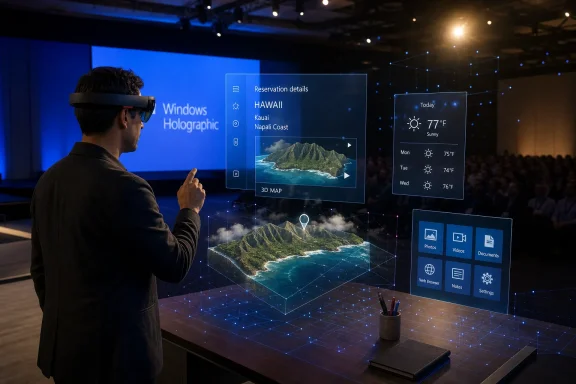 Microsoft Put Windows on Your Face Before the Market Was Ready
The most important thing about HoloLens was not that Microsoft had built an augmented-reality headset. It was that Microsoft introduced the headset as a Windows story.At a Windows 10 event, the natural expectation was a familiar parade of Start menu fixes, tablet-mode compromises, app-platform promises, and perhaps a few conciliatory gestures after the Windows 8 era. Microsoft delivered those things, but then it swerved into a category that still sounded like science fiction. HoloLens was pitched as a computer, not an accessory, and Windows Holographic was pitched as a native part of Windows 10 rather than a laboratory side project.
That framing mattered. Virtual reality at the time was largely being discussed as an immersive entertainment medium, with Oculus occupying the imagination of gamers and developers. Google Glass had already shown how awkward wearable computing could become when social acceptance, usefulness, and industrial design failed to line up. Magic Leap was teasing a cinematic dream but had not yet placed a product in the hands of ordinary developers.
Microsoft’s move was different because it tried to make augmented reality feel inevitable by attaching it to Windows. The company was effectively saying that spatial computing would not need to wait for a new operating system, a new developer culture, or a new computing metaphor invented elsewhere. It would arrive as an extension of the Windows platform.
That was bold, and maybe too bold. But it was also the kind of platform gamble Microsoft had to make. After missing the smartphone platform shift, Microsoft could not afford to treat the next possible computing interface as something to be watched from the sidelines.
The Untethered Headset Was the Real Demo
The stage language leaned heavily on “holograms,” but the more consequential claim was “untethered.” Microsoft said HoloLens needed no wires, no phone, and no connection to a PC. That separated it from the most visible headset efforts of the period, many of which relied on a powerful external machine or treated the headset as a display endpoint.An untethered AR headset has to solve several problems at once. It must understand the room, track the user’s head, place virtual objects convincingly into physical space, render graphics with low enough latency to avoid nausea or disorientation, and do all of that within the thermal and battery limits of something worn on a human head. That is not a minor engineering constraint. It is the product.
Microsoft’s answer was the Holographic Processing Unit, or HPU, a custom coprocessor intended to handle sensor fusion and environmental understanding. The HPU was the quiet admission that ordinary PC architecture was not enough. If a headset is going to map reality continuously, it needs dedicated silicon built around that job.
That choice foreshadowed much of the next decade of computing hardware. Apple, Google, Meta, and others would all lean harder into custom chips for machine learning, sensor processing, imaging, and low-power local intelligence. HoloLens was not only a headset announcement; it was an early public sign that ambient computing would be shaped by specialized processors as much as by operating systems.
The irony is that HoloLens was introduced as part of Windows 10, but its most interesting idea was not desktop Windows at all. It was Windows escaping the desktop by relying on a hardware stack that looked nothing like a conventional PC.
“Holographic” Was Marketing, but the Marketing Had a Job to Do
Microsoft’s use of the word “holographic” was technically slippery. The images shown through HoloLens were not holograms in the classic optical sense. They were rendered digital objects composited into the wearer’s view through a see-through display.But product language is rarely a physics lecture. “Augmented reality” already carried baggage by 2015. It evoked phone screens, QR markers, novelty demos, and half-working overlays that looked impressive in concept videos and underwhelming in everyday use. “Holographic” gave Microsoft a way to describe the same general ambition without dragging along the category’s disappointments.
That does not make the term harmless. When a company invokes holograms, it invites users to imagine Star Wars chessboards, volumetric projections, and digital objects everyone in the room can see. HoloLens did not do that. The illusion existed for the wearer, and only within the headset’s technical limits.
Still, the linguistic gamble was understandable. Microsoft needed a word that told mainstream viewers this was not VR and not Glass. “Holographic” was imprecise, but it pointed toward the product’s desired emotional effect: digital things appearing to occupy physical space.
This is where HoloLens was at its most Microsoft and least Microsoft at the same time. The company that had spent decades making productivity software suddenly tried to sell wonder. Yet it did so by naming APIs, processors, and platform invitations from the stage. Even the dream had an SDK-shaped outline.
HoloStudio Made the Case Better Than the Slogan
The HoloStudio demo was the right kind of theater. A user stood on stage and manipulated a 3D object in the air with hand gestures, as though the physical room had become a modeling workspace. The important point was not whether the model itself was useful. It was that the object appeared stable, anchored, and responsive enough to suggest a real interface.For AR, stability is credibility. A virtual object that jitters, slides, or drifts is not an object; it is a bug wearing a costume. Microsoft’s demo appeared to show convincing environmental tracking, and that mattered more than any single app.
HoloStudio also revealed the productivity-first bias of the product. Microsoft did not lead with a shooter, a roller coaster, or a social app. It led with creation. The user was not consuming a simulation but building something in a space that seemed shared between body, room, and machine.
That was clever because it aligned HoloLens with Microsoft’s institutional strengths. The company knows developers, designers, architects, engineers, and enterprise buyers. A headset that lets a designer inspect a model on a desk, a field worker see repair instructions on a machine, or a medical trainee examine anatomy in 3D is easier to fit into Microsoft’s sales motion than a consumer gadget asking people to wear goggles in the living room.
The demo also hinted at the eventual limitation. Creating in midair looks magical for five minutes, but serious work demands precision, comfort, repeatability, and software depth. The gap between a compelling stage demo and a daily tool is the gap every spatial-computing platform still has to cross.
Microsoft Invited Everyone Because It Needed Everyone
The invitation to Oculus, Magic Leap, Glass developers, and “everyone else” was not just magnanimity. It was an ecosystem recruitment pitch.Microsoft understood that hardware alone would not make HoloLens matter. An AR headset without applications is a sensor-laden curiosity. A platform without developers is a demo reel. By tying Windows Holographic APIs into Windows 10, Microsoft tried to lower the psychological barrier: developers were not being asked to bet on an isolated headset, but on Windows itself.
That was the same platform logic Microsoft had used for decades. The operating system becomes valuable because developers build for it, developers build for it because users have it, and users stay because the software catalog grows. HoloLens attempted to start that flywheel from the opposite end. The users were not there yet, so Microsoft had to sell developers on the size of the future.
This was a harder sell than it sounded. Developers can tolerate immature hardware if they believe the market is coming. They are less forgiving when device price, field of view, input methods, distribution, and audience size remain unclear. At reveal, Microsoft gave the world a vision, not a price sheet.
The company’s decision to frame Windows Holographic as a core Windows capability was therefore both strategic and defensive. It made HoloLens feel bigger than one device, but it also obscured the basic problem: developers still needed actual users wearing actual headsets for actual reasons.
The Windows 10 Moment Gave HoloLens Its Shine and Its Shadow
HoloLens arrived during a crucial reset for Microsoft. Windows 10 was meant to heal the fractures of Windows 8, unify form factors, and reassert Windows as a living platform rather than a legacy business. In that context, HoloLens served as proof that Microsoft still had a claim on the future.The reveal helped Satya Nadella’s Microsoft look less defensive. This was not the company clinging to the desktop while iOS and Android defined modern computing. This was Microsoft standing on a stage and showing a device that seemed ahead of nearly everyone else.
But the Windows 10 association also created a burden. Windows 10 was supposed to run everywhere: PCs, tablets, phones, Xbox, Surface Hub, embedded devices, and now holographic headsets. The universality was elegant in a slide deck, but messy in practice. Each form factor had different input models, power constraints, app expectations, and business realities.
HoloLens was the most ambitious expression of that universal-Windows idea. It was also the one that most clearly tested its limits. A spatial computer needs more than resizable Windows apps floating in a room. It needs software designed around depth, gaze, gestures, voice, mapping, and context.
Microsoft recognized that, at least in theory. Windows Holographic was not simply “desktop apps on glass.” But the gravitational pull of Windows as a legacy platform was always present. The risk was that HoloLens would become another endpoint in Microsoft’s platform taxonomy rather than the start of a new computing language.
Magic Leap Was the Unseen Rival in the Room
The Road to VR report captured the obvious comparison: Microsoft’s pitch sounded a lot like what Magic Leap had been teasing. That comparison was unavoidable in 2015 because Magic Leap had become the mysterious standard-bearer for cinematic augmented reality. It had funding, secrecy, and carefully managed awe.Microsoft had something else: a public device, a software platform, and a developer story. Even if HoloLens was not ready for consumers, its reveal punctured the idea that the AR future belonged only to stealth startups. Microsoft had walked onto a stage and shown the category to the world under its own brand.
That mattered competitively. In emerging markets, being first to define the language can be as important as being first to ship at scale. Microsoft attached “holographic computing” to Windows before Magic Leap could attach its own vocabulary to a broadly available product.
But beating a rival to the punch is not the same as beating the market. AR was, and remains, brutally difficult. The devices must be light, bright, powerful, socially acceptable, affordable, and useful. They must work in varied lighting, across diverse rooms, for users with different eyes and bodies. They must solve interaction without keyboards and mice while avoiding fatigue.
Microsoft’s reveal made Magic Leap look less alone. It did not make the category easy.
Enterprise Was Always the More Plausible Destination
Although the reveal had consumer spectacle, HoloLens always made more sense in enterprise. A headset that costs too much, looks unusual, and requires specialized applications can still succeed if it saves time in factories, training rooms, hospitals, or field service. It does not need to become a Christmas gift.That enterprise logic became clearer over time. HoloLens found its most credible uses in industrial workflows, remote assistance, visualization, and specialized training. These are environments where a device can be assigned, managed, cleaned, secured, and justified through productivity gains rather than personal desire.
For IT administrators, that changes the evaluation. The question is not whether HoloLens is cool. It is whether it can be enrolled, updated, locked down, supported, and integrated with identity and device-management policies. A headset is still an endpoint, and endpoints create operational work.
This is where Microsoft had an advantage over many AR hopefuls. The company could speak the language of Intune, Azure Active Directory, Windows Update for Business, kiosk modes, certificates, and compliance. That vocabulary is boring only until an organization has to deploy fifty headsets across a regulated workplace.
Yet enterprise credibility can also narrow a product’s cultural footprint. HoloLens may be remembered by the public as a futuristic headset that never became a household device. Inside certain industries, it may be remembered more pragmatically as an early mixed-reality tool that pointed toward useful workflows before the hardware economics caught up.
The Later HoloLens Story Complicates the Reveal
Looking back from 2026, the original HoloLens reveal has a melancholy edge. The first-generation device entered long-term servicing and stopped receiving security updates after December 2024. HoloLens 2 moved to Windows 11-based Windows Holographic releases, but its final feature release arrived in November 2024, with monthly security servicing continuing through the end of 2027.Microsoft’s own mixed-reality footprint has also contracted. Windows Mixed Reality was deprecated and removed from newer Windows 11 releases, and the broader consumer VR headset ecosystem around WMR effectively lost its place in mainstream Windows. That does not erase HoloLens, but it does change how the 2015 announcement reads.
At reveal, HoloLens looked like a bridge to a new Windows era. A decade later, it looks more like a technically impressive branch that did not become the trunk. Microsoft kept servicing enterprise customers, but the grand Windows Holographic platform story faded as the company redirected attention toward cloud, AI, and partnerships rather than owning the whole AR stack.
This is not unique to Microsoft. The entire AR market has moved more slowly than its evangelists predicted. Magic Leap’s consumer mystique gave way to enterprise repositioning. Google Glass became an enterprise device after its consumer backlash. Meta spent billions pushing VR and mixed reality into the mainstream with uneven results. Apple entered the category with Vision Pro, but even that arrived as an expensive, carefully bounded product rather than a mass-market replacement for the PC.
HoloLens was early enough to look visionary and early enough to suffer from being early.
The Real Legacy Is Spatial Ambition, Not Sales Volume
The mistake is to judge HoloLens only by whether it became the next Windows PC. It did not. But that was always an implausibly high bar.The more useful measure is whether HoloLens clarified problems the industry still has to solve. On that score, the device mattered. It showed that inside-out tracking, environmental mapping, hand gestures, spatial audio, and standalone mixed-reality computing could be packaged into a serious product years before the broader market was ready to normalize the category.
It also exposed the limits of platform declarations. Microsoft could announce Windows Holographic, but it could not decree a mature application ecosystem into existence. It could build impressive hardware, but it could not make the headset light enough, cheap enough, and broadly useful enough for ordinary buyers in 2015.
That tension is familiar across Microsoft history. The company often identifies important categories early, builds credible technology, and then struggles to turn the first version into a durable mass-market platform. Tablet PCs before the iPad, Windows Mobile before the smartphone explosion, Surface before the modern 2-in-1 category matured, and HoloLens before spatial computing had a clear consumer shape all fit somewhere in that pattern.
HoloLens deserves credit for ambition. It also deserves scrutiny for the gap between ambition and ecosystem reality. The reveal was not vaporware, but neither was it the beginning of a consumer revolution. It was a working thesis in hardware form.
The Headset Asked Windows Developers to Think in Space
For developers, the most radical part of HoloLens was not the display. It was the demand to think spatially.Traditional Windows development assumes windows, controls, input focus, files, and screens. HoloLens asked developers to consider surfaces, rooms, gaze, gestures, occlusion, anchors, and sound fields. A button could exist on a wall. A model could sit on a table. An instruction could appear next to the component being repaired.
That is a different mental model. It is also a harder one to generalize. A 2D app can run on countless monitors with predictable abstractions. A spatial app has to account for messy reality: cluttered rooms, moving people, reflective surfaces, poor lighting, user fatigue, and safety.
Microsoft’s developer invitation therefore carried an implicit challenge. Building for HoloLens was not simply porting an app. It required deciding whether an application genuinely benefited from being spatial. Many did not.
That remains the central discipline for mixed reality. The best uses are not the ones that put floating screens everywhere. They are the ones where spatial placement changes the task: training in context, visualizing scale, guiding hands, collaborating around a shared model, or seeing information where a monitor would be impractical.
HoloLens forced that conversation earlier than most companies were ready to have it.
The HoloLens Reveal Still Reads Like a Warning Label for Platform Hype
The 2015 announcement was exhilarating because it compressed the future into a stage demo. But stage demos have a way of hiding the duller, more important questions. How long does the battery last? How wide is the field of view? How comfortable is it after an hour? How much does it cost? How many developers will build native experiences? How does IT support it over five years?Those questions are not cynical. They are the difference between a magical prototype and a computing platform. HoloLens was a reminder that new interfaces do not win because they are new. They win when they become better enough at specific jobs to survive procurement, habit, and fatigue.
The same lesson now applies to every spatial-computing pitch in the market. Whether the logo on the headset belongs to Microsoft, Meta, Apple, Magic Leap, or someone else, the burden is the same. The product must justify the act of wearing a computer on one’s face.
Microsoft’s reveal also warned against confusing naming with adoption. “Holographic” made for memorable marketing, but the word could not carry the platform by itself. Users eventually judge the experience, not the noun.
That may be the most durable lesson for Windows watchers. Microsoft is at its best when it turns difficult infrastructure into ordinary capability. It is at its weakest when the platform story runs ahead of the lived product.
The 2015 Surprise Looks Smaller Now, but Smarter
The strange thing about revisiting HoloLens in 2026 is that the device feels both less revolutionary and more prescient. Less revolutionary because it did not remake personal computing. More prescient because almost every major computing company now talks, in one form or another, about cameras, sensors, AI, spatial context, wearable displays, and computing that understands the world around the user.HoloLens anticipated that direction. It did not own it.
Its emphasis on local sensing looks especially relevant in an AI-heavy era. A headset that understands the world is not merely a display; it is a machine perception platform. The HPU was an early answer to a question that has become central across devices: how much intelligence should happen locally, close to the sensor, before anything reaches the cloud?
The answer is increasingly “more than we used to think.” Latency, privacy, reliability, and bandwidth all push computation toward the edge. HoloLens was built around that premise before edge AI became a standard phrase in product briefings.
The reveal also anticipated the blending of input modes. Voice, hand gestures, head tracking, and spatial audio were not gimmicks; they were attempts to replace the mouse-keyboard-touch hierarchy with something more natural in 3D space. The industry is still searching for the right mix, but the search looks less eccentric now than it did in 2015.
The Windows Holographic Bet Left These Lessons Behind
HoloLens is best understood as a serious platform bet that produced real technology, real enterprise deployments, and real lessons, even if it never became the mass-market Windows endpoint Microsoft once seemed to imagine. The announcement still matters because it shows how far Microsoft was willing to stretch Windows at a moment when the company needed to prove it could do more than defend the PC.- Microsoft’s most consequential claim was that HoloLens was untethered, because standalone spatial computing required a fundamentally different hardware architecture from PC-connected headsets.
- The “holographic” branding was technically loose, but it helped Microsoft escape the stale expectations attached to early augmented reality.
- Windows Holographic made HoloLens a platform argument, not just a device launch, and that raised the stakes for developers and IT administrators.
- The enterprise path was always more credible than the consumer path because specialized workflows can justify expensive and unusual hardware.
- The later retreat of Windows Mixed Reality shows that a compelling demo does not guarantee a durable ecosystem.
- HoloLens still influenced the industry by proving that inside-out tracking, spatial mapping, and dedicated sensor processing could live inside a standalone headset.
References
- Primary source: Road to VR
Published: 2026-06-10T12:20:07.990378
Loading…
roadtovr.com - Related coverage: techcrunch.com
Loading…
techcrunch.com - Official source: learn.microsoft.com
Features and functionality removed in Windows client
In this article, learn about the features and functionality that have been removed or replaced in Windows client.learn.microsoft.com - Official source: news.microsoft.com
Loading…
news.microsoft.com - Related coverage: geekwire.com
Loading…
www.geekwire.com - Related coverage: pcworld.com
Loading…
www.pcworld.com
- Related coverage: pcgamesn.com
Loading…
www.pcgamesn.com - Related coverage: fortune.com
Loading…
fortune.com - Related coverage: macrumors.com
Loading…
www.macrumors.com - Related coverage: windowscentral.com
Loading…
www.windowscentral.com - Related coverage: time.com
Loading…
time.com - Related coverage: techradar.com
10 products that launched at Microsoft Build — and what happened to them
From Windows 8 to Copilot, here’s everything that was born at Buildwww.techradar.com
- Related coverage: phys.org
Loading…
phys.org - Related coverage: msftstories.thesourcemediaassets.com
Loading…
msftstories.thesourcemediaassets.com