

Microsoft's recent public push on high-temperature superconductors (HTS) for datacenter power delivery is a striking mix of promise and prudence: the company is signaling serious interest in a technology that could radically increase power density and reduce transmission losses, while simultaneously acknowledging the long list of technical, economic, and supply-chain hurdles that make broad deployment a multi-year, high-risk proposition.
High-temperature superconductors are materials that, when cooled with cryogens such as liquid nitrogen, exhibit near-zero electrical resistance and therefore enable effectively lossless power transmission. In practical terms for datacenters, HTS cables and busbars can move much larger currents through much smaller physical conduits than copper or aluminum, potentially reducing cable routing volume, lowering heat dissipation, and enabling higher compute density per square meter.
Microsoft publicly framed this potential in a February 10, 2026 Azure blog post authored by Alistair Speirs, General Manager of Global Infrastructure Marketing, positioning HTS as a technology that could help datacenter operators "meet the growing demand for power and improve operational sustainability." The company has also backed real-world HTS development: Microsoft’s Climate Innovation Fund participated in a $75 million Series B for VEIR (stylized VEIR or Veir), a U.S. firm focused on superconducting power delivery, and VEIR in November 2025 demonstrated a single HTS cable delivering 3 megawatts in a simulated datacenter environment.
These announcements are noteworthy because they move HTS from laboratory curiosity toward applied demonstrations targeted squarely at one of the fastest-growing draws on grid capacity—AI-scale datacenters. Yet the reality is that HTS remains an emerging, capital-intensive, and operationally complex technology. For datacenter architects and operations leaders, the question is not whether HTS is interesting—it is—but whether it is actionable at the scale, cost, and reliability that commercial datacenter operations demand.
These are real and important technical milestones: moving multi-megawatt levels of power through a compact HTS system at the voltages relevant to datacenter distribution is not trivial. VEIR also described prototype systems capable of operating up to hundreds of volts (VEIR mentioned up to 800 V in some technical summaries), and suggested potential paths to commercialization in 2026. Microsoft, for its part, has been explicit that HTS remains in testing, validation, and evaluation stages for adoption at its global scale.
However, the environmental calculus must include the full lifecycle:
But promising demos do not equate to immediate, mass-market utility. HTS remains a high-capital, technically demanding solution that will be adopted first where its unique benefits outweigh the costs and complexity: constrained urban builds, extraordinarily dense AI racks, and greenfield projects designed around the technology. Datacenter operators should watch developments closely, run disciplined pilots, and avoid blanket assumptions of near-term wholesale replacement of copper infrastructure.
In short: HTS is not a fantasy solution destined only to appease critics of datacenter scale—it is a plausible next step in power delivery, but one that will require careful engineering, scaled manufacturing, rigorous lifecycle economics, and operational discipline before it transforms the datacenter landscape.
Source: theregister.com Microsoft touts immature HTS tech for datacenter efficiency
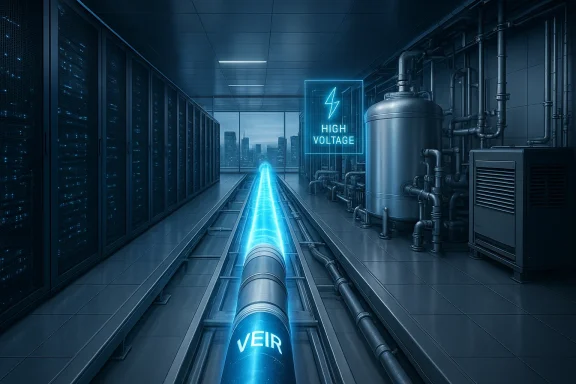 Background / Overview
High-temperature superconductors are materials that, when cooled with cryogens such as liquid nitrogen, exhibit near-zero electrical resistance and therefore enable effectively lossless power transmission. In practical terms for datacenters, HTS cables and busbars can move much larger currents through much smaller physical conduits than copper or aluminum, potentially reducing cable routing volume, lowering heat dissipation, and enabling higher compute density per square meter.Microsoft publicly framed this potential in a February 10, 2026 Azure blog post authored by Alistair Speirs, General Manager of Global Infrastructure Marketing, positioning HTS as a technology that could help datacenter operators "meet the growing demand for power and improve operational sustainability." The company has also backed real-world HTS development: Microsoft’s Climate Innovation Fund participated in a $75 million Series B for VEIR (stylized VEIR or Veir), a U.S. firm focused on superconducting power delivery, and VEIR in November 2025 demonstrated a single HTS cable delivering 3 megawatts in a simulated datacenter environment.
These announcements are noteworthy because they move HTS from laboratory curiosity toward applied demonstrations targeted squarely at one of the fastest-growing draws on grid capacity—AI-scale datacenters. Yet the reality is that HTS remains an emerging, capital-intensive, and operationally complex technology. For datacenter architects and operations leaders, the question is not whether HTS is interesting—it is—but whether it is actionable at the scale, cost, and reliability that commercial datacenter operations demand.
Why HTS is attractive to datacenters
Power density and footprint savings
One of the most tangible HTS benefits is sheer power density. Superconducting conductors can carry many times the current of equivalent copper conductors without resistive losses or heating. For datacenter projects constrained by cable routing, ceiling and underfloor space, or right-of-way for feeders, that density translates into fewer physical feeders and smaller electrical corridors.- HTS enables higher current in a smaller cross-sectional area than copper.
- Reduced heating from cables eases demands on datacenter HVAC and can reduce local thermal hotspots.
- Smaller routing needs can speed construction and reduce civil works costs in constrained urban sites.
Reduced transmission losses
Resistive losses in conventional copper and aluminum conductors are real and accumulate across long runs and high currents. HTS eliminates resistive losses within its operating temperature envelope, which can reduce power consumed purely to overcome line losses—an attractive proposition when operators measure energy efficiency in PUE reductions and carbon accounting.Increased design flexibility
With higher power density, designers can rethink campus power layouts: fewer feeders or the ability to bring much higher power to specific racks or pods without building larger substations. Microsoft framed this as breaking the classic trade-offs between substation expansion, added feeders, or lowered rack density.What VEIR and Microsoft have actually demonstrated
VEIR’s November 2025 "STAR" demonstration transmitted 3 MW through a single low-voltage HTS cable in a simulated datacenter environment, claiming up to 10× the power in the same footprint compared to traditional cables. Microsoft’s Azure team has used that and similar developments to explain why HTS deserves evaluation as part of future infrastructure strategies.These are real and important technical milestones: moving multi-megawatt levels of power through a compact HTS system at the voltages relevant to datacenter distribution is not trivial. VEIR also described prototype systems capable of operating up to hundreds of volts (VEIR mentioned up to 800 V in some technical summaries), and suggested potential paths to commercialization in 2026. Microsoft, for its part, has been explicit that HTS remains in testing, validation, and evaluation stages for adoption at its global scale.
The hard realities: cost, manufacturing, and cooling
HTS is not a free lunch. The technology’s advantages come with three interlinked penalties: high materials and manufacturing cost, specialized cryogenic cooling infrastructure, and supply-chain constraints for HTS wire.Capital costs and LTC (lifecycle cost) debates
Multiple industry analyses and pilots show that HTS installations can have significantly higher upfront capital costs than copper equivalents. The superconducting conductor itself is expensive, and the associated cryogenic infrastructure for continuous operation adds both CAPEX and OPEX.- The conductor architecture and cryostat fabrication are capital-intensive.
- Cryogenic plant design, redundancy, and long-term serviceability add to lifecycle cost.
- Early demonstrations and market reports show HTS systems can be multiple times the capital cost of conventional busbars or cables for the same function.
Cooling: liquid nitrogen, cryostats, and operational complexity
HTS materials operate at high cryogenic temperatures relative to older superconductors—typically in the liquid nitrogen range (~77 K) rather than liquid helium temperatures. Liquid nitrogen is cheaper and easier than helium, but a persistent cryogenic system still introduces operational complexity:- Continuous refrigeration, thermal cycling risks, and cryostat maintenance are new operational domains for datacenter teams.
- Failure modes differ: cryogenic system failures can instantly defeat superconductivity and change the electrical characteristics of installed cables in ways that must be safely managed.
- Redundancy is non-trivial: operators will demand failover strategies, bypass paths, and protection systems that add further cost and design complexity.
Manufacturing scale and material constraints
HTS wire manufacturing requires advanced processes (e.g., coated conductors, IBAD/PLD chambers) and high yields. Building sufficient global capacity to supply thousands of datacenter racks or multiple campuses will need major industrial scale-up.- Specialized manufacturing equipment costs millions per production line and requires long lead times.
- Yields and quality control for long, defect-free conductor lengths are challenging.
- The global supply chain for HTS wire and cryogenic components is limited and geographically concentrated.
Technical and integration challenges for datacenter environments
Voltage and protection coordination
Datacenter power systems are optimized for specific voltage levels, busbar architectures, and protective devices. Integrating HTS into these systems requires careful work:- Low-voltage HTS systems may operate at rack distribution voltages, but integrating at medium-voltage or substation levels introduces insulation, switchgear, and protection coordination challenges.
- HTS behaves differently when quenched (loses superconductivity) and needs protection schemes that can safely handle rapid changes in impedance and fault currents.
- Standards and protective device compatibility are still evolving; HTS introduces new test and certification requirements.
Reliability and maintainability
Mission-critical datacenters demand proven reliability and well-understood maintenance regimes. HTS changes the failure landscape:- Cryogenic systems require preventive maintenance cycles and skilled technicians.
- Failure modes include cryocooler malfunctions, vacuum breaches, and mechanical damage to cryostats—issues not present with copper cables.
- Repair interventions may be more complex and time-consuming, especially for buried or routed HTS assemblies.
Real-world deployment complexity
Demonstrations typically occur in controlled environments. Translating a 3 MW laboratory or simulated demo into a live, multi-MW datacenter installation raises questions:- Cable routing over long distances, terminations, connectors, and feed-throughs across building partitions are all non-trivial.
- Interfacing with existing substations, utility agreements, and local permitting for cryogenic systems may slow adoption.
- Long lifecycle and retrofit considerations: can HTS be retrofitted into existing campuses cost-effectively, or is it primarily a feature of greenfield designs?
Environmental and social footprint: trade-offs and unknowns
Microsoft’s statements emphasize the potential to reduce the physical and social footprint of power infrastructure by decreasing land take and enabling more compact designs. There is merit to that claim: HTS can reduce above-ground cabling, trenching, and substation expansion in constrained urban sites, thereby lowering construction impacts and permitting friction.However, the environmental calculus must include the full lifecycle:
- HTS fabrication uses rare and energy-intensive processes; the embedded carbon footprint of HTS wire and cryostats is non-trivial.
- Cryogenic cooling consumes power continually; while superconductivity reduces resistive losses, the cooling penalty must be subtracted in a lifecycle analysis.
- End-of-life handling of HTS materials and cryogenic fluids introduces recycling and disposal considerations that are not yet standardized.
Commercial readiness and timelines: cautious optimism
VEIR’s demo and Series B financing are important steps toward commercialization—VEIR stated movement toward full commercialization in 2026. Microsoft’s Azure team and its investment partner status show serious interest. Still, broad adoption across global datacenter operations faces typical scaling friction:- Proof-of-concept demonstrations (completed).
- Small-scale pilot integrations in live datacenters (next step for risk mitigation).
- Standards and codes closure for MV/HV HTS terminations, protection, and safety (ongoing; IEC and industry working groups are active).
- Manufacturing scale-up and supply-chain confirmation.
- Cost parity or compelling TCO in targeted scenarios.
Risks that datacenter operators should weigh
- Capital and operating cost uncertainty: Early HTS deployments will carry premium costs for wire, cryogenics, and skilled O&M.
- Operational complexity and skills gap: Datacenter teams must acquire cryogenic, superconductivity, and HTS-specific protection expertise, or contract specialized vendors.
- Standards and certification lag: Protection devices, switchgear, and terminations require industry-standard testing and proven field reliability before becoming mainstream.
- Supply-chain concentration: Limited manufacturing capacity for HTS wire and cryogenic systems presents geopolitical and lead-time risks.
- Failure-mode unfamiliarity: While HTS systems are engineered to fail safely, the practical consequences of quench events and cryocooler failure in live datacenters must be fully understood and tested under operational conditions.
- Uncertain total environmental benefit: Lifecycle analyses may flip based on electricity mix, production footprints, and future improvements in wire manufacturing efficiency.
What success looks like: realistic use cases for early adoption
Not every datacenter or campus will benefit from HTS. Reasonable early-adopter scenarios include:- Urban or constrained sites where widening conduits, adding feeders, or expanding substations is prohibitively expensive or socially contentious.
- High-density AI facilities where per-rack power demands push conventional power distribution to practical limits.
- New greenfield campuses where designers can bake HTS into the electrical design, rather than retrofit older busbar architectures.
- Utility-coupled projects that benefit from HTS at the transmission or substation interface to avoid costly high-voltage expansions.
Practical checklist for datacenter decision-makers
If you are evaluating HTS for a project, a pragmatic procurement and technical roadmap might look like:- Define the precise pain point: is it feeder routing, substation capacity, thermal constraints, or regulatory right-of-way?
- Build a small-scale pilot plan with clear performance, safety, and TCO metrics, and reserve enough time for multiple test cycles.
- Assess vendor maturity: review manufacturing capacity, quality control metrics, and field references.
- Engage protection and switchgear vendors early to align on quench detection, fault coordination, and safe bypass strategies.
- Prepare operations teams: include cryogenic maintenance, emergency procedures, and vendor support contracts in SLAs.
- Conduct a lifecycle environmental and cost assessment using your actual electricity mix and realistic cryogenic plant efficiency numbers.
- Lock in long-term spare parts and supply agreements to mitigate lead-time and vendor concentration risks.
- Consider risk transfer mechanisms—insurance and contractual warranties for early-stage technology deployments.
Industry outlook and implications for the grid
HTS is part of a broader modernization pressure on grids and datacenters caused by AI-driven compute demand. If HTS reaches cost-effective maturity:- Datacenters could become denser and more modular, changing site selection economics.
- Utilities and transmission operators may deploy HTS in urban corridors to avoid costly tunneling or substation expansion.
- Material markets for HTS wire and cryogenic components will grow, lowering per-unit costs over time—but only if demand and manufacturing scale-up occur together.
Conclusion: promise matched to pragmatism
Microsoft’s public exploration of HTS and its partnership with VEIR signal that superconducting power delivery has moved past theory and into applied engineering for datacenters. The value proposition—higher power density, lower resistive losses, and smaller infrastructure footprints—is compelling, particularly for the ultra-high-power, tightly constrained facilities that host large AI workloads.But promising demos do not equate to immediate, mass-market utility. HTS remains a high-capital, technically demanding solution that will be adopted first where its unique benefits outweigh the costs and complexity: constrained urban builds, extraordinarily dense AI racks, and greenfield projects designed around the technology. Datacenter operators should watch developments closely, run disciplined pilots, and avoid blanket assumptions of near-term wholesale replacement of copper infrastructure.
In short: HTS is not a fantasy solution destined only to appease critics of datacenter scale—it is a plausible next step in power delivery, but one that will require careful engineering, scaled manufacturing, rigorous lifecycle economics, and operational discipline before it transforms the datacenter landscape.
Source: theregister.com Microsoft touts immature HTS tech for datacenter efficiency
