

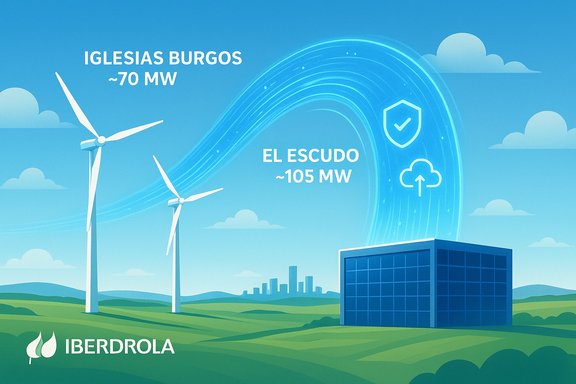
Microsoft’s expansion of a strategic partnership with Iberdrola — combining two Spain-based wind PPAs with deeper Azure, Copilot and AI deployments across the energy group — is a pragmatic example of the tech-energy convergence reshaping how hyperscalers and utilities manage the environmental footprint of cloud and AI growth. The deal covers two long-term power purchase agreements (PPAs) for a combined 150 MW of onshore wind in Spain (the 70 MW Iglesias project in Burgos and the 105 MW El Escudo project in Cantabria), plus an expanded technology pact that will see Iberdrola increase use of Microsoft Azure and deploy Microsoft Copilot and security/compliance tooling across its operations. For Microsoft, the move extends an existing relationship with Iberdrola’s US subsidiaries and adds another European supply pillar as it pursues its 100/100/0 clean-energy vision while wrestling with surging energy demand from AI and data-centre build-out.
The partnership was announced in mid-December 2025, building on a multi-year commercial relationship between the two groups. Iberdrola has already migrated critical systems to Azure and has previously supplied power to Microsoft via Avangrid in the United States. The new Spanish PPAs are the first Microsoft–Iberdrola deals signed in Europe and join three earlier Avangrid agreements that together represent roughly 500 MW of contracted capacity across the US and Europe.
This collaboration is more than a merchant electricity purchase. It combines energy procurement, digital transformation and AI adoption into a single strategic engagement: Microsoft secures incremental renewable supply while Iberdrola deepens its digital and AI capabilities using Azure, Copilot and Microsoft security/compliance stacks. Both companies frame the alliance as a way to align rapid growth in electricity consumption with accelerated decarbonisation commitments.
The timing matters. Microsoft’s publicly stated ambition — its 100/100/0 vision — is to match 100% of its electricity consumption, 100% of the time, with zero-carbon energy by 2030. That level of time‑synchronous, regional matching is a far more demanding goal than simply signing enough PPAs to cover annual energy use. Microsoft’s latest environmental reporting shows a dramatic rise in energy demand since 2020 — a roughly 168% increase — driven largely by AI and cloud expansion, even as the company reports progress across other sustainability programs. This deal with Iberdrola is one incremental answer to the supply-side challenge.
Key technical constraints:
Practical steps:
Strengths of the agreement include supply diversification, closer tech-energy collaboration and the explicit exploration of storage, hydrogen and heat reuse. These are practical moves that improve the bankability and systemic integration of new renewables. But the deal is also emblematic of the larger limits of voluntary corporate action: PPAs, absent firming and time-matching, do not automatically equal hour‑for‑hour zero-carbon operations, and companies must be transparent about what procurement achieves.
For IT leaders and enterprises, the lesson is actionable: decarbonisation in the era of AI requires integrated strategies. Combine smarter procurement (time-aware where possible), workload efficiency, vendor engagement and operational innovations like heat reuse and on-site flexibility. Deals like Microsoft’s with Iberdrola move the needle; the hard work will be operationalising hourly matching at scale and ensuring the growth of AI services does not outpace the real-world pace of grid decarbonisation. The partnership is an important step in that direction — significant, measurable, and above all pragmatic — but it is one step among many needed to reconcile rapid digital growth with genuine, verifiable climate outcomes.
Source: edie.net Microsoft and Iberdrola partner on solar power and AI solutions - edie
 Background / Overview
The partnership was announced in mid-December 2025, building on a multi-year commercial relationship between the two groups. Iberdrola has already migrated critical systems to Azure and has previously supplied power to Microsoft via Avangrid in the United States. The new Spanish PPAs are the first Microsoft–Iberdrola deals signed in Europe and join three earlier Avangrid agreements that together represent roughly 500 MW of contracted capacity across the US and Europe.This collaboration is more than a merchant electricity purchase. It combines energy procurement, digital transformation and AI adoption into a single strategic engagement: Microsoft secures incremental renewable supply while Iberdrola deepens its digital and AI capabilities using Azure, Copilot and Microsoft security/compliance stacks. Both companies frame the alliance as a way to align rapid growth in electricity consumption with accelerated decarbonisation commitments.
The timing matters. Microsoft’s publicly stated ambition — its 100/100/0 vision — is to match 100% of its electricity consumption, 100% of the time, with zero-carbon energy by 2030. That level of time‑synchronous, regional matching is a far more demanding goal than simply signing enough PPAs to cover annual energy use. Microsoft’s latest environmental reporting shows a dramatic rise in energy demand since 2020 — a roughly 168% increase — driven largely by AI and cloud expansion, even as the company reports progress across other sustainability programs. This deal with Iberdrola is one incremental answer to the supply-side challenge.
What the agreement actually contains
Energy procurement: two Spanish onshore PPAs
- Microsoft has contracted the electricity output from two Iberdrola wind projects in Spain:
- The Iglesias wind farm (Burgos) — ~70 MW.
- The El Escudo wind farm (Cantabria) — ~105 MW.
- Together these total 150 MW of contracted capacity and are being characterized as long-term PPAs.
- The Iberdrola projects are at advanced stages: El Escudo is a 105 MW development that Iberdrola lists as under construction with commissioning scheduled in 2025; Iglesias is a 70 MW onshore project using large modern onshore turbines and is being developed in Castilla y León.
Technology, AI and cloud: Azure, Copilot, security and compliance
- Iberdrola will extend its use of Microsoft’s Azure cloud and data/AI products and will deploy Microsoft Copilot across business functions.
- Microsoft technologies will be used to strengthen Iberdrola’s digital capabilities, accelerate AI implementation across the group, and improve security and regulatory compliance processes.
- The partnership notes exploration of joint solutions beyond PPAs: hydrogen, battery storage, waste-heat reuse from data centres (a specific concept referenced is using data‑centre heat in Zaragoza), electrified land/transport solutions, and other grid-scale innovations.
The broader PPA context
- These European PPAs join existing Microsoft agreements with Avangrid (Iberdrola’s US subsidiary) for Powell Creek Solar (Ohio), Camino Solar (California) and Juniper Canyon wind (Washington), which collectively point to a decade-long trend of corporate renewable contracting between the companies.
- Microsoft has been one of the largest corporate renewable buyers; the company reports tens of gigawatts of contracted carbon‑free energy across many countries. The Iberdrola expansion consolidates Microsoft’s regional renewable footprint in Europe.
Why this matters: strategic and operational implications
For Microsoft: supply diversification and regulatory optics
Microsoft needs both power and political cover to sustain fast AI-driven growth. These European PPAs help on three fronts:- They diversify contracted supply regionally, which is crucial for Microsoft’s 100/100/0 ambition that emphasizes time- and grid‑specific matching.
- They strengthen Microsoft’s renewables pipeline so it can claim additional carbon-free electricity procurement while it scales data centres and AI services.
- They provide a real-world testbed for exploring beyond-PPAs technologies (battery storage, hydrogen, heat reuse), which can help smooth intermittency and provide additional grid services that are vital for time-matching.
For Iberdrola: digital transformation and new revenue streams
Iberdrola benefits through:- An expanded commercial anchor customer for specific Spanish projects, improving project bankability.
- Deeper use of Azure and Copilot inside the energy business — speeding internal AI adoption to optimise operations, predictive maintenance, regulatory reporting and cyber-security posture.
- Access to a major global cloud partner’s engineering and product ecosystem, strengthening Iberdrola’s ability to innovate around distributed energy assets, storage and sector-coupling solutions.
For the energy transition and the market
- Corporate PPAs continue to act as a demand signal that unlocks capital for new renewables. Microsoft’s incremental purchases channel financing into projects that might otherwise face higher offtake risk.
- The tie-up underscores the practical limits of renewable procurement today: while companies can cover annual consumption with off-site renewables, 100/100/0 forces attention on hourly matching, storage, and grid decarbonisation.
- The inclusion of hydrogen, battery storage and heat reuse in the partnership language reflects a maturing corporate playbook: efficient AI operations will require integrated solutions, not just more wind and solar.
The technical challenge: why 100/100/0 is hard
The phrase “match 100% of consumption, 100% of the time, with zero-carbon energy” converts a simple annual procurement challenge into a system‑level engineering problem.Key technical constraints:
- Intermittency: Wind and solar output fluctuates hourly and seasonally. A PPA that delivers energy annually does not guarantee energy production in the specific hours when a data centre draws power.
- Grid mix and location: The physical electrons consumed by a data centre may still come from the local grid, whose generation mix can include fossil fuels. Market-based accounting (RECs, contractual instruments) and location-based accounting (actual grid mix) can produce differing sustainability claims.
- Storage and flexibility: Hourly matching at scale requires dispatchable zero-carbon resources, long-duration storage, demand-side flexibility, or some form of grid-level carbon-free scheduling — not merely more wind farms.
- Timescales: Building new generation or storage and re‑wiring regional grids are lengthy projects; corporate procurement signals help but do not instantly change the operational grid mix.
- Hourly or sub-hourly matching via storage + smart dispatch, or via contracts that specify delivery profiles that align with consumption patterns.
- Hybrid PPAs that combine intermittent generation with battery storage to firm output.
- Virtual power purchase agreements (VPPAs) and synthetic PPAs that enable internal power-schedule matching, albeit with accounting and additional market risk complexity.
- On-site generation where feasible, or procurement close to the load to reduce transmission losses and increase the chance of true grid decarbonisation.
AI, data centres, and escalating energy demand
AI services drive unique load characteristics that increase the strain on corporate sustainability plans:- Training large models is energy-intensive and often concentrated during high‑compute bursts. In contrast, inference at scale imposes steady but rising consumption.
- Microsoft reported a substantial increase in overall energy consumption driven by AI and cloud growth — an aggregated increase in the order of magnitude of 168% since 2020; the company describes this as a key operational challenge in its recent environmental reporting.
- Data centre cooling and water usage also come under pressure as processor densities increase. This intensifies interest in waste-heat recovery: using data-centre heat for district heating or industrial processes can improve overall system efficiency and generate local benefits.
Strengths of the partnership
- Integrated approach: Combining PPAs with cloud, AI and security services aligns energy procurement with operational decarbonisation and digital transformation.
- Supply diversification: Adding European PPAs reduces geographic concentration risk and helps Microsoft build regionally relevant renewable portfolios.
- Commercial scale and bankability: A major corporate buyer strengthens the viability of mid-scale European wind projects, accelerating grid-ready capacity.
- Operational improvements for Iberdrola: Using Azure and Copilot across Iberdrola’s businesses can accelerate predictive maintenance, improve regulatory reporting automation and reduce operational risk.
- Exploration of advanced solutions: Including hydrogen, battery storage and heat reuse acknowledges the need for multi-vector decarbonisation, not just more renewables.
Risks and potential weaknesses
- Time-matching limitation: Signing PPAs adds renewable energy to the system, but without explicit hourly matching or firming solutions, PPAs alone do not guarantee operational zero-carbon consumption at each hour.
- Accounting and perception risk: The difference between claims based on contractual instruments (RECs) versus actual on‑site grid carbon intensity can create credibility issues; critics argue that corporate renewable accounting can appear like window-dressing if not accompanied by system decarbonisation.
- Scale mismatch: Microsoft’s absolute energy demand from AI and data centres is enormous; incremental PPAs, even when aggregated across many suppliers, must scale rapidly to make a dent in hourly demand growth.
- Dependency on offsets and removals: If corporate net-zero narratives rely heavily on carbon removals or offsets rather than real, verifiable reductions and time-matched electricity, that invites reputational risk.
- Policy and incentive uncertainty: Changes in tax incentives, permitting delays for new renewables or grid upgrades, and local resistance can slow project timelines and affect the economics of corporate PPAs.
The geopolitics and market context
- Corporate procurement is reshaping renewable markets. Tech majors signing PPAs provide predictable demand for developers and can influence grid planning and storage deployment.
- Europe’s permitting environment and grid constraints remain a bottleneck for rapid renewable scale-up. Deals like these show demand-side willingness to invest, but building generation, transmission and storage infrastructure still requires coordinated policy action and long lead times.
- The energy transition’s intersection with AI growth creates a new lobbying vector: hyperscalers and utilities have aligned incentives to accelerate grid decarbonisation and storage deployment, potentially reshaping national energy priorities.
What enterprise IT leaders and WindowsForum readers should take from this
The Microsoft–Iberdrola partnership is not just corporate public relations — it signals practical strategies enterprises and IT teams can use as they modernise infrastructure and face increasing sustainability reporting obligations.Practical steps:
- Map energy-aware workloads: identify which services or clusters run AI/ML training and which are moderate-load inference systems.
- Choose cloud regions thoughtfully: prefer cloud regions and providers with stronger commitments to time-matched renewable supply and visible decarbonisation roadmaps.
- Use vendor sustainability features: enable provider sustainability dashboards and reporting tools to track emissions and consumption accurately.
- Prioritise efficiency in software and infrastructure: optimise models, use lower‑precision computing where acceptable, and schedule heavy training jobs for times of lower carbon intensity where feasible.
- Engage on procurement options: where material, negotiate clauses with cloud providers that reflect time-of-day matching, or seek options for storage-backed, time‑firmed renewable supply.
- Explore heat reuse and on-site solutions where practical: co‑locate workloads with opportunities for waste‑heat capture and industrial symbiosis.
- Ensure disclosures are robust: demand clarity on whether renewables are accounted for via market-based instruments, time-matched schedules, or location-based metrics.
What to watch next
- Commissioning milestones for the Iglesias (70 MW) and El Escudo (105 MW) projects — Iberdrola expects near-term commissioning activity, and project completion dates will determine when contracted energy becomes deliverable.
- Whether Microsoft pursues additional time-matching or firming mechanisms for European consumption, such as battery-backed PPAs, VPPAs with explicit hourly attributes, or on-site generation for key campuses.
- Pilots for waste-heat reuse (for example, Zaragoza), plus any demonstration projects combining hydrogen or battery storage with data-centre operations.
- Regulatory developments affecting renewable incentives and corporate PPA economics across EU member states.
- Additional transparency from both parties on contract structure and on how these PPAs will be used within Microsoft’s hour-by-hour matching strategy toward 100/100/0.
Final assessment: pragmatic progress, not a silver bullet
The expanded Microsoft–Iberdrola partnership is a pragmatic, multi-dimensional response to a clear problem: AI-driven growth has materially increased electricity demand, and corporates must blend procurement, technology and grid innovation to decouple growth from emissions.Strengths of the agreement include supply diversification, closer tech-energy collaboration and the explicit exploration of storage, hydrogen and heat reuse. These are practical moves that improve the bankability and systemic integration of new renewables. But the deal is also emblematic of the larger limits of voluntary corporate action: PPAs, absent firming and time-matching, do not automatically equal hour‑for‑hour zero-carbon operations, and companies must be transparent about what procurement achieves.
For IT leaders and enterprises, the lesson is actionable: decarbonisation in the era of AI requires integrated strategies. Combine smarter procurement (time-aware where possible), workload efficiency, vendor engagement and operational innovations like heat reuse and on-site flexibility. Deals like Microsoft’s with Iberdrola move the needle; the hard work will be operationalising hourly matching at scale and ensuring the growth of AI services does not outpace the real-world pace of grid decarbonisation. The partnership is an important step in that direction — significant, measurable, and above all pragmatic — but it is one step among many needed to reconcile rapid digital growth with genuine, verifiable climate outcomes.
Source: edie.net Microsoft and Iberdrola partner on solar power and AI solutions - edie
