

Microsoft’s move to build first‑party AI models — branded MAI — marks a decisive shift from the company’s years‑long dependence on OpenAI and signals a new chapter in the Copilot era where speed, cost and governance are as important as capability.
Microsoft has publicly announced a new slate of in‑house models under the MAI umbrella, including a speech generation system called MAI‑Voice‑1 and a foundational language model released as MAI‑1‑preview, alongside image and multimodal variants being tested in labs and public leaderboards. These models are already appearing inside Microsoft’s Copilot experiences — powering news recaps, podcast‑style audio, and early Copilot Labs demos — while Microsoft positions MAI as a strategic hedge that gives it optionality beyond OpenAI-supplied models. This report explains what Microsoft announced, verifies technical and contractual claims where possible, analyzes the strategic rationale, and highlights the practical implications and risks for Windows users, enterprises and the wider cloud‑AI market.
Microsoft’s announcement of MAI is consequential: it changes the balance of power in the cloud‑AI era and reframes the Microsoft‑OpenAI relationship, while offering customers new tradeoffs between capability, cost and control. The next steps to watch are clear — independent benchmarks, published model cards, and the first large‑scale enterprise deployments that prove MAI’s claims in production. Until then, treat Microsoft’s technical headlines as meaningful signals, but verify them before committing mission‑critical systems to any single model.
Source: AOL.com Microsoft is making its own AI models to compete with OpenAI. Meet MAI
 Background / Overview
Microsoft has publicly announced a new slate of in‑house models under the MAI umbrella, including a speech generation system called MAI‑Voice‑1 and a foundational language model released as MAI‑1‑preview, alongside image and multimodal variants being tested in labs and public leaderboards. These models are already appearing inside Microsoft’s Copilot experiences — powering news recaps, podcast‑style audio, and early Copilot Labs demos — while Microsoft positions MAI as a strategic hedge that gives it optionality beyond OpenAI-supplied models. This report explains what Microsoft announced, verifies technical and contractual claims where possible, analyzes the strategic rationale, and highlights the practical implications and risks for Windows users, enterprises and the wider cloud‑AI market.What Microsoft announced
The MAI family: headline models and product tie‑ins
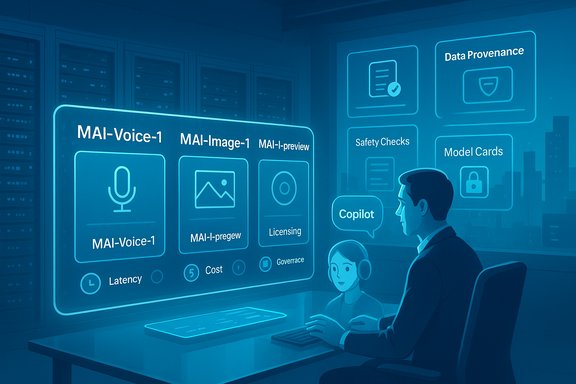
Microsoft’s public materials and product pages describe the initial MAI lineup like this:- MAI‑Voice‑1 — a high‑fidelity speech generation model Microsoft says can synthesize one minute of audio in under a second on a single GPU. It’s already integrated into Copilot Daily and Copilot Podcasts and is available to try in Copilot Labs.
- MAI‑1‑preview — described as a mixture‑of‑experts (MoE) foundation model that Microsoft says was pre‑ and post‑trained on roughly 15,000 NVIDIA H100 accelerators. Microsoft is exposing MAI‑1‑preview in public blind comparisons (e.g., LMArena) and to trusted testers through API access, with limited Copilot rollouts for early text use‑cases.
- MAI‑Image‑1 and other multimodal variants — Microsoft has also showcased in‑house image generation models and multimodal tooling that are being integrated into Bing, Microsoft Designer and Copilot flows, and which have appeared on public preference leaderboards.
Where MAI sits in Microsoft’s stack
Microsoft frames MAI as part of a broader “multi‑model orchestration” strategy: route requests to the best model for the task (OpenAI frontier models where depth matters, MAI where latency/cost/governance matter, and third‑party models where specialization is useful). This is aimed at lowering inference cost, reducing latency in interactive flows, and offering tighter enterprise controls for data and telemetry.Technical claims: what’s verifiable and what isn’t
Microsoft has made concrete technical claims about performance and training scale. Those claims deserve independent scrutiny.MAI‑Voice‑1: the latency and throughput claim
Microsoft says MAI‑Voice‑1 can generate a minute of audio in under one second on a single GPU, and emphasizes the model’s efficiency in product demos. This is a striking performance benchmark if measured consistently — it implies exceptionally low‑cost, high‑throughput speech synthesis that materially changes the economics of audio generation inside consumer apps. Microsoft’s product pages and initial press reports repeat this figure. However, independent, reproducible benchmarks from third‑party researchers or academic papers are not yet available in the public domain. The one‑second figure should therefore be treated as a vendor performance claim that is plausible given modern optimizations (model quantization, efficient decoding, and short autoregressive windows), but still unverified until independent benchmarking or a technical engineering write‑up is published. Readers should expect latency to vary by audio quality, voice complexity, sampling rate, model quantization and hardware generation. Treat the claim as promising but provisional.MAI‑1‑preview and the 15,000 H100s claim
Microsoft describes MAI‑1‑preview as a MoE model pre‑ and post‑trained on about 15,000 NVIDIA H100 GPUs. A training‑scale headline like this matters because training compute is a major input to a model’s ceiling of capability. Microsoft’s materials and several press outlets repeat the figure, which gives a sense of the investment scale behind MAI. That said, the raw GPU count is an engineering shorthand that does not by itself tell the whole story: it omits details on effective FLOPs, training steps, dataset curation, post‑training alignment work, mixture‑of‑experts routing ratios and evaluation methodology. Until Microsoft publishes a reproducible training recipe, model cards and third‑party benchmarks, the precise capability implications of “15,000 H100s” remain a company‑provided metric rather than a fully verifiable performance guarantee. Independent media have flagged the number as a company assertion that looks credible but requires more transparency to be fully assessed.LMArena and crowd preference results
Microsoft is allowing MAI‑1‑preview (and MAI‑Image‑1) to appear on public comparison sites like LMArena, where human voters rank outputs. Early placements on such leaderboards are useful signals about preference and aesthetic quality, but they are not substitutes for reproducible, adversarially robust benchmarks that measure hallucinations, safety, bias and worst‑case failures. Treat leaderboard results as one (useful) data point among many.Why Microsoft is building MAI: strategic rationale
Optionality, cost and product SLAs
For years Microsoft’s rapid productization of generative AI relied heavily on OpenAI frontier models. That partnership delivered major wins, including Copilot, Bing Chat integrations and improved perception of Azure as the cloud of choice for large models. But reliance on an external provider created exposure: inference costs, latency in global product deployments, and limited direct control over telemetry and enterprise data governance. Building MAI gives Microsoft operational optionality — route to cheaper, lower‑latency models where those properties matter most.Contractual and corporate dynamics with OpenAI
Microsoft remains materially invested in OpenAI. Public reporting and official statements confirm Microsoft’s large financial position in OpenAI as part of a restructured arrangement around OpenAI’s transformation to a public benefit corporation. That history includes a multibillion‑dollar investment, widely reported as around $13 billion, which underpins the close but complex commercial relationship between the two organizations. The restructured deal also changed the exclusivity and governance terms and opened Microsoft to pursue its own frontier research in parallel. This new posture — partner plus competitor — explains the simultaneous logic of continued OpenAI access and first‑party MAI development. Microsoft will still route some “frontier” requests to OpenAI where needed, but MAI reduces strategic exposure and gives Microsoft more negotiating leverage and product control.Product differentiation and governance for enterprises
Enterprises care about auditability, data residency, and contractual guarantees. Microsoft is explicitly tying MAI to a governance and safety narrative — the company’s new MAI Superintelligence Team, led by Mustafa Suleyman, emphasizes Humanist Superintelligence: a stated commitment to containment, interpretability and human control for high‑impact, domain‑specialist systems (healthcare is frequently cited as an early vertical). That safety framing is partly about product trust for regulated industries and partly about public positioning in an era of increased regulatory scrutiny.Product implications: what users and IT teams should expect
- Faster, lower‑cost voice features: If MAI‑Voice‑1’s efficiency claims hold in real deployments, Copilot voice services and Copilot Podcasts could become markedly cheaper and more responsive, enabling features that previously were impractical at scale.
- More model choice inside Copilot: Microsoft will likely expose routing choices (first‑party MAI, OpenAI frontier, third‑party) behind the scenes and may provide product‑level toggles or tiers for organizations that need specific tradeoffs between price, latency and capability.
- Stronger enterprise SLAs and data governance: In‑house models let Microsoft promise tighter controls for telemetry, retention and on‑premises or dedicated cloud inference as required by highly regulated customers. Expect additional enterprise controls and compliance features over time.
- Developer and integration work: Multi‑model orchestration increases architectural complexity. Developers should prepare for model‑routing, increased integration testing and the possibility of differing response characteristics across models. Design systems to be model‑agnostic where possible.
Safety, governance and the “humanist superintelligence” framing
Microsoft has publicly branded the MAI Superintelligence Team with a safety‑first narrative. The company’s leadership describes Humanist Superintelligence as domain‑specific systems built to remain controllable, aligned and auditable. That is an important signal for regulators and enterprise customers alike, and it differs rhetorically from an unchecked “race to AGI” narrative. But rhetoric must be matched with independent verification. Key questions that require transparent answers:- What are the model cards, dataset provenance and licensing terms for MAI training data?
- What independent audits or third‑party evaluations will Microsoft publish for safety, bias, and robustness?
- How will containment and kill‑switch mechanisms function in deployed systems, and what tests will show their effectiveness?
Risks and unknowns
1) Verification gap and marketing vs. engineering transparency
Several of Microsoft’s most eye‑catching claims (single‑GPU sub‑second audio, 15,000 H100 training scale) are plausible but currently rely on company reporting rather than fully open, reproducible engineering disclosures. That gap matters: companies and customers should demand published model cards, dataset provenance statements and third‑party benchmarks to validate vendor claims.2) Data and copyright provenance
For image and generative content, training data provenance and licensing remain a legal and reputational risk. Microsoft has not yet published a fully detailed dataset inventory for its MAI image and text models, leaving enterprises unsure about downstream copyright risk for commercial uses. Independent scrutiny will be required.3) Market concentration and compute arms race
MAI is part of a broader industry dynamic where a handful of hyperscalers command huge compute and talent budgets. That consolidation raises governance challenges: who sets the standards and how are harms redressed when they occur? Microsoft’s intentions to lead in safety are positive, but the concentration of capability also concentrates power — and regulatory bodies will likely pay close attention.4) Partner dynamics and the future of the Microsoft‑OpenAI relationship
The Microsoft–OpenAI relationship is now simultaneously cooperative and competitive. Microsoft holds a large financial stake and negotiated access arrangements, while OpenAI’s new corporate structure gives it more freedom to work across clouds. This is a delicate, evolving dynamic that could affect product roadmaps and pricing over the next several years. Enterprises should plan for multi‑vendor contingencies.Practical guidance for IT teams and decision makers
- Audit AI dependencies: Map which business processes rely on third‑party models today and create contingency plans for multi‑model orchestration.
- Require model cards and data provenance from vendors: Insist on written documentation for training data, licensing, and safety testing before deploying MAI or any comparable model into regulated workflows.
- Design for model interchangeability: Build product layers that can route tasks to different backends depending on SLA, cost and compliance needs. This reduces vendor lock‑in risk.
- Track auditability and human‑in‑the‑loop controls: For decisions that affect safety, health, finance or legal outcomes, require explicit human review workflows and auditable logs.
Final analysis — opportunity and caution in equal measure
Microsoft’s MAI initiative is a logical and strategically defensible response to real operational needs: lower latency, controllable unit economics, and enterprise governance. If MAI‑Voice‑1’s efficiency and MAI‑1‑preview’s capability are realized in practice, the company will have achieved a meaningful degree of product independence while preserving its OpenAI partnership for frontier capabilities. That dual strategy — partner and competitor — gives Microsoft flexibility in product design and negotiating leverage in a fast‑moving market. At the same time, many of the most consequential technical claims remain vendor assertions until the company publishes reproducible engineering details and independent evaluations. The safety rhetoric underpinning the MAI Superintelligence Team is welcome, but it raises the bar for transparency: outside audits, dataset provenance and open benchmarks will be essential to convert corporate promises into public trust. For Windows users and organizations, the near term will bring new Copilot features that may feel faster and more integrated. For enterprise architects, MAI increases options — but also the need for careful governance, contractual clarity, and thorough testing. The MAI story is not only about who builds the biggest model; it’s about who can run models at product scale with explainability, safety, and predictable cost. That combination will determine winners in the next phase of the AI age.Microsoft’s announcement of MAI is consequential: it changes the balance of power in the cloud‑AI era and reframes the Microsoft‑OpenAI relationship, while offering customers new tradeoffs between capability, cost and control. The next steps to watch are clear — independent benchmarks, published model cards, and the first large‑scale enterprise deployments that prove MAI’s claims in production. Until then, treat Microsoft’s technical headlines as meaningful signals, but verify them before committing mission‑critical systems to any single model.
Source: AOL.com Microsoft is making its own AI models to compete with OpenAI. Meet MAI
