

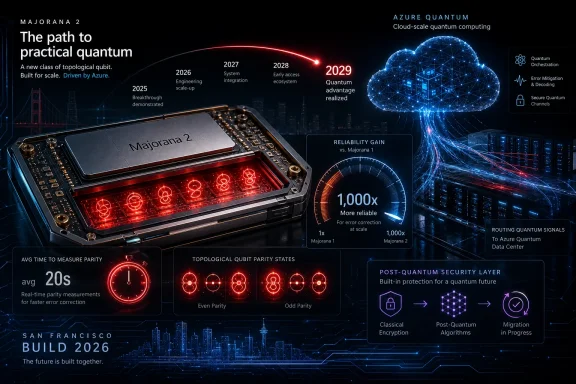
Microsoft introduced Majorana 2 at Build 2026 in San Francisco on June 2, saying its second-generation topological quantum chip delivers a 1,000-fold reliability gain, 20-second average qubit lifetimes, and a revised path to a scalable commercial quantum computer in 2029. The claim is not just that Microsoft has made a better qubit; it is that the company’s long, risky wager on topological quantum computing has finally produced a hardware signal strong enough to reorganize its roadmap. That makes Majorana 2 one of the most consequential announcements in Microsoft’s post-AI infrastructure story — and also one of the most in need of independent proof.
For years, Microsoft’s quantum strategy had an unusual shape. Google, IBM, Quantinuum, IonQ, and others built public momentum around processors with growing qubit counts, better gates, cloud access, and increasingly sophisticated demonstrations. Microsoft, by contrast, spent the better part of two decades pursuing a harder and more speculative route: topological qubits based on Majorana zero modes.
That choice made Microsoft look either patient or stubborn, depending on the year. Topological qubits promise inherent protection from certain errors, which is exactly the kind of advantage that could matter when the industry tries to move from today’s noisy devices to fault-tolerant systems. But the physics has been controversial, the experimental evidence has been difficult to interpret, and Microsoft’s previous claims have attracted unusually sharp scrutiny.
Majorana 2 changes the conversation because Microsoft is no longer merely saying that its architecture could win in theory. It is saying the new device has crossed a practical reliability threshold, with qubit state lifetimes moving from the millisecond range to an average of 20 seconds and occasional runs approaching a minute. If that holds up, it is not an incremental tuning pass. It is a hardware redesign with roadmap consequences.
The phrase to watch is if that holds up. Microsoft’s announcement is ambitious enough to matter, but the company has not yet turned it into the kind of settled, peer-reviewed consensus that would silence skeptics. In quantum computing, especially at the edge of materials physics, the distance between a spectacular device measurement and a scalable computing platform can still be vast.
That matters because quantum computing progress is often described in software-adjacent terms: better control systems, better calibration, better error correction, better compilers. Majorana 2 is being framed differently. Microsoft is saying the breakthrough came from the physical system itself, from a materials stack that produces more stable parity lifetimes and gives error correction more room to breathe.
A qubit lifetime of 20 seconds is striking in a field where many architectures still discuss coherence in microseconds or milliseconds, though direct comparisons can mislead because different qubit types and measurement targets are not interchangeable. Microsoft is not simply claiming that a conventional superconducting qubit stayed coherent longer. It is pointing to parity lifetime in a topological device, which is a specific claim inside a specific architecture.
That is why the announcement is both exciting and narrow. A long-lived parity state is a necessary ingredient for Microsoft’s approach, but it is not the same thing as demonstrating a large population of high-quality logical qubits running useful algorithms under fault-tolerant control. Microsoft has shown, or says it has shown, that one of the most stubborn physical bottlenecks can be pushed dramatically outward. The next question is whether the rest of the system scales with it.
Microsoft’s Majorana program has been here before. The company has pursued one of the most theoretically elegant routes to quantum computing, but elegance has not spared it from controversy. Researchers have repeatedly debated whether observed signatures in Majorana-style systems prove the existence of the desired topological states or merely resemble them under certain device conditions.
That history explains the unusually cautious reaction among physicists. A 20-second parity lifetime is impressive even if interpreted conservatively, but the commercial claim depends on more than a long-lived state. Microsoft needs to show that these devices are truly topological qubits, that they can be manufactured reproducibly, that they can be braided or otherwise operated as required, and that logical operations can scale without the hidden overhead exploding.
The company’s strongest argument is that the engineering curve has changed. The strongest counterargument is that quantum computing has a graveyard full of curves that looked good before the next layer of system complexity arrived.
That is the strategic reason Microsoft’s quantum claims deserve attention from Windows and enterprise IT readers, not only physicists. Microsoft is building quantum as a cloud service, not as a niche laboratory instrument. The company’s likely customer is not a hobbyist with a quantum workstation; it is a pharmaceutical firm, materials company, financial institution, energy group, or national lab running hybrid workloads that combine classical high-performance computing, AI systems, and quantum accelerators.
This is also why the timing matters. A 2029 target does not mean a flood of enterprise quantum applications arrives in 2029. It means Microsoft wants to convince customers, researchers, and investors that the platform decisions being made now should assume Azure will be a serious quantum venue when fault tolerance becomes practical.
The cloud angle is classic Microsoft. The company does not need quantum revenue to matter this fiscal year for the strategy to be rational. It needs quantum to reinforce the idea that Azure is the place where the next compute paradigm will be provisioned, governed, secured, metered, and sold through enterprise agreements.
IBM has also shifted the conversation from qubit-count spectacle toward fault-tolerant roadmaps. Its Starling target for 2029 and Blue Jay ambitions beyond that are designed to show that superconducting quantum systems can become engineered platforms rather than science demonstrations. Quantinuum and IonQ continue to push trapped-ion systems, often emphasizing high-fidelity operations and cloud integration.
That competitive context cuts both ways for Microsoft. On one hand, Majorana 2 gives the company a differentiated story at a moment when quantum roadmaps are becoming more concrete. On the other hand, Microsoft no longer gets credit merely for pursuing an exotic architecture. The relevant comparison is now against competitors that have published error-correction milestones, shipped cloud-accessible systems, and built broader developer ecosystems.
The industry is converging on the same brutal truth: physical qubits are not the prize. Useful logical qubits are the prize. Microsoft’s bet is that topological qubits can reduce the overhead required to get there, and Majorana 2 is presented as evidence that the overhead story may finally tilt in its favor.
But the calendar remains contested. Claims that Q-Day could arrive around 2030 are plausible enough to influence policy and security planning, but not certain enough to treat as a scheduled product launch. The difference matters. Panic produces bad migrations; complacency produces worse ones.
For Windows administrators, the correct response is neither to dismiss quantum risk nor to assume Majorana 2 means every certificate authority and VPN concentrator is obsolete tomorrow. The practical work is already underway through post-quantum cryptographic standards, inventory efforts, crypto-agility planning, and vendor support across operating systems, browsers, identity stacks, and hardware security modules.
Microsoft’s announcement strengthens the argument for taking those migrations seriously. It does not prove that a cryptographically relevant quantum computer will arrive by 2029 or 2030. It does make it harder for security teams to justify treating quantum readiness as a distant academic concern.
The more sensible financial interpretation is option value. If Microsoft’s topological approach scales, Azure Quantum could become another high-margin infrastructure layer on top of an already enormous cloud business. It would deepen enterprise dependency on Azure, create new categories of premium compute, and reinforce Microsoft’s position as a full-stack provider from developer tooling to frontier hardware.
That bull case is clean but conditional. It assumes Microsoft can convert a laboratory breakthrough into manufacturable devices, convert those devices into logical qubits, convert logical qubits into useful workloads, and convert workloads into cloud revenue. Each step has its own failure modes.
The bear case is equally obvious. Majorana 2 could turn out to be an important physics result that does not scale commercially. Competitors could reach fault tolerance first with less exotic architectures. Or the first commercially valuable quantum workloads could remain too narrow, too expensive, or too awkward to justify the infrastructure spend for many enterprises.
That is strategically convenient, but not necessarily empty. Quantum hardware is a manufacturing and measurement problem as much as a theory problem. The ability to automate experiments, characterize devices, and iterate materials stacks faster could become a real advantage if it shortens the loop between design, fabrication, testing, and redesign.
It also gives Microsoft a more integrated narrative for Build-era audiences. AI is not just a product feature in Windows, Office, and Azure. It becomes an accelerator for frontier research that, in turn, produces new compute platforms for Azure. That is a tidy flywheel, and Microsoft will surely keep telling it.
The risk is that the story becomes too tidy. AI-assisted discovery can help find better candidates and optimize processes, but it does not repeal physics. If Majorana 2 survives scrutiny, Discovery gets a halo. If the device claims weaken under review, the AI-science framing will look more like brand architecture than proof.
For IT teams, the near-term work is mostly architectural literacy. Organizations should understand where quantum might matter in their industry, which vendors are building credible platforms, and how post-quantum cryptography will affect identity, storage, software signing, VPNs, TLS, and long-lived data. Most companies do not need a quantum center of excellence tomorrow. They do need a crypto inventory yesterday.
Developers should be careful too. Quantum programming models remain specialized, and useful applications will not emerge simply because a cloud provider exposes a backend. The early winners will likely be teams that combine domain expertise, classical optimization, AI tooling, and quantum methods without pretending that quantum is magic.
For WindowsForum readers, the most practical lesson is familiar: platform shifts arrive first as dependencies. Quantum will show up through cloud services, security requirements, compliance language, SDKs, procurement questions, and vendor roadmaps before it shows up as something most admins directly operate.
 Microsoft Has Moved Quantum From Research Theater to Roadmap Pressure
For years, Microsoft’s quantum strategy had an unusual shape. Google, IBM, Quantinuum, IonQ, and others built public momentum around processors with growing qubit counts, better gates, cloud access, and increasingly sophisticated demonstrations. Microsoft, by contrast, spent the better part of two decades pursuing a harder and more speculative route: topological qubits based on Majorana zero modes.That choice made Microsoft look either patient or stubborn, depending on the year. Topological qubits promise inherent protection from certain errors, which is exactly the kind of advantage that could matter when the industry tries to move from today’s noisy devices to fault-tolerant systems. But the physics has been controversial, the experimental evidence has been difficult to interpret, and Microsoft’s previous claims have attracted unusually sharp scrutiny.
Majorana 2 changes the conversation because Microsoft is no longer merely saying that its architecture could win in theory. It is saying the new device has crossed a practical reliability threshold, with qubit state lifetimes moving from the millisecond range to an average of 20 seconds and occasional runs approaching a minute. If that holds up, it is not an incremental tuning pass. It is a hardware redesign with roadmap consequences.
The phrase to watch is if that holds up. Microsoft’s announcement is ambitious enough to matter, but the company has not yet turned it into the kind of settled, peer-reviewed consensus that would silence skeptics. In quantum computing, especially at the edge of materials physics, the distance between a spectacular device measurement and a scalable computing platform can still be vast.
The 1,000x Number Is Really a Materials Story
The headline number — 1,000 times more reliable than the prior generation — is easy to flatten into marketing language. The more interesting claim is how Microsoft says it got there. Majorana 2 reportedly replaces the aluminum-based topological superconductor stack used in the earlier design with a lead-based architecture intended to better isolate the qubit from environmental interference.That matters because quantum computing progress is often described in software-adjacent terms: better control systems, better calibration, better error correction, better compilers. Majorana 2 is being framed differently. Microsoft is saying the breakthrough came from the physical system itself, from a materials stack that produces more stable parity lifetimes and gives error correction more room to breathe.
A qubit lifetime of 20 seconds is striking in a field where many architectures still discuss coherence in microseconds or milliseconds, though direct comparisons can mislead because different qubit types and measurement targets are not interchangeable. Microsoft is not simply claiming that a conventional superconducting qubit stayed coherent longer. It is pointing to parity lifetime in a topological device, which is a specific claim inside a specific architecture.
That is why the announcement is both exciting and narrow. A long-lived parity state is a necessary ingredient for Microsoft’s approach, but it is not the same thing as demonstrating a large population of high-quality logical qubits running useful algorithms under fault-tolerant control. Microsoft has shown, or says it has shown, that one of the most stubborn physical bottlenecks can be pushed dramatically outward. The next question is whether the rest of the system scales with it.
The Preprint Problem Is Not a Footnote
The most important caveat is not hidden in the fine print; it is the central tension of the story. Majorana 2’s strongest scientific claims still need the kind of independent validation and peer-reviewed examination that turns a company announcement into a durable milestone. In a field where experimental signatures can be ambiguous, that distinction is not academic housekeeping.Microsoft’s Majorana program has been here before. The company has pursued one of the most theoretically elegant routes to quantum computing, but elegance has not spared it from controversy. Researchers have repeatedly debated whether observed signatures in Majorana-style systems prove the existence of the desired topological states or merely resemble them under certain device conditions.
That history explains the unusually cautious reaction among physicists. A 20-second parity lifetime is impressive even if interpreted conservatively, but the commercial claim depends on more than a long-lived state. Microsoft needs to show that these devices are truly topological qubits, that they can be manufactured reproducibly, that they can be braided or otherwise operated as required, and that logical operations can scale without the hidden overhead exploding.
The company’s strongest argument is that the engineering curve has changed. The strongest counterargument is that quantum computing has a graveyard full of curves that looked good before the next layer of system complexity arrived.
Azure Quantum Is the Business Model Waiting for the Physics
Microsoft’s endgame is not a standalone quantum appliance sitting in a corporate data center. It is Azure Quantum as an enterprise control plane, with quantum resources exposed through the same cloud economics and developer workflows that already define modern Microsoft infrastructure. If Majorana 2 is real at scale, Azure becomes the distribution channel before most customers know what to do with the machine.That is the strategic reason Microsoft’s quantum claims deserve attention from Windows and enterprise IT readers, not only physicists. Microsoft is building quantum as a cloud service, not as a niche laboratory instrument. The company’s likely customer is not a hobbyist with a quantum workstation; it is a pharmaceutical firm, materials company, financial institution, energy group, or national lab running hybrid workloads that combine classical high-performance computing, AI systems, and quantum accelerators.
This is also why the timing matters. A 2029 target does not mean a flood of enterprise quantum applications arrives in 2029. It means Microsoft wants to convince customers, researchers, and investors that the platform decisions being made now should assume Azure will be a serious quantum venue when fault tolerance becomes practical.
The cloud angle is classic Microsoft. The company does not need quantum revenue to matter this fiscal year for the strategy to be rational. It needs quantum to reinforce the idea that Azure is the place where the next compute paradigm will be provisioned, governed, secured, metered, and sold through enterprise agreements.
The Competition Has Already Raised the Bar
Microsoft is making its claim into a more serious quantum market than the one that existed even a few years ago. Google’s Willow processor demonstrated below-threshold quantum error correction in published work, a major step because it showed logical error rates improving as the code distance increased. That was not a general-purpose quantum computer, but it attacked one of the most important questions in the field: can adding more physical qubits actually reduce errors rather than merely add complexity?IBM has also shifted the conversation from qubit-count spectacle toward fault-tolerant roadmaps. Its Starling target for 2029 and Blue Jay ambitions beyond that are designed to show that superconducting quantum systems can become engineered platforms rather than science demonstrations. Quantinuum and IonQ continue to push trapped-ion systems, often emphasizing high-fidelity operations and cloud integration.
That competitive context cuts both ways for Microsoft. On one hand, Majorana 2 gives the company a differentiated story at a moment when quantum roadmaps are becoming more concrete. On the other hand, Microsoft no longer gets credit merely for pursuing an exotic architecture. The relevant comparison is now against competitors that have published error-correction milestones, shipped cloud-accessible systems, and built broader developer ecosystems.
The industry is converging on the same brutal truth: physical qubits are not the prize. Useful logical qubits are the prize. Microsoft’s bet is that topological qubits can reduce the overhead required to get there, and Majorana 2 is presented as evidence that the overhead story may finally tilt in its favor.
Q-Day Hype Is Useful Only When It Scares the Right People
Every quantum hardware announcement now arrives with a shadow narrative: Q-Day, the moment a sufficiently capable quantum computer can break widely used public-key cryptography. That fear is not fictional. Shor’s algorithm threatens RSA and elliptic-curve systems in principle, and governments have already pushed post-quantum cryptography because encrypted traffic captured today may be vulnerable later.But the calendar remains contested. Claims that Q-Day could arrive around 2030 are plausible enough to influence policy and security planning, but not certain enough to treat as a scheduled product launch. The difference matters. Panic produces bad migrations; complacency produces worse ones.
For Windows administrators, the correct response is neither to dismiss quantum risk nor to assume Majorana 2 means every certificate authority and VPN concentrator is obsolete tomorrow. The practical work is already underway through post-quantum cryptographic standards, inventory efforts, crypto-agility planning, and vendor support across operating systems, browsers, identity stacks, and hardware security modules.
Microsoft’s announcement strengthens the argument for taking those migrations seriously. It does not prove that a cryptographically relevant quantum computer will arrive by 2029 or 2030. It does make it harder for security teams to justify treating quantum readiness as a distant academic concern.
Investors Should See an Option, Not an Earnings Line
The market temptation is to translate Majorana 2 into Microsoft stock upside, but quantum is not a near-term earnings catalyst in the way Azure AI capacity or Microsoft 365 pricing can be. Microsoft does not break out meaningful quantum revenue, and a 2029 utility-scale target sits outside the planning window that usually drives quarterly valuation.The more sensible financial interpretation is option value. If Microsoft’s topological approach scales, Azure Quantum could become another high-margin infrastructure layer on top of an already enormous cloud business. It would deepen enterprise dependency on Azure, create new categories of premium compute, and reinforce Microsoft’s position as a full-stack provider from developer tooling to frontier hardware.
That bull case is clean but conditional. It assumes Microsoft can convert a laboratory breakthrough into manufacturable devices, convert those devices into logical qubits, convert logical qubits into useful workloads, and convert workloads into cloud revenue. Each step has its own failure modes.
The bear case is equally obvious. Majorana 2 could turn out to be an important physics result that does not scale commercially. Competitors could reach fault tolerance first with less exotic architectures. Or the first commercially valuable quantum workloads could remain too narrow, too expensive, or too awkward to justify the infrastructure spend for many enterprises.
Microsoft Discovery Is the Quiet Platform Play Behind the Chip
One of the more revealing parts of the announcement is Microsoft’s claim that its Discovery platform helped accelerate materials research and automate measurements. That positions Majorana 2 not only as a quantum chip story, but as an AI-for-science case study. In Microsoft’s telling, agentic AI helped search the materials and process space faster than traditional lab workflows could.That is strategically convenient, but not necessarily empty. Quantum hardware is a manufacturing and measurement problem as much as a theory problem. The ability to automate experiments, characterize devices, and iterate materials stacks faster could become a real advantage if it shortens the loop between design, fabrication, testing, and redesign.
It also gives Microsoft a more integrated narrative for Build-era audiences. AI is not just a product feature in Windows, Office, and Azure. It becomes an accelerator for frontier research that, in turn, produces new compute platforms for Azure. That is a tidy flywheel, and Microsoft will surely keep telling it.
The risk is that the story becomes too tidy. AI-assisted discovery can help find better candidates and optimize processes, but it does not repeal physics. If Majorana 2 survives scrutiny, Discovery gets a halo. If the device claims weaken under review, the AI-science framing will look more like brand architecture than proof.
Enterprise IT Should Prepare for Hybrid Reality, Not Quantum Replacement
The first useful quantum systems will not replace classical computing. They will sit beside it, probably inside cloud workflows, and accelerate specific classes of problems where quantum methods have an advantage. That means enterprise adoption will look less like a PC refresh and more like the gradual arrival of GPUs, specialized accelerators, and managed AI services.For IT teams, the near-term work is mostly architectural literacy. Organizations should understand where quantum might matter in their industry, which vendors are building credible platforms, and how post-quantum cryptography will affect identity, storage, software signing, VPNs, TLS, and long-lived data. Most companies do not need a quantum center of excellence tomorrow. They do need a crypto inventory yesterday.
Developers should be careful too. Quantum programming models remain specialized, and useful applications will not emerge simply because a cloud provider exposes a backend. The early winners will likely be teams that combine domain expertise, classical optimization, AI tooling, and quantum methods without pretending that quantum is magic.
For WindowsForum readers, the most practical lesson is familiar: platform shifts arrive first as dependencies. Quantum will show up through cloud services, security requirements, compliance language, SDKs, procurement questions, and vendor roadmaps before it shows up as something most admins directly operate.
The Majorana 2 Bet Comes Down to Six Hard Tests
Microsoft has earned attention with Majorana 2, but not yet deference. The announcement is big because the claimed reliability improvement attacks a real bottleneck; it remains provisional because the most consequential claims still need broader scientific confirmation and engineering repetition.- Majorana 2’s central claim is a 1,000-fold reliability improvement over Microsoft’s prior topological qubit generation, with average qubit lifetimes around 20 seconds.
- The hardware shift reportedly comes from a redesigned materials stack, moving away from the earlier aluminum-based approach toward a lead-based design.
- Microsoft’s 2029 target is a roadmap acceleration, not evidence that enterprise quantum applications are ready for production today.
- Independent validation matters because long parity lifetimes do not automatically prove scalable topological qubits or fault-tolerant logical operations.
- Azure Quantum is the commercial prize, since Microsoft’s likely path to monetization runs through hybrid cloud workloads rather than customer-owned quantum machines.
- Security teams should treat the announcement as another reason to accelerate post-quantum cryptography planning, not as proof that Q-Day has a fixed date.
References
- Primary source: Investing.com
Published: 2026-06-03T13:30:36.888752
Loading…
m.investing.com - Official source: news.microsoft.com
Loading…
news.microsoft.com - Related coverage: tomshardware.com
Loading…
www.tomshardware.com - Related coverage: techtimes.com
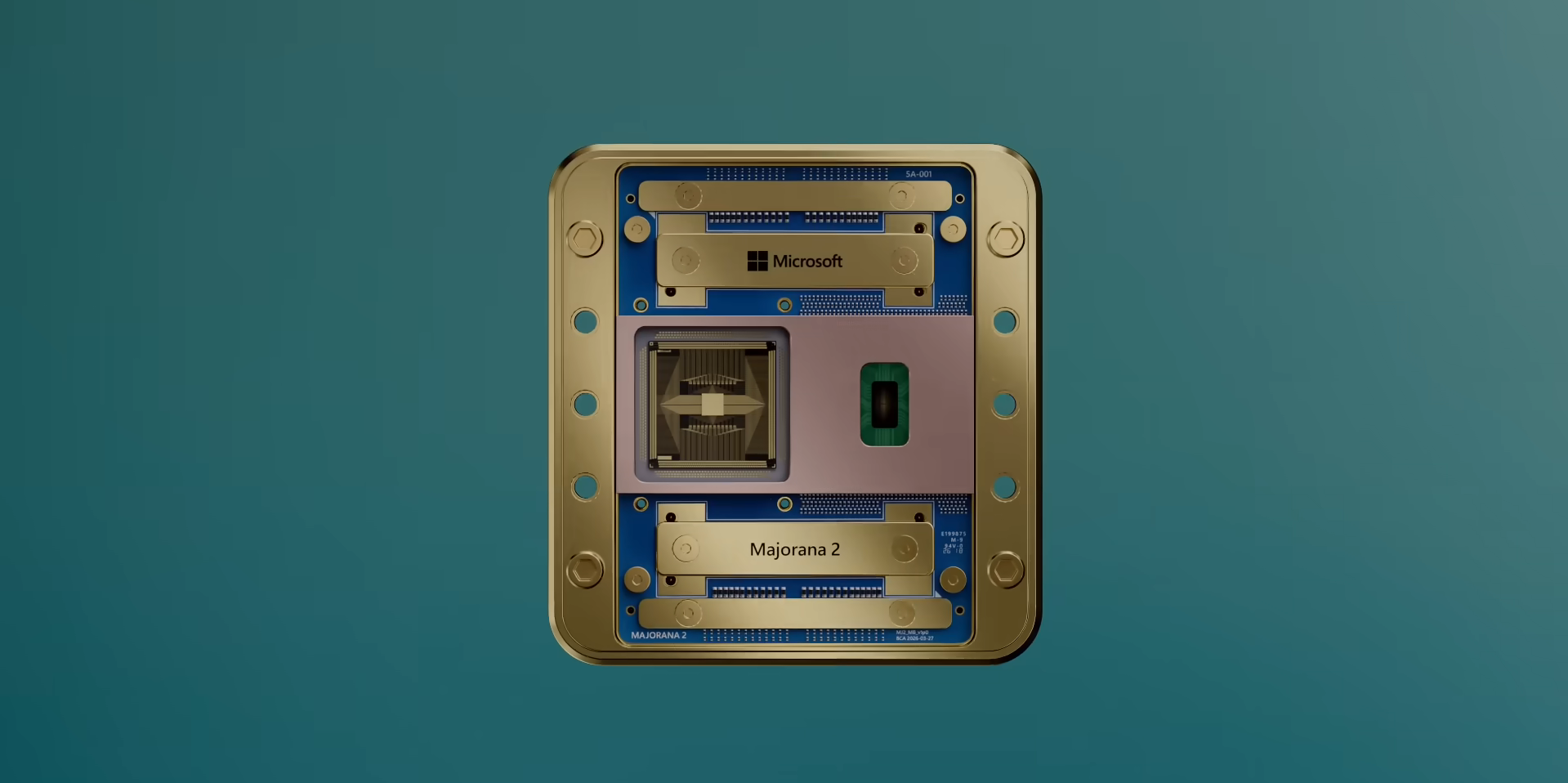
Majorana 2 Quantum Chip Revealed at Microsoft Build 2026: Features and Specs Explained
Majorana 2 quantum chip unveiled at Microsoft Build 2026 shows improved topological qubits, higher stability, and a roadmap toward scalable quantum computing. www.techtimes.com
- Related coverage: europapress.es
Loading…
www.europapress.es - Official source: quantum.microsoft.com
Microsoft Quantum | Homepage
Microsoft Quantum is leading the industry with advanced technology that accelerates scientific discovery. Discover our solutions, learning tools, and education resources. Access Copilot in Microsoft Quantum and explore the path to a quantum supercomputer.quantum.microsoft.com
- Related coverage: techzine.eu
Loading…
www.techzine.eu - Related coverage: phys.org
Loading…
phys.org - Official source: microsoft.com
Loading…
www.microsoft.com - Related coverage: ibm.com
Loading…
www.ibm.com - Related coverage: latam.newsroom.ibm.com
Loading…
latam.newsroom.ibm.com - Related coverage: scientificamerican.com
Loading…
www.scientificamerican.com - Related coverage: axios.com
Loading…
www.axios.com - Related coverage: livescience.com
Loading…
www.livescience.com