

Microsoft quietly became the first major platform to offer built-in support for interracial couple emoji in early Windows 10 Insider builds — a small, technical-looking change that carries outsized social and technical implications for how identity is represented in digital communication.
Emoji have evolved from a novelty pictogram set into a global micro-language used in billions of messages daily. As that use has grown, so has scrutiny over whose faces and relationships are represented. The Unicode Consortium and major vendors introduced skin tone modifiers, gendered professions, and same-sex couple options across 2015–2017, but interracial couples remained an awkward gap: couple emoji historically rendered as a single yellow glyph, which some users interpreted as a coded “default” or even as implicitly white.
Technically, emoji are either single Unicode code points or sequences of existing code points joined by a zero-width joiner (ZWJ). The ZWJ lets platforms glue together multiple characters so they render as one combined glyph. That flexibility allows vendors to represent conceptually new emoji (like professions with gender variations or multi-person family groupings) without adding entirely new Unicode characters. But being technically possible isn’t the same as being practically usable across devices and keyboards — and that’s where implementation challenges begin.
In January 2017, an Insider build of Windows 10 (Build 15002) started showing interracial couple sequences in preview form, and when the Windows 10 Creators Update rolled to the public in April 2017 these additions became more broadly available in Microsoft’s emoji font and rendering system. The change was first widely reported by emoji-watchers and mainstream tech outlets at the time and became a reference point in later industry discussions about emoji inclusivity.
Because Windows can compose existing person glyphs (e.g., woman + heart + man) and apply skin-tone modifiers to each person independently, the platform can render multiracial couples without creating thousands of individual image files. This is why Microsoft could feasibly support an enormous set of family / couple permutations without exploding the on-disk font size the way rasterized, per-variant emoji sets would.
 +
+  +
+  ), albeit not as a fused single glyph. This graceful degradation is a key part of making non-standard sequences safe to deploy: messages remain readable even when full rendering isn't supported.
Beyond symbolic representation, the change also set a precedent: a major vendor demonstrating that broad, per-person skin-tone customization in composite emoji sequences was technically feasible. That gave campaigners, product teams, and the Unicode ecosystem a tangible example to point to when advocating for formal standardization and wider adoption.
The takeaway for Windows enthusiasts and product designers alike is clear: representation is not only a social design choice but a technical architecture question. Solving it well requires both creative engineering (think composition-friendly fonts and rendering) and thoughtful UX (discoverability and keyboard design). If the last several years have taught us anything, it’s that emoji are not mere decorations — they are a meaningful part of digital identity, and the platforms that get the implementation details right will also win on accessibility, inclusion, and user trust.
Source: Mashable Interracial couples are finally getting some emoji representation
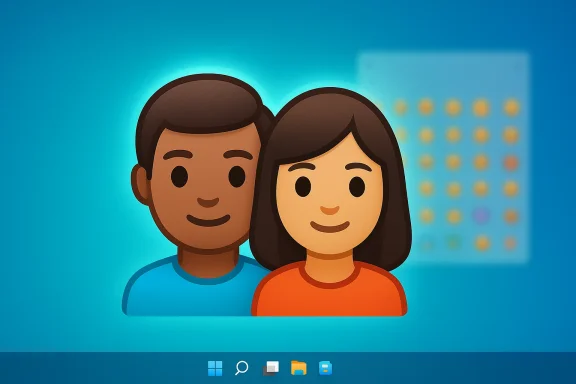 Background: why emoji diversity matters — and why it's hard
Emoji have evolved from a novelty pictogram set into a global micro-language used in billions of messages daily. As that use has grown, so has scrutiny over whose faces and relationships are represented. The Unicode Consortium and major vendors introduced skin tone modifiers, gendered professions, and same-sex couple options across 2015–2017, but interracial couples remained an awkward gap: couple emoji historically rendered as a single yellow glyph, which some users interpreted as a coded “default” or even as implicitly white.Technically, emoji are either single Unicode code points or sequences of existing code points joined by a zero-width joiner (ZWJ). The ZWJ lets platforms glue together multiple characters so they render as one combined glyph. That flexibility allows vendors to represent conceptually new emoji (like professions with gender variations or multi-person family groupings) without adding entirely new Unicode characters. But being technically possible isn’t the same as being practically usable across devices and keyboards — and that’s where implementation challenges begin.
In January 2017, an Insider build of Windows 10 (Build 15002) started showing interracial couple sequences in preview form, and when the Windows 10 Creators Update rolled to the public in April 2017 these additions became more broadly available in Microsoft’s emoji font and rendering system. The change was first widely reported by emoji-watchers and mainstream tech outlets at the time and became a reference point in later industry discussions about emoji inclusivity.
Overview: what Microsoft actually changed
What was added
- Microsoft added support for interracial couple sequences in its emoji system. This lets each person in a couple have an independent skin tone modifier.
- On Windows, those sequences can render as a single combined emoji rather than as separate glyphs, thanks to Microsoft’s vector emoji font and composition approach.
- Early reports cited either 144 or 288 new couple variations depending on which build or count was referenced; Microsoft’s final Creators Update-era changelogs counted hundreds of related additions as part of a larger emoji refresh.
Concrete numbers (verified)
- The Creators Update included a considerable emoji expansion: roughly 770 new emoji images/sequences were reported as part of the release when counting all new, modified, and variation-driven glyphs.
- One public breakdown counted 482 brand-new emoji plus an additional set of interracial-couple variations (sources differ between 144 and 288 depending on counting methodology).
- If you tally gender, position, and skin-tone permutations across the whole set, the reported total supported emoji options on Windows after the update reached about 2,381.
- For context, the earlier Windows Anniversary Update in 2016 added an extremely large family/couple expansion that resulted in tens of thousands (often reported as ~52,000) of unique multiracial family combinations on Windows — though many of those remained impractical to surface via the standard emoji keyboard.
How Microsoft did it: the technical underpinnings
Vector fonts and composition
Microsoft’s solution relied on its vector-based color emoji font (Segoe UI Emoji / Segoe Color Emoji) and the platform’s rendering pipeline that can layer and compose glyphs dynamically. That approach contrasts with bitmap or fixed-image emoji font strategies used by some mobile vendors, where each distinct emoji image must be separately designed, stored, and shipped.Because Windows can compose existing person glyphs (e.g., woman + heart + man) and apply skin-tone modifiers to each person independently, the platform can render multiracial couples without creating thousands of individual image files. This is why Microsoft could feasibly support an enormous set of family / couple permutations without exploding the on-disk font size the way rasterized, per-variant emoji sets would.
ZWJ sequences and graceful degradation
The interracial couple emoji are implemented as ZWJ sequences — multiple characters joined invisibly. That means on platforms that don’t support the combined sequence the message will still convey the constituent emoji (for example: + + ), albeit not as a fused single glyph. This graceful degradation is a key part of making non-standard sequences safe to deploy: messages remain readable even when full rendering isn't supported.Input and UI limitations
One practical limitation of Microsoft’s early implementation was discoverability. Because the Windows emoji input panel and touch keyboard were not updated to expose the new permutations, many users could only access the multiracial-couple glyphs by copy-and-paste from a web page or character map. That made the feature functionally present but difficult to use in everyday typing — a frequent problem when vendors add non-RGI (Recommended for General Interchange) sequences that aren’t integrated into standard input surfaces.The numbers debate: why sources disagree (and what to believe)
Public reporting at the time shows two commonly cited counts for the interracial-couple additions: 144 and 288. Those differences arise from how permutations are counted:- A conservative count includes only one set of couple sequences (for example, “couple with heart”) and applies the six skin-tone options across two people, multiplied by couple gender combinations and ordering. That approach yields counts near 144.
- A more expansive count includes multiple couple sequence types (for example, “couple with heart” and “kiss”), or counts both left/right person ordering as distinct entries, doubling the total to around 288.
Why this matters socially: representation, visibility, and identity
Representation in small digital artifacts matters because emoji are shorthand for identity and relationships in modern messaging. Allowing people to send an emoji that more closely matches their relationship helps reduce the feeling of erasure and improves digital visibility for interracial couples.Beyond symbolic representation, the change also set a precedent: a major vendor demonstrating that broad, per-person skin-tone customization in composite emoji sequences was technically feasible. That gave campaigners, product teams, and the Unicode ecosystem a tangible example to point to when advocating for formal standardization and wider adoption.
The activism and ecosystem response
The Windows change did not happen in isolation. The years around 2015–2018 saw growing activism to make emoji more inclusive:- Third-party keyboards and apps (for iOS and Android) created sticker packs or keyboard extensions that allowed users to send more diverse couple emoji before platform vendors adopted similar features.
- Campaigns such as Tinder’s “Interracial Couple Emoji Project” pushed the Unicode Consortium to consider standardized approaches for couple skin-tone combinations.
- Unicode’s technical updates in late 2016 (Emoji 4.0) introduced many ZWJ-based sequences for gendered professions and family groupings; vendors had to choose how many of those sequences to implement and how they’d be surfaced in their own input systems.
Strengths of Microsoft’s approach
- Technical feasibility at scale: By using vector composition and ZWJ sequences, Microsoft demonstrated a path to support thousands of permutations without shipping a separate image for each.
- Inclusivity by design: Allowing per-person skin-tone modifiers in couple sequences acknowledges mixed-race relationships explicitly.
- Graceful fallback: ZWJ sequences mean messages remain readable on unsupported platforms, reducing the risk of complete breakdown in meaning.
- Proof-of-concept leadership: Being first among major vendors to ship this signaled momentum and provided a real implementation for other vendors to study.
Risks and limitations — practical and social
No implementation occurs in a vacuum. Microsoft’s additions highlighted several practical and social risks that still shape emoji design decisions.Fragmentation and cross-platform inconsistency
Because the Unicode Consortium decides which sequences are RGI (Recommended for General Interchange) and which are vendor extensions, vendor-specific additions can lead to inconsistent rendering across devices. A couple that shows as a single combined multiracial emoji on Windows may render as separate characters or as the default yellow glyph on another platform. This inconsistency can cause visual confusion and erode the intended representational benefits.Discoverability and UX constraints
Adding thousands of possible permutations creates real UX problems for emoji input surfaces. Fonts and rendering alone don’t solve the problem of how to find the right variant on a smartphone or hardware keyboard. Microsoft’s initial implementation — functional but hidden behind copy-and-paste — illustrates why vendors hesitate to surface massive variant pools directly in their keyboards.Bandwidth, storage, and performance trade-offs
For platforms that rely on raster images or pre-rendered glyphs, each new variant increases app size and memory use. This is especially relevant for constrained devices or for apps that bundle emoji fonts inside their packages. The vector composition strategy reduces that burden, but not all vendors have identical font or rendering toolchains.Unintended messaging and political sensitivity
Unicode and vendors have long debated the social implications of explicit skin-tone distinctions and mixed-skin family depictions. Some implementers worry about unintentional signaling or about introducing new kinds of exclusion if only partial variant sets are released. That sensitivity is part technical and part sociocultural: emoji are tiny cultural artifacts that can carry outsized meanings.What this means for other platforms and users
- Other major vendors can and have since explored incremental ways to handle mixed-skin sequences. The path Microsoft used — vector composition plus ZWJ sequences — is a practical template, but platform UI and storage decisions affect adoption.
- For users who want multiracial couple emoji now, practical options include:
- Using copy-and-paste from a source that exposes the composed sequences (what early Windows users had to do).
- Installing third-party sticker or emoji keyboard apps that provide premade multiracial couple stickers.
- Advocating through petitions and vendor feedback channels (some campaigns, like those led by dating apps and activists, have influenced vendor priorities).
Recommendations for platform designers
- Prioritize discoverability: If you support composed or variant-heavy emoji, design input surfaces that let users find variants quickly (long-press, skin-tone pickers, or quick-swap UI).
- Use composition where possible: Vector composition reduces storage overhead and scales better than shipping bitmap permutations.
- Coordinate with Unicode: When a vendor implements widely useful sequences, propose them for RGI status or contribute to UTR documentation to reduce fragmentation.
- Measure usage and iterate: Track how often variant permutations are actually used and surface the most popular options to avoid overwhelming users.
- Communicate transparently: When introducing new representation features, explain limitations (e.g., copy-paste only) and future UI plans so users understand practical availability.
Broader implications for digital identity and standards
Microsoft’s interracial-couple additions are a useful case study in how technical design choices shape social outcomes. The Unicode model — which balances standardization with vendor autonomy — created a space where vendors could be creative but also left room for uneven support. That tension continues to influence debates about emoji representation:- Should standards try to enumerate every permutation (risking combinatorial explosion), or should they provide composable building blocks that vendors can assemble?
- How can standards bodies and vendors work together to prioritize the most socially meaningful variants without creating unsupportable numbers of glyphs?
- What responsibility do vendors have to make diversity features discoverable and usable, not merely present in fonts?
What to watch next
- Vendor keyboard updates: Watch whether platforms integrate multiracial couple permutations into their default emoji pickers (long-press menus or skin-tone UI).
- Unicode guidance: Any movement to make common multiracial-couple sequences RGI would significantly improve cross-platform consistency.
- Adoption metrics: If vendors report real-world usage of multiracial couple sequences, other platforms will have an easier case to follow.
- Third-party innovation: Expect sticker apps, keyboard extensions, and social platforms to keep filling gaps where vendor keyboards lag.
Conclusion
Microsoft’s early support for interracial couple emoji was a small technical change with outsized symbolic importance: it showed that per-person skin-tone combinations in composite emoji were feasible at scale, and it crystallized the practical trade-offs that vendors face between inclusivity, performance, and usability. For Windows users the change meant immediate — if sometimes awkward-to-access — representation. For the emoji ecosystem it meant a practical blueprint and a renewed public debate about how to represent identity in the tiniest units of our digital language.The takeaway for Windows enthusiasts and product designers alike is clear: representation is not only a social design choice but a technical architecture question. Solving it well requires both creative engineering (think composition-friendly fonts and rendering) and thoughtful UX (discoverability and keyboard design). If the last several years have taught us anything, it’s that emoji are not mere decorations — they are a meaningful part of digital identity, and the platforms that get the implementation details right will also win on accessibility, inclusion, and user trust.
Source: Mashable Interracial couples are finally getting some emoji representation
