

Microsoft’s Azure team announced today that Microsoft has been named a Leader in Gartner’s 2025 Magic Quadrant for AI Application Development Platforms — and, according to Microsoft, placed furthest to the right on the Completeness of Vision axis — a recognition the company ties directly to the rise of agentic applications and the platform it calls Microsoft Foundry.
Gartner’s Magic Quadrant framework evaluates vendors on two axes: Ability to Execute and Completeness of Vision. Vendors placed in the Leaders quadrant are those Gartner judges to have both strong current capabilities and credible, differentiated roadmaps. The AI Application Development Platforms Magic Quadrant (published in November 2025) is intended to help enterprise buyers choose platforms for building, grounding, orchestrating, and governing AI applications and multi‑agent systems. Microsoft’s announcement frames this recognition as validation of its investment in agent frameworks, orchestration, and enterprise governance. Microsoft bundles the pieces it highlights under the brand Foundry (also referenced publicly as Azure AI Foundry). Foundry is presented as a unified stack for models, grounding, tools, agent runtimes, and a control plane for observability and policy. The vendor’s public product pages and Ignite technical briefings describe an extensive model catalog, model routing, tooling connectors, multi‑agent orchestration, observability/Control Plane, and options to run models from cloud to edge. Microsoft also asserts Foundry is already in use at scale across “more than 80,000 enterprises.”
For organizations that already run significant workloads on Azure or rely on Microsoft 365/Entra identity, Foundry offers high integration value — and that alone can justify deeper evaluation. For organizations that prefer multi‑cloud or specialist model vendors, compare critical capabilities and benchmark model routing, observability, and connector coverage before committing.
Source: Microsoft Azure Microsoft named a Leader in Gartner® Magic Quadrant™ for AI Application Development Platforms | Microsoft Azure Blog
 Background / Overview
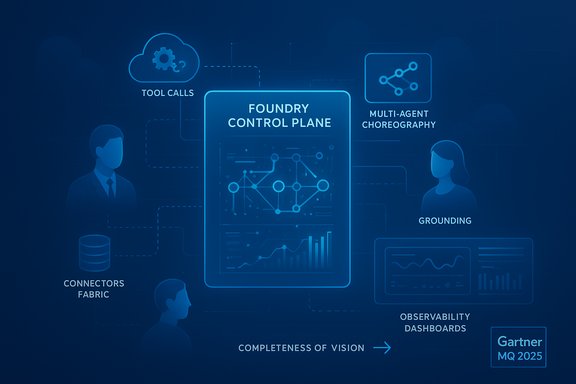
Gartner’s Magic Quadrant framework evaluates vendors on two axes: Ability to Execute and Completeness of Vision. Vendors placed in the Leaders quadrant are those Gartner judges to have both strong current capabilities and credible, differentiated roadmaps. The AI Application Development Platforms Magic Quadrant (published in November 2025) is intended to help enterprise buyers choose platforms for building, grounding, orchestrating, and governing AI applications and multi‑agent systems. Microsoft’s announcement frames this recognition as validation of its investment in agent frameworks, orchestration, and enterprise governance. Microsoft bundles the pieces it highlights under the brand Foundry (also referenced publicly as Azure AI Foundry). Foundry is presented as a unified stack for models, grounding, tools, agent runtimes, and a control plane for observability and policy. The vendor’s public product pages and Ignite technical briefings describe an extensive model catalog, model routing, tooling connectors, multi‑agent orchestration, observability/Control Plane, and options to run models from cloud to edge. Microsoft also asserts Foundry is already in use at scale across “more than 80,000 enterprises.” What Microsoft announced (summary of the blog and product claims)
Microsoft’s blog post announcing the Gartner recognition lays out four pillars Microsoft says separate production AI from proof-of-concept:- Real data, real tools (Foundry IQ + Foundry Tools): a single grounding API (Foundry IQ) to connect agents to enterprise data and a catalog of prebuilt connectors (Microsoft claims more than 1,400) for document processing, speech, translation and mainstream business systems.
- Workflow integration, not just conversation (Foundry Agent Service): agent runtimes and orchestration that let agents perform work, call tools and coordinate multi‑agent workflows that can be deployed into Copilot and other application surfaces.
- Observability and governance (Foundry Control Plane): telemetry, audit trails, policy enforcement, and organization‑wide visibility so autonomous agents can be monitored and governed at scale.
- Models from cloud to edge (Foundry Models and Foundry Local): a model catalog with hosted models, fine‑tuning and GenAI Ops for deployment, plus on‑device inference for low‑latency or regulated scenarios.
Verifying the key claims: cross‑checks and independent confirmation
Because vendor claims are frequently framed to highlight strengths, a responsible technical evaluation needs independent corroboration. Here’s what independent or third‑party sources confirm today:- Microsoft’s blog post and Foundry product pages explicitly state the features summarized above (Foundry IQ, Agent Service, Control Plane, Tools, Foundry Models/Local). Microsoft’s site and Ignite / tech community writeups provide the official feature descriptions.
- Industry and partner write‑ups from multiple outlets covering Microsoft Ignite and Foundry confirm the same feature set and public preview cadence (multi‑agent workflows, model router, Foundry IQ and Control Plane), and several independent tech reports repeat the “1,400+ connectors” and large model catalog claims in their coverage. These write‑ups provide independent verification that the product descriptions and preview announcements were widely published and discussed.
- Gartner’s Magic Quadrant itself is a paid research product; vendors quote and embed Gartner graphics in their public announcements. Other major cloud vendors (Google, IBM) publicized their Leader placements in the same Magic Quadrant, which confirms Gartner’s report included multiple Leaders in this market. Google specifically stated it was positioned highest on Ability to Execute; IBM also published a Leader announcement. That pattern — multiple vendors declaring “Leader” status while emphasizing different axes — is consistent with how Gartner reports are commonly used by vendors.
Technical analysis — strengths that justify the Leader argument
Microsoft is leaning its Leader argument on several concrete technical advances. Those claims hold up under scrutiny, and there are practical reasons CIOs and platform engineers will find them credible:- Platform completeness for agentic workflows. Foundry explicitly bundles model choice, grounding (RAG/Foundry IQ), tools (MCP/OpenAPI/A2A), orchestration (Agent Service), and governance (Control Plane). That end‑to‑end stack is what organizations building agentic production systems repeatedly ask for: identity‑bound agents, tool invocation governance, and end‑to‑end telemetry. Product documentation and Ignite write‑ups corroborate this architecture.
- Model and tool routing at scale. Microsoft’s Model Router, shown as generally available in recent Foundry briefings, is intended to route requests based on cost, latency and quality tradeoffs — a practical capability for production systems seeking predictable SLAs while managing inference costs. Independent write‑ups and the Foundry product page confirm the model router and priority processing lanes.
- Enterprise grounding and connectors. Foundry IQ plus a large connector fabric (Microsoft cites 1,400+ connectors in multiple product pages and partner briefings) is meaningful: agentic systems are only useful if they can securely and reliably access internal systems and documents. Independent summaries and partner materials repeat this connector count; nonetheless, enterprises should validate specific connector availability by product and region during procurement.
- Observability + governance as first‑class features. Foundry Control Plane is Microsoft’s response to the inescapable operational challenge: when agents act autonomously, you must be able to observe decisions, enforce policies, and audit actions. Microsoft’s public previews and partner briefings describe OpenTelemetry integration, audit trails, and policy enforcement. Those are exactly the primitives enterprises need to operationalize agentic AI.
- Hybrid deployment options. Foundry Models plus Foundry Local promises on‑device and edge execution for low‑latency or regulated scenarios — important for manufacturing, healthcare, and regulated industries. Microsoft’s product pages and preview announcements document on‑device SDKs and a local runtime path.
Risks, gaps, and areas that need independent validation
No platform is risk‑free. The announcements and vendor positioning are significant, but IT teams should plan against these practical hazards:- Vendor messaging vs. lived operational reality. Marketing and blog posts emphasize readiness. Reality for enterprises is often integration cost, connector coverage differences, latency tradeoffs, account and identity setup, and bespoke tool wrapping. The vendor claim that Foundry is used by “more than 80,000 enterprises” is supported on Microsoft’s product pages, but that figure is a marketing metric that should be tested against actual enterprise rollouts and validated references for your industry and geography.
- Gartner position nuance and procurement decisions. Being a Leader in Gartner’s Magic Quadrant is a meaningful signal, but it’s not a procurement decision by itself. Different leaders may be strongest on different axes (vision vs. execution) and across different use cases. Gartner’s full report (and its companion Critical Capabilities research) should be reviewed before committing to a vendor for large projects, especially where regulatory constraints matter. Multiple vendors have issued Leader announcements for the same MQ; check the original Gartner report to see how the axes and use‑case evaluations map to your requirements.
- Agent sprawl and governance complexity. Agents that can act autonomously raise new attack surfaces: mistaken tool invocations, privilege escalation through delegated tool calls, data exfiltration via connectors, and tightly coupled workflows that amplify errors. Gartner and independent analyst coverage have underscored the need for identity, least privilege, runtime isolation, and continuous evaluation of agent behavior — all operational responsibilities the platform can help with but which still require governance discipline from customers.
- Model safety and regulatory risk. Microsoft is itself rolling out internal safety and model‑ranking features, but vendors and independent press note that model safety metrics are evolving and incomplete. The Financial Times and other outlets have discussed Microsoft’s intent to rank model safety inside Foundry; that’s a positive step, but it’s early work, and safety rankings are not a substitute for rigorous testing in regulated contexts. If you operate in healthcare, finance, or other regulated sectors, insist on formal validation and compliance evidence.
- Cost and FinOps. Multi‑model routing, hosted agents, and priority inference lanes are operationally valuable — and they can also become expensive without proper FinOps controls. Evaluate pricing models, observe real inference costs in pilot projects, and factor model routing behavior into cost modeling before large rollouts. Microsoft’s product pages acknowledge consumption‑based pricing and per‑service billing; testing is essential.
Practical guidance for enterprise IT and Windows administrators
For teams evaluating Foundry (or any AI application platform), a disciplined approach will reduce surprises. These are recommended, sequential steps:- Map business outcomes to platform capabilities. Identify 2–3 prioritized use cases (for example: claims triage, supply‑chain exception handling, or voucher processing) and enumerate the required connectors, SLAs, and compliance needs.
- Run a scoped pilot with clear KPIs. Validate grounding (RAG quality), tool calls (MCP/OpenAPI integrations), agent orchestration, audit trails and cost per inference. Measure latency, throughput and error recovery under realistic load.
- Assess identity and least‑privilege architecture. Ensure agents are represented in your directory (Entra ID or equivalent), implement conditional access rules, and verify on‑behalf‑of and delegated access flows before connecting production data.
- Adopt an observability baseline. Deploy OpenTelemetry or your standard APM and log aggregation to capture agent decisions, tool invocations, and model outputs. Use the platform’s Control Plane to correlate and retain audit logs for compliance.
- Design safety and evaluation gates. Treat model rollout like a feature rollout: create staged environments, red‑team testing, prompt and output monitoring, and an incident response playbook for model deviations or hallucinations.
- Financial guardrails. Create FinOps policies for priority lanes and model routing. Use quotas, alerting and simulated traffic tests to understand cost behavior at scale.
- Vendor and contract validation. Clarify model licenses, data residency, and SLAs. If your project spans jurisdictions, confirm regional availability of connectors and control plane features.
How to interpret the Gartner Leader placement (practical buying advice)
- Treat the Magic Quadrant as a screening tool, not a single procurement criterion. Leaders typically offer the broadest capabilities, but the best vendor for any given organization will depend on the prioritized use cases, existing cloud commitments, and compliance requirements.
- Request the Gartner report and the companion Critical Capabilities report. Those documents explain use‑case fit and the tradeoffs Gartner observed in vendor scoring — the actionable detail buyers need.
- Ask vendors for customer references in your vertical and confirm those references’ architecture, SLA and ROI claims. Public marketing claims (including Microsoft’s blog) are useful, but verified reference conversations are more telling.
Bottom line — what this recognition means for Windows and Azure customers
Microsoft’s Leader placement in Gartner’s 2025 Magic Quadrant for AI Application Development Platforms signals that the company has packaged an ambitious, integrated stack for building agentic AI systems. Microsoft’s Foundry messaging is coherent: model choice, grounding, tools, orchestration, and governance in one platform is precisely what enterprises asked for after a year of many disjointed pilots. Independent coverage and partner briefings back up the existence and availability of the product components Microsoft highlights. At the same time, Gartner placement and marketing statements are not a substitute for due diligence. The operational challenges remain — agent sprawl, governance, cost controls, safety testing, and vendor‑specific connector availability. The most pragmatic approach is a careful pilot, early governance and identity controls, rigorous telemetry, and vendor contract terms that support your compliance needs.For organizations that already run significant workloads on Azure or rely on Microsoft 365/Entra identity, Foundry offers high integration value — and that alone can justify deeper evaluation. For organizations that prefer multi‑cloud or specialist model vendors, compare critical capabilities and benchmark model routing, observability, and connector coverage before committing.
Conclusion
Microsoft’s announcement that it’s a Gartner‑recognized Leader for AI Application Development Platforms — and its assertion that Foundry places it furthest in Completeness of Vision — is an important milestone in the enterprise AI platform race. The technical claims behind that position are plausible and well documented in Microsoft’s product literature and independent coverage: Foundry bundles grounding, tools, multi‑agent orchestration, model routing, and governance in a single platform that targets production AI challenges. Still, the real test for enterprise IT will be operational: whether Foundry’s observability and governance primitives truly scale, how well connectors and tool invocations work in complex heterogeneous environments, and whether cost and safety controls are practical and auditable at fleet scale. Buyers should read Gartner’s full report, run targeted pilots against high‑value use cases, and insist on reference validation before making strategic platform bets. The recognition is significant — but in the era of agentic AI, leadership will be proved in production, not press releases.Source: Microsoft Azure Microsoft named a Leader in Gartner® Magic Quadrant™ for AI Application Development Platforms | Microsoft Azure Blog
