

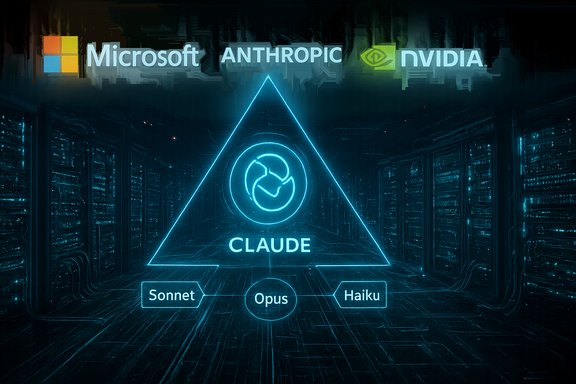
Microsoft, NVIDIA and Anthropic have announced a triangular strategic partnership that ties deep infrastructure commitments to product distribution and co‑engineering — Anthropic says it will purchase roughly US$30 billion of Azure compute capacity and “contract additional compute capacity up to one gigawatt”, NVIDIA will enter a co‑engineering and investment relationship with Anthropic, and Microsoft will expand Claude model availability across Azure, Microsoft Foundry and Microsoft 365 Copilot.
Anthropic has been one of the fastest‑growing challengers in the enterprise LLM market, with its Claude family (Sonnet, Opus, Haiku variants) positioned as a capability‑tiered alternative to other frontier models. The company has pursued a multi‑cloud strategy to balance scale, resilience and model delivery across AWS, Google Cloud and now deeper ties with Microsoft Azure. Microsoft has been shifting its Copilot and Foundry strategies from a single‑model dependency toward a multi‑model orchestration approach, allowing enterprise customers to select the model best suited to each task inside Microsoft 365, GitHub and developer tooling. NVIDIA has concurrently tightened its role as both a supplier of accelerators and a strategic investor in prominent model builders — a posture that increasingly ties silicon roadmaps to model architecture choices. These three moves — a very large cloud‑compute purchase commitment, deep model‑to‑silicon co‑engineering, and expanded enterprise distribution inside Microsoft products — are not isolated product updates. They mark an industrial shift where models, datacenters and chip vendors are cross‑subscribed into long‑term commercial and technical ecosystems.
For Windows‑centric IT organizations, the immediate upside is practical: easier access to a new set of frontier models through tools already in use. The prudent path forward is to pilot methodically, document data flows, verify contractual protections for regulated workloads, and build automation to manage model routing and provenance across Copilot, Foundry and other orchestration layers. The long run will be shaped by whether these large infrastructure commitments translate into delivered capacity, predictable pricing and interoperable standards — the same variables that decide whether this partnership becomes a durable competitive advantage or a contested market concentration episode.
Source: capacityglobal.com Microsoft, Nvidia to invest Anthropic as part of new strategic partnerships - Capacity
 Background / Overview
Anthropic has been one of the fastest‑growing challengers in the enterprise LLM market, with its Claude family (Sonnet, Opus, Haiku variants) positioned as a capability‑tiered alternative to other frontier models. The company has pursued a multi‑cloud strategy to balance scale, resilience and model delivery across AWS, Google Cloud and now deeper ties with Microsoft Azure. Microsoft has been shifting its Copilot and Foundry strategies from a single‑model dependency toward a multi‑model orchestration approach, allowing enterprise customers to select the model best suited to each task inside Microsoft 365, GitHub and developer tooling. NVIDIA has concurrently tightened its role as both a supplier of accelerators and a strategic investor in prominent model builders — a posture that increasingly ties silicon roadmaps to model architecture choices. These three moves — a very large cloud‑compute purchase commitment, deep model‑to‑silicon co‑engineering, and expanded enterprise distribution inside Microsoft products — are not isolated product updates. They mark an industrial shift where models, datacenters and chip vendors are cross‑subscribed into long‑term commercial and technical ecosystems. What the announcement actually says (and what’s reported)
Key reported facts (company statements and press reporting)
- Anthropic has committed to purchase approximately US$30 billion of Azure compute capacity; it has also stated a plan to contract additional compute capacity up to one gigawatt. These are headline figures reported across multiple outlets.
- NVIDIA will invest up to US$10 billion in Anthropic and enter a co‑engineering partnership to optimize Claude for NVIDIA architectures (including current Blackwell‑class and future architectures).
- Microsoft will invest up to US$5 billion in Anthropic and make Claude variants available via Azure, Microsoft Foundry and Microsoft 365 Copilot (Sonnet 4.5, Opus 4.1, Haiku 4.5 are cited as relevant model releases).
Important verification note
These dollar figures and the “one gigawatt” claim are reported in coordinated press materials and by major outlets, but they are company‑level announcements. Detailed term sheets, cadence of tranches, regional allocations or exact timelines often remain proprietary; treat headline numbers as contractual commitments subject to staging, conditions and execution risk. Where possible, independent reporting corroborates the existence and scale of the deal, but some specifics remain vendor‑reported.Why “one gigawatt” matters — the technical and facilities picture
What 1 GW of compute capacity means in practice
“One gigawatt” is an electrical and facilities metric, not a simple count of GPUs. It implies the capacity to operate multiple high‑density AI data halls or even a cluster of hyperscale AI campuses. A gigawatt for AI workloads maps to:- tens to hundreds of thousands of high‑end accelerators (depending on generation and efficiency);
- bespoke power delivery (substations, transformers), chilled‑water and liquid cooling systems;
- significant fiber and internal fabric investments to support NVLink/NVSwitch‑style topologies for low‑latency collective operations.
Rack‑scale vs. VM‑scale thinking
Modern training and many inference workloads are optimized when GPUs are grouped into rack‑scale NVLink/NVSwitch domains (for example, GB300/Blackwell NVL72 racks) so that a rack behaves like a single, unified accelerator with pooled memory and ultra‑high intra‑rack bandwidth. Microsoft’s NDv6 / GB300 messaging and NVIDIA’s GB300/Blackwell roadmaps are concrete examples of the industry moving to “rack as the unit of acceleration”, not individual VMs. That design reduces synchronization overhead for massive tensor operations and enables long‑context, high‑throughput models.Operational realities and timeframes
Turning contractual power commitments into live compute is nontrivial. Utility interconnects, permitting, cooling infrastructure, hardware supply and testing pipelines can stretch deployments across months or years. Enterprises and procurement teams should therefore expect phased rollouts and conditional capacity availability rather than instant delivery of a single gigawatt of ready capacity. Vendor statements often represent multi‑year forecasts.Product and enterprise implications: Claude in Azure, Foundry and Copilot
Model availability and product surfaces
Microsoft has committed to list Anthropic’s Claude variants inside Microsoft Foundry and Microsoft 365 Copilot, and Anthropic published model designations and role guidance (Sonnet for high‑capability coding/agents, Opus for multi‑step reasoning, Haiku for cost‑efficient high‑volume deployments). This gives IT administrators the option to route specific tasks to Claude models from the same orchestration surfaces where Copilot and other services run.Model Context Protocol and integration plumbing
Anthropic’s Model Context Protocol (MCP) — an open connectivity layer — has seen growing adoption and has also been integrated into Microsoft tooling for agent and tool connectivity. MCP support in Copilot Studio and the availability of Anthropic’s connectors make retrieval‑augmented generation and tool integration more seamless, but they also extend the surface area for cross‑service data flows that must be governed by enterprises.What enterprise customers actually gain
- Model choice: IT teams can choose different Claude variants for different use cases and balance cost, latency and capability.
- Simpler provisioning: Foundry lets Azure customers deploy production‑grade Claude variants within their existing account and network topology.
- Easier adoption inside Microsoft surfaces: having Claude selectable inside Copilot shortens procurement cycles for Windows‑centric organizations that already rely on Microsoft 365 and GitHub.
Caveat on default protections
When Copilot routes a request to an external model provider, processing can occur under the third party’s data handling terms rather than Microsoft’s standard DPA or managed Azure controls. Organizations should not assume that model selection inside the Copilot UI automatically carries the same legal protections as models hosted directly on Microsoft‑managed infrastructure. This is an operational and compliance risk that needs explicit contractual checks.Strategic analysis: what each party gains and the trade‑offs
Anthropic
Strengths:- Predictable capacity economics and prioritized access to Azure’s large, co‑engineered racks could materially lower Anthropic’s marginal cost for large‑scale inference.
- Deeper distribution through Microsoft’s enterprise channels accelerates commercial adoption.
- Heavy compute commitments to a single cloud, even with multi‑cloud posture elsewhere, can reintroduce concentration risk at the infrastructure level.
- Large headline investments and buildouts are contingent on hardware pipelines, permits and capital allocation. Some figures quoted publicly are projections rather than immediate transfers.
Microsoft
Strengths:- Expands Copilot’s model roster and positions Microsoft Foundry as an orchestration fabric that supports multi‑vendor models, strengthening its enterprise moat.
- Locks in long‑term revenue streams from Anthropic’s Azure purchases and reduces control risk by offering customers multiple frontier models inside a single governance surface.
- Offering models hosted externally or routed outside of Microsoft‑managed infrastructure introduces legal and data‑flow complexity that must be squared with enterprise customers and regulators.
NVIDIA
Strengths:- Deep technical alignment with Anthropic secures a large, early workload for future architectures (Blackwell, Vera Rubin), improving utilization of next‑gen accelerators.
- Direct financial participation (reported up to US$10B) deepens NVIDIA’s role beyond silicon vendor to strategic industry partner.
- Tighter coupling between model builders and a single silicon family can create portability concerns for models in environments where alternative accelerators exist (e.g., Google TPUs).
- Large equity or structured investments are sensitive to model economics and regulatory scrutiny.
Market and competition: what this changes
- The deal amplifies an industry trend: model builders, cloud providers and chip makers are forming vertically integrated relationships that accelerate performance optimization but can raise competitive concentration.
- Multi‑cloud model availability remains relevant — Anthropic previously committed to use Google TPUs and AWS allocations — so enterprises should expect model choice at the product layer but potentially concentration at the compute and power layer. This split complicates how regulators and customers evaluate competition and resilience.
Regulatory, compliance and governance concerns
Cross‑cloud data flows and legal protections
Large enterprises, especially in regulated industries, must map where model inference runs and confirm which contractual protections (DPAs, breach notification, deletion guarantees) apply. Processing routed to Anthropic endpoints — even from within Copilot — may be governed by Anthropic’s DPA and not Microsoft’s default Azure terms. Enterprises should demand regional hosting guarantees for regulated workloads.Antitrust, competition and strategic infrastructure
A large compute purchase by a single model builder can re‑shape bargaining power in cloud negotiations and may invite regulatory attention in jurisdictions sensitive to infrastructure concentration. Regulators in the EU and elsewhere are already scrutinizing cloud market conduct; these kinds of large, strategic commitments will likely draw attention if they materially affect competitive access to scarce accelerator capacity.Auditable guarantees and vendor claims
Vendors will cite performance, context window sizes and throughput. Enterprises should require testable SLAs, representative A/B benchmarks under realistic workloads and per‑request telemetry for auditability. Treat vendor benchmarks as directional until validated in enterprise pilots.Environmental, operational and community impacts
Large‑scale AI campuses and gigawatt‑scale compute require heavy infrastructure: electrical substations, cooling loops and often water for heat rejection unless closed‑loop systems are used. Local grid impacts, permitting and renewable procurement are longer‑lead items and can shape where capacity becomes available. Companies increasingly sign long‑term renewable contracts, but those take time to execute and verify. Expect multi‑year phasing for the densest capacity to come online.Practical guidance for Windows admins and enterprise IT
Enterprises should convert the big strategic change into a clear operational program. The following steps are recommended:- Inventory and classify: map which workloads could use Claude models and their data sensitivity levels.
- Pilot with pilots that mirror production: run A/B tests comparing Claude variants to in‑house and other third‑party models for accuracy, latency and edit rates.
- Map data flows: document where inference occurs (which cloud, which region) and whether processing falls under Microsoft’s DPA or Anthropic’s terms.
- Negotiate explicit terms: require SLAs for latency, retention, deletion, breach notifications and regional hosting for regulated data.
- Implement telemetry and provenance: log model IDs, provider details, MCP tool calls, and source provenance for RAG outputs; ensure logs are auditable for compliance.
- Create model‑selection policies: define which model families are permitted for which use cases and automate routing and chargeback.
- Test failure modes: simulate the external model provider being unavailable and document fallback behaviours.
Financial and supply‑chain perspective
- Committing to tens of billions in cloud spend and gigawatt capacity effectively secures long‑term demand for next‑gen accelerators. That demand signal accelerates vendor supply planning, rack design procurement and utility negotiations.
- For investors and procurement teams, the critical lens is timing and realization risk: large headline authorizations (e.g., NVIDIA’s up‑to‑US$10B commitment) do not imply immediate cash deployment; they often reflect authorized purchase/investment ceilings that are executed in tranches and linked to milestones. Treat caps as upper bounds until tranche schedules are disclosed.
Strengths and notable opportunities
- Faster enterprise adoption: embedding Claude inside Copilot and Foundry reduces procurement friction for Windows‑first organizations.
- Performance and TCO upside: co‑engineering between model builder and silicon vendor can yield meaningful efficiency gains per dollar of inference and training. Historical co‑design efforts in HPC and cloud have reduced costs materially when aligned.
- Model plurality: giving IT admins the ability to choose a model per task is a practical win for balancing capability and cost.
Major risks and what to watch closely
- Concentration risk at the infrastructure layer: a heavy compute commitment to Azure changes bargaining leverage and could reduce spare capacity for competitors in high‑demand periods.
- Contractual gaps on data processing: enterprise customers must verify whether data processed by Claude inside Copilot is protected under Microsoft’s contractual umbrella or Anthropic’s separate DPA.
- Execution and timeline uncertainty: headline dollar figures and "one gigawatt" targets are significant as signals but will require multi‑year execution across facilities, supply chains and utilities. Treat them as staged commitments unless tranche schedules are disclosed.
Final assessment and takeaways
This Microsoft–NVIDIA–Anthropic arrangement is an industrial‑scale play: it couples capital, data‑center engineering and product distribution in a way that materially accelerates Anthropic’s ability to run and sell Claude at enterprise scale while giving Microsoft broader model choice inside Copilot and Foundry and securing NVIDIA as a preferred silicon partner. The technical benefits — lower latency for large contexts, pooled rack memory and improved tokens‑per‑dollar via co‑engineering — are real and verifiable in principle. At the same time, the deal brings classic trade‑offs: increased systemic concentration of compute, legal complexity from cross‑cloud processing, and long lead times for the infrastructure that underpins the headline numbers. Enterprises that move to adopt Claude via Microsoft should adopt governance‑first pilots, insist on auditable SLAs and treat vendor benchmarks as starting points for their own representative testing.For Windows‑centric IT organizations, the immediate upside is practical: easier access to a new set of frontier models through tools already in use. The prudent path forward is to pilot methodically, document data flows, verify contractual protections for regulated workloads, and build automation to manage model routing and provenance across Copilot, Foundry and other orchestration layers. The long run will be shaped by whether these large infrastructure commitments translate into delivered capacity, predictable pricing and interoperable standards — the same variables that decide whether this partnership becomes a durable competitive advantage or a contested market concentration episode.
Source: capacityglobal.com Microsoft, Nvidia to invest Anthropic as part of new strategic partnerships - Capacity
