

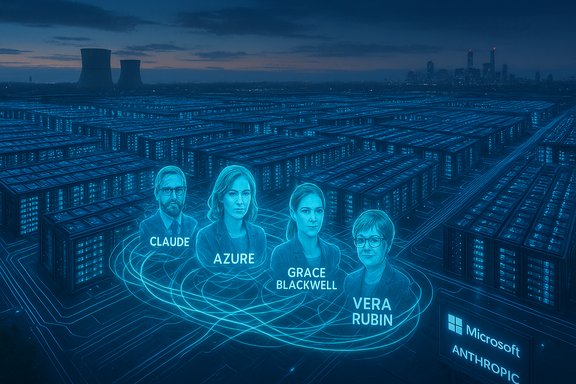
Microsoft, Nvidia, and Anthropic have announced a high-stakes, three‑way alliance that ties Anthropic’s Claude family of foundation models to Microsoft Azure at scale while creating an unprecedented co‑engineering relationship with Nvidia — a pact anchored by headline compute and investment commitments that reshape enterprise AI procurement and datacenter planning.
Anthropic launched Claude as a safety‑focused, enterprise‑oriented alternative in the frontier large‑language‑model (LLM) market. Over the last two years it has deliberately pursued multi‑cloud distribution to minimize single‑vendor dependency and to reach enterprise customers through multiple cloud marketplaces. Microsoft, after evolving Copilot from a single‑model proposition into a multi‑model orchestration layer, has been expanding Azure’s purpose‑built AI infrastructure. Nvidia has moved from a pure silicon supplier into a systems and platform partner with tight hardware‑software co‑design ambitions. The new agreement formalizes these trends by combining long‑term reserved cloud spend, deep chip‑to‑model engineering collaboration, and integrated commercial distribution.
Key public headlines from the joint announcement:
At the same time, the announcement crystallizes familiar tradeoffs: vendor concentration, execution risk, environmental costs, and the need for rigorous governance. The headline numbers are consequential, but the real test will be execution — tranche schedules, reproducible performance on representative workloads, and robust contractual protections for enterprise customers. Until then, organizations should pilot, measure, and insist on transparency before committing mission‑critical systems to any single vendor's frontier AI stack.
Source: TechRepublic Microsoft, Nvidia, and Anthropic Forge New AI Alliance
 Background / Overview
Anthropic launched Claude as a safety‑focused, enterprise‑oriented alternative in the frontier large‑language‑model (LLM) market. Over the last two years it has deliberately pursued multi‑cloud distribution to minimize single‑vendor dependency and to reach enterprise customers through multiple cloud marketplaces. Microsoft, after evolving Copilot from a single‑model proposition into a multi‑model orchestration layer, has been expanding Azure’s purpose‑built AI infrastructure. Nvidia has moved from a pure silicon supplier into a systems and platform partner with tight hardware‑software co‑design ambitions. The new agreement formalizes these trends by combining long‑term reserved cloud spend, deep chip‑to‑model engineering collaboration, and integrated commercial distribution.Key public headlines from the joint announcement:
- Anthropic has committed to purchase approximately $30 billion of Azure compute capacity over a multi‑year period.
- Anthropic may contract additional, dedicated capacity up to an electrical ceiling described as one gigawatt of IT load.
- Nvidia has pledged to invest up to $10 billion in Anthropic and enter a deep technical partnership for model ↔ silicon co‑optimization.
- Microsoft will invest up to $5 billion and will surface Claude models across Azure AI Foundry and Microsoft’s Copilot family.
What the deal actually includes
Financial and capacity commitments
The numeric scale is the headline: the $30 billion Azure compute commitment and the 1 GW capacity ceiling convert Anthropic’s model roadmap into predictable infrastructure demand for Microsoft and a marquee customer for Nvidia. These figures signal long‑term, reservation‑style consumption rather than an immediate one‑time purchase; they give Anthropic stabilized unit economics for training and inference while justifying Microsoft’s and Nvidia’s deeper investments and facility planning.- $30B compute purchase: Frames multi‑year Azure reserved capacity and predictable cloud spend.
- 1 gigawatt ceiling: An electrical capacity target implying multiple AI‑dense data halls and heavy facility engineering (substations, liquid cooling, high floor loading). This is not a GPU count; it’s a facilities metric.
- $10B Nvidia / $5B Microsoft: Staged strategic investments intended to align incentives and support Anthropic’s growth.
Product and distribution commitments
Anthropic’s most recent frontier Claude variants — Claude Sonnet 4.5, Claude Opus 4.1, and Claude Haiku 4.5 — are named in partner messaging as being made available through Azure AI Foundry and integrated across Microsoft Copilot surfaces (Microsoft 365 Copilot, GitHub Copilot, Copilot Studio). That places Claude as one of the frontier models intentionally usable inside Microsoft productivity tooling and Azure's enterprise model catalog. Anthropic has emphasized that Claude will remain multi‑cloud in practice, but the Azure commitment anchors a material footprint on Microsoft’s platform.Technical partnership: model-to-silicon co‑engineering
For the first time, Nvidia and Anthropic will co‑engineer model optimizations and tune future Nvidia architectures to Claude’s workload profiles. The collaboration explicitly names Nvidia’s latest families — Grace Blackwell and the upcoming Vera Rubin systems — and references rack‑scale GB300/Blackwell topologies as target systems. The goal is better throughput, lower token cost, and improved total cost of ownership (TCO) for large training and inference runs. Nvidia’s CEO framed the collaboration in optimistic terms, and executives expect significant performance and efficiency gains from the co‑design work.The technical and operational implications
What "one gigawatt" really means
“One gigawatt” is shorthand for very large, sustained IT load — not a simple accelerator count. Practically, a 1 GW IT footprint implies:- Multiple AI‑dense data halls or campuses, each requiring substations, high‑capacity transformers, and long‑term utility contracts.
- Advanced cooling systems (often liquid cooling) and significant floor loading and mechanical infrastructure.
- Rack and fabric architectures that favor NVLink/NVSwitch domains and tightly coupled GPU clusters to support synchronous distributed training.
Co‑design for performance and cost
The technical partnership aims to tune Claude across several axes:- Kernel and operator optimizations targeting tensor cores and custom instruction pipelines.
- Quantization and precision strategies that trade off memory footprint for throughput while retaining model quality.
- Memory and interconnect topologies that exploit Grace Blackwell’s CPU+accelerator coherency and future Vera Rubin designs.
Integration with Microsoft’s stack
Anthropic’s Claude will be integrated more deeply into Azure AI Foundry and Microsoft Copilot. For enterprise customers this means:- Easier selection and routing of models inside existing productivity and developer surfaces.
- Potentially lower latency and integrated enterprise SLAs for Claude‑based workloads when served from Azure regions.
Strategic analysis: strengths and potential gains
Strengths and upside
- Predictable scale for Anthropic: Long‑term reserved Azure capacity stabilizes the economics of training and inference at frontier scale, enabling larger models and more frequent iterations.
- Hardware‑aware efficiency: Co‑engineering with Nvidia should materially reduce iteration times and token costs when Claude variants are tuned to Blackwell/Vera Rubin topologies. That improves TCO for production deployments.
- Enterprise distribution: Embedding Claude across Microsoft Copilot and Foundry opens direct enterprise channels that package models with identity, billing, SLAs, and compliance controls—making it easier for IT teams to pilot and scale.
- Ecosystem incentives aligned: Nvidia and Microsoft’s investments align incentives: Anthropic gets capital and preferential access; Microsoft secures a richer model catalog; Nvidia gains a high‑value workload partner that helps shape future hardware.
Tangible business benefits for adopters
- Faster time to scale for production AI agents and retrieval‑augmented generation (RAG) systems via integrated stacks.
- Potential cost reductions for high‑volume inference if co‑optimization yields the promised throughput and token‑cost improvements.
- Simplified procurement and support for customers already committed to Azure, especially for Windows‑centric enterprise environments.
Risks, unknowns, and governance concerns
Vendor concentration and lock‑in
A single vendor controlling significant slices of the frontier stack creates legal, economic, and operational risk. A $30 billion reserved buy and a gigawatt‑class capacity commitment materially increase Anthropic’s dependency on Azure for certain classes of workloads — an outcome that shifts bargaining power toward Microsoft and Nvidia for those use cases. Enterprises should watch for SLA guarantees, regional redundancy, and contractual portability clauses.Execution risk and timing uncertainty
Headline numbers are public announcements of intent. The companies have not published granular tranche schedules, exact hardware counts, or regional rollout timetables in full detail. Converting a multi‑year commitment into actual, sustained gigawatt‑class deployments takes significant engineering and utility work — and those timelines will shape when customers can rely on promised capacity. Treat the public figures as strategic commitments, not immediate deliverables.Unverified performance claims
Statements about “an order of magnitude speed up” or similar accelerations must be validated through independent, workload‑specific benchmarks. Performance gains depend on multiple variables: model architecture, batch size, context length, quantization, and network fabric. Enterprises should require reproducible benchmarks on representative workloads before committing to large migrations.Environmental and operational costs
Gigawatt‑scale AI campuses carry substantial energy, water, and emissions considerations. Power procurement, onsite cooling design, and heat‑recovery strategies will matter financially and reputationally. CIOs should evaluate sustainability metrics and regulatory exposure as part of any procurement decision tied to these capacity promises.Regulatory and antitrust scrutiny
Large, cross‑ownership ties between cloud, chip, and model vendors can attract regulatory attention in multiple jurisdictions — especially where investments create circular commercial dependencies between companies that are supplier and investor to one another. Watch for antitrust and national security reviews in key markets.Practical guidance for Windows‑centric enterprises
For IT leaders and architects working in Windows and Azure ecosystems, this alliance is an operational inflection point. The sensible path forward is staged, measurable, and governance‑first.- Pilot first, then scale: run scoped POCs with clear success metrics (latency, cost per token, accuracy) and insist on reproducible benchmarks on the exact Azure SKUs you will use.
- Require contractual clarity: insist SLAs include model routing guarantees, regional redundancy, capacity commitments, and transparent pricing for peak load and egress.
- Maintain multicloud options: preserve portability of critical model assets (fine‑tuning recipes, knowledge graphs, and curated datasets) so you can move workloads if economics or policy compel it.
- Benchmark for your workloads: demand vendor‑neutral, third‑party benchmarks that mimic your production queries and context lengths; do not rely solely on vendor marketing claims.
- Strengthen governance: adopt AgentOps and AI lifecycle controls—identity, provenance, explainability, access control, and audit trails—before moving agents into production.
Competitive and market implications
The alliance accelerates an industry trend: the industrialization of AI through combined compute, capital, and co‑engineering. It reshapes who controls front‑end distribution (cloud marketplaces and productivity surfaces) and who shapes the hardware roadmap (chip vendors cooperating with model developers).- For cloud rivals: AWS and Google already host Anthropic in different capacities; this Azure commitment preserves Anthropic’s multi‑cloud posture but anchors a major operational footprint in Microsoft’s data centers — forcing competitors to rethink incentives for other model developers.
- For chip makers: Nvidia deepens its pivot into platform engineering; co‑design partnerships like this make accelerator roadmaps more workload‑driven. That dynamic favors vendors who can demonstrate close hardware‑software feedback loops.
- For model vendors: The lines between customer, supplier, and investor are blurring. Strategic investments by Nvidia and Microsoft into Anthropic align commercial incentives but also create new governance questions about independence and competitive dynamics.
What to watch next
- Implementation timelines and tranche details for the $30B Azure purchases: when and where capacity will be delivered, regional allocations, and amortization schedules. These determine when customers can rely on the new capacity.
- Independent benchmark results demonstrating real‑world throughput and cost improvements on Grace Blackwell and Vera Rubin systems. Until we see reproducible tests, treat vendor speed‑up claims as aspirational.
- Contractual language around availability, SLAs, and portability—especially clauses that protect customers from sudden allocation changes or geopolitical restrictions.
- Regulatory scrutiny in major jurisdictions and any public filings that disclose investment terms or equity dilution related to Nvidia’s and Microsoft’s capital commitments.
Conclusion
The Microsoft–Nvidia–Anthropic alliance is a defining moment in the industrialization of frontier AI: a coordinated bet that ties capital, compute, and co‑design to accelerate Claude’s progression from research artifact to enterprise grade service. For Windows‑centric organizations and Azure adopters, the upside is clear — broader model choice inside Copilot and Foundry, potential cost and speed gains from Nvidia co‑optimization, and a path to scale production AI faster than before.At the same time, the announcement crystallizes familiar tradeoffs: vendor concentration, execution risk, environmental costs, and the need for rigorous governance. The headline numbers are consequential, but the real test will be execution — tranche schedules, reproducible performance on representative workloads, and robust contractual protections for enterprise customers. Until then, organizations should pilot, measure, and insist on transparency before committing mission‑critical systems to any single vendor's frontier AI stack.
Source: TechRepublic Microsoft, Nvidia, and Anthropic Forge New AI Alliance
