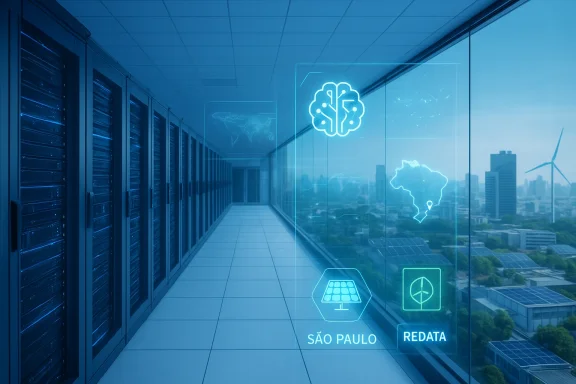
Microsoft has quietly moved the next piece of its Brazil strategy into production: during the company’s AI Tour in São Paulo, Microsoft confirmed that two data halls are now in operation at a São Paulo site as part of its previously announced R$14.7 billion (roughly $2.7 billion) investment in cloud and artificial intelligence infrastructure for Brazil. The announcement — delivered by Priscyla Laham, president of Microsoft Brasil — is short on technical detail but long on strategic consequence: it marks the transition from land, permits and construction to the actual availability of additional capacity to serve AI and cloud workloads inside Brazil’s most populous state. This article unpacks what “two data halls in operation” likely means, places the move in the context of Microsoft’s broader Brazil commitments, and assesses the economic, regulatory, sustainability and technical implications for customers, competitors and the local market.
Microsoft’s September 2024 pledge to invest R$14.7 billion in Brazil over three years tied a major capital expansion to a national skilling program called ConectAI, which set out to train 5 million Brazilians in AI-related skills. The spending plan framed Brazil as a strategic market for Microsoft’s global cloud and AI rollout and included specific plans to expand Azure capacity in the São Paulo metropolitan and greater Campinas areas. Over the last 18 months Microsoft has published local construction updates confirming multiple campuses in the Campinas corridor — notably sites in Hortolândia and Sumaré — and local authorities have tracked the project as among the largest technology investments in the region’s recent history.
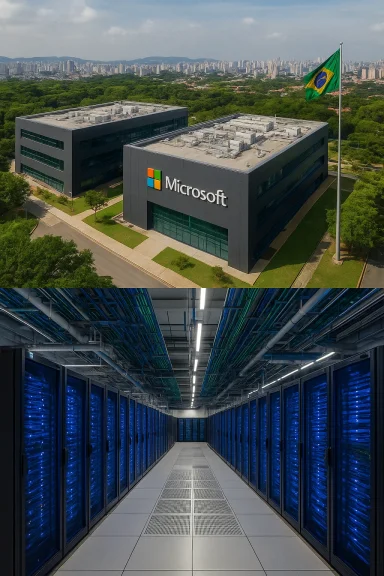
The term “data halls” is deliberately narrow: in hyperscale operator language it usually refers to the interior, operational spaces where server racks and networking equipment live, as distinct from mechanical yards, power substations or external campus works. When Microsoft says two data halls are “in operation,” it does not necessarily mean two separate new buildings — the phrase can describe two completed rooms within a larger campus or two modules inside an existing facility. Microsoft, when announcing the update on stage in São Paulo, did not disclose the precise location, the electrical capacity, rack counts, design power density or whether these halls are intended primarily for general-purpose cloud, specialized AI inference/training, or a mix of both. That lack of disclosure is meaningful: it leaves the industry to infer intent from construction activity, local planning documents and Microsoft’s global datacenter posture.
However, the policy landscape is not without friction:
Equally important are the unknowns: Microsoft’s omission of size, power capacity and accelerator mix leaves customers, competitors and regulators to infer intent. Investors and policymakers should prioritize clarity on REDATA’s final form, grid capacity planning for high-density AI operations, and transparent community commitments on water, energy and tax contribution. If handled well, this new operational capacity can accelerate Brazil’s digital economy and position São Paulo as a regional AI hub; if handled poorly, it risks the usual pitfalls of rushed infrastructure growth — regulatory friction, supply bottlenecks and community backlash.
Microsoft’s quietly announced operational milestone — two data halls live in São Paulo — is less a single headline and more a practical inflection point. It confirms that significant, tangible capacity has moved from plans to production inside Brazil, aligning with Microsoft’s broader R$14.7 billion commitment and the ConectAI skilling push. The next chapters will be written in the details Microsoft chooses to release about power, hardware and service tiers, and in the legislative and local infrastructure choices policymakers make to accommodate a new class of energy- and compute-intensive facilities. For Brazilian enterprises, cloud architects and public-sector planners, the imperative is the same: convert the announcement into concrete technical and commercial review, because the capability to run AI inside Brazil is no longer a future promise — it is now a live option that demands immediate, practical decisions.
Source: Data Center Dynamics Microsoft brings two data halls online in São Paulo, Brazil
 Background / Overview
Microsoft’s September 2024 pledge to invest R$14.7 billion in Brazil over three years tied a major capital expansion to a national skilling program called ConectAI, which set out to train 5 million Brazilians in AI-related skills. The spending plan framed Brazil as a strategic market for Microsoft’s global cloud and AI rollout and included specific plans to expand Azure capacity in the São Paulo metropolitan and greater Campinas areas. Over the last 18 months Microsoft has published local construction updates confirming multiple campuses in the Campinas corridor — notably sites in Hortolândia and Sumaré — and local authorities have tracked the project as among the largest technology investments in the region’s recent history.The term “data halls” is deliberately narrow: in hyperscale operator language it usually refers to the interior, operational spaces where server racks and networking equipment live, as distinct from mechanical yards, power substations or external campus works. When Microsoft says two data halls are “in operation,” it does not necessarily mean two separate new buildings — the phrase can describe two completed rooms within a larger campus or two modules inside an existing facility. Microsoft, when announcing the update on stage in São Paulo, did not disclose the precise location, the electrical capacity, rack counts, design power density or whether these halls are intended primarily for general-purpose cloud, specialized AI inference/training, or a mix of both. That lack of disclosure is meaningful: it leaves the industry to infer intent from construction activity, local planning documents and Microsoft’s global datacenter posture.
What “two data halls” could mean — decoding the terminology
Data halls versus data centers: the semantics matter
- Data hall: a single interior block designed to hold rows of server racks, with its own cooling and power distribution; a building can contain multiple data halls.
- Data center campus: multiple buildings (each potentially with multiple data halls), separate substation connections, and dedicated site infrastructure such as water treatment and renewable generation agreements.
- Microsoft brought two completed hall modules inside an already announced campus online (the most likely interpretation when expansion is staged).
- Microsoft opened two small standalone buildings that qualify as halls rather than full multi-hall campuses.
- Microsoft is operating two specialized halls (for example, one for general-purpose cloud and one provisioned for high-density AI accelerators).
Why the company might not disclose capacity or power density
Hyperscalers often withhold specifics for reasons including commercial confidentiality, security and local permitting strategies. Revealing rack counts, megawatt (MW) capacities, or accelerator types can reveal absorption rates for supply chains and attract regulatory or public scrutiny about energy and water use. Microsoft’s public posture in other markets balances transparency on community benefits and sustainability with discretion on technical throughput.The local footprint: Hortolândia, Sumaré, Campinas and the wider São Paulo region
Microsoft’s local communications and municipal records have been explicit about a broader campus program in the greater Campinas region. Public updates indicate:- Multiple construction sites in Hortolândia with at least two separate facilities reported as under development.
- A third facility in Sumaré described as part of the same regional strategy, with the operational access and campus logistics tying the sites together.
- Earlier Azure region launches placed Azure’s Brazil South region in Campinas and documented expansion to support three availability zones.
Why this matters: strategic and commercial implications
1) In-country capacity for AI workloads
Bringing capacity into São Paulo addresses a pressing market need: AI workloads — particularly large-scale inference and any on-prem-style private deployments — benefit from reduced latency, regulatory compliance for data residency, and resilience against cross-border outages. Having operational halls in Brazil means Microsoft can advertise in-country compute for customers seeking to keep sensitive data within national borders or to host latency-sensitive services in São Paulo.2) Reinforcing Azure’s Brazil footprint and disaster recovery posture
Azure’s two geographies in Brazil — historically Brazil South (São Paulo state) and Brazil Southeast (Rio) — serve different regional requirements. Additional on-the-ground capacity in São Paulo increases redundancy options inside the Brazil South region and can ease constrained capacity or service availability for enterprise customers. It also provides Microsoft with the flexibility to support “restricted access” region scenarios for disaster recovery without pushing workloads offshore.3) Supply chain and vendor opportunities
Large-scale datacenter builds create local and regional demand for power infrastructure, modular construction, security services, freight and data cabling. Microsoft’s approach tends to create multi-year procurement cycles, benefiting local integrators, civil contractors and power suppliers.Regulatory and fiscal environment: REDATA, Bill 278 and the policy ambiguity
Brazil’s federal government has pursued an ambitious incentive program — commonly called REDATA — designed to reduce the effective tax burden associated with importing and installing critical IT equipment for data center projects. The incentive framework envisages suspension or exemption from federal levies such as PIS/Pasep, Cofins and IPI for qualifying investments, with conditions often tied to sustainability commitments and local ecosystem investment.However, the policy landscape is not without friction:
- Legislative instruments have shifted between provisional measures and bills, and numbering can differ across reporting; that legal evolution creates timing uncertainty for investors who plan procurement schedules years in advance.
- There have been reports of concurrently rising import tariff adjustments for electronics that, if applied, could blunt the attractiveness of the REDATA exemption unless the law’s final wording robustly supersedes those tariff changes.
- Microsoft has publicly stated that REDATA (or the bill referred to in some coverage as Bill 278) did not alter “what we agreed with Brazil,” signaling that Microsoft negotiators consider existing commitments intact. But industry associations and customs resolution changes have flagged potential contradictions that introduce regulatory risk.
Local economic impact: jobs, training, and the ConectAI skilling program
Microsoft’s investment has two clear economic components:- The direct capital injection for physical infrastructure, which drives construction employment, local procurement and municipal tax revenue.
- The ConectAI skilling program, which commits to training 5 million Brazilians in AI and cloud-related competencies over the stated timeframe.
Sustainability and resource management: capacity versus responsibility
Microsoft’s corporate pledges are explicit: to be carbon negative, water positive, and zero waste by 2030. In practice this translates to:- Procuring renewable energy or energy attributes to cover datacenter consumption (often via long-term power purchase agreements or grid investments).
- Designing cooling systems and electrical architecture to minimize water consumption — global Microsoft engineering includes direct-to-chip cooling and other water-saving innovations.
- Community commitments around not increasing local electricity prices, minimizing water use and investing in local sustainability programs.
Technical architecture and customer implications
What customers should expect
- Lower latency for São Paulo-hosted services and improved compliance posture for data residency requirements.
- Potentially new SKUs or commitments from Microsoft for region-localized AI inference, model deployment and dedicated accelerator access depending on the installed hardware mix.
- Improved disaster-recovery topology options for enterprises that want to keep all copies inside Brazil.
What remains unknown (and why it matters)
- Mains capacity and MW per hall: Without disclosed megawatt figures, it’s impossible to infer how many racks or what density (kW per rack) each hall supports.
- Accelerator mix: Whether halls are provisioned for GPU-heavy AI training, inference with optimized accelerators, or general-purpose compute will determine which enterprise use-cases are best served locally.
- Connectivity and peering: Peering arrangements and direct interconnect capacities to São Paulo’s major network nodes will determine the user experience for latency-sensitive workloads.
Risks and downside scenarios
- Regulatory volatility — If REDATA’s final terms shift or if concurrent tariff policies increase equipment import costs, project economics can be affected and future Microsoft procurement schedules may be adjusted.
- Resource contention — Large AI-capable halls draw significant power and can elevate local grid constraints, potentially triggering the need for on-site substations, new transmission agreements or local energy investments.
- Community and political pushback — Datacenters frequently encounter local scrutiny over land use, water use and perceived corporate tax behavior. Microsoft’s community-first pledges reduce but do not eliminate the risk of local opposition.
- Supply-chain strain — Global competition for AI accelerators and high-density servers remains acute. Local availability of these components and customs processing will influence the speed at which additional halls can come online.
- Uncertain disclosure — The lack of detailed public specifications inhibits precise market and competitive analysis. Competitors, customers and regulators must interpret incremental updates carefully.
Competitive and regional context
Brazil is now part of a broader Latin American battleground for datacenter investment. Multiple governments have made tax and regulatory overtures to attract hyperscalers, and regional operators are scaling up capacity. Microsoft’s move to operate halls inside São Paulo increases competitive pressure on other cloud providers and local colocation players to scale capacity, negotiate power and accelerate network interconnection. For customers, this creates more choices, but it also raises the bar for compliance and cybersecurity expectations: in-country capacity can lower latency and satisfy residency rules, but it also concentrates demand for up-to-date governance, incident response and local staffing.What to watch next — practical signals and timelines
- Microsoft site updates and local project filings — Microsoft’s own “local” datacenter community pages and municipal building filings are the best near-term sources for progress, as they often list contractor activity, dates and community engagement programs.
- Equipment procurement signals — Large tenders from power suppliers or long-term renewable energy contracts in the Campinas corridor will indicate the scale of future halls coming online.
- Legislative movement on REDATA/Bill 278 — Passage and final text of the tax regime will materially affect capex planning and procurement timetables.
- Service announcements from Microsoft Azure — New region-level SKUs, availability zone expansions, or GPU/accelerator-specific offerings targeted at Brazil will be the clearest sign of how these halls are being used.
- Local labor and training outputs — Metrics on ConectAI progress and datacenter academy placements will show whether the promised workforce funnel is materializing.
Bottom line — what this really means for Brazilian cloud and AI users
Microsoft bringing two data halls online in São Paulo is a pivotal operational milestone in a larger three-year, multi-campus strategy to make Brazil a more native hub for cloud and AI services. For enterprises and public institutions, it signals tangible in-country capacity that can reduce latency, improve data sovereignty and broaden Azure’s resilience options in Brazil. For the local economy, the move brings construction employment, supplier demand and long-term, higher-skilled roles — but the majority of jobs will come from the broader ecosystem rather than from long-term datacenter staffing alone.Equally important are the unknowns: Microsoft’s omission of size, power capacity and accelerator mix leaves customers, competitors and regulators to infer intent. Investors and policymakers should prioritize clarity on REDATA’s final form, grid capacity planning for high-density AI operations, and transparent community commitments on water, energy and tax contribution. If handled well, this new operational capacity can accelerate Brazil’s digital economy and position São Paulo as a regional AI hub; if handled poorly, it risks the usual pitfalls of rushed infrastructure growth — regulatory friction, supply bottlenecks and community backlash.
Practical guidance for customers and partners
- Evaluate your data residency needs now. If compliance or low-latency access to São Paulo matters, engage Microsoft account teams to understand which services can be routed to the newly operational halls.
- Assess disaster recovery plans in light of new in-country capacity. Additional local halls can change replication strategies and reduce cross-border dependencies.
- Monitor REDATA developments closely. Tax certainty will influence procurement timing and cost forecasting for hardware-dependent projects.
- Push for vendor transparency on resource usage and service SLAs. Operators should provide clearer signals about accelerator availability and power density so customers can architect appropriately.
- Engage with local training initiatives (ConectAI) to help cultivate the operational talent pipeline Microsoft and the region will need as these halls scale.
Microsoft’s quietly announced operational milestone — two data halls live in São Paulo — is less a single headline and more a practical inflection point. It confirms that significant, tangible capacity has moved from plans to production inside Brazil, aligning with Microsoft’s broader R$14.7 billion commitment and the ConectAI skilling push. The next chapters will be written in the details Microsoft chooses to release about power, hardware and service tiers, and in the legislative and local infrastructure choices policymakers make to accommodate a new class of energy- and compute-intensive facilities. For Brazilian enterprises, cloud architects and public-sector planners, the imperative is the same: convert the announcement into concrete technical and commercial review, because the capability to run AI inside Brazil is no longer a future promise — it is now a live option that demands immediate, practical decisions.
Source: Data Center Dynamics Microsoft brings two data halls online in São Paulo, Brazil