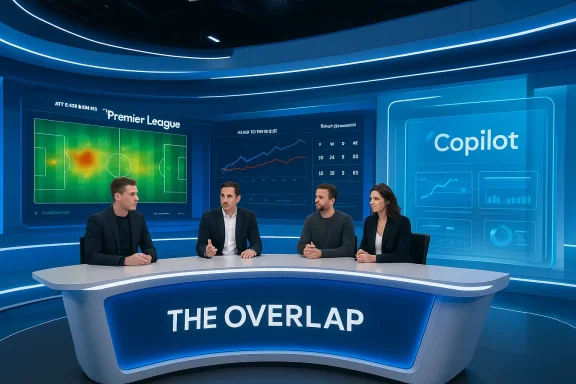
Microsoft’s Copilot is now being folded directly into one of the Premier League’s most influential fan channels, with the tech giant and Sky Media launching a campaign that embeds the Premier League Companion into Gary Neville’s The Overlap network to bring near‑real‑time, data‑driven insight to pundits and viewers.
That architecture uses Azure OpenAI tooling to index and query league‑curated content and statistics, with Microsoft describing subsequent enhancements — multilingual Q&A, near‑real‑time data overlays and planned Fantasy Premier League assistance — as part of an evolving roadmap. The stated goal: let fans ask natural‑language questions and get timely, contextual answers that bring archive footage, stats and match context together instantly.
Important to note: the detailed campaign elements — the specific segments, TVC length and media plan — have been reported via Advanced Television and quoted statements from participating parties. At the time of reporting, those campaign particulars appear in trade coverage rather than as a single co‑published press release from Microsoft, the Premier League or Sky Media; readers should treat platform placement and airtime specifics as those reported in the trade announcement until they are repeated in broadcaster or corporate channels.
For broadcasters and rights holders, that’s powerful: real‑time, evidence‑based insight can increase viewer retention, encourage second‑screen interaction and create micro‑moments that are highly shareable on social — exactly what advertisers and commercial partners want. Sky Media’s involvement indicates a commercial strategy that pairs creative media planning with tech novelty, giving sponsors a place inside the conversation rather than simply a banner around it.
However, the initiative is not risk‑free. Real‑time reliability, rights complexity, editorial transparency and the persistent hazard of model hallucination are all active concerns that must be mitigated through engineering discipline and rigorous editorial processes. Trade reports indicate the campaign’s creative and media plan, but those specifics should be treated as reported by trade press pending fuller confirmation from the involved corporate parties.
Yet the success of this initiative will be measured less by marketing language and more by operational realities: the Companion’s factual accuracy, the stability of live data pipelines, the clarity of commercial signals and the robustness of content rights arrangements. If those pieces come together, we’ll see a template for future sport‑tech collaborations; if they don’t, the activation risks becoming a reminder that great tech demos still need painstaking editorial and legal work before they become trusted parts of the broadcast ecosystem.
Source: Advanced Television Microsoft launches Premier League Companion with The Overlap
 Background
What the Premier League Companion is — and where it came from
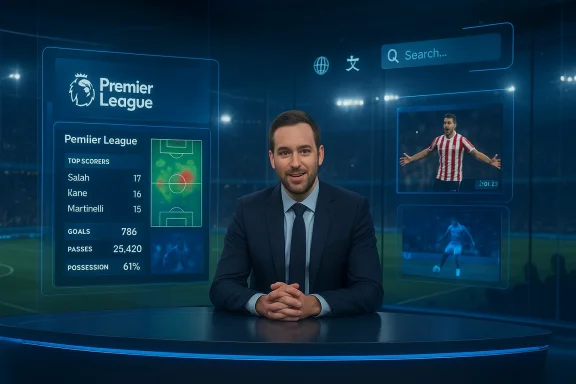
The Premier League Companion is the fan‑facing expression of the Premier League’s 2025 technology tie‑up with Microsoft. Built on Microsoft’s Copilot and Azure AI Foundry services, the Companion was introduced as part of a five‑year strategic partnership announced in July 2025 that positions Microsoft as the Premier League’s official cloud and AI partner and commits to modernizing league systems, broadcasts and fan experiences. At launch, Microsoft and the Premier League said the Companion draws on more than 30 seasons of stats, roughly 300,000 articles and around 9,000 videos, and is designed to deliver personalized, searchable insights via the league’s official app and web platforms.That architecture uses Azure OpenAI tooling to index and query league‑curated content and statistics, with Microsoft describing subsequent enhancements — multilingual Q&A, near‑real‑time data overlays and planned Fantasy Premier League assistance — as part of an evolving roadmap. The stated goal: let fans ask natural‑language questions and get timely, contextual answers that bring archive footage, stats and match context together instantly.
The Overlap: from YouTube native to mainstream platform
The Overlap began as a fan‑facing YouTube and podcast network co‑founded by Gary Neville and has grown rapidly into a multi‑format sports media brand. Its shows — notably Stick to Football, The Breakdown and The Fan Debate — feature high‑profile football voices such as Neville, Roy Keane and Jill Scott and command large audiences across YouTube, audio platforms and social channels. The Overlap has also undergone recent commercial evolution, including a majority stake sale and broader distribution ambitions reported in major outlets, making it a logical testbed for branded, talent‑led technology activations.The new activation: what Microsoft, Sky Media and The Overlap are doing
The announcement — first reported by trade outlet Advanced Television — describes a campaign created by Sky Media and Microsoft that integrates the Premier League Companion into Overlap content from now until the end of the football season. Branded segments will appear within key Overlap formats (notably Stick to Football, The Breakdown and The Fan Debate), and the programme of activity will be amplified with social cutdowns, a 30‑second TV commercial airing around selected Premier League matches, and distribution across YouTube, major audio platforms and linear TV. Microsoft UK & Ireland CEO Darren Hardman and Gary Neville provided soundbites for the launch, with Sky Media’s Karin Seymour framing the tie‑up as an example of brand and content working together to “power culture, not interrupt it.”Important to note: the detailed campaign elements — the specific segments, TVC length and media plan — have been reported via Advanced Television and quoted statements from participating parties. At the time of reporting, those campaign particulars appear in trade coverage rather than as a single co‑published press release from Microsoft, the Premier League or Sky Media; readers should treat platform placement and airtime specifics as those reported in the trade announcement until they are repeated in broadcaster or corporate channels.
Why this matters: the intersection of AI, broadcast and fandom
Making punditry data‑driven and interactive
Embedding Copilot‑powered insight into a conversational, personality‑led show is a deliberate attempt to reframe how analysis is produced and consumed. Microsoft’s stated ambition is to make analysis “more interactive and accessible,” letting pundits and fans “go deeper, faster.” When a panelist says “show me the last five times a manager rotated his midfield and what happened,” the Companion aims to produce a concise stat + video clip + historical comparison in seconds — a capability that shifts the role of the pundit from sole source of insight to an interpreter of an AI‑assisted dataset.For broadcasters and rights holders, that’s powerful: real‑time, evidence‑based insight can increase viewer retention, encourage second‑screen interaction and create micro‑moments that are highly shareable on social — exactly what advertisers and commercial partners want. Sky Media’s involvement indicates a commercial strategy that pairs creative media planning with tech novelty, giving sponsors a place inside the conversation rather than simply a banner around it.
Fan experience: personalization, translation and fantasy assistance
From a consumer perspective, the Companion’s headline features are personalization and searchability. The Premier League has said Companion can be used to explore archives, summarize latest club news, and provide updates in multiple languages — useful for a global audience that numbers in the billions by the league’s estimates. Microsoft has also signaled future integration with Fantasy Premier League, promising fans an “assistant manager” that can recommend transfers or set‑ups based on data and fixtures. This pathway — from passive viewer to actively coached user — represents a broader shift in how sports apps aim to retain engagement.Technical anatomy: what powers the Companion and what it requires
Core stack and data sources
According to Microsoft and Premier League material, the Companion uses:- Azure OpenAI / Copilot for natural language interaction and answer generation.
- Azure AI Foundry capabilities and other Azure services for live overlays and post‑match analysis.
- Large, league‑curated data sets: match statistics across 30 seasons, hundreds of thousands of articles and thousands of videos that have been indexed for retrieval.
Real‑time vs near‑real‑time: the latency problem
“Near‑real‑time” is often used as a flexible marketing phrase; in practice, achieving genuinely low latency for live match events — seconds rather than minutes — requires direct ingest of official match feeds and low‑latency indexing. Microsoft has emphasized real‑time overlays as a future enhancement, and the underlying Azure Foundry tools are aimed at enabling faster inference and overlaying live datasets, but the tolerances for broadcast use are tight: any delay or error in live stats undermines credibility. That technical bar is achievable at scale, but it depends on tight integration with the Premier League’s official data partners and careful orchestration of streaming and model inference pipelines.Editorial and ethical considerations
Accuracy, hallucination and trust
Generative models are powerful for synthesis, but they can produce plausible‑sounding hallucinations — statements that read like fact but are incorrect. For sports journalism and punditry, the cost of a hallucinated stat or misattributed clip is reputational. Microsoft and the Premier League have sought to hedge this risk by describing the Companion as a retrieval‑backed system that pulls from curated league content; retrieval grounding reduces hallucination risk but does not eliminate it. Newsrooms and talent teams embedding these systems must retain editorial checks: every data point the Companion surfaces during live segments should be verifiable by a producer or stat‑checker before it’s relied on in broadcast.Commercialisation of punditry and native advertising risks
Embedding branded segments inside editorial podcasts and shows blurs the line between content and advertising. Sky Media’s stated objective — “to connect with and power culture, not interrupt it” — frames the activation as additive rather than intrusive, but publishers will need to keep transparency front and center. Regulators and audiences increasingly expect clear labeling where content is branded or sponsored; failing to signpost sponsored tech segments risks viewer distrust and raises questions about editorial independence.Data privacy and personalization
Personalized Companion features — especially those that tie into a user’s account or Fantasy Premier League — rely on user data, preferences and potentially behavioral inference. That raises the usual privacy obligations under UK and EU frameworks (and other jurisdictions where the Premier League operates). Microsoft and the Premier League will need robust data governance: clear consent, minimal data retention, options to opt out of personalization, and transparent explanations of how AI recommendations are generated. These are not just legal niceties; they are central to long‑term user trust.Commercial and rights implications
Media rights, clip licensing and distribution
Delivering short archive clips on demand inside a show or app requires precise licensing. The Premier League holds rights to match footage, but the ways publishers can surface that footage — topical clips inside podcasts, clips for social cutdowns, or in‑broadcast overlays — are governed by contracts with broadcast partners. Microsoft’s platform must respect those rights layers; Sky Media’s role as campaign creator suggests those contractual lines have been navigated for the UK market, but international distribution raises additional layers of complexity (different rights holders, territories and broadcast partners). Rights friction can cap what content can be used in certain places or how quickly clips can be repurposed.Sponsor value and measurement
From an advertiser’s point of view, an activation that embeds Copilot insights inside a high‑engagement show is attractive: it creates contextual ad opportunities, measurable engagement signals (clicks, app opens, retention) and social virality. Measurement will need to move beyond traditional TV GRPs: advertisers will want cross‑platform attribution, view‑through and interaction metrics that show Companion usage, clip plays and conversion lift. This is an opportunity for Sky Media and Microsoft to show how AI experiences can be monetized while remaining useful to the fan.Practical risks and limitations — what could go wrong
- Hallucinated or out‑of‑date information: Even retrieval‑backed systems can surface stale stats or mislabelled clips, especially in complex historical queries. Editorial guardrails are essential.
- Latency in live data feeds: Claims of “real‑time” insight are only as good as the match data pipeline. Without dedicated low‑latency feeds, the Companion may be delayed by tens of seconds or more.
- Rights and licencing friction: Territorial restrictions could limit where and how clips are used, complicating global rollouts of the campaign.
- Audience confusion / sponsorship transparency: If branded segments are not clearly labeled, trust may erode and damage both publisher credibility and advertiser outcomes.
- Privacy exposure at scale: Personalization features must be implemented with clear consent and robust data minimization to avoid regulatory and reputational risk.
How producers, pundits and rights holders should approach integration
- Maintain editorial checks: designate a stats producer or researcher to verify Companion outputs before they hit air.
- Transparently label branded integrations: use clear on‑screen marks and spoken cues to indicate when a segment is sponsored or powered by an external tool.
- Build fallback flows: if a Companion query fails or returns ambiguous results, have pre‑approved stats or clips producers can serve instead.
- Log and audit model outputs: retain query logs and human checks to analyze where the Companion succeeds or fails and to inform model retraining.
- Prioritize accessibility and language support: ensure Companion outputs are usable across languages and include captions and transcripts for the hearing‑impaired.
Strategic takeaways for Microsoft, the Premier League and broadcasters
- For Microsoft, the Companion is demonstrable evidence of Copilot being applied outside enterprise productivity: a fan‑facing, emotionally charged use case that can accelerate adoption narratives in consumer and media verticals. If executed cleanly, the activation demonstrates Copilot’s value in live, culturally relevant contexts.
- For the Premier League, the Companion can consolidate fragmented fan journeys — a single destination for discovery, clips and contextual insight. That helps increase direct engagement and gives the league more control over fan data and monetization compared to wholly distributed third‑party ecosystems.
- For broadcasters and publishers like The Overlap, the partnership offers a pathway to monetize talent‑led formats via value‑added tech while keeping the show’s personalities central. But editorial independence must be preserved to protect credibility and ensure pundit authenticity remains a core audience draw.
Broader industry context: AI and sport media in 2026
This launch fits a broader trend of sports leagues and tech firms partnering to layer AI over archives, stats and broadcast workflows. In 2025 and 2026 the industry has seen multiple large tie‑ups — leagues seeking platform modernization and tech firms wanting consumer showcase products — and the Premier League/Microsoft deal is among the most visible examples. The difference here is the deliberate pairing of a mainstream fan app (the Companion) with talent‑led third‑party content (The Overlap) to push the feature into cultural conversation rather than confine it to a standalone product.Verdict: a promising experiment with caveats
The integration of the Premier League Companion into The Overlap represents a turnkey use of AI to enrich sports conversation: it leverages personality‑driven content to surface contextual, data‑backed insight in a way that feels immediately useful to fans and pundits alike. If Microsoft’s retrieval approaches and the Premier League’s content indexing deliver consistent accuracy and low latency, the Companion could become an indispensable second‑screen tool and a compelling ad proposition for sponsors.However, the initiative is not risk‑free. Real‑time reliability, rights complexity, editorial transparency and the persistent hazard of model hallucination are all active concerns that must be mitigated through engineering discipline and rigorous editorial processes. Trade reports indicate the campaign’s creative and media plan, but those specifics should be treated as reported by trade press pending fuller confirmation from the involved corporate parties.
Quick takeaways for fans, tech watchers and media buyers
- Fans: expect faster, more contextual answers about matches, players and archives in the official Premier League app; treat quick AI conclusions as helpful but check official club or league announcements for breaking news.
- Tech watchers: the Companion is an important, consumer‑facing illustration of Copilot applied to a high‑volume, real‑time domain; watch how Microsoft balances retrieval grounding with generative flair.
- Media buyers: talent‑led activations that integrate useful tech can outperform traditional ad units — but insist on transparent measurement and clear sponsorship labelling to preserve trust.
Conclusion
Microsoft’s move to place the Copilot‑powered Premier League Companion inside The Overlap is a calculated experiment at the nexus of AI, fandom and commercial media. It translates a league‑level AI investment into the everyday conversations fans have about matches, while giving advertisers a new native space to reach engaged audiences. The potential is real: better, faster analysis; smarter personalization; and deeper engagement across platforms.Yet the success of this initiative will be measured less by marketing language and more by operational realities: the Companion’s factual accuracy, the stability of live data pipelines, the clarity of commercial signals and the robustness of content rights arrangements. If those pieces come together, we’ll see a template for future sport‑tech collaborations; if they don’t, the activation risks becoming a reminder that great tech demos still need painstaking editorial and legal work before they become trusted parts of the broadcast ecosystem.
Source: Advanced Television Microsoft launches Premier League Companion with The Overlap