
 Microsoft Finally Treats the 1.5TB Archive Wall as a Product Problem
For years, auto-expanding archiving in Exchange Online occupied an awkward place in Microsoft 365: marketed as cloud elasticity, administered like a compliance feature, and bounded by a hard limit that could become very real for the wrong organization at the wrong time. The current Microsoft documentation still describes auto-expanding archiving as providing up to 1.5TB of additional archive storage. More importantly, it warns that once an auto-expanded archive reaches that aggregate size, no more data is stored in the auto-expanding archive or moved from the main archive into it.
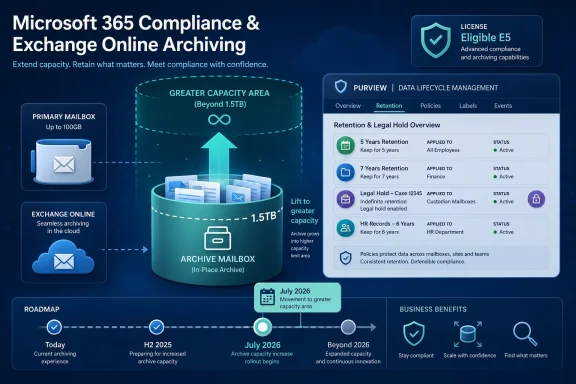
That is a dry sentence with ugly consequences. A mailbox that exists because a company is required to preserve data should not become inoperative precisely because the preservation requirement worked. Yet that is the situation Microsoft’s roadmap item is designed to address: archive mailboxes that previously stopped at 1.5TB will be able to expand beyond that threshold.
The timing matters. The feature was created on April 23, 2026, updated on June 26, 2026, marked as “In development,” and scheduled for general availability in July 2026. In Microsoft roadmap language, that does not mean every tenant wakes up on July 1 with infinite archive headroom. It means Microsoft has put a stake in the ground for a service-side change that will roll into the commercial Microsoft 365 cloud, specifically the worldwide standard multi-tenant environment.
The old limit was not simply an inconvenience for a few digital pack rats. It was a structural mismatch between how modern organizations use email and how Microsoft’s archive architecture had been bounded. Executive mailboxes, shared mailboxes with long operational histories, legal hold mailboxes, regulated communications, and long-lived inactive mailboxes can all become storage pressure cookers. The move beyond 1.5TB is Microsoft conceding that the edge case has become a predictable case.
The Archive Mailbox Became a Compliance System by Accident
The word “archive” still carries consumer baggage. It sounds like a place where old mail goes so Outlook feels cleaner. In Microsoft 365, though, the archive mailbox is often part of a much more serious chain of custody.
Auto-expanding archiving works by adding storage to a user’s archive mailbox as it fills. Administrators enable the feature, retention policies move older content out of the primary mailbox, and Microsoft’s service provisions additional archive capacity behind the scenes. For users, the online archive looks like another mailbox tree. For compliance teams, it is a place where retention, litigation hold, eDiscovery, and data lifecycle policies intersect.
That dual identity has always made Exchange Online archiving tricky to explain. A user may think of the archive as a dumping ground. A records manager may think of it as a governed repository. A sysadmin sees it as a quota-management tool. Microsoft Purview tries to wrap those roles in one compliance fabric, but the underlying Exchange mechanics still matter.
The 1.5TB cap exposed the tension. If a mailbox was retained because of legal or regulatory obligations, the organization could not simply say, “Stop preserving older content because Microsoft ran out of archive expansion.” Nor could it always delete data, especially when holds or retention settings required preservation. That made the archive ceiling a business-risk boundary, not just a storage limit.
This is why the new roadmap item belongs under Microsoft Purview Data Lifecycle Management rather than being framed as a minor Exchange Online capacity increase. It is about the lifecycle promise. If Microsoft tells customers to define retention rules in Purview, rely on cloud archives, and preserve content in place, then the platform must keep absorbing the results of those policies.
The July 2026 Change Is Narrower Than the Marketing Will Sound
The crucial phrase in Microsoft’s roadmap language is “eligible E5 licenses.” That is where the story becomes less about technical abundance and more about product segmentation.
Microsoft has not said, at least in the roadmap text, that every Microsoft 365 tenant with Exchange Online archiving will receive archive expansion beyond 1.5TB. The capability is explicitly described as available to customers with eligible E5 licenses. That leaves administrators with an immediate question: which users, mailbox types, and service plans count as eligible when the feature reaches production?
That distinction will matter in mixed-license environments. Many large tenants do not license every user at E5. They blend E3, frontline plans, Exchange Online plans, add-ons, shared mailboxes, and compliance licenses in patterns that reflect budget, role, geography, and risk. If the mailbox that needs more than 1.5TB is not attached to the right entitlement, the new ceiling may be irrelevant until procurement catches up.
The E5 tie also reinforces a broader Microsoft 365 pattern. Features that reduce compliance risk, improve investigation readiness, or extend governance at scale increasingly sit at the premium end of the licensing ladder. Microsoft can argue that massive archive growth imposes real service costs and belongs in the top tier. Customers can counter that retention obligations are not luxury features.
Both arguments can be true. Storage beyond 1.5TB is not free for Microsoft to operate, index, protect, and expose to search and compliance tooling. But for customers already paying for cloud productivity as critical infrastructure, a mailbox becoming inoperative at a hard compliance boundary was never a satisfying answer.
“Unlimited” Was Always the Wrong Word
The history of auto-expanding archiving is a reminder that cloud language ages badly. Earlier generations of Microsoft 365 marketing leaned heavily on the idea of very large or effectively unlimited archives. Over time, the service settled into more explicit limits, and the 1.5TB aggregate archive cap became the line administrators had to plan around.
That was not irrational. Every cloud platform has limits. The fiction is that elasticity removes capacity planning; the reality is that elasticity moves capacity planning into policy, licensing, and service behavior. Microsoft’s change does not make archive storage metaphysically infinite. It moves the visible boundary for certain customers.
This matters because some organizations will read “beyond 1.5TB” as “we no longer need to worry.” That would be a mistake. Microsoft has not used the roadmap item to publish a new upper limit, define the expansion increments, or describe any changed behavior for search, restore, eDiscovery export, migration, or inactive mailbox recovery at multi-terabyte scale. The word “beyond” is useful, but it is not the same as a service design document.
Admins should treat the July 2026 release as a capacity-risk reduction, not a license to ignore mailbox hygiene. A mailbox archive that grows past 1.5TB may no longer hit the old cliff, but it still carries operational weight. Search can become more consequential. Export workflows can become slower. Legal review sets can become larger. Backup and third-party archive strategies may still be required, depending on the organization’s recovery and compliance posture.
The healthier reading is that Microsoft is removing an artificial stop sign from a road that many compliance tenants were already forced to travel. It is not removing the need to know where the road goes.
The Practical Winner Is the Tenant With a Few Monster Mailboxes
Most organizations will never see a single user archive approach 1.5TB. Even in companies with long retention periods, the median mailbox is not the problem. The problem is the small population of mailboxes that accumulate unusually dense, unusually valuable, or unusually regulated communication over many years.
Those mailboxes often belong to senior executives, legal teams, finance departments, public-sector officials, HR investigators, customer-facing operational teams, or shared addresses that became institutional dumping grounds. They may also include inactive mailboxes preserved because a former employee’s communications are subject to hold. These are not always the mailboxes that receive daily admin attention until they become a crisis.
For that category, the new expansion behavior could be quietly important. The old model forced administrators to watch for archive growth, explain hard service limits to legal or compliance teams, and sometimes consider awkward remediation paths. Moving beyond 1.5TB reduces the odds that a single mailbox turns into a retention incident.
It also improves the credibility of in-place preservation. If an organization is trying to avoid exporting mail to PST files, third-party repositories, or bespoke retention silos, Microsoft has to make the native archive reliable at the sizes real customers produce. A 1.5TB ceiling may have been sufficient for typical users, but compliance systems are judged by the exceptions.
The change may also reduce some pressure to split workflows across tools. When a tenant trusts Exchange Online and Purview to keep holding data as it ages, it can simplify policy design. When the tenant fears a hard archive boundary, it starts designing around Microsoft rather than with Microsoft.
This Is Also a Search and Discovery Story
Storage is the visible part of the iceberg. The submerged part is discovery.
Keeping more mail is useful only if the organization can search, preserve, review, and produce it when required. Microsoft Purview’s value proposition depends on the idea that retained content remains governable. An archive that grows beyond 1.5TB must still be accessible to compliance search, eDiscovery workflows, holds, retention processing, and administrative reporting.
That is where administrators should be careful. Microsoft’s roadmap entry promises uninterrupted retention and scalable archive growth as thresholds are reached. It does not spell out performance expectations for very large archives. It does not say whether customers should expect different indexing behavior, different reporting surfaces, or different operational guidance once archives exceed the previous limit.
This is not nitpicking. In the real world, “we kept the data” is only half the sentence. The other half is “we can find and produce it.” A multi-terabyte archive that technically exists but is painful to search can still create business risk.
The likely answer is that Microsoft is making a back-end capacity change inside a system whose front-end management model remains familiar. That is good for continuity but leaves open the usual admin burden: test, measure, document, and avoid discovering the limits during litigation. If your organization has mailboxes anywhere near the current ceiling, the July 2026 rollout should trigger a review of eDiscovery assumptions, not just quota dashboards.
Retention Without Deletion Is Not a Strategy
A bigger archive can also enable bad habits. One of the least glamorous truths in information governance is that storage growth often reflects indecision. Organizations keep data forever not because they have a defensible retention strategy, but because deletion is politically harder than accumulation.
Microsoft’s roadmap language frames the new capability around uninterrupted retention. That is fair for organizations with legitimate retention obligations. But there is a difference between retaining what policy requires and preserving everything because no one wants to sign off on disposal. A larger auto-expanding archive makes the second behavior easier to ignore.
Purview Data Lifecycle Management is supposed to help solve that. Retention labels, retention policies, disposition reviews, and lifecycle rules exist so organizations can keep what they must and delete what they should. But many tenants still operate with broad, aging policies that were created years ago and rarely revisited. The archive grows because the policy says it should, and the policy remains because the archive can absorb it.
Raising the ceiling beyond 1.5TB removes a failure mode, but it does not create governance maturity. If anything, it raises the stakes for good policy. The more data a tenant can retain, the more expensive, risky, and cumbersome poor retention decisions become.
The best administrators will use this change as a reason to reopen conversations with legal, compliance, privacy, and records teams. Which mailboxes are growing fastest? Which retention policies are responsible? Which holds are still valid? Which inactive mailboxes are being preserved because of a real obligation, and which are simply ghosts no one has dared to remove?
The E5 Boundary Turns Capacity Into a Governance Tax
Microsoft’s decision to tie beyond-1.5TB archive expansion to eligible E5 licenses will be the part many customers notice first. It is not surprising, but it is consequential.
E5 is where Microsoft places much of its advanced security, compliance, analytics, and governance value. From Microsoft’s perspective, a massive archive expansion feature belongs there because it serves organizations with serious compliance needs and high storage consumption. From the customer side, it can look like an unavoidable tax on long-term data obligations.
This divide will be especially sharp in tenants with a small number of high-risk mailboxes. A company may not need E5 everywhere, but it may need beyond-1.5TB archiving for a few users or preserved mailboxes. If Microsoft’s entitlement model allows targeted licensing, that becomes a manageable cost. If eligibility is harder to apply cleanly across mailbox states and scenarios, it becomes another licensing puzzle.
Administrators should resist the temptation to treat this as a purely technical rollout. The first operational question is not “How do I enable it?” but “Who is entitled to benefit from it?” The answer may require coordination between Microsoft 365 admins, licensing owners, compliance officers, and finance teams.
There is also a risk of false reassurance. A tenant might see Microsoft’s announcement, assume the archive ceiling has gone away, and fail to notice that only a subset of mailboxes qualify. In compliance, assumptions are how small configuration details become large incidents.
Microsoft’s Roadmap Language Leaves the Hard Questions for Docs Day
The roadmap item is short, as roadmap items usually are. It tells us the previous 1.5TB limit, the new ability to expand beyond it, the eligible E5 customer framing, the product area, the cloud instance, the release ring, and the target month. It does not tell us the new maximum, if any.
That omission is the center of the uncertainty. “Beyond 1.5TB” could mean a substantially higher fixed ceiling. It could mean a service-managed growth model with internal limits Microsoft does not want to publish. It could mean different limits by license, mailbox type, or operational state. Until Microsoft updates its Learn documentation or posts detailed admin guidance, customers should avoid writing policies based on implied infinity.
There are other open points. Will existing archives that are already near or at the cap begin expanding automatically once the feature reaches eligible tenants? Will administrators see new reporting fields or alerts? Will PowerShell-exposed properties change? Will service health or message center posts describe rollout phases? Will Microsoft clarify support boundaries for extremely large archive mailboxes?
Those are not objections to the feature. They are the questions serious tenants need answered before they can treat the change as production reality. Roadmap entries are intent. Documentation and observed tenant behavior are implementation.
The good news is that this is a cloud service change, so customers are unlikely to face a client deployment project. The bad news is that cloud service changes can be opaque until they arrive. The July 2026 milestone should be treated as the beginning of verification, not the end of planning.
Admins Should Audit Before the Ceiling Moves
The right response to Microsoft’s announcement is not panic and not celebration. It is inventory.
Every Microsoft 365 tenant with serious retention obligations should know which archive mailboxes are largest, which are growing fastest, which are under hold, which are inactive, and which licenses apply. That information is not just useful for this feature; it is basic operational hygiene for any organization relying on Exchange Online as a long-term repository.
Tenants near the 1.5TB boundary should create a short list now. Identify the mailboxes approaching the cap, determine why they are growing, and map them to licensing eligibility. If the growth is driven by legitimate retention policy, the new feature may be exactly what is needed. If the growth is driven by stale holds, overly broad retention, or unmanaged shared mailbox practices, more storage may simply postpone the reckoning.
Admins should also test eDiscovery workflows against the largest archives they already have. The future beyond 1.5TB will not become easier if the present at 900GB is already painful. Export time, search accuracy, review workflow, and legal production requirements all deserve attention before the archive grows further.
This is also a moment to re-examine user expectations. Online archives are not backups in the traditional sense, and they are not a substitute for a recovery strategy. They are part of Microsoft’s compliance and mailbox storage architecture. If your organization needs point-in-time recovery, independent backup, or non-Microsoft archive preservation, the larger Purview archive does not automatically replace those needs.
The 1.5TB Wall Is Moving, Not Vanishing
The most concrete reading of the roadmap is simple: Microsoft is preparing to stop auto-expanded archive mailboxes from becoming inoperative at the old 1.5TB boundary for eligible E5 customers. That is an important and welcome change. It addresses a real failure mode in a system customers use for serious governance work.
But the broader lesson is that cloud limits rarely disappear; they become more abstract. The old limit was visible and documented. The new model may be more elastic, but until Microsoft publishes the operational details, administrators should assume there are still boundaries somewhere in the service.
That distinction matters for risk conversations. Legal and compliance teams do not need to become Exchange engineers, but they do need to understand that retention architecture has technical assumptions. IT teams do not need to decide records policy alone, but they do need to explain what the platform can and cannot guarantee.
The most mature tenants will treat Microsoft’s change as an opportunity to tighten governance. They will not merely ask how much more mail they can keep. They will ask why they are keeping it, who owns the decision, how it will be searched, when it can be deleted, and what happens if Microsoft’s service behavior changes again.
The New Archive Math Belongs in the Next Governance Meeting
Microsoft’s July 2026 archive expansion plan gives administrators a practical reason to revisit mailbox governance before the feature lands. The headline number is 1.5TB, but the operational story is entitlement, retention design, and discovery readiness.
- Organizations with eligible E5 licenses should expect relief from the previous 1.5TB auto-expanding archive ceiling once the capability reaches general availability.
- Tenants should not assume the feature applies to every mailbox until Microsoft clarifies eligible license behavior and updates administrative documentation.
- Mailboxes near the current archive limit should be inventoried now, including growth rate, hold status, retention policy, and business owner.
- Bigger archives will reduce capacity failures, but they may also make eDiscovery, export, and review workflows more demanding.
- The feature should prompt organizations to validate retention policies rather than use extra storage as a substitute for defensible deletion.
Microsoft’s move beyond the 1.5TB archive cap is the kind of change that will barely register for most users and matter enormously to the admins responsible for the few mailboxes that never stop growing. It strengthens the case for keeping compliance data inside Microsoft 365, but it also sharpens the need for disciplined retention and clear licensing strategy. The old archive wall is being pushed back; the next challenge is making sure organizations do not mistake a higher ceiling for a governance plan.
