

Microsoft’s Quantum Development Kit (QDK) has taken a decisive step from research toolkit to practical developer platform with a set of new domain libraries, VS Code integrations, and AI-assisted workflows that together aim to make quantum development accessible, repeatable, and hardware‑agnostic for scientists and application engineers. The January 22, 2026 announcement lays out two major, immediately relevant additions — a chemistry toolkit engineered for end‑to‑end molecular workflows, and a suite of error‑correction developer tools — while reinforcing the QDK’s role inside Microsoft’s broader Azure‑powered Quantum platform and its co‑design of the Magne Level‑2 system for the Nordics. ])
Quantum software has matured quickly over the last few years, shifting attention from low‑level gate experiments toward developer ergonomics, toolchain integration, and the crucial gap of error correction. Microsoft’s QDK — the company’s open‑source developer toolkit around Q#, Python bindings, simulators, and resource estimation tools — has steadily expanded to address those gaps. The January 2026 update formalizes work that had been visible in the QDK repo and documentation: deep Visual Studio Code integration, GitHub Copilot agent workflows, richer language interoperability (OpenQASM, Qiskit, Cirq), and two large domain libraries targeted at chemistry and error correction. This release is pragmatic in tone: it does not promise immediate “quantum supremacy” business wins, but instead focuses on making developers productive on today’s hardware and preparing workflows for the logical‑qubit era. The blog post explicitly positions QDK as part of Microsoft’s end‑to‑end Quantum platform — software, operating system, cloud orchestration, and partnerships with hardware vendors — and anchors that vision in a high‑profile Nordic collaboration to deploy “Magne,” a Level‑2 logical‑qubit system co‑designed with Atom Computing and operated through the QuNorth initiative.
That said, widespread deployment of full error‑corrected workloads still depends on hardware progress (logical‑qubit density, gate fidelity, and latency), so these software tools are necessary but not sufficient to guarantee an early commercial transition.
At the same time, enterprises should approach near‑term projects as exploratory: identify pilot use cases where classical preprocessing plus quantum subroutines provide a clear, demonstrable benefit; pair pilots with post‑quantum cryptography planning; and treat larger adoption as a multi‑year program tied to hardware milestones like Magne.
At the same time, the most impactful numerical claims in the announcement (e.g., dramatic gate‑count compression) should be treated with scrutiny and validated with open benchmarks and reproducible experiments. Organizations planning to rely on these gains should build small, measurable pilots that compare classical baselines against the QDK‑driven quantum workflow before scaling investments.
For developers and researchers ready to experiment now:
Source: Microsoft Azure Powerful new developer tools increase the versatility of the Microsoft Quantum platform - Microsoft Azure Quantum Blog
 Background and overview
Quantum software has matured quickly over the last few years, shifting attention from low‑level gate experiments toward developer ergonomics, toolchain integration, and the crucial gap of error correction. Microsoft’s QDK — the company’s open‑source developer toolkit around Q#, Python bindings, simulators, and resource estimation tools — has steadily expanded to address those gaps. The January 2026 update formalizes work that had been visible in the QDK repo and documentation: deep Visual Studio Code integration, GitHub Copilot agent workflows, richer language interoperability (OpenQASM, Qiskit, Cirq), and two large domain libraries targeted at chemistry and error correction. This release is pragmatic in tone: it does not promise immediate “quantum supremacy” business wins, but instead focuses on making developers productive on today’s hardware and preparing workflows for the logical‑qubit era. The blog post explicitly positions QDK as part of Microsoft’s end‑to‑end Quantum platform — software, operating system, cloud orchestration, and partnerships with hardware vendors — and anchors that vision in a high‑profile Nordic collaboration to deploy “Magne,” a Level‑2 logical‑qubit system co‑designed with Atom Computing and operated through the QuNorth initiative. What’s new in the QDK: Developer ergonomics and AI assistance
Native VS Code extension + Copilot agent
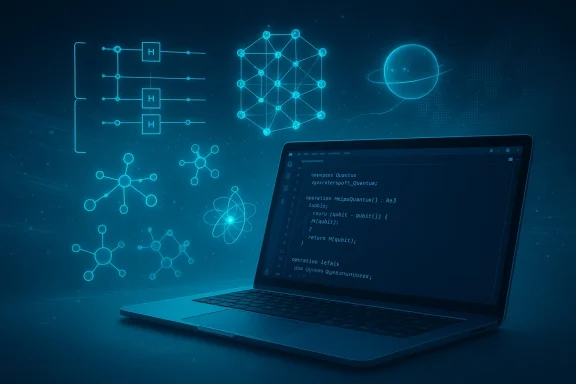
Microsoft has placed developer experience front‑and‑center. The QDK VS Code extension now supports a range of capabilities developers expect from modern IDEs: syntax highlighting, IntelliSense, breakpoint debugging, circuit rendering, histogram visualizations, and notebook integration for Python and Jupyter. Crucially, the QDK ships with a targeted GitHub Copilot agent mode that can:- Suggest Q# code and Python glue for hybrid workflows
- Generate unit tests and job submission scaffolding
- Help with hardware submission commands and resource estimation
- Assist with circuit introspection and visualization
Local simulators, resource estimation and cross‑language support
QDK continues to support powerful local simulators and the Azure‑backed execution path for real hardware. The QDK’s resource estimator — an essential tool as teams prepare circuits for constrained hardware — is integrated with the development flow in VS Code and is exposed for Python/Jupyter workflows. The toolkit also stresses interoperability: it accepts inputs and integrates with popular frameworks such as OpenQASM, Qiskit, and Cirq, making it easier for multi‑tool projects and collaborative teams to reuse code or switch backends.QDK for chemistry: A domain‑aware, end‑to‑end workflow
What the chemistry toolkit delivers
The QDK for chemistry is explicitly presented as an end‑to‑end solution designed by chemists for chemists and quantum application engineers. Key features include:- Molecular modeling and electronic‑structure preparation pipelines
- Hamiltonian generation and automated active‑space selection
- Chemistry‑aware circuit optimization and deep‑circuit compression
- Real‑time molecular and orbital visualizations inside VS Code
- WSL and Docker support for reproducibility and portable execution
Independent corroboration and partner input
Microsoft’s announcement includes a partner endorsement from Algorithmiq and is consistent with recent industry collaborations aimed at practical chemistry workflows. Coverage of Algorithmiq’s collaborations with major quantum platforms and with Microsoft confirms that advanced measurement and preprocessing techniques can materially change how problems map to quantum resources — for example, reducing measurement overhead and improving ground‑state preparation fidelity. However, the specific phrasing that gate counts fall “from thousands to single digits for certain problems” should be treated as an illustrative best‑case example rather than a guaranteed, universal outcome. Algorithmiq’s public statements and peer literature do show large reductions in some metrics, but the magnitude depends heavily on the molecular system, the chosen active space, and the target accuracy.Why this matters to scientific users
The chemistry toolkit’s value proposition is its ability to integrate:- Classical preprocessing (basis‑set reduction, active‑space selection)
- Circuit generation and aggressive compression
- Measurement‑efficient algorithms and post‑processing
QDK for error correction: Tooling for the logical‑qubit era
What’s included and the roadmap
Microsoft has exposed parts of the toolset its own researchers use for error‑correction workflows. The announced collection includes:- Open‑source modules for characterization, validation, and debugging of encoded programs
- Customizable encoding and decoding strategies aligned with target runtimes
- Notebook samples for common research use cases
- Decoders and validation harnesses intended to be extensible and aligned with hardware runtimes
Practical implications
Error correction is the pivotal technology that separates noisy experimental qubits from useful logical qubits. By packaging learnings, decoders, and validation tools in the QDK, Microsoft aims to democratize a domain that previously required deep hardware‑level knowledge and bespoke tooling. This is strategically important: if consistent, well‑documented decoders and runtime integrations are available in the QDK, algorithm designers can test fault‑tolerant mappings earlier, and hardware teams can benchmark and co‑design more effectively.That said, widespread deployment of full error‑corrected workloads still depends on hardware progress (logical‑qubit density, gate fidelity, and latency), so these software tools are necessary but not sufficient to guarantee an early commercial transition.
The Microsoft Quantum platform and Magne: hardware, co‑design, and regional partnerships
QDK as part of a platform strategy
Microsoft positions QDK as a core component of an Azure‑powered, full‑stack quantum platform that includes a qubit virtualization layer, a quantum OS, a quantum engine for orchestration, and integrations with third‑party QPUs. That platform framing matters: Microsoft’s approach is explicitly multi‑vendor and multi‑language, aiming to avoid lock‑in while retaining the cloud orchestration and toolbox advantages of Azure. The QDK fits into that platform by exposing resource estimation, hardware orchestration, and development pipelines in a single integrated dev experience.Magne, QuNorth, and Atom Computing
A particularly high‑visibility element of Microsoft’s announcement is the reference to Magne, a Level‑2 quantum computer that will be built by Atom Computing and operated by the new Nordic initiative QuNorth. Public QuNorth and EIFO materials confirm the basic technical commitments:- Magne is described as a Level‑2 system with approximately 50 logical qubits and over 1,200 physical qubits.
- Atom Computing is the hardware vendor (neutral‑atom technology); Microsoft will integrate Azure‑based software, the quantum OS, and error‑correction tooling.
- Construction was slated to begin in autumn 2025, with availability targeted around the turn of 2026/27; a Discover Magne event was scheduled for January 26, 2026 in Copenhagen.
Getting started: practical steps for developers and researchers
- Install the QDK VS Code extension from the VS Code Marketplace and enable the Copilot agent mode for AI assistance.
- Set up the Python environment (3.10+ recommended) and install QDK Python bindings for notebook and hybrid workflows.
- Use local simulators and the resource estimator to profile circuits early. Convert small classical models into Hamiltonians with the chemistry toolkit’s pipelines before attempting hardware runs.
- For error‑correction experiments, explore the QDK error‑correction modules as they land; plan for incremental tooling availability over 2026.
Strengths: Why this is a meaningful step
- Developer productivity: Deep VS Code integration and Copilot agent assistance lower the barrier to entry for Q# and hybrid quantum workflows. For teams already standardized on VS Code, adoption friction is small.
- End‑to‑end consistency: Bringing preprocessing, circuit generation, optimization, and execution into one integrated flow is a major win for reproducibility and iterative science.
- Interoperability: Broad language and framework support (OpenQASM, Qiskit, Cirq) reduces vendor‑specific lock‑in and eases collaboration across research groups.
- Platform positioning: Tying the QDK to Azure and to a specific logical‑qubit deployment (Magne) creates a path for realistic testing of fault‑tolerant workflows in the near term.
Risks, limitations, and cautionary notes
- Claims vs. generality: Statements like reducing gate counts “from thousands to single digits” are compelling but highly context‑dependent. They may describe best‑case outcomes for carefully designed, chemistry‑aware circuits rather than typical results across arbitrary chemical systems. Where Microsoft or partners claim dramatic reductions, those should be validated on case‑by‑case benchmarks. Flag these claims as illustrative and verify experimentally for production use.
- Hardware dependency: Error‑correction toolchains are necessary but insufficient without hardware that provides the required physical qubit quality, connectivity, and low latency. Full system performance depends on the joint maturity of hardware and software; software alone cannot create logical qubits if physical qubit fidelity and volume lag expectations.
- Timeline uncertainty: The blog states “full availability expected later in 2026” for error‑correction tooling packages. Software release schedules are easier to commit to than hardware roadmaps; timelines for Magne’s operational readiness and for widespread logical‑qubit access still carry execution risk. Independent reporting indicates Magne construction timelines spanning 2025–2027, but those dates can slip for technical or logistical reasons. Treat multi‑party schedules as planning guidance, not firm delivery guarantees.
- Skill gap and workforce: The announcement sensibly pairs tooling with training (qBraid and regional partners), but deploying error‑corrected systems will require highly specialized skills. Organizations should budget for training and iterative upskilling before expecting immediate productivity gains.
What this means for Windows developers and enterprise teams
Microsoft’s QDK refresh is a signal that quantum development is moving from research‑only experiments toward regulated, repeatable developer workflows that mirror cloud‑native software engineering. For Windows developers and enterprises that already rely on Microsoft’s toolchain and Azure, the QDK offers familiar productivity primitives (IDE, notebooks, CI workflows), making it practical to add quantum tasks to broader engineering roadmaps. The platform approach also helps enterprises avoid building bespoke orchestration stacks in favor of a managed cloud pipeline.At the same time, enterprises should approach near‑term projects as exploratory: identify pilot use cases where classical preprocessing plus quantum subroutines provide a clear, demonstrable benefit; pair pilots with post‑quantum cryptography planning; and treat larger adoption as a multi‑year program tied to hardware milestones like Magne.
Final assessment and practical advice
Microsoft’s QDK updates represent a pragmatic, developer‑centric advance: integrations with VS Code and GitHub Copilot, the chemistry toolkit for domain workflows, and a roadmap for error‑correction tooling are all aligned with current industry priorities. The platform’s interoperability and emphasis on reproducible pipelines are particularly useful for scientific teams, while the Magne/QuNorth collaboration demonstrates Microsoft’s appetite to co‑design hardware‑level systems with regional partners.At the same time, the most impactful numerical claims in the announcement (e.g., dramatic gate‑count compression) should be treated with scrutiny and validated with open benchmarks and reproducible experiments. Organizations planning to rely on these gains should build small, measurable pilots that compare classical baselines against the QDK‑driven quantum workflow before scaling investments.
For developers and researchers ready to experiment now:
- Install the QDK VS Code extension and enable Copilot agent workflows.
- Use the QDK’s resource estimator and local simulators to profile and optimize circuits early.
- Follow the evolving error‑correction modules as they are released through 2026 and engage with community examples and notebooks.
- For regionally situated research groups, track Magne/QuNorth timelines and participation programs to gain early access to Level‑2 logical‑qubit systems.
Source: Microsoft Azure Powerful new developer tools increase the versatility of the Microsoft Quantum platform - Microsoft Azure Quantum Blog
