

Microsoft pulled a developer tutorial this week after a Hacker News thread exposed that the post directed readers to train AI models on a Kaggle dataset containing the full Harry Potter novels — a dataset that had been mis‑labeled as public domain and downloaded by thousands while the tutorial remained live.
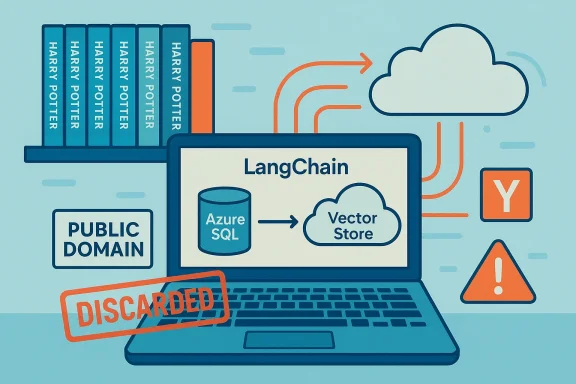
Microsoft’s now‑deleted post, “LangChain Integration for Vector Support for SQL‑based AI applications,” was published on November 19, 2024 on the Azure SQL developer blog and credited to senior product manager Pooja Kamath. The step‑by‑step tutorial explained how to use the newly introduced native vector support in Azure SQL and the langchain‑sqlserver integration to build retrieval‑augmented generation (RAG) examples — and it used the seven Harry Potter novels as the worked dataset. The live tutorial explicitly pointed readers to a Kaggle dataset of the books and included code and concrete examples demonstrating Q&A retrieval and AI‑generated Harry Potter fan fiction.
Within roughly 24 hours of a Hacker News discussion flagging the copyright problem, Microsoft removed the post. Ars Technica and other outlets report the Kaggle dataset had been downloaded more than ten thousand times while the tutorial was live, and that the dataset’s uploader — a data scientist identified as Shubham Maindola — said the files were “marked as Public Domain by mistake.” The dataset was removed the same day Ars Technica contacted the uploader.
This episode sits at the intersection of three trends that have reshaped AI development over the past three years: (1) the push by cloud vendors to produce developer‑facing tutorials with high‑impact, relatable examples; (2) the pervasive but often opaque reliance on large text corpora scraped from the web, including questionably licensed or pirated materials; and (3) a torrent of litigation and regulatory scrutiny around the provenance of AI training data. The Microsoft removal is a cautionary case study in how those forces collide inside a major vendor’s developer advocacy program.
From a developer‑experience standpoint, this is exactly the kind of content teams want: short, reproducible, and emotionally resonant examples that help developers understand quickly how a product feature can be applied. The problem — and the legal exposure — was not the LLM code itself but the provenance of the sample data the company chose to showcase.
That combination — a high‑visibility corporate tutorial pointing to a hosted dataset with careless licensing metadata — created a multiplier effect. Tens of thousands of developers (and at least ten thousand direct Kaggle downloads) now had a simple reverse‑engineering path from a Microsoft sample to an apparently ready‑to‑use training corpus of copyrighted books.
Two separate but overlapping pathways of legal risk are particularly salient:
Beyond process, the technical ecosystem amplified the mistake:
The episode should be read as a governance warning for every organization that publishes runnable demos tied to third‑party content: data provenance matters as much as code correctness. For developers, it’s a reminder to validate dataset provenance before training models. For vendors, it’s a reminder that developer friendly must not become lawyer‑unfriendly. And for rights holders and courts, it’s another data point in an evolving jurisprudence about how copyright law applies to the age of large language models and corporate cloud services. The coming months — as litigation proceeds and as companies adopt clearer dataset controls and licensing strategies — will determine whether this remains an embarrassing footnote or becomes another precedent shaping industry behavior.
Source: WinBuzzer Microsoft Pulls AI Tutorial For AI Training with Pirated Harry Potter Books
 Background / Overview
Microsoft’s now‑deleted post, “LangChain Integration for Vector Support for SQL‑based AI applications,” was published on November 19, 2024 on the Azure SQL developer blog and credited to senior product manager Pooja Kamath. The step‑by‑step tutorial explained how to use the newly introduced native vector support in Azure SQL and the langchain‑sqlserver integration to build retrieval‑augmented generation (RAG) examples — and it used the seven Harry Potter novels as the worked dataset. The live tutorial explicitly pointed readers to a Kaggle dataset of the books and included code and concrete examples demonstrating Q&A retrieval and AI‑generated Harry Potter fan fiction.Within roughly 24 hours of a Hacker News discussion flagging the copyright problem, Microsoft removed the post. Ars Technica and other outlets report the Kaggle dataset had been downloaded more than ten thousand times while the tutorial was live, and that the dataset’s uploader — a data scientist identified as Shubham Maindola — said the files were “marked as Public Domain by mistake.” The dataset was removed the same day Ars Technica contacted the uploader.
This episode sits at the intersection of three trends that have reshaped AI development over the past three years: (1) the push by cloud vendors to produce developer‑facing tutorials with high‑impact, relatable examples; (2) the pervasive but often opaque reliance on large text corpora scraped from the web, including questionably licensed or pirated materials; and (3) a torrent of litigation and regulatory scrutiny around the provenance of AI training data. The Microsoft removal is a cautionary case study in how those forces collide inside a major vendor’s developer advocacy program.
What the tutorial said, and why it mattered
An operational how‑to with an attention‑grabbing dataset
The tutorial’s technical content was straightforward: install langchain‑sqlserver, upload text files to Azure Blob Storage, split long documents into chunks, generate embeddings (the sample used Azure OpenAI embeddings), push vectors into Azure SQL as a Vector Store, and build a retriever + LLM chain for Q&A and text generation. The code samples were concrete and runnable; the article framed the Harry Potter text as a familiar dataset to demonstrate RAG workflows and to illustrate the new vector support in Azure SQL.From a developer‑experience standpoint, this is exactly the kind of content teams want: short, reproducible, and emotionally resonant examples that help developers understand quickly how a product feature can be applied. The problem — and the legal exposure — was not the LLM code itself but the provenance of the sample data the company chose to showcase.
The dataset: mislabeled, widely downloaded, and then deleted
Investigations show the Kaggle dataset linked in the tutorial contained plain text versions of all seven Harry Potter novels, and it had been uploaded by an individual who labeled the collection “public domain.” Ars Technica verified the dataset’s contents and reported more than 10,000 cumulative downloads while the post was online; the uploader said the public‑domain label was a mistake and removed the dataset after being contacted. The Microsoft post remained live for roughly 15 months before deletion.That combination — a high‑visibility corporate tutorial pointing to a hosted dataset with careless licensing metadata — created a multiplier effect. Tens of thousands of developers (and at least ten thousand direct Kaggle downloads) now had a simple reverse‑engineering path from a Microsoft sample to an apparently ready‑to‑use training corpus of copyrighted books.
Timeline and key facts (verified)
- Microsoft published the Azure SQL / LangChain tutorial on November 19, 2024.
- The tutorial included examples that used the complete Harry Potter series as a sample dataset and linked to a Kaggle dataset of the seven books.
- The Kaggle upload was later identified as uploaded by Shubham Maindola and labeled (incorrectly) as public domain; Ars Technica reports the uploader removed the dataset after being contacted.
- The developer blog remained publicly accessible for more than 15 months (Nov 2024 — Feb 2026) before being deleted in response to a viral Hacker News thread and subsequent coverage.
- While the tutorial linked to the Kaggle repo, Ars also reported Microsoft’s demo used an Azure dataset containing at least Harry Potter and the Sorcerer’s Stone and that other Microsoft sample repositories contained additional copyrighted works (issues noted by independent commenters).
Legal exposure: layered and compounding
The legal stakes here are not theoretical. Copyright law in the United States allows statutory damages ranging from $750 to $30,000 per work in ordinary cases, and — crucially — up to $150,000 per work if a court finds willful infringement. That statutory ceiling is codified in Section 504(c) of the U.S. Copyright Act. The difference between a $30,000 award and a $150,000 award per title is legally dispositive when multiple works are involved.Two separate but overlapping pathways of legal risk are particularly salient:
- Direct and derivative infringement arising from training data: If a party knowingly obtains and uses pirated copies of copyrighted books to train models, rights holders may argue that training from those unauthorized copies is itself an act of infringement or at least provides strong proof of willfulness. Recent litigation demonstrates plaintiffs will press this point aggressively. For example, authors have alleged Microsoft trained its Megatron model using hundreds of thousands of pirated books; that litigation is pending and highlights the scale of potential exposure.
- Secondary (contributory) liability for encouraging infringement: The act of publishing a tutorial that steers developers toward a pirated dataset — and that provides runnable instructions showing how to ingest that material into Azure services — can expose the publisher to claims of contributory infringement if it can be shown the publisher knew or had reason to know the source was infringing and materially contributed to others’ infringing acts. U.S. law recognizes contributory liability where a party “induces, causes, or materially contributes” to infringing acts and has knowledge or reason to know of the infringement. Courts will scrutinize whether a corporation’s conduct meets that standard.
Corporate contradiction: licensing and unlearning on the one hand, casual diversion on the other
What makes this episode especially awkward for Microsoft — beyond the immediate copyright question — is that the company had been publicly pursuing two distinct, sometimes contradictory strategies.- In November 2024 Microsoft (via reporting and publisher statements) was identified as the tech company that reached a licensing agreement with HarperCollins to permit certain backlist nonfiction titles to be used for AI model training under opt‑in terms. That deal was presented publicly as an attempt to create a legal, compensatory channel for book content to be used in AI.
- In 2023 Microsoft Research produced a paper titled “Who’s Harry Potter? Approximate Unlearning in LLMs,” which explored techniques for removing copyrighted content from models that had learned it. The research implicitly acknowledged the legal and ethical complexities of training on copyrighted books and proposed a technical mitigation: approximate unlearning that can excise a model’s retention of a corpus like the Harry Potter books in a short amount of compute. That work shows Microsoft’s research groups were aware of the copyright issues and were investing in remediation techniques.
Operational and governance failures: not just an isolated human error
Public commentary from former Microsoft employees and independent observers suggests the issue may not be a lone bad judgment but rather a systemic gap in how developer advocacy content is reviewed and governed. Hacker News participants who claimed inside knowledge described a culture where employees can publish personal or team posts without formal editorial or legal review. If true, that policy would make it easy for technically competent authors to proceed without a compliance check — a high‑risk configuration for a company running services that will be used to ingest third‑party data at scale.Beyond process, the technical ecosystem amplified the mistake:
- Kaggle’s permissive upload model and user‑supplied metadata allowed a dataset to be labeled incorrectly as “public domain” and to persist without takedown. That single point of metadata failure propagated rapidly once a major vendor linked to the dataset.
- Developer tutorials that contain executable code and dataset pointers become operational playbooks in the hands of readers; they are not mere marketing artifacts. A misstep in this genre scales: a single blog linking an improperly licensed corpus can turn thousands of otherwise lawful developers into accidental users of infringing material.
Practical implications for developers and enterprises
This incident is more than a headline for legal teams; it has practical consequences for developers and organizations that rely on vendor tutorials.- If you followed the tutorial: Be aware that training models on the Kaggle collection could expose you to copyright risk. The law distinguishes between innocent mistakes and willful misconduct, but the presence of an official vendor tutorial pointing to alleged infringing content complicates the “reasonable reliance” defense. Legal exposure will depend on facts such as whether the dataset was obtained after a take‑down notice, whether outputs reproduce large verbatim extracts, and whether a rights holder moves to enforce.
- Operational hygiene: Developers and platform teams should treat third‑party content provenance as a first‑class concern. That means requiring dataset metadata validation, implementing automated provenance checks, restricting production builds that ingest unverified public datasets, and routing any external dataset link through legal review before it becomes part of a public tutorial or sample. These are straightforward, practical controls that could have prevented a high‑visibility mistake.
- Rights‑clearing and licensing: For production systems, prefer licensed datasets or create synthetic/public‑domain corpora for demos. Publishers are experimenting with licensing models (HarperCollins is one early example), and those tend to be far safer for production and public examples.
What this means for Microsoft’s risk profile
Taken alone, a single deleted blog post might look like a minor embarrassment. But layered atop ongoing litigation about pirated book training sets — including high‑profile cases and settlements against other AI vendors — the episode raises serious governance and reputational questions for Microsoft:- Ongoing litigation alleges Microsoft used pirated books for the Megatron model; those cases are active and could produce large damages or injunctive relief depending on outcomes. Public mistakes that point to careless data handling or lax oversight can be used by plaintiffs to support claims of willfulness or systemic disregard for rights clearance.
- At trial, plaintiffs will scrutinize whether a company demonstrated awareness of potential licensing problems. The existence of a contemporaneous corporate licensing deal with a major publisher and a research program investigating “unlearning” may cut either way: they show both knowledge of the issue and (potentially) an available alternative, which can be leveraged by plaintiffs arguing the defendant knowingly chose a cheaper, riskier course.
- Even where courts eventually find training from lawfully obtained copyrighted books can sometimes be transformative fair use, disputes about pirated sources remain unsettled. Courts have signaled they will treat illegally obtained data differently, and settlements (like the high‑profile Anthropic agreement) show defendants may choose to resolve exposures rather than litigate to final judgment. The industry is still generating precedent in this area.
Recommended steps for vendors, developer advocates, and legal teams
- Institute mandatory rights‑clearance checks for any public tutorial that links to third‑party data or demonstrates training on external corpora.
- Create a staging policy that disallows live product demos that reference potentially protected creative works unless those works are cleared and documented.
- Build tooling to automatically check dataset provenance (file metadata, host reputation, rights declarations) before a dataset link can be published in official channels.
- Educate developer advocates on copyright basics and create a fast legal review lane for demos that use cultural IP.
- When possible, favor public‑domain corpora, synthetic text, or licensed content for public examples. If a recognizable commercial work is used for demonstration only, mark it clearly as demo content and provide an alternative public dataset version.
Strengths and weaknesses in Microsoft’s response
- Strengths: Microsoft acted quickly to remove the offending content once the problem went viral, and the company’s broader public research (for example, unlearning techniques) demonstrates an investment in addressing the technical aspects of copyrighted content in models. The HarperCollins licensing engagement also signals movement toward negotiated, rights‑cleared sources.
- Weaknesses: The presence of a high‑profile tutorial pointing to an allegedly pirated dataset for more than a year suggests a gap in editorial and legal controls for developer advocacy content. Given the multiplicative impact of an official tutorial — which acts as an operational blueprint — that gap moves the issue from a single employee’s mistake to a structural governance shortfall. The deletion without a public explanation also leaves lingering questions about how widespread similar errors might be.
Broader industry context: precedent, settlements, and shifting norms
The AI industry has already seen major litigation related to pirated books and copyrighted training data. Recent high‑value settlements and rulings — including a multibillion‑dollar settlement posture and multiple author‑led suits naming large AI firms — indicate the legal environment has moved from theoretical risk to material, balance‑sheet level exposure for companies that relied on poorly sourced training corpora. Courts have started to treat pirated data differently from lawfully purchased content in their analyses. That larger legal trend contextualizes why a tutorial linking to an obviously copyrighted series was not a mere academic error but a real commercial risk.Conclusion
The deleted Microsoft tutorial is a clear, contemporary example of how developer outreach and product marketing — when combined with the raw, unvetted datasets that circulate across developer platforms — can create legal and operational hazards at scale. The facts are straightforward and corroborated by multiple outlets: Microsoft published a LangChain + Azure SQL tutorial in November 2024 that used the Harry Potter novels as its sample dataset, linked to a Kaggle collection mislabeled as public domain, and the tutorial was removed in February 2026 after the issue went viral.The episode should be read as a governance warning for every organization that publishes runnable demos tied to third‑party content: data provenance matters as much as code correctness. For developers, it’s a reminder to validate dataset provenance before training models. For vendors, it’s a reminder that developer friendly must not become lawyer‑unfriendly. And for rights holders and courts, it’s another data point in an evolving jurisprudence about how copyright law applies to the age of large language models and corporate cloud services. The coming months — as litigation proceeds and as companies adopt clearer dataset controls and licensing strategies — will determine whether this remains an embarrassing footnote or becomes another precedent shaping industry behavior.
Source: WinBuzzer Microsoft Pulls AI Tutorial For AI Training with Pirated Harry Potter Books
