

Microsoft's latest in‑product marketing has moved from polite persuasion to explicit incentives: when some Windows users search for "Chrome" inside Microsoft Edge, Bing can now surface a prominent, Promoted by Microsoft card offering up to 1,300 Microsoft Rewards points to "try Edge" instead of downloading Google Chrome — a small, redeemable economic nudge that has reignited debate over platform power, UX dark patterns, and antitrust optics.
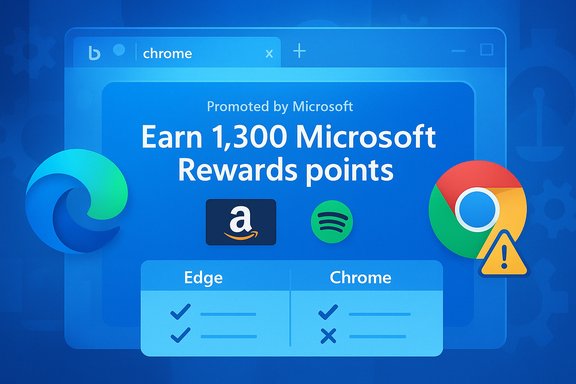
Microsoft Edge has for years been the subject of high‑visibility promotional tactics inside Windows and Bing: in‑OS prompts, comparison cards and interstitial banners have repeatedly nudged users toward Edge and Bing. The new element is that Microsoft is now attaching tangible loyalty currency to the prompt — Microsoft Rewards points that can be exchanged for gift cards, digital items, or donated to charities — and specifically presenting that incentive at the exact moment a user appears intent on installing a competing browser. That timing turns a marketing nudge into a transactional persuasion. Multiple outlets and community witnesses have documented the promotion: screenshots show a card reading “Earn 1,300 Microsoft Rewards points by trying Edge,” with redemption examples such as Amazon gift cards, Roblox items, or a few months of Spotify Premium depending on region. The creative is labeled “Promoted by Microsoft” and appears above the organic search results for queries like “Chrome” or “download Chrome,” pushing the Chrome download link lower on the page. Why this matters: the tactic combines three levers — platform distribution (Windows + Edge), search placement (Bing result surface), and a loyalty program (Microsoft Rewards) — to create a low‑friction, economic incentive precisely when users are deciding whether to switch browsers. At scale, even modest incentives can move significant numbers of users, which is why competitors and privacy/choice advocates are calling the move a borderline "bribe."
The offer’s dollar equivalence — roughly a dollar or two of buying power in many markets — is small enough that the promotion looks trivial, until you consider scale and timing. That combination is why rivals and advocates call it a borderline bribe: not because the per‑user amount is large, but because the tactic is designed to intercept a switching moment carried out on a platform Microsoft controls. Until Microsoft publishes full details about targeting and campaign rules, observers should treat A/B and targeting claims as plausible and likely but not definitively confirmed. Users worried about vendor lock‑in or nudging should follow the practical steps above; regulators and competitors will be watching whether this experiment remains an isolated marketing tactic or becomes part of a sustained pattern of in‑OS advantage for first‑party software.
Microsoft’s move exposes a new phase in platform competition: persuasion is now transactional as well as technical. The reward card may be small in absolute money terms, but its presence at a high‑intent decision point makes it disproportionately influential — and that is precisely why the debate over whether it is a clever incentive or a coercive bribe has already moved from tech blogs to regulators’ radars.
Source: Новини Live https://novyny.live/en/tehnologii/m...s-with-gifts-whats-behind-it-293772.html/amp/
 Background / Overview
Microsoft Edge has for years been the subject of high‑visibility promotional tactics inside Windows and Bing: in‑OS prompts, comparison cards and interstitial banners have repeatedly nudged users toward Edge and Bing. The new element is that Microsoft is now attaching tangible loyalty currency to the prompt — Microsoft Rewards points that can be exchanged for gift cards, digital items, or donated to charities — and specifically presenting that incentive at the exact moment a user appears intent on installing a competing browser. That timing turns a marketing nudge into a transactional persuasion. Multiple outlets and community witnesses have documented the promotion: screenshots show a card reading “Earn 1,300 Microsoft Rewards points by trying Edge,” with redemption examples such as Amazon gift cards, Roblox items, or a few months of Spotify Premium depending on region. The creative is labeled “Promoted by Microsoft” and appears above the organic search results for queries like “Chrome” or “download Chrome,” pushing the Chrome download link lower on the page. Why this matters: the tactic combines three levers — platform distribution (Windows + Edge), search placement (Bing result surface), and a loyalty program (Microsoft Rewards) — to create a low‑friction, economic incentive precisely when users are deciding whether to switch browsers. At scale, even modest incentives can move significant numbers of users, which is why competitors and privacy/choice advocates are calling the move a borderline "bribe."How the offer works (mechanics and scope)
What appears and where
- The banner or comparison card is served inside Microsoft Edge when a user performs a Bing search for terms like “Chrome” or “download Chrome.”
- It is visually prominent, sometimes showing a side‑by‑side checklist comparing Edge and Chrome, and explicitly states a Rewards offer such as 1,300 Microsoft Rewards points for trying Edge.
What 1,300 Microsoft Rewards points are
- Microsoft Rewards is a points‑based loyalty program tied to Microsoft accounts. Points are earned through Bing searches, Edge activity, quizzes, Xbox/Game Pass interactions, and designated promotions.
- Points are redeemable in the Rewards catalog for gift cards, Xbox/Microsoft Store credit, subscriptions, in‑game content, or charitable donations. They are not cash but can act as a near‑cash equivalent for many users because gift cards are spendable at mainstream retailers.
What the points are worth — practical conversion
- There is no official fixed exchange rate published as a universal USD equivalence for Microsoft Rewards points, and redemption pricing varies by reward and region.
- Independent, practical analyses and community guides often use ~1,000 points ≈ $1 USD as a rule‑of‑thumb for common gift‑card redemptions; that makes 1,300 points roughly equivalent to about $1–$1.50 of buying power for many typical redemptions — a small but tangible reward for a micro‑decision. Treat that figure as an approximation rather than a guaranteed rate.
Targeting and rollout
- Reporting indicates the promotional units are A/B tested and regionally targeted rather than globally uniform. Screenshots and community reproductions show variance by locale and user cohort.
- Microsoft has not published a global rollout notice for this creative at the time observers captured it; independent reporters and testers documented the creative appearing for some Windows 11 users. That selective delivery is consistent with server‑side experiments used by large platforms. This targeting detail is reported but not formally confirmed by Microsoft, so it should be considered based on observed patterns rather than an official, universal campaign statement.
The product and UX framing: what Microsoft is pitching
Microsoft’s creatives typically combine three claims:- Edge is built on the same Chromium technology as Chrome, so compatibility is preserved.
- Edge delivers extra capabilities (advertised examples include Microsoft Rewards, Edge Secure Network — a browser‑level privacy proxy, and AI personalization features).
- The incentive (Rewards points) makes trying Edge risk‑free and immediately rewarded.
- Edge Secure Network is a browser‑level privacy tunnel implemented with Cloudflare technology; it encrypts browser traffic and hides IP metadata for certain browsing sessions, but it is not a full desktop VPN that lets users arbitrarily select exit locations or replace system‑wide VPNs. The Cloudflare partnership and operational limits (capped usage, feature scope) are documented publicly.
- AI personalization in Edge today spans UI and content personalization features rather than a system‑level rework that changes how the web fundamentally behaves. Advertising often highlights AI as a single advantage, which can overstate the practical difference for many users.
Why critics call it a “bribe”: competition and ethics
The behavioral economics problem
A modest reward delivered at the moment of decision is disproportionately persuasive. Behavioral research shows that timing, salience, and perceived immediacy of small incentives can change behavior far more than their absolute dollar value suggests. At Windows scale, a $1–$2 effective incentive multiplied by millions of impressions becomes economically meaningful.The antitrust and regulatory question
- Critics argue the tactic is an escalation of an existing pattern in which Microsoft uses Windows‑level surfaces and default flows to give Edge a visibility advantage. Those historic conflicts over bundling and default setting are part of the context for heightened scrutiny by regulators worldwide.
- Antitrust authorities will likely evaluate such promotions in context: are they isolated marketing, or part of a pattern of exclusionary design and persistent nudges that materially harm rivals’ ability to compete? Past regulatory scrutiny on platform self‑preferencing makes this approach consequential beyond PR optics.
Who’s objecting
- A coalition called the Browser Choice Alliance (a group of browser vendors and advocates) and multiple browser developers have criticized the tactic publicly, labeling incentives attached to in‑OS behavior as effectively coercive and anticompetitive. Multiple outlets have quoted or documented the alliance’s concerns.
Strengths of Microsoft’s approach (from a marketing/product lens)
- Low marginal cost, high reach. Points are cheap to distribute and highly measurable, while Windows/Bing deliver prime impressions.
- Tactically efficient. The offer sits at a high‑intention decision point: users who search for Chrome are likely to be setting up a device or switching browsers, so converting even a fraction generates outsized retention value.
- Cross‑product stickiness. Reward recipients are more likely to make Bing and Edge part of their habit loop, generating future opportunities to earn more points — a compound retention effect.
Risks, downsides and legal exposure
- Regulatory scrutiny. The move amplifies existing narratives around platform gatekeepers and self‑preferencing. In jurisdictions with strict gatekeeper regulation, these tactics increase the risk of complaints or investigations.
- Reputational cost. Framing a promotion as a “bribe” — even if technically accurate that points are redeemable — can generate consumer resentment. Repeated heavy‑handed prompts may erode trust in Microsoft’s neutrality.
- Perceived manipulation / dark patterns. When a promoted creative displaces a competitor's download link and adds friction to switching, UX critics may flag it as a dark pattern, which influences consumer and regulator perception.
- Limited marginal impact on committed users. Enthusiastic Chrome users or privacy‑focused users are unlikely to switch for a small gift‑card equivalent; the core impact is on undecided or casual switchers, but aggregated at large scale.
What to verify and what remains unconfirmed
- Observers have documented the 1,300‑point creative in multiple regions, but Microsoft has not published a centralized disclosure of this specific creative or its full targeting parameters; apparent A/B testing and cohort targeting are consistent with platform ad practices, but exact targeting criteria (which cohorts see the card, country rollouts, user history triggers) are not publicly disclosed and should be considered unverified until Microsoft confirms.
- The effective purchasing power of 1,300 points depends on region, catalog inventory, and whether discounts or sales are available in the Rewards catalog; approximate conversions (1,000 points ≈ $1) are community estimates and should be treated as useful heuristics rather than contractually guaranteed values.
Practical advice — users and IT administrators
If you want to avoid seeing the promotional card
- Type the direct download URL into Edge’s address bar (for example, chrome.google.com) instead of searching for “Chrome.” This bypasses Bing result experiments and takes you straight to the target page.
- Change your default search provider for the address bar away from Bing (if you prefer Chrome/Google search results).
- Clear Edge cookies or use a private browsing session when searching for a competitor to reduce the chance of seeing targeted server‑side experiments.
- Dismiss the card when it appears; it does not alter the underlying availability of the Chrome download, it only changes prominence.
For IT administrators (enterprise / managed devices)
- Use Group Policy or MDM to lock in a default browser and set file/URL associations so that organizational links open in the browser of record.
- Consider provisioning a managed setup script (PowerShell or winget) to install the organization‑approved browser on new devices before handing them to end users.
- Document the organization’s default browser policy and educate users so they are not confused by in‑OS marketing creatives that can vary by user profile and update state.
Likely outcomes and what to watch next
- Short term: the promotion will likely move marginal users and produce measurable lifts for Edge trial and short‑term engagement metrics. The incentive is cheap per user and testable.
- Medium term: expect increased scrutiny from rival browser vendors and consumer‑choice coalitions, which may file complaints or request investigations in markets with active digital‑market regulations.
- Long term: regulators assessing platform self‑preferencing will consider rewards programs as one more lever in a set of design choices. If combined with other persistent nudges, this tactic may be folded into broader antitrust or regulatory inquiries about distribution neutrality.
- Official Microsoft clarification or an FAQ about the campaign and its targeting.
- Formal complaints or expanded statements from the Browser Choice Alliance or major browser vendors.
- Any regulatory filings that cite rewards‑based promotions as evidence of exclusionary conduct.
Ethical and design considerations
There is a meaningful distinction between transparent promotional marketing and manipulative interface design:- Transparency requires that users understand the economic tradeoff (the effective value of points, how to redeem them) and that promotions are not presented in ways that obscure alternatives or make switching technically harder.
- Consent and context matter: targeted incentives that rely on behavioral signals (search intent, download queries) raise privacy questions about how much telemetry is used to trigger persuasion.
- Platform neutrality: when an OS owner controls the primary distribution surface, best practice design ethics argue for clear separation between system management and promotional placement — especially where the promotion pushes a first‑party product into the top slot.
Final assessment
Microsoft’s reward‑backed promotion is a clever marketing play that leverages a loyalty economy to reduce friction and increase retention. Technically and legally, offering rewards for product adoption is not per se illegal; firms routinely use discounts and incentives to win customers. What changes the debate here is the platform owner context: when a dominant OS maker uses integrated system surfaces to present targeted, redeemable incentives at the precise moment a user is deciding whether to switch, the practice raises valid competition and ethics questions.The offer’s dollar equivalence — roughly a dollar or two of buying power in many markets — is small enough that the promotion looks trivial, until you consider scale and timing. That combination is why rivals and advocates call it a borderline bribe: not because the per‑user amount is large, but because the tactic is designed to intercept a switching moment carried out on a platform Microsoft controls. Until Microsoft publishes full details about targeting and campaign rules, observers should treat A/B and targeting claims as plausible and likely but not definitively confirmed. Users worried about vendor lock‑in or nudging should follow the practical steps above; regulators and competitors will be watching whether this experiment remains an isolated marketing tactic or becomes part of a sustained pattern of in‑OS advantage for first‑party software.
Microsoft’s move exposes a new phase in platform competition: persuasion is now transactional as well as technical. The reward card may be small in absolute money terms, but its presence at a high‑intent decision point makes it disproportionately influential — and that is precisely why the debate over whether it is a clever incentive or a coercive bribe has already moved from tech blogs to regulators’ radars.
Source: Новини Live https://novyny.live/en/tehnologii/m...s-with-gifts-whats-behind-it-293772.html/amp/
