

Microsoft’s RSAC plan lands squarely on the idea that the next security frontier isn’t just about smarter defenses — it’s about re-architecting how organizations manage intelligent, autonomous agents at scale and making security itself an ambient, autonomous capability woven into every layer of the stack. verview
RSAC™ 2026 (Moscone Center, San Francisco) runs March 23–26, with several vendor pre-day and executive experiences starting the day before the main conference. That schedule makes March 22 the practical jump‑start for vendor briefings and CISO‑level events.
Microsoft’s public program for RSAC leans into a single thesis: the agentic era is here, and security must become ambient and autonomous to keep pace. The company frames this around two claims that recur across its messaging: (1) organizations are rapidly adopting AI agents and will soon treat them as first‑class operational entities, and (2) defending that agentic surface requires end‑to‑end observability, identity‑bound controls, and governance baked into the platforms that people already use. Those themes show up across keynote promises, the Microsoft booth experience, private CISO dinners and the Palace Hotel “Security Hub” programmiamines what Microsoft will present at RSAC 2026, verifies the most consequential technical claims, and offers practical analysis for security leaders evaluating Microsoft’s roadmap — including what it materially changes for governance, identity, telemetry, and risk management.
However, the story is not a plug‑and‑play cure. Key questions — telemetry exportability, contractual guarantees on telemetry use, third‑party agent handling, and the real operational costs of governance — remain live and should be your focus in one‑on‑one meetings. Treat the IDC and Work Trend Index numbers as directional (prepare for rapid agent growth), and press vendors on defensible, auditable controls and contractual commitments that survive the preview phase.
At RSAC, you can do more than watch demos: bring use cases, ask for architecture diagrams, and insist on SIEM/forensic access to agent telemetry. If Microsoft’s pitch is right, the next decade will be defined by how well organizations governed agents — not whether they used them. That is a practical, actionable mandate for CISOs: build governance now, or inherit the risk later.
Microsoft’s RSAC program is intentionally ambitious: it asks security teams to rethink identity, telemetry, and operations for a new class of digital actors. The vendor’s platform bets — Agent 365, Entra Agent ID, Security Dashboard for AI, and integrated Defender/Purview protections — can materially reduce friction for governed agent adoption, but only if security teams insist on clear operational guarantees, exportable telemetry, and binding contractual protections that match product claims. The era of agentic security is arriving quickly; RSAC 2026 will be one of the first major fields where those promises are tested in public.
Source: Microsoft Your complete guide to Microsoft experiences at RSAC™ 2026 Conference | Microsoft Security Blog
RSAC™ 2026 (Moscone Center, San Francisco) runs March 23–26, with several vendor pre-day and executive experiences starting the day before the main conference. That schedule makes March 22 the practical jump‑start for vendor briefings and CISO‑level events.
Microsoft’s public program for RSAC leans into a single thesis: the agentic era is here, and security must become ambient and autonomous to keep pace. The company frames this around two claims that recur across its messaging: (1) organizations are rapidly adopting AI agents and will soon treat them as first‑class operational entities, and (2) defending that agentic surface requires end‑to‑end observability, identity‑bound controls, and governance baked into the platforms that people already use. Those themes show up across keynote promises, the Microsoft booth experience, private CISO dinners and the Palace Hotel “Security Hub” programmiamines what Microsoft will present at RSAC 2026, verifies the most consequential technical claims, and offers practical analysis for security leaders evaluating Microsoft’s roadmap — including what it materially changes for governance, identity, telemetry, and risk management.
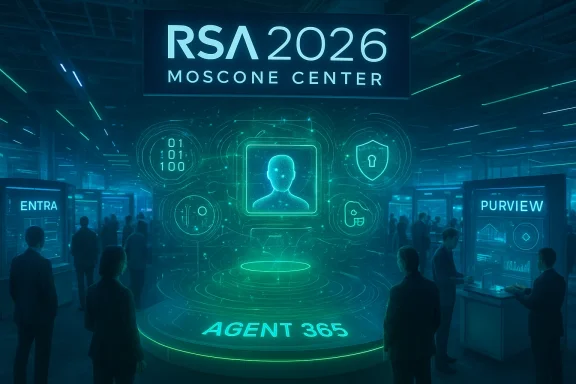 What Microsoft is showing at RSAC 2026
Core themes Microsoft will emphasize
- Agentic security: Microsoft is positioning agent management as the next enterprise control plane — inventory, identity, access control, telemetry, and lifecycle governance for AI agents will be treated like user management. Expect demos focused on agent registries, agent identities, and agent-aware conditional access.
- *Ambient ob Microsoft repeatedly points to its massive telemetry footprint as a differentiator, arguing defenders can only scale if observability is consolidated across identity (Entra), data (Purview), threat protection (Defender), and AI control surfaces (Agent 365 / Security Dashboard for AI). The company highlights “100 trillion security signals” processed per day as evidence of data scale for threat detection.
- Security as a platform primitive: Rather than bolt‑on tools, Microsoft will show how security primitives — identity, data protection, DLP, telemetry — are integrated into agent authoring and runtime paths (Copilot Studio, Foundry, Agent 365). This is a narrative aimed at reducprises to adopt agents while enforcing governance by default.
- CISO‑centric programming: Microsoft schedules executive briefings, dinners, and invite‑only sessions focused on translating agent risk into board‑level strategy — the company is pitching both product anho must operationalize agent governance.
Event highlights you should not miss
- Microsoft Pre‑Day (Palace Hotel, March 22): A focused, executive kickoff with keynote remarks from Microsoft Security leadership covering agentic defense and product strategies. Expect detailed briefings on Agent 365, Entra Ageny Dashboard for AI.
- Vasu Jakkal keynote on the mainstage: A short mainstage address on "Ambient and Autonomous Security" (timed in Microsoft materials) that distills the product messaging and threat framing for defenders. Microsoft will use this to set the tone for the week.
- Booth theatre demos and hands‑on scenarios: The Moscone booth will include an interactive single‑player experience (triage scenarios with adaptive agents) and demo stations for identity, data governance, and SOC acceleration. The booth number Microsoft lists is an expo detail to track on arrivanical claims — verified and contextualized
Claim 1 — “By 2028 IDC projects 1.3 billion agents in use.”
- What Microsoft says: Microsoft cites an IDC Info Snapshot showing 1.3 billion AI agents by 2028 to underline the scale of “agent sprawl” that enterprises must prepare for.
- Verification and context: The IDC figure is real as a published Info Snapshot; however, the specific IDC snapshot Microsoft references is sponsored by Microsoft. That sponsorship does not invalidate the projection, but it does mean the number should be treated as a vendor‑supported forecast rather than an independent consensus. Analyst projections of “agents” depend heavily on definitions: whether an agent equals a lightweight automation, an RPA run, a persistent tenant‑level Copilot, or a single API‑backed function. Different definitions produce drastically different counts. Independent commentary and industry reporting picked up the IDC number and used it to stress governance urgency — but you should interpret 1.3B as a planning signal (prepare for rapid proliferation), not a precise inventory target you must match.
Claim 2 — “More than 80% of leaders already using or planning to use agents in the year.”
- What Microsoft says: Microsoft references its Work Trend Index and related surveys that report leaders view 2025 as pivotal and indicate high intent to adopt agents.
- Verification and context: The Work Trend Index is Microsoft’s annual research combining surveys, telemetry and LinkedIn labor data. Media coverage and Microsoft’s own releases confirm the headline statistics (e.g., 82% of leaders see 2025 as pivotal; many expect agents to be integrated into workflows). These are credible as corporate research outputs, but readers should remember they reflect Microsoft‑run research and aggregated telemetry from Microsoft platforms. Use the Work Trend Index as a directional indicator about executive intent and early adopter behaviour rather than a definitive adoption metric across all industries.
Claim 3 — “Microsoft processes 100 trillion security signals each day.”
- What Microsoft says: The company uses this to position its security telemetry advantage and to justify claims that it can surface large‑scale trends and coordinate agent‑aware protections.
- Verification and context: The “100 trillion signals” is a figure Microsoft publishes in its Digital Defense Report and Security product literature. While the raw number is not independently audited in public, it’s consistent across Microsoft threat reports and presentations and is widely quoted by analysts. The practical takeaway is not the exact number but that Microsoft operates at a very large telemetry scale — which matters when correlating identity, data and endpoint events. Treat the figure as a company‑reported operational scale rather than an externally verified metric.
Claim 4 — “Agent 365 provides observability, registry, access control and security for agents.”
- What Microsoft says: Microsoft positions Agent 365 as the tenant‑level control plane: registry, access control, visualization, interoperability and security for agent fleets. This is presented as available to early adopters via Microsoft’s Frontier program.
- Verification and context: Agent 365 appears in multiple Microsoft product blogs and Ignite briefings as a service to manage lifecycles and governance for agents. The public materials pair Agent 365 with Entra Agent ID (agent identities), Microsoft Purview (data governance), and Defender (detections). The capability set aligns with what enterprises need, but product availability and integration timelines vary by customer tenant and preview program. If you’re evaluating Agent 365 in person, insist on clear statements about preview vs GA, supported agent runtimes, telemetry retention, and contract language for data residency and telemetry usage.
What this means for CISOs and security teams
Security surface expands from “people and devices” to “people, devices, and agents”
Agents are identity‑bound, persistent, and can call APIs or modify data — they are not just a UI hook. That elevates three operational requirements:- Identity-first governance — Every agent needs an identity lifecycle: creation, sponsorship, least‑privilege policy, rotation, and decommissioning. Entra Agent ID is Microsoft’s response, but you must ensure it integrates with your internal approval workflows and audit trails.
- Observability and audit — Full telemetry of agent inputs, actions, tool calls and decisions is mandatory. Correlating those logs with Defender alerts, Purview DLP events, and Entra identity signals is the only way to prove safe operation or to triage malicious behaviour. Microsoft’s Security Dashboard for AI aims to do this; validate how long telemetry is retained and what’s exportable for independent forensic analysis.
- Data minimization and boundary controls — Agents often need acto be useful. Implement fine‑grained, purpose‑bound access policies and never grant broad, persistent data access unless absolutely necessary. Agent 365’s registry and access control are designed for this, but the real challenge is application of policy at authoring time (Copilot Studio / Foundry) and runtime enforcement.
Operational checklist — how to evaluate Microsoft demos and claims at RSAC
- Ask whether the oor generally available and which tenants are in the preview cohort.
- Request a detailed data‑flow diagram showing what telemetry leaves the tenant, what is stored, and where training or model telemetry is routed.
- Validate the integration between Entra identities and your existing IAM/SSO tooling (role mapping, conditional access, MFA enforcement).
- Confirm retention times, exportability and SIEM integration for agent telemetry.
- Insist on contractual terms that cover telemetry, retention, data residency, and security incident obligations.
Strengths in Microsoft’s approach
- Platform integration reduces friction. Extending identity and data controls to agents from users makes governance pragmatically achievable — organizations that already use Entra, Purview and Defender can apply consistent controls. This is a practical advantage many large enterprises will value.
- Scale of telemetry matters. Microsoft’s claim of massive daily signals (the “100 trillion” figure) is meaningful: correlation across identity, email, endpoints and cloud services helps detect anomalous agent behavior that single‑pane tools might miss.
- Executive engagement and playbook focus. Microsoft’s RSAC programming is deliberately CISO‑focused — the vendor recognizes this is as much about governance frameworks and cultural change as it is about shiney features. That makes Microsoft’s content useful not just for product evaluation but for building internal executive buy‑in.
Risks, unanswered questions, and where to press for clarity
- Vendor sponsorship of analyst numbers. The IDC 1.3B projection is real but comes from an IDC Info Snapshot sponsored by Microsoft. It’s er, but not an independent consensus. Ask vendors to present multiple independent analyst viewpoints and define the term “agent” precisely. (microsoft.com)
- Exportability and independent forensics. If agent telemetry is stored in vendor services, can your SOC export it to third‑party SIEMs or for legal discovery? The devil is in how telemetry is exposed and what access controls exist. Demand technical readouts on API access and egress.
- Model provenance and training signals. Will agent interactions (prompts, tool calls) be used to train third‑party models? Where does telemetry go, and is it subject to reuse in model training? This matters for IP‑sensitive industries. Get binding contractual commitments on telemetry usage and deletion.
- Supply chain & third‑party agents. Today’s enterprise will run a mix of vendor and third‑party agents. How does the control plane manage and quarantine non‑Microsoft agents? Confirm supported integration patterns and enforcement points.
- Operational personnel and budgets. Agent fleets change team responsibilities. Expect to invest in agent governance roles, change control, and new operational runbooks — this is not a pure cost‑savings story. Validate TCO models and realistic staffing requirements.
Practical advice: three short-term moves for RSAC attendees and CISOs
- Visit Microsoft’s Palace Hotel Security Hub and request a one‑on‑one to probe telemetry, retention, and data‑use contracts. Those sessions are where you get the granular answers behind demo narratives.
- Bring a test case. Prepare a 10‑minute, real workflow you’d like an agent to automate, and ask Microsoft to show how that agent would be: (a) created; (b) assigned an identity; (c) given least‑privilege access; (d) monitored and quarantined if suspicious. Real examples expose gaps faster than theoretical demos.
- Validate integration with your existing SOC. Ask for architecture diagrams showing Defender, Entra, Purview, and Agent 365 telemetry flows into your SIEM/SOAR. Confirm APIs and event formats for automation and forensics.
Long‑view — governance, regulation, and the future of agentic work
As agents proliferate, regulators and auditors will look for evidence of governance, auditability, and accountability. We should expect three waves of regulatory attention:- Operational governance: Requirements that agents be identity‑bound, auditable, and subject to human sponsorship — similar to privileged access controls today.
- Data protection & privacy: Rules clarifying when agent interactions constitute processing of personal data, and what consent/notice is required for cross‑border telemetry.
- Sectoral controls: Financial services, health, and critical infrastructure will likely see stricter guardrails for agent‑driven actions (transaction approvals, PHI‑accessing agents, etc.).
The bottom line for WindowsForum readers
Microsoft’s RSAC program is an exectegy: convert the coming agentic sprawl from a chaotic risk into a manageable enterprise surface by making agents first‑class citizens in and governance systems. If you run a large Microsoft‑centric estate, the platform integration makes this an attractive path — it minimizes friction and lets you apply familiar security controls to a new class of assets.However, the story is not a plug‑and‑play cure. Key questions — telemetry exportability, contractual guarantees on telemetry use, third‑party agent handling, and the real operational costs of governance — remain live and should be your focus in one‑on‑one meetings. Treat the IDC and Work Trend Index numbers as directional (prepare for rapid agent growth), and press vendors on defensible, auditable controls and contractual commitments that survive the preview phase.
At RSAC, you can do more than watch demos: bring use cases, ask for architecture diagrams, and insist on SIEM/forensic access to agent telemetry. If Microsoft’s pitch is right, the next decade will be defined by how well organizations governed agents — not whether they used them. That is a practical, actionable mandate for CISOs: build governance now, or inherit the risk later.
Quick reference: RSAC 2026 Microsoft experiences to prioritize
- Microsoft Pre‑Day (Palace Hotel) — executive briefings and hands‑on strategy sessions.
- Mainstage keynote (Vasu Jakkal) — high‑level framing of ambient & autonomous security.
- Booth demos and the single‑player triage scenario — test agent triage workflows and response automation.
- CISO dinners and roundtables — get candid feedback from peers and Microsoft security execs on governance playbooks.
- Post‑Day forums / Microsoft Experience Center sessions — deeper technical workshops and collaborative sessions for hands‑on testing.
Microsoft’s RSAC program is intentionally ambitious: it asks security teams to rethink identity, telemetry, and operations for a new class of digital actors. The vendor’s platform bets — Agent 365, Entra Agent ID, Security Dashboard for AI, and integrated Defender/Purview protections — can materially reduce friction for governed agent adoption, but only if security teams insist on clear operational guarantees, exportable telemetry, and binding contractual protections that match product claims. The era of agentic security is arriving quickly; RSAC 2026 will be one of the first major fields where those promises are tested in public.
Source: Microsoft Your complete guide to Microsoft experiences at RSAC™ 2026 Conference | Microsoft Security Blog
