

A Microsoft engineer’s LinkedIn post that set off a flurry of headlines — claiming a goal to “eliminate every line of C and C++ from Microsoft by 2030” — has been clarified as a research project rather than an official company edict, but the episode crystallizes a real and accelerating shift inside major platform vendors toward memory-safe languages like Rust, and toward using AI-assisted tooling to scale large, risky engineering tasks. The original post and the follow-up correction reveal both the ambition and the limits of applying generative AI and automated program-transformation to decades of mission-critical code.
The pathway from research prototypes to safe, production-grade, large-scale migration is neither trivial nor guaranteed. Success will require careful engineering, rigorous verification, and organizational discipline. The most realistic near-term outcome is incremental modernization: Rust for new code and selected high-value subsystems, with AI-driven tools to accelerate targeted refactors and to assist developers — not to replace the human engineering judgment that keeps critical systems safe and correct. In short: the idea of eliminating C and C++ from every line of Microsoft’s codebase by 2030 is a provocative call-to-action for research and tooling, not a validated production roadmap. The real story to watch will be the data — demonstrated error rates, performance results, and tooling artifacts — that turn aspiration into practiced engineering.
Source: TechRadar Don't worry — a Microsoft engineer clarifies that the goal to 'eliminate every line of C and C++ from Microsoft by 2030' is currently just a research project
 Background
What happened, in brief
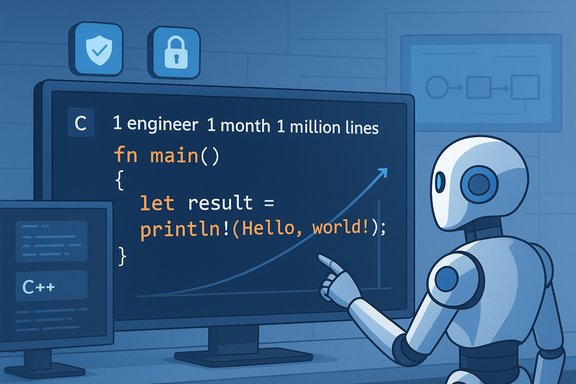
Late-December social-media coverage focused on a LinkedIn job post by Microsoft Distinguished Engineer Galen Hunt in which he described a team-level mission: “My goal is to eliminate every line of C and C++ from Microsoft by 2030.” The posting advertised a Principal Software Engineer role to help evolve infrastructure that can translate Microsoft’s largest C and C++ systems to Rust, and described a so-called “North Star” productivity metric: “1 engineer, 1 month, 1 million lines of code.” The publicity cascade included broad media commentary and post-copying across technical communities. Hours after the attention grew, Hunt updated the post to clarify that Windows is NOT being rewritten in Rust with AI, and that the work he described is a research project aimed at building tooling and platforms to make language migration possible — not an immediate company-wide plan to rip-and-replace Windows or other products. That clarification has become central to parsing what the announcement actually means internally at Microsoft.Why this matters now
Large platform vendors are quietly reshaping engineering toolchains and language policy in response to three long-standing pressures:- Security and reliability concerns stemming from memory-safety bugs in C and C++.
- The promise of Rust as a systems language that enforces memory and thread-safety at compile time while preserving low-level control.
- The rise of AI-driven code analysis and transformation, which promises to automate parts of large-scale refactoring and migration that were previously impractical.
The factual record: what can be verified
The LinkedIn post and the clarification
- The original job posting and text of the LinkedIn note by Galen Hunt included the quoted ambition to remove C and C++ from Microsoft codebases by 2030, plus the “1 engineer, 1 month, 1 million lines” metric and a description of existing code processing infrastructure for AI-guided code modification.
- Hunt’s subsequent update explicitly stated that the work is a research project, that Windows is not being rewritten with AI or Rust as an immediate company strategy, and that the post sought like-minded engineers rather than to announce product strategy changes. That clarification is significant: it converts an apparent corporate plan into a declared internal research experiment.
Microsoft’s prior investment and public stance on Rust
Microsoft has publicly signaled a strategic interest in Rust for memory-safety improvements. Executives and technical leads have previously announced significant investments — widely reported as around $10 million toward making Rust a “first-class” language within Microsoft engineering systems, alongside contributions to Rust ecosystem governance. That commitment predates Hunt’s post and supplies context for why a team-level Rust migration research project has traction inside the company.Industry precedent: Google and Android
Google’s public guidance around Rust and Android is a useful comparator. Google’s security team documented why memory-safety bugs in C/C++ account for a very large share of severe vulnerabilities, and explained that the Android Open Source Project (AOSP) added first-class Rust support to reduce future memory-safety defects — focusing primarily on new development rather than wholesale rewrites of mature C/C++ code. That public stance is instructive: major vendors prefer gradual migration and new-code use of memory-safe languages rather than immediate, full-scale rewrites.Parsing the claims: what’s credible, what’s aspirational, and what’s unsure
Credible
- Microsoft has a research effort exploring AI-assisted code understanding and transformation at scale; the existence of tool investments and job postings to operate them is verifiable. The company’s prior public investments in Rust tooling and ecosystem strengthening are also documented.
- There is a genuine industry trend: major vendors are actively adopting Rust for new systems code and adding it to OS and kernel development roadmaps to reduce memory-safety vulnerabilities. Google’s experience with AOSP demonstrates measurable reductions in memory-safety defects when Rust is used in new components.
Aspirational (and therefore risky)
- The headline metric — “1 engineer, 1 month, 1 million lines of code” — is aspirational and reads as a productivity North Star rather than a validated throughput claim for safe, production-quality migration. Critics have pointed out arithmetic and practical pitfalls once you factor in code understanding, test coverage, spec gaps, ABI and API compatibility, performance regressions, and security validation. Treating this metric as a schedule guarantee would be misleading.
- The idea of eliminating every line of C and C++ by 2030 within a company with many hundreds of millions of lines of legacy code is politically and technically ambitious. Even with powerful automation, migration choices will be constrained by third-party dependencies, driver ecosystems, hardware interfaces, localized performance characteristics, and regulatory or certification regimes. These constraints make a full, across-the-board rewrite unlikely within the stated timeframe without large follow-on caveats.
Unverifiable or ambiguous claims
- The public posts do not — and cannot, at this stage — prove that an automated system can reliably produce production-ready Rust replacements for arbitrary C/C++ systems at scale without a human-in-the-loop validation stage. The claim that the team’s infrastructure is “already operating at scale on problems such as code understanding” is plausible and supported by generic statements, but specific metrics about accuracy, bug-introduction rates, or validated production deployments are not public. Treat such operational claims as research-stage assertions until independent verification emerges.
Technical analysis: how feasible is large-scale C/C++ → Rust migration with AI?
Main technical challenges
- Semantics and intent: Translating code literally is different from preserving semantics. C/C++ systems often rely on implicit invariants, UB (undefined behavior) quirks, inline assembly, compiler extensions, and undocumented runtime assumptions. Automation must infer intent correctly or risk introducing subtle correctness bugs.
- ABI and platform interfaces: Interoperability with OS APIs, hardware, and drivers typically relies on stable ABIs and particular memory layouts. Migration must preserve these contracts exactly or provide tested adapters.
- Unsafe operations and concurrency models: Some legacy code uses low-level concurrency patterns or manual memory management for performance. Rust permits unsafe blocks for necessary low-level control, but the goal of purely safe Rust everywhere is unrealistic for some subsystems. Migration will be a mixed model.
- Performance parity: Rust can match or exceed C/C++ performance, but micro-optimizations, cache behavior, and platform-specific assembly must be considered. Automated translation risks performance regressions if not validated.
- Toolchain and build complexity: Microsoft’s codebases are built over decades with custom build systems, code generation, and configuration choices. A translation pipeline must integrate with these systems or adapt artifacts into usable CI/CD flows.
- Testing, fuzzing, and verification: Automated translations must come with heavy testing — unit, integration, fuzzing, and property-based tests — to detect regressions and ensure safety guarantees hold.
Why AI + algorithms might help
- Large-scale code understanding: Transformer models and static-analysis graphs can accelerate the discovery of invariants, API usage patterns, and call graphs at scale. Microsoft’s reference to a “scalable graph over source code” matches that approach: build a language-agnostic graph and apply transformations programmatically.
- Synthesis and pattern mapping: For many idiomatic patterns — buffer handling, string APIs, common algorithms — models can synthesize Rust equivalents that match intent while eliminating common classes of memory errors. The value is greatest in repetitive, well-understood code patterns.
- Human-in-the-loop workflows: Pragmatic systems will use AI to propose changes, automated checks to validate invariants, and engineers to sign off on risky or ambiguous transformations. The most credible path is augmentation, not outright replacement.
Where automation will struggle
- Edge-case-heavy systems code — kernel subsystems, device drivers, and hypervisor components often rely on hardware quirks and timing assumptions that are not easily inferred from source-level patterns alone.
- Legacy protocols and undocumented behavior, where the intended semantics are only expressed in integration tests or operational knowledge, not in the code itself.
Organizational, security, and governance implications
Organizational shifts
- A successful, sustained migration program requires cross-team governance: architecture boards, compatibility teams, security verification, and product owners must align on what gets migrated, when, and how. Otherwise the cost of integration and the risk of regressions will rise steeply.
- Skill and hiring strategy will change: Rust expertise, systems-level Rust engineering, and tools engineering (analysis pipelines, program transformation, LLM fine-tuning for code tasks) will be in demand. Microsoft’s posting reflects that hiring focus.
Security and supply-chain considerations
- Rewriting in Rust reduces exposure to a major class of memory-safety bugs, but it does not eliminate all vulnerability classes: logic errors, insecure I/O handling, authorization bugs, and cryptographic misuse remain. Migration effort must couple Rust conversion with threat modeling and secure-by-design practices.
- Automated transformations raise supply-chain verification questions: transformed artifacts must be reproducible and auditable. If AI-generated changes propagate through binary builds, maintainers and security teams need tools to trace and attest the provenance and correctness of those transformations.
Legal and compliance
- Some platform components are subject to safety certifications, export controls, or industry compliance regimes that require rigorous validation and documentation. Automated translations risk invalidating certifications unless the migration process is designed with certification evidence in mind.
Practical migration approaches that make sense
- Focus on new development and recently modified code first. This limits risk and yields early wins: the code’s developers are known and tests are available. Google’s AOSP approach follows this path.
- Build adapter layers for ABI-stable boundaries. Preserve native interfaces and incrementally replace internals behind clear, tested boundaries.
- Use automated proposal + review workflows: AI proposes, static analysis and fuzzers vet, engineers approve. This hybrid approach balances scale and safety.
- Prioritize safety-critical subsystems where memory-safety bugs are most costly, and where Rust’s guarantees offer the largest marginal return.
- Institutionalize reproducibility and provenance in the transformation pipeline so that every change is traceable, testable, and auditable.
The “1 engineer, 1 month, 1 million lines” metric: inspirational or misleading?
The “North Star” slogan is vivid and shows ambitious intent, but it collapses under simple operational modeling unless the following are true and proven:- The translator produces near-zero semantic regressions at scale.
- A comprehensive, automated testing and verification pipeline detects and rejects subtle regressions.
- Performance parity holds across millions of LOC without massive manual tuning.
Strengths of the approach Microsoft’s researchers are taking
- Focused tooling investment: Building a scalable graph-based representation of massive codebases and coupling it with AI agents is the right architectural direction to enable large-scale code comprehension and pattern-based transformation. It is a necessary infrastructural precondition for any automated migration effort.
- Alignment with industry trends: Microsoft’s interest in Rust matches broader industry movement toward memory-safe languages for new systems code. This alignment makes hiring, tool adoption, and ecosystem collaboration easier.
- Potential security upside: Targeted Rust adoption can reduce future memory-safety vulnerabilities and improve long-term maintainability for newly-written components. Google’s AOSP experience suggests measurable declines in memory-safety defects.
Risks and open questions
- Over-reliance on AI without rigorous validation: If AI agents are used to propose or enact code changes without a robust verification stack, there is a substantial risk of subtle, high-impact regressions. The consequences can range from crashes to security vulnerabilities that are harder to detect because they originate from automated transformations rather than human authorship.
- Operational and human factors: Migration at this scale requires organizational buy-in, documentation updates, and training. Without that, teams can become fragmented between legacy maintenance and migrated subsystems, increasing cognitive load and error rates.
- Third-party and ecosystem constraints: Drivers, firmware, and third-party libraries may not have Rust equivalents and will need stable interop strategies. Some dependencies are intractable to translate without cooperation from external vendors.
- Regulatory and certification hurdles: Safety-critical components that require certification (medical devices, automotive, avionics) cannot be casually transformed without evidence and recertification work.
- Unclear ROI and churn: Large rewrites historically carry high short-term costs and uncertain long-term ROI. Organizations must quantify benefits (reduced vulnerabilities, lower maintenance cost, faster feature velocity) against migration costs and integration risks.
What to expect next
- Expect Microsoft’s research team to publish more technical progress and tooling artifacts if the program is intended to catalyze ecosystem engagement and hiring. Early milestones may include prototype translators for well-defined subsystems, evidence of promising transformation accuracy, and reproducible pipelines for test-and-verify loops.
- Look for incremental, pragmatic adoption: Microsoft is likely to push Rust into new components, internal tooling, and greenfield modules first, while using translation tools to accelerate modernization where ROI is clear. That mirrors Google’s measured AOSP approach.
- The conversation will shape how enterprises think about AI-assisted code transformation. If Microsoft or others publish empirical results (error rates, verification success, performance parity), that data will be decisive in turning research into production practice.
Practical advice for engineers and managers
- Treat AI-assisted translation as a tool for augmentation, not a substitute for system understanding. Integrate it into standard engineering workflows with mandatory human review, testing, and provenance.
- Prioritize migration candidates by risk and ROI: modules with high incidence of memory-safety bugs or that handle untrusted input should be higher priority.
- Invest in CI/CD and fuzzing for both legacy and translated code. This reduces the probability of silent regressions.
- Build cross-functional governance: security, product, certification, and platform teams must align on migration goals and acceptance criteria.
- Start small and measure: run pilots with clear metrics (bug density, performance delta, developer onboarding time) before expanding the approach.
Conclusion
Galen Hunt’s LinkedIn post and its subsequent clarification have done the industry a service: they made visible a research effort that sits at the intersection of three powerful trends — the shift toward memory-safe languages, the practical need to reduce class-of-bug risk in systems code, and the rising capability of AI to analyze and transform software at scale. The clarified reality — a research program aimed at enabling migration, not a unilateral corporate edict to rip out C and C++ immediately — is the more credible and sober interpretation.The pathway from research prototypes to safe, production-grade, large-scale migration is neither trivial nor guaranteed. Success will require careful engineering, rigorous verification, and organizational discipline. The most realistic near-term outcome is incremental modernization: Rust for new code and selected high-value subsystems, with AI-driven tools to accelerate targeted refactors and to assist developers — not to replace the human engineering judgment that keeps critical systems safe and correct. In short: the idea of eliminating C and C++ from every line of Microsoft’s codebase by 2030 is a provocative call-to-action for research and tooling, not a validated production roadmap. The real story to watch will be the data — demonstrated error rates, performance results, and tooling artifacts — that turn aspiration into practiced engineering.
Source: TechRadar Don't worry — a Microsoft engineer clarifies that the goal to 'eliminate every line of C and C++ from Microsoft by 2030' is currently just a research project
