
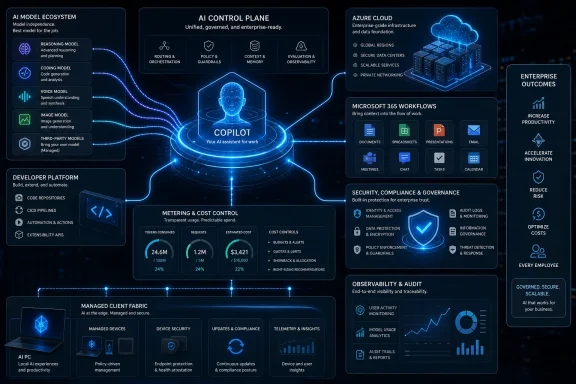
Microsoft’s artificial intelligence pitch in June 2026 is no longer just a story about owning the best seat next to OpenAI; it is a broader attempt to make Azure, Copilot, GitHub, Microsoft 365, security, custom models, and agents into one enterprise AI operating layer. That distinction matters because the market has begun treating AI spending as a cost problem before it has fully priced in Microsoft’s platform advantage. The bull case is not that Microsoft found a clever chatbot partner. It is that Microsoft is trying to make AI boring, governed, metered, auditable, and unavoidable inside the software stack companies already use.
For the past three years, the easiest way to explain Microsoft’s AI strategy was to point at OpenAI. Microsoft supplied cloud infrastructure, product distribution, and capital. OpenAI supplied the frontier-model sparkle that made Copilot demos feel like a genuine break from the old productivity-software cycle.
That shorthand was useful, but it is now too small. Microsoft’s June 2026 message is that it wants more of the stack under its own roof: not merely model access, but model design, orchestration, runtime, developer tooling, compliance, and security. The company is still economically and technically tied to OpenAI, but it is also building a world in which OpenAI is one high-value input among many.
That is the strategic pivot investors should watch. Partnerships are powerful, but platforms compound. Microsoft’s most durable businesses have historically come from turning technical waves into administrative defaults: Windows for PCs, Office for knowledge work, Active Directory for identity, Azure for cloud operations, and now Copilot for enterprise AI.
The difference between a partner-led AI story and a platform-led AI story is control. If Microsoft owns the place where users work, the cloud where workloads run, the identity layer that governs access, the developer tools where software is written, and the security plane that watches it all, it can monetize AI even when the underlying model market becomes more competitive.
The company introduced seven internally developed Microsoft AI models across reasoning, coding, image generation, voice, and transcription. The names are less important than the intent: MAI-Thinking-1, MAI-Code-1-Flash, MAI-Image-2.5, MAI-Voice-2, and MAI-Transcribe-1.5 are not merely branding exercises. They are Microsoft’s attempt to prove that it can optimize models for its own products, economics, latency targets, and governance needs.
That last part is the hinge. The next phase of enterprise AI will not be won only by the model that posts the flashiest benchmark. It will be won by the platform that can answer a less glamorous set of questions: How much does each workflow cost? Can the output be audited? Can the model be constrained by corporate policy? Can it use company context without leaking it? Can the whole thing run inside the procurement, compliance, and security rules that already define enterprise IT?
MAI-Thinking-1 is emblematic of this shift. Microsoft has described it as its first reasoning model, with a 35-billion-active-parameter mixture-of-experts design and a long context window. The company has also highlighted strong benchmark results in math and coding tasks. But the model’s strategic importance is not simply that it can reason; it is that Microsoft can tune, price, integrate, and deploy it on its own terms.
For years, the anxiety around Microsoft’s AI strategy was dependency. What happens if OpenAI becomes too powerful, too expensive, too strategically divergent, or too constrained by its own consumer ambitions? Microsoft’s answer is not a divorce. It is redundancy, leverage, and optionality.
A company does not deploy AI across finance, legal, engineering, sales, and operations because the demo was impressive. It deploys because the system can be governed, measured, secured, and supported. CIOs and CISOs have learned to fear shadow AI for the same reason they once feared shadow IT: the business will adopt useful tools faster than central IT can control them.
Microsoft’s advantage is that it already owns the control surfaces. Entra ID handles identity. Purview handles compliance and data governance. Defender and Sentinel sit in the security workflow. Microsoft 365 contains much of the company’s working memory. Teams and Outlook contain the conversational exhaust of modern corporate life.
That context is not a nice-to-have. It is the raw material that separates a generic assistant from an enterprise agent. A chatbot that can summarize public information is useful; an agent that can understand your company’s documents, respect your permissions, update your CRM, open a pull request, and notify the right channel is a different category.
This is why Microsoft keeps pushing Copilot beyond the assistant metaphor. The company does not want Copilot to be a sidebar. It wants Copilot to become the user interface for work across applications, documents, meetings, code, business processes, and eventually long-running agents.
Microsoft’s “Copilot Super App” architecture, with concepts such as Chat, Cowork, Code, and Autopilots, points in that direction. The product ambition is obvious: keep the user inside Microsoft’s work graph while AI becomes the mediator between people and software. If Microsoft succeeds, Copilot becomes less like Clippy and more like a command shell for the enterprise.
The Autopilots concept is especially telling. A short-lived assistant answers a question. A long-running agent tracks objectives, remembers context, follows policy, and takes action over time. That is the difference between “summarize this email thread” and “monitor this customer escalation, prepare the update, coordinate with engineering, and tell me when legal approval is needed.”
Scout, Microsoft’s first Autopilot, illustrates the direction of travel. An always-on personal agent that works across Teams, Outlook, and Microsoft 365 is not revolutionary because it has a friendly name. It is meaningful because Microsoft can wire it into the applications where enterprise work already happens.
Distribution is the boring superpower here. Startups can build elegant AI workspaces, but Microsoft can place AI into the default software estate of large organizations. That does not guarantee adoption, but it lowers the friction dramatically.
Those numbers matter because they move AI out of the realm of option value. Investors can argue about how much future demand is already priced in, but Microsoft is no longer asking Wall Street to believe only in future monetization. It is showing current revenue growth across infrastructure, first-party applications, and developer services.
The complication is that revenue growth is arriving with a huge capital bill. Microsoft’s calendar 2026 capital expenditure framework of roughly $190 billion underscores the scale of the buildout. Data centers, GPUs, networking, power, and specialized infrastructure do not materialize for free because the word “AI” is attached to them.
That is why the stock’s weakness is not irrational. Investors are right to ask how much free cash flow will be absorbed by infrastructure, how long capacity constraints will last, and whether AI demand is durable enough to justify the buildout. The market has seen cloud investment cycles before, and not every dollar of capex earns a premium return.
But the bullish counterargument is equally serious. Microsoft says demand continues to exceed available capacity, and that is a much better problem than empty data centers waiting for a use case. If AI workloads become a normal part of enterprise computing, Azure’s current capacity shortage may look less like overextension and more like the early bottleneck of a new infrastructure cycle.
This is where smaller, specialized, and internally tuned models become strategically important. A frontier model may be necessary for the hardest tasks, but most enterprise workflows do not need maximum theoretical intelligence every time a user asks for a summary, extracts fields from a document, drafts a routine email, or checks code for a common issue. They need acceptable accuracy at acceptable cost.
Microsoft’s emphasis on efficient models such as MAI-Code-1-Flash is therefore not a side note. A 5-billion-parameter coding model, if good enough for everyday developer assistance, changes the economics of Copilot-like services. The same logic applies to transcription, voice, and image workflows where latency and unit cost matter at scale.
Enterprise AI will become more cost-sensitive as it leaves pilot programs. In a pilot, a department can tolerate expensive inference because usage is limited and the sponsor wants to prove feasibility. In production, millions of prompts, documents, calls, tickets, and code suggestions become a line item someone has to defend.
Microsoft understands this because it sells to the people who approve those budgets. The future of AI adoption depends on moving from magical demos to predictable costs. If Microsoft can route workloads across frontier models, smaller proprietary models, customer-tuned models, and task-specific agents, it can offer enterprises something more valuable than raw model access: a managed cost-performance curve.
GitHub Copilot was one of the earliest mainstream examples of paid generative AI at work. It made the value proposition legible: fewer keystrokes, faster scaffolding, quicker explanations, and help navigating unfamiliar code. The product also gave Microsoft a live feedback loop inside the software development process, which is where many enterprise AI workflows will be born.
Coding models are not just another category of AI model. They are a bridge into automation. A coding assistant can suggest a function today, modify a repository tomorrow, and eventually coordinate with test suites, deployment pipelines, issue trackers, documentation, and security scanners. That path leads naturally from assistant to agent.
This is why the integration of Microsoft’s own coding models into GitHub Copilot and Visual Studio Code matters. Microsoft can shape the model around the actual behavior of developers in its ecosystem. It can optimize for latency in the editor, cost in high-frequency completions, and governance in enterprise repositories.
There is also a Windows angle that should not be overlooked. Developers remain one of the most strategically important user groups for any platform. If Microsoft can make Windows, VS Code, GitHub, Azure, and Copilot feel like the most coherent place to build and operate AI-enabled software, it strengthens an ecosystem that had once seemed at risk of drifting toward browser-first and cloud-neutral tools.
A conventional chatbot that cannot touch enterprise systems is limited. An agent that can read email, query databases, file tickets, write code, update records, and message employees must be treated as a new class of privileged actor. It needs identity, permissions, logging, policy enforcement, data-loss prevention, and incident response.
This is where Microsoft’s security business becomes more than an adjacent revenue stream. The company can argue that enterprise AI should be governed by the same identity and compliance architecture that already governs users, devices, applications, and data. That is a compelling pitch to customers who do not want to bolt an unproven AI governance layer onto an already complex IT estate.
The risk, of course, is concentration. If Microsoft becomes the productivity suite, identity provider, cloud platform, AI interface, developer toolchain, and security layer, failures become systemic. A misconfiguration, outage, or security incident can have broader consequences when so many functions converge.
Still, enterprise buyers often prefer integrated risk to fragmented risk. A best-of-breed AI stack assembled from multiple vendors may offer flexibility, but it also creates more seams. Microsoft’s bet is that regulated and security-conscious customers will pay for fewer seams, even if they complain about lock-in while doing it.
The discount reflects skepticism. Investors are no longer willing to treat AI capex as automatically accretive. They want evidence that Copilot seats, Azure consumption, GitHub usage, security integration, and AI agents can generate returns large enough to justify the spending surge.
That skepticism is healthy. The worst version of the AI boom would be a capital arms race where every hyperscaler builds ahead of demand, trains overlapping models, subsidizes usage, and discovers too late that customers enjoy AI features more than they like paying for them. Microsoft is not immune to that risk.
But Microsoft has a stronger claim than most to converting infrastructure into software margin over time. It can sell AI through existing enterprise agreements. It can bundle, meter, and tier usage. It can attach AI to productivity, development, analytics, security, and business applications. It can also use its own software estate as a testing ground before pushing capabilities outward.
That makes the valuation question less about whether Microsoft has an AI story and more about whether investors trust the company’s ability to convert AI demand into durable operating leverage. The stock’s year-to-date decline suggests many do not fully trust that conversion yet.
The better interpretation is portfolio management. Microsoft does not want one model provider, one architecture, one cost structure, or one strategic dependency to define its future. It wants a menu of models and a platform that can route work to the right one.
This is also how enterprises think. A bank, hospital, manufacturer, or government agency may want access to frontier models for certain tasks, smaller governed models for others, and domain-specific agents for internal workflows. The winning platform is unlikely to be the one that insists every problem use the same hammer.
Microsoft’s Foundry and Azure AI ecosystem are built around that pluralism. Bring your own model, use Microsoft’s models, use OpenAI models, tune for the domain, govern through Microsoft’s controls, and deploy through Azure. It is a pragmatic strategy, and pragmatism tends to sell well in enterprise IT.
The OpenAI partnership gave Microsoft credibility and urgency. The broader stack gives it staying power. That is the difference investors are still digesting.
AI PCs, local inference, developer workstations, enterprise device management, and security telemetry all give Windows a continuing role. Not every AI task belongs in the cloud. Some work will need lower latency, offline availability, privacy-preserving local execution, or hybrid routing between device and data center.
Microsoft’s challenge is to make that hybrid model feel coherent rather than gimmicky. Windows users have seen too many features arrive as promotional surfaces instead of durable workflows. Copilot on the PC has to become more than a branded panel if it is going to matter to professionals.
The strongest Windows case is not that every user will chat with the operating system all day. It is that Windows can become a managed endpoint for AI-assisted work: local models where appropriate, cloud models where necessary, enterprise policy everywhere, and developer tooling that treats the PC as part of a broader AI fabric.
That is a harder story to market than a new Start menu trick. But it is a more plausible one.
A startup can pivot when its agent framework disappoints. Microsoft has to support customers for years. A research lab can celebrate a benchmark. Microsoft has to turn that benchmark into a service-level agreement, a compliance posture, a pricing plan, and a support document.
That burden is precisely why Microsoft may be well positioned. Enterprise technology adoption is rarely about the cleanest architecture in the abstract. It is about who can reduce the number of new decisions a customer has to make. Microsoft’s pitch is that companies can adopt AI without abandoning their existing identity systems, productivity tools, developer platforms, and security operations.
The danger is complacency. Microsoft has repeatedly shown that it can bundle its way into markets, but AI is moving too quickly for bundling alone to be enough. If Copilot feels mediocre, if agents prove brittle, if costs remain opaque, or if security incidents pile up, customers will experiment elsewhere.
That is why the in-house model push matters. It is evidence that Microsoft knows distribution alone will not carry the next decade. The company needs technical depth, not just channel power.
The most concrete points are now visible enough to separate signal from pitch:
 Microsoft’s AI Story Has Outgrown the OpenAI Shortcut
For the past three years, the easiest way to explain Microsoft’s AI strategy was to point at OpenAI. Microsoft supplied cloud infrastructure, product distribution, and capital. OpenAI supplied the frontier-model sparkle that made Copilot demos feel like a genuine break from the old productivity-software cycle.That shorthand was useful, but it is now too small. Microsoft’s June 2026 message is that it wants more of the stack under its own roof: not merely model access, but model design, orchestration, runtime, developer tooling, compliance, and security. The company is still economically and technically tied to OpenAI, but it is also building a world in which OpenAI is one high-value input among many.
That is the strategic pivot investors should watch. Partnerships are powerful, but platforms compound. Microsoft’s most durable businesses have historically come from turning technical waves into administrative defaults: Windows for PCs, Office for knowledge work, Active Directory for identity, Azure for cloud operations, and now Copilot for enterprise AI.
The difference between a partner-led AI story and a platform-led AI story is control. If Microsoft owns the place where users work, the cloud where workloads run, the identity layer that governs access, the developer tools where software is written, and the security plane that watches it all, it can monetize AI even when the underlying model market becomes more competitive.
Build 2026 Was a Declaration of Model Independence
The most important signal from Microsoft Build 2026 was not that the company introduced another round of AI features. That is now table stakes. The real message was that Microsoft wants to be seen as a model maker in its own right.The company introduced seven internally developed Microsoft AI models across reasoning, coding, image generation, voice, and transcription. The names are less important than the intent: MAI-Thinking-1, MAI-Code-1-Flash, MAI-Image-2.5, MAI-Voice-2, and MAI-Transcribe-1.5 are not merely branding exercises. They are Microsoft’s attempt to prove that it can optimize models for its own products, economics, latency targets, and governance needs.
That last part is the hinge. The next phase of enterprise AI will not be won only by the model that posts the flashiest benchmark. It will be won by the platform that can answer a less glamorous set of questions: How much does each workflow cost? Can the output be audited? Can the model be constrained by corporate policy? Can it use company context without leaking it? Can the whole thing run inside the procurement, compliance, and security rules that already define enterprise IT?
MAI-Thinking-1 is emblematic of this shift. Microsoft has described it as its first reasoning model, with a 35-billion-active-parameter mixture-of-experts design and a long context window. The company has also highlighted strong benchmark results in math and coding tasks. But the model’s strategic importance is not simply that it can reason; it is that Microsoft can tune, price, integrate, and deploy it on its own terms.
For years, the anxiety around Microsoft’s AI strategy was dependency. What happens if OpenAI becomes too powerful, too expensive, too strategically divergent, or too constrained by its own consumer ambitions? Microsoft’s answer is not a divorce. It is redundancy, leverage, and optionality.
The Enterprise Wants AI That Behaves Like Infrastructure
Consumer AI rewards surprise. Enterprise AI rewards reliability. That difference explains why Microsoft’s approach may look less dazzling than the latest viral demo but could matter more to the customers with the largest budgets.A company does not deploy AI across finance, legal, engineering, sales, and operations because the demo was impressive. It deploys because the system can be governed, measured, secured, and supported. CIOs and CISOs have learned to fear shadow AI for the same reason they once feared shadow IT: the business will adopt useful tools faster than central IT can control them.
Microsoft’s advantage is that it already owns the control surfaces. Entra ID handles identity. Purview handles compliance and data governance. Defender and Sentinel sit in the security workflow. Microsoft 365 contains much of the company’s working memory. Teams and Outlook contain the conversational exhaust of modern corporate life.
That context is not a nice-to-have. It is the raw material that separates a generic assistant from an enterprise agent. A chatbot that can summarize public information is useful; an agent that can understand your company’s documents, respect your permissions, update your CRM, open a pull request, and notify the right channel is a different category.
This is why Microsoft keeps pushing Copilot beyond the assistant metaphor. The company does not want Copilot to be a sidebar. It wants Copilot to become the user interface for work across applications, documents, meetings, code, business processes, and eventually long-running agents.
Copilot Is Becoming Microsoft’s Enterprise AI Control Plane
The phrase “AI control plane” sounds like vendor jargon until you consider what Microsoft is trying to place behind it. Copilot is no longer just the button in Word that rewrites a paragraph or the meeting tool that summarizes Teams calls. It is becoming the layer where employees find agents, assign work, retrieve context, and interact with business systems.Microsoft’s “Copilot Super App” architecture, with concepts such as Chat, Cowork, Code, and Autopilots, points in that direction. The product ambition is obvious: keep the user inside Microsoft’s work graph while AI becomes the mediator between people and software. If Microsoft succeeds, Copilot becomes less like Clippy and more like a command shell for the enterprise.
The Autopilots concept is especially telling. A short-lived assistant answers a question. A long-running agent tracks objectives, remembers context, follows policy, and takes action over time. That is the difference between “summarize this email thread” and “monitor this customer escalation, prepare the update, coordinate with engineering, and tell me when legal approval is needed.”
Scout, Microsoft’s first Autopilot, illustrates the direction of travel. An always-on personal agent that works across Teams, Outlook, and Microsoft 365 is not revolutionary because it has a friendly name. It is meaningful because Microsoft can wire it into the applications where enterprise work already happens.
Distribution is the boring superpower here. Startups can build elegant AI workspaces, but Microsoft can place AI into the default software estate of large organizations. That does not guarantee adoption, but it lowers the friction dramatically.
Azure Is Where the AI Bill Becomes the AI Business
The most concrete evidence that Microsoft’s AI strategy is more than narrative comes from Azure. In fiscal third-quarter 2026, Microsoft reported Azure and other cloud services revenue growth of roughly 40 percent, or 39 percent in constant currency. The company also said its AI business had surpassed a $37 billion annual revenue run rate, up 123 percent year over year.Those numbers matter because they move AI out of the realm of option value. Investors can argue about how much future demand is already priced in, but Microsoft is no longer asking Wall Street to believe only in future monetization. It is showing current revenue growth across infrastructure, first-party applications, and developer services.
The complication is that revenue growth is arriving with a huge capital bill. Microsoft’s calendar 2026 capital expenditure framework of roughly $190 billion underscores the scale of the buildout. Data centers, GPUs, networking, power, and specialized infrastructure do not materialize for free because the word “AI” is attached to them.
That is why the stock’s weakness is not irrational. Investors are right to ask how much free cash flow will be absorbed by infrastructure, how long capacity constraints will last, and whether AI demand is durable enough to justify the buildout. The market has seen cloud investment cycles before, and not every dollar of capex earns a premium return.
But the bullish counterargument is equally serious. Microsoft says demand continues to exceed available capacity, and that is a much better problem than empty data centers waiting for a use case. If AI workloads become a normal part of enterprise computing, Azure’s current capacity shortage may look less like overextension and more like the early bottleneck of a new infrastructure cycle.
Efficiency Is Microsoft’s Quiet Answer to the Capex Panic
The capital-spending debate tends to flatten AI into one question: how many chips can Microsoft buy? That is the wrong endpoint. The more important question is how much useful work Microsoft can extract from each dollar of compute.This is where smaller, specialized, and internally tuned models become strategically important. A frontier model may be necessary for the hardest tasks, but most enterprise workflows do not need maximum theoretical intelligence every time a user asks for a summary, extracts fields from a document, drafts a routine email, or checks code for a common issue. They need acceptable accuracy at acceptable cost.
Microsoft’s emphasis on efficient models such as MAI-Code-1-Flash is therefore not a side note. A 5-billion-parameter coding model, if good enough for everyday developer assistance, changes the economics of Copilot-like services. The same logic applies to transcription, voice, and image workflows where latency and unit cost matter at scale.
Enterprise AI will become more cost-sensitive as it leaves pilot programs. In a pilot, a department can tolerate expensive inference because usage is limited and the sponsor wants to prove feasibility. In production, millions of prompts, documents, calls, tickets, and code suggestions become a line item someone has to defend.
Microsoft understands this because it sells to the people who approve those budgets. The future of AI adoption depends on moving from magical demos to predictable costs. If Microsoft can route workloads across frontier models, smaller proprietary models, customer-tuned models, and task-specific agents, it can offer enterprises something more valuable than raw model access: a managed cost-performance curve.
GitHub Gives Microsoft the Developer Wedge It Never Had in Office
Microsoft 365 gives Microsoft access to knowledge workers. Azure gives it access to infrastructure buyers. GitHub gives it access to developers, and that may be the most important route into AI-native workflows.GitHub Copilot was one of the earliest mainstream examples of paid generative AI at work. It made the value proposition legible: fewer keystrokes, faster scaffolding, quicker explanations, and help navigating unfamiliar code. The product also gave Microsoft a live feedback loop inside the software development process, which is where many enterprise AI workflows will be born.
Coding models are not just another category of AI model. They are a bridge into automation. A coding assistant can suggest a function today, modify a repository tomorrow, and eventually coordinate with test suites, deployment pipelines, issue trackers, documentation, and security scanners. That path leads naturally from assistant to agent.
This is why the integration of Microsoft’s own coding models into GitHub Copilot and Visual Studio Code matters. Microsoft can shape the model around the actual behavior of developers in its ecosystem. It can optimize for latency in the editor, cost in high-frequency completions, and governance in enterprise repositories.
There is also a Windows angle that should not be overlooked. Developers remain one of the most strategically important user groups for any platform. If Microsoft can make Windows, VS Code, GitHub, Azure, and Copilot feel like the most coherent place to build and operate AI-enabled software, it strengthens an ecosystem that had once seemed at risk of drifting toward browser-first and cloud-neutral tools.
Security Is the Moat Microsoft Wants Investors to Remember
AI agents create a security problem by design. They are useful because they can access context and take action. They are dangerous for exactly the same reason.A conventional chatbot that cannot touch enterprise systems is limited. An agent that can read email, query databases, file tickets, write code, update records, and message employees must be treated as a new class of privileged actor. It needs identity, permissions, logging, policy enforcement, data-loss prevention, and incident response.
This is where Microsoft’s security business becomes more than an adjacent revenue stream. The company can argue that enterprise AI should be governed by the same identity and compliance architecture that already governs users, devices, applications, and data. That is a compelling pitch to customers who do not want to bolt an unproven AI governance layer onto an already complex IT estate.
The risk, of course, is concentration. If Microsoft becomes the productivity suite, identity provider, cloud platform, AI interface, developer toolchain, and security layer, failures become systemic. A misconfiguration, outage, or security incident can have broader consequences when so many functions converge.
Still, enterprise buyers often prefer integrated risk to fragmented risk. A best-of-breed AI stack assembled from multiple vendors may offer flexibility, but it also creates more seams. Microsoft’s bet is that regulated and security-conscious customers will pay for fewer seams, even if they complain about lock-in while doing it.
The Valuation Debate Is Really a Trust Debate
At around $374 per share on June 24, 2026, Microsoft trades at roughly 22 times trailing earnings, with a market value near $2.8 trillion. That is not cheap in absolute terms, but it is not the kind of multiple one might expect for a company claiming to sit at the center of the next enterprise computing cycle.The discount reflects skepticism. Investors are no longer willing to treat AI capex as automatically accretive. They want evidence that Copilot seats, Azure consumption, GitHub usage, security integration, and AI agents can generate returns large enough to justify the spending surge.
That skepticism is healthy. The worst version of the AI boom would be a capital arms race where every hyperscaler builds ahead of demand, trains overlapping models, subsidizes usage, and discovers too late that customers enjoy AI features more than they like paying for them. Microsoft is not immune to that risk.
But Microsoft has a stronger claim than most to converting infrastructure into software margin over time. It can sell AI through existing enterprise agreements. It can bundle, meter, and tier usage. It can attach AI to productivity, development, analytics, security, and business applications. It can also use its own software estate as a testing ground before pushing capabilities outward.
That makes the valuation question less about whether Microsoft has an AI story and more about whether investors trust the company’s ability to convert AI demand into durable operating leverage. The stock’s year-to-date decline suggests many do not fully trust that conversion yet.
OpenAI Remains an Asset, Not the Whole Thesis
It would be a mistake to frame Microsoft’s in-house AI push as an anti-OpenAI rebellion. OpenAI remains a major strategic partner, and frontier models still matter. Microsoft benefits when OpenAI pushes the state of the art forward, especially when those models drive Azure demand and enrich Copilot experiences.The better interpretation is portfolio management. Microsoft does not want one model provider, one architecture, one cost structure, or one strategic dependency to define its future. It wants a menu of models and a platform that can route work to the right one.
This is also how enterprises think. A bank, hospital, manufacturer, or government agency may want access to frontier models for certain tasks, smaller governed models for others, and domain-specific agents for internal workflows. The winning platform is unlikely to be the one that insists every problem use the same hammer.
Microsoft’s Foundry and Azure AI ecosystem are built around that pluralism. Bring your own model, use Microsoft’s models, use OpenAI models, tune for the domain, govern through Microsoft’s controls, and deploy through Azure. It is a pragmatic strategy, and pragmatism tends to sell well in enterprise IT.
The OpenAI partnership gave Microsoft credibility and urgency. The broader stack gives it staying power. That is the difference investors are still digesting.
Windows Is Not the Center of the Story, but It Is Back in the Frame
For WindowsForum readers, the obvious question is where Windows fits in a Microsoft AI story dominated by Azure and Copilot. The answer is that Windows is no longer the center of Microsoft’s economic gravity, but it remains an important endpoint in the AI control loop.AI PCs, local inference, developer workstations, enterprise device management, and security telemetry all give Windows a continuing role. Not every AI task belongs in the cloud. Some work will need lower latency, offline availability, privacy-preserving local execution, or hybrid routing between device and data center.
Microsoft’s challenge is to make that hybrid model feel coherent rather than gimmicky. Windows users have seen too many features arrive as promotional surfaces instead of durable workflows. Copilot on the PC has to become more than a branded panel if it is going to matter to professionals.
The strongest Windows case is not that every user will chat with the operating system all day. It is that Windows can become a managed endpoint for AI-assisted work: local models where appropriate, cloud models where necessary, enterprise policy everywhere, and developer tooling that treats the PC as part of a broader AI fabric.
That is a harder story to market than a new Start menu trick. But it is a more plausible one.
The Microsoft Bull Case Now Has to Survive Its Own Scale
Microsoft’s advantage is scale. Its problem is also scale. Every AI promise the company makes must survive the reality of global enterprise deployment, regulatory scrutiny, security exposure, energy constraints, and investor impatience.A startup can pivot when its agent framework disappoints. Microsoft has to support customers for years. A research lab can celebrate a benchmark. Microsoft has to turn that benchmark into a service-level agreement, a compliance posture, a pricing plan, and a support document.
That burden is precisely why Microsoft may be well positioned. Enterprise technology adoption is rarely about the cleanest architecture in the abstract. It is about who can reduce the number of new decisions a customer has to make. Microsoft’s pitch is that companies can adopt AI without abandoning their existing identity systems, productivity tools, developer platforms, and security operations.
The danger is complacency. Microsoft has repeatedly shown that it can bundle its way into markets, but AI is moving too quickly for bundling alone to be enough. If Copilot feels mediocre, if agents prove brittle, if costs remain opaque, or if security incidents pile up, customers will experiment elsewhere.
That is why the in-house model push matters. It is evidence that Microsoft knows distribution alone will not carry the next decade. The company needs technical depth, not just channel power.
The Numbers Are Big Enough That the Story Can No Longer Be Cosmetic
The practical read for Microsoft watchers is that the company has crossed from AI narrative into AI execution. That does not make the stock an obvious bargain for every investor, and it does not eliminate capex risk. It does mean the debate should be grounded in operating evidence rather than outdated assumptions about a single partnership.The most concrete points are now visible enough to separate signal from pitch:
- Microsoft’s AI strategy now spans internal models, Azure infrastructure, Copilot, GitHub, Microsoft 365, security, and enterprise agents rather than relying solely on OpenAI access.
- Build 2026 signaled that Microsoft wants more control over model economics, latency, governance, and product integration through its own MAI model family.
- Azure’s fiscal third-quarter 2026 growth and Microsoft’s $37 billion AI annual revenue run rate show that AI is already contributing at material scale.
- The company’s massive capital spending is the central risk, but current capacity constraints suggest Microsoft is building into real demand rather than merely chasing hype.
- Copilot’s long-term importance depends on whether it becomes an enterprise control plane for agents, not whether it can occasionally produce impressive productivity demos.
- For Windows users and IT administrators, the most important development is the gradual merger of endpoint, cloud, identity, security, and AI policy into one managed fabric.
References
- Primary source: TipRanks
Published: 2026-06-24T09:12:07.208089
- Related coverage: techradar.com
Microsoft's AI spending spree is now facing a shareholder revolt after billions were poured into Copilot and cloud infrastructure | TechRadar
Microsoft's biggest AI bet yet has landed in courtwww.techradar.com - Official source: microsoft.com
FY26 Q3 - Press Releases - Investor Relations - Microsoft
FY26 Q3 - Press Releases - Investor Relations - Microsoftwww.microsoft.com
- Related coverage: techiexpert.com
Microsoft Shows 7 New Self Made MAI Models at Build 2026 - Techiexpert.com
At Build 2026, Microsoft AI CEO Mustafa Suleyman showed 7 new MAI models. This helps Microsoft build its own AI ecosystem and rely less on OpenAI.techiexpert.com - Related coverage: enterprisedna.co
Microsoft Launches 7 Homegrown AI Models at Build 2026 — Enterprise DNA
Microsoft's MAI family: 7 in-house models at Build 2026, trained without OpenAI data. Here's what enterprise AI buyers need to know.enterprisedna.co - Related coverage: vectrel.ai
Microsoft Built Seven of Its Own AI Models: What It Means When Your Software Vendor Becomes a Model Maker | Vectrel
Microsoft launched seven in-house MAI models at Build 2026 to cut its reliance on OpenAI. Here is what your software vendor becoming a model maker means.www.vectrel.ai
- Related coverage: gihyo.jp
Microsoft Build 2026、AIエージェント開発向けにMicrosoft IQ、MAIモデル、MXCなどを発表 ——Coreutils for WindowsやIntelligent Terminalも | gihyo.jp
Microsoftは2026年6月2日から開催されている開発者イベントMicrosoft Build 2026」で、AIエージェントの構築、実行、管理に関わる開発者向けの発表を行った。gihyo.jp - Related coverage: windowscentral.com
Microsoft launches seven in‑house AI models to cut developer costs and reduce reliance on OpenAI | Windows Central
Microsoft’s new MAI model family includes a flagship reasoning model, zero distillation, and lower developer costs.www.windowscentral.com - Related coverage: ai-revolution.co.jp
Microsoft MAI-Thinking-1とは|35Bパラメータ・OpenAI不使用・AIME97%・MAI-Code-1-Flash・Build 2026自社AI7モデル完全解説 | AI革命株式会社
MicrosoftがBuild 2026で発表した自社製推論AIモデル「MAI-Thinking-1」の仕様・ベンチマーク・料金・利用方法を徹底解説。MAI-Code-1-Flash(GitHub Copilot統合)や残り5モデルの概要、「OpenAI不使用」主張の実態、競合モデル比較まで、2026年6月時点の最新情報をまとめます。ai-revolution.co.jp - Related coverage: geekwire.com
Microsoft unveils seven homegrown AI models in new bid for 'long term self-sufficiency' – GeekWire
Microsoft used its Build conference to unveil seven in-house AI models, including a reasoning model it says draws even with Anthropic's Claude Sonnet 4.6 — part of a push to depend less on the AI partners it has invested billions in.www.geekwire.com - Related coverage: abhs.in
Microsoft Build 2026: 7 MAI Models Cut OpenAI Reliance for Developers | Abhishek Gautam
Microsoft launched 7 in-house AI models at Build 2026 including MAI-Thinking-1 and MAI-Code-1-Flash, now live in GitHub Copilot and VS Code, as it moves to reduce revenue paid to OpenAI.www.abhs.in
- Official source: microsoft.ai
Microsoft AI
 microsoft.ai
- Related coverage: axios.com
Microsoft debuts Scout agent, homegrown reasoning model
Microsoft is seeking to show it is a serious player in AI.www.axios.com
- Related coverage: tomsguide.com
Biggest Microsoft Build 2026 announcements — agentic AI, RTX Spark Dev Box, GitHub Copilot app, new MAI models, and more | Tom's Guide
All the big news from Microsoft's AI-focused eventwww.tomsguide.com - Related coverage: techxplore.com
- Related coverage: henryfund.tippie.uiowa.edu