

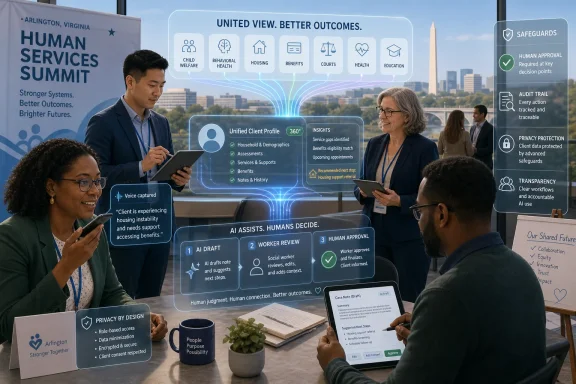
Microsoft used the 2026 APHSA National Human Services Summit in Arlington, Virginia, on June 16 to argue that AI can reduce social workers’ administrative burden, improve case insight, coordinate services, and support safer decisions across public human services agencies. The pitch is timely because the sector’s workforce crisis is no longer a temporary staffing gap; it is the operating condition under which modern welfare systems now function. The question for governments is not whether AI belongs in social work, but whether it can be deployed without turning vulnerability into another data-extraction business model.
The most important thing about Microsoft’s latest government-sector argument is that it does not lead with a model, a chatbot, or a shiny Copilot demo. It leads with a profession under pressure. That is the right frame, because social work’s core problem is not a lack of software enthusiasm; it is a shortage of time, attention, and trust.
The company’s blog post, published alongside the APHSA National Human Services Summit, positions responsible AI as a way to return time to caseworkers, unify fragmented records, support cross-agency collaboration, and keep consequential decisions in human hands. This is vendor messaging, of course, but it lands because it maps onto problems every human services agency already recognizes. Case notes, intake forms, duplicate data entry, disconnected systems, missed signals, and compliance reporting are not glamorous issues, but they are where frontline capacity quietly disappears.
Microsoft is also careful to place AI inside the language of public administration rather than Silicon Valley disruption. The company talks about social workers spending more time with people, agencies seeing a fuller picture of families, and leaders moving beyond pilots into responsible scale. That is a notable tonal shift from the earlier generative AI boom, when vendors often implied that every knowledge-work profession was simply waiting to be automated.
The promise here is narrower and more politically defensible. AI is not presented as a replacement for judgment. It is presented as infrastructure for better judgment.
That is why case recording has become the most plausible first beachhead for generative AI in social services. A system that can summarize a visit, draft a case note, extract structured fields from a conversation, and prepare a worker for review does not have to solve poverty or family violence to be useful. It only has to reduce the clerical tax on an already strained profession.
Microsoft’s framing reflects this reality. The company says the “single most powerful” thing AI can do for social workers is give them time back, particularly by turning long write-ups into shorter review tasks. That distinction matters. In a responsible workflow, the machine drafts and organizes; the professional reads, edits, signs off, and remains accountable.
For IT leaders, that is the difference between an automation project and a liability generator. If AI-generated notes become invisible official records, the agency inherits risks around hallucination, bias, omission, and overconfidence. If they become supervised drafts inside a governed workflow, they can become a practical relief valve.
The irony is that the least glamorous use case may be the most transformative. A generative AI pilot that saves five or ten minutes per case interaction will not make for the most dramatic conference slide. Across thousands of workers and millions of contacts, however, those minutes become capacity, and capacity is the scarce resource in human services.
A family may touch child welfare, housing, behavioral health, courts, schools, Medicaid, food assistance, domestic violence services, and nonprofit providers. Each system has its own statutory purpose, consent rules, data formats, retention policies, and political history. The technology problem is real, but it sits on top of legal, ethical, and organizational problems that are usually harder to solve.
That is why examples like South Australia’s Family Safety Portal are strategically useful for Microsoft. The portal is described as replacing paper-based information sharing with a real-time, multi-agency view for high-risk domestic and family violence cases. In plain English, it tries to ensure that agencies responding to danger are not each holding a different fragment of the truth.
The same logic applies to North Yorkshire Council’s work on children’s social care, where Microsoft points to Azure and Azure OpenAI as part of an effort to help social workers see more context around a child or family. These deployments are not just about AI summarization. They are about whether public agencies can make the accumulated knowledge of government visible to the professionals who need it at the moment they need it.
But this is also where AI can make bad systems fail faster. If the underlying data is incomplete, stale, biased, or collected under assumptions that no longer hold, AI can surface that weakness with a veneer of authority. The machine may not invent the silo, but it can make siloed knowledge look comprehensive.
Microsoft’s article emphasizes transparent triage, demand forecasting, and routing requests to the right service the first time. These are sensible goals. Anyone who has dealt with public assistance systems knows that delay and misrouting are not minor inconveniences; for a family close to eviction or a child in an unsafe setting, bureaucratic lag can become harm.
Still, triage in social work is never just a queueing problem. A missed school appointment, an unanswered phone call, or a prior report may mean very different things depending on culture, disability, poverty, domestic violence risk, immigration status, digital access, or simple exhaustion. AI can help assemble signals, but it cannot be allowed to flatten lived context into a score.
That is why human oversight is not a decorative phrase in this field. It is the core safety mechanism. The worker must be able to see why a system raised a flag, challenge the conclusion, document disagreement, and override the recommendation without being treated as noncompliant.
Public agencies should be especially wary of “efficiency” projects that quietly redefine success as processing more cases with fewer people. The better test is whether AI improves the quality and timeliness of human decisions, not whether it gives budget offices a new argument for understaffing.
The lives of vulnerable people rarely match the org chart. A child welfare case may involve a school district, a pediatrician, a court, a housing authority, a mental health provider, and a relative caregiver. A person experiencing homelessness may need identification documents, benefits enrollment, medical care, transportation, substance-use treatment, and safe placement before any single agency’s intervention can stick.
Microsoft argues that AI-powered case management and modern contact centers can help create “one experience for the citizen” and a coordinated response from government. That is the right aspiration. It is also the aspiration that government technology projects have been chasing for decades under different names: integrated service delivery, whole-person care, no-wrong-door access, and digital government.
Generative AI changes the mechanics. It can summarize long histories, translate dense records into usable briefings, and help staff navigate knowledge bases across programs. But it does not automatically solve interagency accountability. If five agencies can see a risk and none owns the response, the dashboard becomes a witness, not a remedy.
The City of Hope example in Microsoft’s post is telling because it comes from healthcare rather than social care. The organization used Azure to process and summarize large volumes of medical history for physicians. Microsoft presents it as a transferable pattern: complex records can be made usable before a professional meets a person.
That transfer is plausible, but social care adds layers of ambiguity that medicine does not always face in the same way. A medical history may be complicated, but a social history often includes contested narratives, family dynamics, legal thresholds, trauma, poverty, and institutional mistrust. Summarization is useful only if it preserves uncertainty rather than sanding it away.
But public-sector contact centers are not retail support desks. A resident calling about housing, food assistance, family violence, disability services, or benefits eligibility may not know which words trigger which process. The system has to handle ambiguity, distress, low digital literacy, language access, and urgency.
AI can help by making the front door less fragmented. It can interpret plain language, suggest next steps, and hand off to humans when the situation is complex or risky. The design challenge is making that handoff generous rather than punitive.
There is a familiar failure mode in automated service systems: the technology works beautifully for the people with the simplest problems and becomes a maze for everyone else. In social services, that would invert the mission. The people with the most complex needs must not be forced to prove complexity to a bot before reaching a human being.
Microsoft’s best argument is that automation can free officers for the most complex cases personally. Agencies should hold vendors to that promise. If AI reduces queues but also raises barriers, it will be experienced by vulnerable residents not as modernization, but as abandonment with better branding.
Microsoft’s post points to its Responsible AI Transparency Report and to tools such as Microsoft 365 Copilot, Azure AI, Dynamics 365, and Power Platform as components used in selected public-sector deployments. It also highlights Northumbria Healthcare NHS Foundation Trust’s use of Azure Machine Learning and Microsoft’s responsible AI dashboard for surgical risk and triage models, with fairness and bias checks built into the work.
That example matters because it moves the discussion from principles to operations. Fairness testing cannot be a press-release noun. It has to be a repeatable process with named owners, measurable thresholds, documented exceptions, and real consequences when a model behaves badly.
For human services agencies, responsible AI also means procurement discipline. Contracts should specify data use, retention, model training boundaries, logging, audit rights, incident response, accessibility, and explainability requirements. Agencies cannot outsource public trust to a platform provider, even a major one.
The public will not judge these systems by architecture diagrams. People will judge them by whether they can correct a record, understand a decision, reach a human, and avoid being profiled by an opaque system that treats prior hardship as future risk.
King County Housing Authority’s use of Microsoft 365 Copilot, cited in the post, illustrates the strategy. The agency is using Copilot to draft scripts, build training materials, and experiment in real time while staying inside public-sector guardrails around data protection and records requirements. That is a less dramatic use case than automated case decisions, and that is precisely why it is sensible.
The early wins for government AI may come from administrative and internal-facing work: training materials, policy summaries, meeting preparation, document drafting, knowledge retrieval, and case-note assistance. These uses still need governance, but they carry lower stakes than automated eligibility or risk scoring. They also build staff familiarity before agencies move into more sensitive territory.
This is where Microsoft can make an unusually pragmatic argument. Agencies do not need to begin with the most controversial AI use case. They can start with the work that burns time but does not decide anyone’s fate.
That sequence matters for workforce trust. Social workers have seen enough technology projects imposed from above to be skeptical of another tool promising transformation. If AI first shows up as a helper that reduces late-night paperwork, it will be received differently than if it arrives as a scoring engine that second-guesses professional judgment.
Social workers know where records are misleading, where forms fail to capture reality, where risk language becomes distorted, and where families experience systems as surveillance. People with lived experience know where government processes feel humiliating, confusing, or punitive. If those perspectives are not present during design, AI will faithfully optimize the wrong process.
The danger is not only that AI will replace human judgment. It is that it will encode managerial assumptions about what social work is. A system built primarily to satisfy reporting requirements may produce tidy records and worse relationships. A system built around practice may produce better conversations, better notes, and more honest escalation.
For leaders, this means AI governance must include more than IT, legal, and procurement. It needs practitioners, supervisors, data protection officers, accessibility experts, community representatives, and independent scrutiny. It also needs time for iteration, because the first version of a workflow rarely survives contact with frontline reality.
The social worker of the AI era, in Microsoft’s telling, begins the day with an AI-prepared briefing, uses voice-to-text after visits, and receives early warnings about missed appointments or school attendance changes. That future is plausible. Whether it is humane depends on who gets to shape it.
This is especially important in child welfare, domestic violence, housing instability, and adult safeguarding. These domains involve high-stakes decisions under uncertainty. They also involve populations that may already distrust government because of past surveillance, discrimination, or institutional failure.
AI systems can reinforce that distrust if they feel extractive. A family may not object to technology that helps a worker remember details and follow through faster. The same family may object strongly to being silently scored, summarized, or flagged by systems they cannot inspect or challenge.
There is also a subtler workforce risk. If AI-generated summaries become the main way supervisors and courts understand a case, the language of the model may begin to shape the language of practice. Repeated enough times, that can standardize not only documentation, but perception.
The antidote is not to reject AI. It is to keep the human record alive. Workers should be trained to edit aggressively, preserve dissenting facts, identify uncertainty, and avoid letting generated text become the default truth simply because it is fluent.
The company’s broader pitch is that technology is only one part of the transformation. It points to cloud modernization, AI development tools, security, responsible AI practices, partner ecosystems, and government-experienced advisors. This is classic Microsoft: sell the platform, the partner channel, the compliance posture, and the implementation network together.
For WindowsForum readers, the significance is that AI adoption in government will not arrive as a single app. It will arrive through familiar enterprise plumbing: Entra identity, Microsoft 365, Teams, Power Platform, Dynamics 365, Azure, Power BI, security tooling, and line-of-business integrations. The AI layer will be woven into workflows that public employees already use.
That makes adoption easier, but it also concentrates dependency. Agencies that build their human-services AI strategy around one vendor gain integration and governance advantages, but they also deepen lock-in. In a sector where records may need to outlive platforms, administrations, and contracts, that is not a trivial concern.
Microsoft’s strongest public-sector argument is that it can help agencies move safely because it already understands government compliance. Its weakest point is the same fact viewed from another angle: the more government work becomes embedded in a single commercial ecosystem, the more public accountability depends on private infrastructure.
Pilots can hide difficult questions. They often involve motivated teams, narrow use cases, extra support, and limited consequences. Full deployment is different. It reaches tired workers, uneven data, edge cases, hostile audits, budget cycles, and people whose lives are already complicated enough.
Before agencies scale AI in social work, they should be able to answer basic operational questions. What task is the AI performing? What decision, if any, does it influence? Who reviews it? What happens when it is wrong? How are affected people informed? How is bias measured? How can staff challenge the tool without career risk?
These questions are not anti-innovation. They are what separates public-interest modernization from procurement theater. If AI is going to touch case records, triage, or service coordination, it must be treated as part of the public service itself, not merely as back-office software.
The prize is still real. A well-designed AI workflow could help a social worker walk into a visit better prepared, leave with less paperwork, spot a risk earlier, and coordinate support faster. That is meaningful. But in this field, meaningful is not the same as harmless.
Microsoft’s APHSA message is persuasive because it identifies the right pain point: social workers do not need technology that makes their profession less human; they need systems that stop stealing the time required to practice it. The next phase will be harder than the demos. Governments will have to prove that AI can lighten the load without narrowing judgment, connect services without expanding surveillance, and make public systems faster without making them colder. If they can do that, AI’s most important contribution to social work may be surprisingly modest and profoundly consequential: giving professionals enough room to be present when presence matters most.
 Microsoft Sells AI as a Workforce Strategy, Not a Gadget
The most important thing about Microsoft’s latest government-sector argument is that it does not lead with a model, a chatbot, or a shiny Copilot demo. It leads with a profession under pressure. That is the right frame, because social work’s core problem is not a lack of software enthusiasm; it is a shortage of time, attention, and trust.The company’s blog post, published alongside the APHSA National Human Services Summit, positions responsible AI as a way to return time to caseworkers, unify fragmented records, support cross-agency collaboration, and keep consequential decisions in human hands. This is vendor messaging, of course, but it lands because it maps onto problems every human services agency already recognizes. Case notes, intake forms, duplicate data entry, disconnected systems, missed signals, and compliance reporting are not glamorous issues, but they are where frontline capacity quietly disappears.
Microsoft is also careful to place AI inside the language of public administration rather than Silicon Valley disruption. The company talks about social workers spending more time with people, agencies seeing a fuller picture of families, and leaders moving beyond pilots into responsible scale. That is a notable tonal shift from the earlier generative AI boom, when vendors often implied that every knowledge-work profession was simply waiting to be automated.
The promise here is narrower and more politically defensible. AI is not presented as a replacement for judgment. It is presented as infrastructure for better judgment.
The Paperwork Crisis Is the Opening AI Has Been Waiting For
Social work has always been documentation-heavy, but modern compliance systems have pushed documentation from support function to daily obstacle. Every home visit, safeguarding concern, risk assessment, referral, eligibility determination, and court-related update has to be recorded, categorized, shared, and retained. When those systems are clumsy, the worker becomes the middleware.That is why case recording has become the most plausible first beachhead for generative AI in social services. A system that can summarize a visit, draft a case note, extract structured fields from a conversation, and prepare a worker for review does not have to solve poverty or family violence to be useful. It only has to reduce the clerical tax on an already strained profession.
Microsoft’s framing reflects this reality. The company says the “single most powerful” thing AI can do for social workers is give them time back, particularly by turning long write-ups into shorter review tasks. That distinction matters. In a responsible workflow, the machine drafts and organizes; the professional reads, edits, signs off, and remains accountable.
For IT leaders, that is the difference between an automation project and a liability generator. If AI-generated notes become invisible official records, the agency inherits risks around hallucination, bias, omission, and overconfidence. If they become supervised drafts inside a governed workflow, they can become a practical relief valve.
The irony is that the least glamorous use case may be the most transformative. A generative AI pilot that saves five or ten minutes per case interaction will not make for the most dramatic conference slide. Across thousands of workers and millions of contacts, however, those minutes become capacity, and capacity is the scarce resource in human services.
The “Single Source of Truth” Is Still the Hard Part
Microsoft’s second argument is that AI becomes more valuable when agencies can work from a unified data foundation. This is true, but it is also where the difficulty begins. The phrase “single source of truth” sounds clean in a keynote and messy in a county government.A family may touch child welfare, housing, behavioral health, courts, schools, Medicaid, food assistance, domestic violence services, and nonprofit providers. Each system has its own statutory purpose, consent rules, data formats, retention policies, and political history. The technology problem is real, but it sits on top of legal, ethical, and organizational problems that are usually harder to solve.
That is why examples like South Australia’s Family Safety Portal are strategically useful for Microsoft. The portal is described as replacing paper-based information sharing with a real-time, multi-agency view for high-risk domestic and family violence cases. In plain English, it tries to ensure that agencies responding to danger are not each holding a different fragment of the truth.
The same logic applies to North Yorkshire Council’s work on children’s social care, where Microsoft points to Azure and Azure OpenAI as part of an effort to help social workers see more context around a child or family. These deployments are not just about AI summarization. They are about whether public agencies can make the accumulated knowledge of government visible to the professionals who need it at the moment they need it.
But this is also where AI can make bad systems fail faster. If the underlying data is incomplete, stale, biased, or collected under assumptions that no longer hold, AI can surface that weakness with a veneer of authority. The machine may not invent the silo, but it can make siloed knowledge look comprehensive.
Better Triage Can Help, but It Can Also Harden Bureaucracy
AI-supported triage is one of the most attractive and dangerous ideas in public services. Done well, it can route urgent cases faster, identify missed risks, reduce duplication, and help agencies forecast demand. Done poorly, it can become a black box that decides which families receive attention and which ones wait.Microsoft’s article emphasizes transparent triage, demand forecasting, and routing requests to the right service the first time. These are sensible goals. Anyone who has dealt with public assistance systems knows that delay and misrouting are not minor inconveniences; for a family close to eviction or a child in an unsafe setting, bureaucratic lag can become harm.
Still, triage in social work is never just a queueing problem. A missed school appointment, an unanswered phone call, or a prior report may mean very different things depending on culture, disability, poverty, domestic violence risk, immigration status, digital access, or simple exhaustion. AI can help assemble signals, but it cannot be allowed to flatten lived context into a score.
That is why human oversight is not a decorative phrase in this field. It is the core safety mechanism. The worker must be able to see why a system raised a flag, challenge the conclusion, document disagreement, and override the recommendation without being treated as noncompliant.
Public agencies should be especially wary of “efficiency” projects that quietly redefine success as processing more cases with fewer people. The better test is whether AI improves the quality and timeliness of human decisions, not whether it gives budget offices a new argument for understaffing.
Interoperability Is Where AI Meets the Oldest Government Problem
The most ambitious part of Microsoft’s case is not note-taking or chat. It is the idea that AI can help human services agencies coordinate care across institutional boundaries. This is where the technology story becomes a governance story.The lives of vulnerable people rarely match the org chart. A child welfare case may involve a school district, a pediatrician, a court, a housing authority, a mental health provider, and a relative caregiver. A person experiencing homelessness may need identification documents, benefits enrollment, medical care, transportation, substance-use treatment, and safe placement before any single agency’s intervention can stick.
Microsoft argues that AI-powered case management and modern contact centers can help create “one experience for the citizen” and a coordinated response from government. That is the right aspiration. It is also the aspiration that government technology projects have been chasing for decades under different names: integrated service delivery, whole-person care, no-wrong-door access, and digital government.
Generative AI changes the mechanics. It can summarize long histories, translate dense records into usable briefings, and help staff navigate knowledge bases across programs. But it does not automatically solve interagency accountability. If five agencies can see a risk and none owns the response, the dashboard becomes a witness, not a remedy.
The City of Hope example in Microsoft’s post is telling because it comes from healthcare rather than social care. The organization used Azure to process and summarize large volumes of medical history for physicians. Microsoft presents it as a transferable pattern: complex records can be made usable before a professional meets a person.
That transfer is plausible, but social care adds layers of ambiguity that medicine does not always face in the same way. A medical history may be complicated, but a social history often includes contested narratives, family dynamics, legal thresholds, trauma, poverty, and institutional mistrust. Summarization is useful only if it preserves uncertainty rather than sanding it away.
The Contact Center Is Becoming a Front Door to the Welfare State
Derby Council’s reported use of Azure OpenAI to automate around 43 percent of customer interactions is the kind of number that will get attention from every local government CIO. It suggests a future in which many routine citizen contacts can be handled quickly, consistently, and at lower cost. For residents trying to find information, check status, or navigate services, that can be a genuine improvement.But public-sector contact centers are not retail support desks. A resident calling about housing, food assistance, family violence, disability services, or benefits eligibility may not know which words trigger which process. The system has to handle ambiguity, distress, low digital literacy, language access, and urgency.
AI can help by making the front door less fragmented. It can interpret plain language, suggest next steps, and hand off to humans when the situation is complex or risky. The design challenge is making that handoff generous rather than punitive.
There is a familiar failure mode in automated service systems: the technology works beautifully for the people with the simplest problems and becomes a maze for everyone else. In social services, that would invert the mission. The people with the most complex needs must not be forced to prove complexity to a bot before reaching a human being.
Microsoft’s best argument is that automation can free officers for the most complex cases personally. Agencies should hold vendors to that promise. If AI reduces queues but also raises barriers, it will be experienced by vulnerable residents not as modernization, but as abandonment with better branding.
Responsible AI Is Not a Compliance Appendix Here
In many industries, responsible AI language can feel like boilerplate. In social work, it is the product. Privacy, fairness, transparency, auditability, human review, and co-design are not optional safeguards added after deployment; they determine whether the deployment should exist at all.Microsoft’s post points to its Responsible AI Transparency Report and to tools such as Microsoft 365 Copilot, Azure AI, Dynamics 365, and Power Platform as components used in selected public-sector deployments. It also highlights Northumbria Healthcare NHS Foundation Trust’s use of Azure Machine Learning and Microsoft’s responsible AI dashboard for surgical risk and triage models, with fairness and bias checks built into the work.
That example matters because it moves the discussion from principles to operations. Fairness testing cannot be a press-release noun. It has to be a repeatable process with named owners, measurable thresholds, documented exceptions, and real consequences when a model behaves badly.
For human services agencies, responsible AI also means procurement discipline. Contracts should specify data use, retention, model training boundaries, logging, audit rights, incident response, accessibility, and explainability requirements. Agencies cannot outsource public trust to a platform provider, even a major one.
The public will not judge these systems by architecture diagrams. People will judge them by whether they can correct a record, understand a decision, reach a human, and avoid being profiled by an opaque system that treats prior hardship as future risk.
Copilot Inside Government Guardrails Is Microsoft’s Strongest Hand
Microsoft’s advantage in this market is not that it has the only AI models worth using. It is that many governments already live inside Microsoft’s identity, productivity, compliance, and cloud stack. That makes the company’s pitch less about adopting AI from scratch and more about turning on AI where public agencies already work.King County Housing Authority’s use of Microsoft 365 Copilot, cited in the post, illustrates the strategy. The agency is using Copilot to draft scripts, build training materials, and experiment in real time while staying inside public-sector guardrails around data protection and records requirements. That is a less dramatic use case than automated case decisions, and that is precisely why it is sensible.
The early wins for government AI may come from administrative and internal-facing work: training materials, policy summaries, meeting preparation, document drafting, knowledge retrieval, and case-note assistance. These uses still need governance, but they carry lower stakes than automated eligibility or risk scoring. They also build staff familiarity before agencies move into more sensitive territory.
This is where Microsoft can make an unusually pragmatic argument. Agencies do not need to begin with the most controversial AI use case. They can start with the work that burns time but does not decide anyone’s fate.
That sequence matters for workforce trust. Social workers have seen enough technology projects imposed from above to be skeptical of another tool promising transformation. If AI first shows up as a helper that reduces late-night paperwork, it will be received differently than if it arrives as a scoring engine that second-guesses professional judgment.
The Workforce Must Be a Design Partner, Not a Change-Management Audience
Microsoft repeatedly emphasizes co-design with frontline workers and people with lived experience. That line should not be treated as soft language. It is the difference between a tool that strengthens practice and one that becomes another system workers route around.Social workers know where records are misleading, where forms fail to capture reality, where risk language becomes distorted, and where families experience systems as surveillance. People with lived experience know where government processes feel humiliating, confusing, or punitive. If those perspectives are not present during design, AI will faithfully optimize the wrong process.
The danger is not only that AI will replace human judgment. It is that it will encode managerial assumptions about what social work is. A system built primarily to satisfy reporting requirements may produce tidy records and worse relationships. A system built around practice may produce better conversations, better notes, and more honest escalation.
For leaders, this means AI governance must include more than IT, legal, and procurement. It needs practitioners, supervisors, data protection officers, accessibility experts, community representatives, and independent scrutiny. It also needs time for iteration, because the first version of a workflow rarely survives contact with frontline reality.
The social worker of the AI era, in Microsoft’s telling, begins the day with an AI-prepared briefing, uses voice-to-text after visits, and receives early warnings about missed appointments or school attendance changes. That future is plausible. Whether it is humane depends on who gets to shape it.
The Risk Is Not Killer Robots; It Is Administrative Overconfidence
Public debate around AI often reaches for science-fiction fears, but the nearer risk in human services is more ordinary. It is the risk that agencies become overconfident because the system appears to know more than any individual worker. A polished summary can conceal missing context better than a messy file ever could.This is especially important in child welfare, domestic violence, housing instability, and adult safeguarding. These domains involve high-stakes decisions under uncertainty. They also involve populations that may already distrust government because of past surveillance, discrimination, or institutional failure.
AI systems can reinforce that distrust if they feel extractive. A family may not object to technology that helps a worker remember details and follow through faster. The same family may object strongly to being silently scored, summarized, or flagged by systems they cannot inspect or challenge.
There is also a subtler workforce risk. If AI-generated summaries become the main way supervisors and courts understand a case, the language of the model may begin to shape the language of practice. Repeated enough times, that can standardize not only documentation, but perception.
The antidote is not to reject AI. It is to keep the human record alive. Workers should be trained to edit aggressively, preserve dissenting facts, identify uncertainty, and avoid letting generated text become the default truth simply because it is fluent.
The Summit Pitch Reveals Microsoft’s Public-Sector AI Playbook
The APHSA context is important because this is not a generic enterprise AI announcement. Microsoft is addressing state, county, municipal, tribal, and territorial human services leaders at a moment when agencies are expected to modernize services while handling workforce shortages, budget constraints, cybersecurity threats, and public skepticism.The company’s broader pitch is that technology is only one part of the transformation. It points to cloud modernization, AI development tools, security, responsible AI practices, partner ecosystems, and government-experienced advisors. This is classic Microsoft: sell the platform, the partner channel, the compliance posture, and the implementation network together.
For WindowsForum readers, the significance is that AI adoption in government will not arrive as a single app. It will arrive through familiar enterprise plumbing: Entra identity, Microsoft 365, Teams, Power Platform, Dynamics 365, Azure, Power BI, security tooling, and line-of-business integrations. The AI layer will be woven into workflows that public employees already use.
That makes adoption easier, but it also concentrates dependency. Agencies that build their human-services AI strategy around one vendor gain integration and governance advantages, but they also deepen lock-in. In a sector where records may need to outlive platforms, administrations, and contracts, that is not a trivial concern.
Microsoft’s strongest public-sector argument is that it can help agencies move safely because it already understands government compliance. Its weakest point is the same fact viewed from another angle: the more government work becomes embedded in a single commercial ecosystem, the more public accountability depends on private infrastructure.
From Pilot Projects to Public Accountability
Microsoft says the opportunity now is to move beyond pilots and scale what works. That is the right ambition, but scaling in human services should mean more than expanding licenses. It should mean scaling evidence, accountability, training, and public consent.Pilots can hide difficult questions. They often involve motivated teams, narrow use cases, extra support, and limited consequences. Full deployment is different. It reaches tired workers, uneven data, edge cases, hostile audits, budget cycles, and people whose lives are already complicated enough.
Before agencies scale AI in social work, they should be able to answer basic operational questions. What task is the AI performing? What decision, if any, does it influence? Who reviews it? What happens when it is wrong? How are affected people informed? How is bias measured? How can staff challenge the tool without career risk?
These questions are not anti-innovation. They are what separates public-interest modernization from procurement theater. If AI is going to touch case records, triage, or service coordination, it must be treated as part of the public service itself, not merely as back-office software.
The prize is still real. A well-designed AI workflow could help a social worker walk into a visit better prepared, leave with less paperwork, spot a risk earlier, and coordinate support faster. That is meaningful. But in this field, meaningful is not the same as harmless.
Four Promises That Will Define Whether This Works
Microsoft’s argument is strongest when translated from platform language into tests that agencies and workers can actually apply. The technology should be judged by its effect on time, insight, coordination, and trust, because those are the pressures social work feels most acutely.- AI should reduce documentation time without weakening the accuracy, nuance, or accountability of official case records.
- AI should give workers a fuller view of people and families without pretending that incomplete government data is the whole truth.
- AI should improve cross-agency coordination while preserving privacy, consent, and clear responsibility for action.
- AI should keep consequential decisions with trained professionals and make every recommendation contestable, auditable, and explainable.
- AI should be co-designed with frontline workers and people with lived experience, not delivered to them as a finished managerial system.
- AI should be scaled only when agencies can show evidence of better outcomes, not merely faster processing.
Microsoft’s APHSA message is persuasive because it identifies the right pain point: social workers do not need technology that makes their profession less human; they need systems that stop stealing the time required to practice it. The next phase will be harder than the demos. Governments will have to prove that AI can lighten the load without narrowing judgment, connect services without expanding surveillance, and make public systems faster without making them colder. If they can do that, AI’s most important contribution to social work may be surprisingly modest and profoundly consequential: giving professionals enough room to be present when presence matters most.
References
- Primary source: Microsoft
Published: 2026-06-16T15:10:08.690165

4 impactful ways AI is empowering social workers | The Microsoft Cloud Blog
AI is helping social workers save time, reduce burnout, and deliver better, more connected care across public health and social services. Learn more.www.microsoft.com - Related coverage: bls.gov
- Related coverage: lifetimeearningsforecast.com

Social Worker Salaries - $61,330 Median, by Specialization & State
Social worker median salary $61,330 per BLS OEWS May 2024. Healthcare social workers earn $68,090, mental health/substance abuse $60,060.
lifetimeearningsforecast.com
- Related coverage: local.gov.uk

North Yorkshire Council: Using AI to reimagine Children’s Social Care
North Yorkshire Council's successful proof-of-concept has positioned it at the forefront of AI-powered solutions for children's social care.www.local.gov.uk - Official source: blogs.microsoft.com

Empowering the nonprofit sector to meet tomorrow’s challenges - Microsoft On the Issues
Microsoft announces Microsoft Elevate for Changemakers, a new initiative that equips nonprofit leaders with essential AI credentials, access to a strong peer community, and role-based capacity-building resources—empowering them to lead AI adoption aligned with their missions and communities.blogs.microsoft.com