

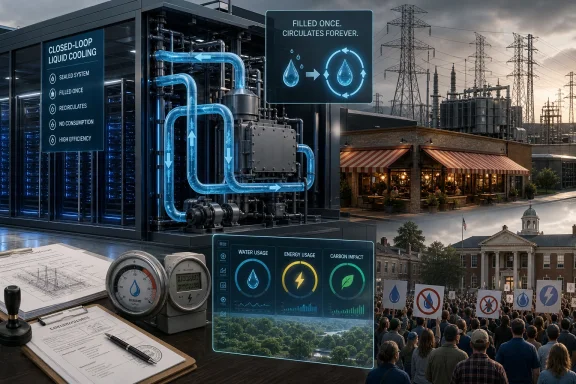
Microsoft CEO Satya Nadella told Build 2026 attendees in early June that Microsoft’s newest AI data centers can use, over a year, roughly the same amount of water as a single restaurant, because their cooling systems rely on a closed liquid loop filled once. The claim is technically plausible, politically useful, and nowhere near the end of the argument. Water is only one part of the public bargain Microsoft now needs to strike with communities hosting the physical machinery of AI. The real question is whether “restaurant-level” consumption describes a systemic breakthrough or a carefully framed talking point in a much larger resource fight.
Nadella’s comparison landed because it did what every good executive line is supposed to do: it turned an abstract infrastructure problem into something ordinary people can picture. A hyperscale AI campus sounds like a thirsty machine. A neighborhood restaurant sounds manageable, maybe even trivial.
That contrast matters because data centers have become the least virtual part of the AI boom. For years, cloud computing was sold as a kind of frictionless utility, with workloads drifting invisibly into Microsoft Azure, Amazon Web Services, or Google Cloud. Generative AI has broken that illusion. The cloud now has a public silhouette: substations, transmission lines, backup generators, cooling systems, land deals, tax incentives, and angry town-hall meetings.
Microsoft’s argument is that the next generation of AI facilities is not just bigger, but fundamentally different. Closed-loop liquid cooling, direct-to-chip systems, and denser server layouts are meant to reduce the need for evaporative cooling, the technique that has historically made some data centers heavy local water users. In the version Nadella presented, water goes into the system during construction and then circulates rather than being continuously consumed.
That is a meaningful engineering shift. It is also a narrow answer to a broader objection. A data center that consumes less water can still demand enormous power, strain transmission capacity, reshape local development, and create a political fight over who benefits and who pays.
That is why the “filled once” phrase is important. Traditional evaporative cooling can consume water as part of normal operations, especially in hot conditions. A sealed or mostly closed liquid loop changes the operating profile by treating water more like a circulating coolant than a disposable input.
But the public should be careful with the word “uses.” In sustainability accounting, water use can mean different things: withdrawals, consumption, cooling demand, onsite water, or replenishment-adjusted totals. A facility may have low operational water consumption for cooling while still carrying water impacts through construction, supply chains, power generation, or emergency operating modes.
The restaurant comparison is therefore not false so much as incomplete. It describes one visible metric at one kind of facility under one cooling architecture. It does not, by itself, settle whether Microsoft’s expanding AI footprint is compatible with local water resilience, energy affordability, and the company’s own 2030 environmental promises.
Nadella reportedly described Azure as operating roughly 500 data centers across 80 regions, a footprint Microsoft presents as one of the broadest in the hyperscale market. More striking was his assertion that Microsoft has added more data-center capacity in the past 18 months than during the first decade of Azure. Even allowing for executive-stage compression, that is the sound of a business crossing from rapid growth into wartime construction tempo.
For WindowsForum readers, this matters because AI is not an abstract Microsoft 365 feature or a Copilot button on the taskbar. It is becoming the infrastructure layer under Windows development, enterprise management, security tooling, search, coding assistants, and cloud-hosted productivity. The faster Microsoft turns AI into the default interface for computing, the faster the company must expand the physical substrate behind it.
That creates a tension Microsoft cannot solve with product demos. The same company asking users and businesses to trust AI everywhere must also persuade towns, utilities, and regulators to accept AI infrastructure somewhere. The restaurant line is part of that persuasion campaign.
That word, permission, is revealing. Hyperscalers have traditionally spoken as if demand justified supply. Customers needed cloud services, therefore data centers had to be built. AI has made that logic less persuasive because the costs are more concentrated than the benefits. A city may host the power and water burden while the revenue accrues globally.
Microsoft’s new posture acknowledges that political reality. If a data center raises local electricity bills, competes with residents for water, or turns farmland into a fenced industrial campus, no amount of abstract AI optimism will calm opposition. Communities are increasingly asking for enforceable commitments rather than ceremonial ribbon cuttings.
The company says it wants to ensure its facilities do not increase local electricity prices and that it replenishes water use. Those are the right promises to make. The harder test is whether they are measurable, local, durable, and independently verifiable. A community does not experience a global sustainability spreadsheet; it experiences the monthly utility bill.
AI data centers require vast amounts of electricity not only for chips, but for cooling, networking, storage, and redundancy. A large campus can demand power on the scale of heavy industry. When such projects arrive in regions with limited grid headroom, the question becomes whether utilities build new generation, upgrade transmission, delay other customers, or spread costs across ratepayers.
That is why the Kenya report cited in the source material is politically potent, even if every local project has its own details. When a president says a data center’s power requirements would effectively require switching off half the country, he is not making a technical engineering statement so much as a political one: AI infrastructure competes with national development priorities.
Microsoft can reduce water consumption with better cooling. It can buy renewable energy credits or sign power purchase agreements. But the grid is physical, local, and timing-sensitive. A megawatt contracted on paper does not instantly become a transformer, a transmission line, or dispatchable capacity on a hot evening when homes, factories, and data centers all want power.
The company now has to reconcile those promises with a business model that requires more compute, more facilities, and more electricity. Its sustainability materials argue that AI can help optimize energy, water, and carbon systems. That may be true in important cases. But AI also creates its own resource appetite, and the rebound effect is staring everyone in the face: efficiency gains can lower the cost of compute, which can increase demand for compute.
This is where Microsoft’s rhetoric faces its hardest test. If water use at a new facility drops dramatically, but the number and size of facilities explode, total impact may still rise. If a model becomes more efficient, but Microsoft embeds AI into every enterprise workflow, aggregate consumption may still climb.
The company’s reported internal expectation that water requirements could double by 2030, if accurate, sits awkwardly beside the water-positive pledge. It does not make the pledge impossible. It does make the pledge harder, more expensive, and more dependent on accounting choices that outsiders will scrutinize.
Microsoft knows this, and its sustainability programs increasingly emphasize local watershed projects. That is better than treating water like a global commodity ledger. Still, the distinction matters because public trust often collapses when corporate offsets feel detached from lived consequences.
A restaurant-level cooling claim also does not eliminate embedded water in the broader AI stack. Chip manufacturing, construction materials, power generation, and upstream supply chains all carry water footprints. Data centers are not isolated machines; they are endpoints in an industrial system.
For communities, the key question is not whether Microsoft can produce a credible global sustainability report. It is whether residents can see binding local commitments before construction, transparent monitoring during operation, and meaningful remedies if projections fail. The burden of proof has shifted from activists to builders.
But data centers are not factories in the old employment sense. Once built, they typically employ far fewer people than their size and cost might suggest. The most valuable jobs may require specialized skills that local workers do not already have. Training programs can help, but they must be concrete rather than ornamental.
This is why Microsoft’s talk of local training and nonprofit support matters. The company is trying to answer a criticism that has dogged hyperscale projects for years: communities provide land, infrastructure, and political permission, while the lasting economic benefits are thinner than promised. A “community-first” model has to do more than sprinkle philanthropy around a predetermined buildout.
The best version of Microsoft’s approach would tie incentives to outcomes. If a community grants tax breaks or expedited approvals, it should receive enforceable hiring targets, apprenticeships, grid protections, water transparency, and clawbacks if promised benefits fail to materialize. Otherwise, the phrase community-first risks becoming the infrastructure equivalent of “AI-powered”: technically meaningful in some cases, marketing fog in others.
Copilot is the obvious example, but it is not the only one. Code generation, endpoint security analysis, document summarization, cloud identity risk scoring, helpdesk automation, and administrative scripting all increasingly depend on data-center compute. Even when some AI workloads shift to NPUs on local PCs, the largest models, training runs, orchestration layers, and enterprise data integrations remain cloud-heavy.
That means the environmental and infrastructure costs of AI are not separate from the software experience Microsoft is selling. If AI features become default, bundled, or unavoidable, users and organizations inherit the consequences indirectly. They may not see the water loop, but they fund the demand signal.
Enterprise IT should therefore treat sustainability claims as procurement questions, not public-relations trivia. If an organization is under pressure to report Scope 3 emissions, manage vendor risk, or satisfy environmental governance requirements, Microsoft’s AI infrastructure choices become part of the customer’s own compliance picture. The diner metaphor will not be enough for auditors.
This is the central trick of scale in the AI era. Unit efficiency can improve dramatically while total system consumption rises. A chip can be more efficient, a rack can be better cooled, a facility can use less water per unit of compute, and Microsoft can still expand so fast that aggregate resource demand grows.
That does not make the engineering irrelevant. Better cooling matters enormously, especially in water-stressed regions. If Microsoft can make closed-loop designs standard for new AI facilities, competitors will face pressure to follow. The industry should not dismiss genuine efficiency gains simply because they arrive wrapped in corporate messaging.
But the public conversation should not stop at the metric Microsoft chooses. The right question is not merely, “How much water does this site use?” It is, “What is the full local resource bargain, and who enforces it when the business case changes?”
Expect more regions to demand disclosures before approving large projects. Utilities will face pressure to show whether data-center growth raises residential rates. Water authorities will ask harder questions about drought scenarios and priority access. Legislators may begin treating AI infrastructure as strategic industry rather than ordinary commercial real estate.
Microsoft would prefer to shape that process voluntarily. Its community-first messaging is partly defensive: if the company can convince local governments that it is a responsible partner, it may avoid heavier mandates. That is rational corporate behavior, but it is not a substitute for public oversight.
The best outcome is not a blanket anti-data-center backlash. Modern economies need compute, and AI will likely produce real benefits in science, accessibility, software development, and public services. The goal should be to make the infrastructure honest: visible costs, enforceable commitments, and engineering choices that reduce harm before offsets are invoked.
That is a healthier debate. For too long, hyperscale infrastructure has hidden behind the metaphor of the cloud, as if compute were a weather pattern rather than a capital project. AI has made the machinery impossible to ignore.
The argument Microsoft should make is not that data centers are impact-free. No serious person believes that. The stronger argument is that some designs are better than others, some locations make more sense than others, and some community agreements are more honest than others.
If Microsoft can prove that new AI campuses use minimal cooling water, avoid ratepayer harm, fund local grid upgrades, create durable jobs, and replenish water in the places affected, it will have a defensible model. If it cannot, the restaurant comparison will age like a slogan from the first phase of the backlash.
 Microsoft Shrinks the Water Story to a Diner-Sized Claim
Nadella’s comparison landed because it did what every good executive line is supposed to do: it turned an abstract infrastructure problem into something ordinary people can picture. A hyperscale AI campus sounds like a thirsty machine. A neighborhood restaurant sounds manageable, maybe even trivial.That contrast matters because data centers have become the least virtual part of the AI boom. For years, cloud computing was sold as a kind of frictionless utility, with workloads drifting invisibly into Microsoft Azure, Amazon Web Services, or Google Cloud. Generative AI has broken that illusion. The cloud now has a public silhouette: substations, transmission lines, backup generators, cooling systems, land deals, tax incentives, and angry town-hall meetings.
Microsoft’s argument is that the next generation of AI facilities is not just bigger, but fundamentally different. Closed-loop liquid cooling, direct-to-chip systems, and denser server layouts are meant to reduce the need for evaporative cooling, the technique that has historically made some data centers heavy local water users. In the version Nadella presented, water goes into the system during construction and then circulates rather than being continuously consumed.
That is a meaningful engineering shift. It is also a narrow answer to a broader objection. A data center that consumes less water can still demand enormous power, strain transmission capacity, reshape local development, and create a political fight over who benefits and who pays.
The Cooling Breakthrough Is Real, but the Framing Is Doing Overtime
The technical center of Microsoft’s claim is not magic; it is heat transfer. Modern AI chips are brutally power-dense, and air cooling alone is increasingly poorly matched to racks packed with accelerators. Liquid cooling moves heat more efficiently, allowing Microsoft and its peers to run hotter, denser, and more powerful systems without relying as heavily on evaporating water into the air.That is why the “filled once” phrase is important. Traditional evaporative cooling can consume water as part of normal operations, especially in hot conditions. A sealed or mostly closed liquid loop changes the operating profile by treating water more like a circulating coolant than a disposable input.
But the public should be careful with the word “uses.” In sustainability accounting, water use can mean different things: withdrawals, consumption, cooling demand, onsite water, or replenishment-adjusted totals. A facility may have low operational water consumption for cooling while still carrying water impacts through construction, supply chains, power generation, or emergency operating modes.
The restaurant comparison is therefore not false so much as incomplete. It describes one visible metric at one kind of facility under one cooling architecture. It does not, by itself, settle whether Microsoft’s expanding AI footprint is compatible with local water resilience, energy affordability, and the company’s own 2030 environmental promises.
AI Has Turned Azure From a Cloud Business Into a Land-Use Business
Microsoft’s cloud expansion used to be discussed mostly in financial terms: Azure growth rates, enterprise migrations, margins, and competition with AWS. AI has shifted the conversation toward industrial policy. The company is no longer merely renting compute; it is building a global machine that must be permitted, powered, cooled, and politically tolerated.Nadella reportedly described Azure as operating roughly 500 data centers across 80 regions, a footprint Microsoft presents as one of the broadest in the hyperscale market. More striking was his assertion that Microsoft has added more data-center capacity in the past 18 months than during the first decade of Azure. Even allowing for executive-stage compression, that is the sound of a business crossing from rapid growth into wartime construction tempo.
For WindowsForum readers, this matters because AI is not an abstract Microsoft 365 feature or a Copilot button on the taskbar. It is becoming the infrastructure layer under Windows development, enterprise management, security tooling, search, coding assistants, and cloud-hosted productivity. The faster Microsoft turns AI into the default interface for computing, the faster the company must expand the physical substrate behind it.
That creates a tension Microsoft cannot solve with product demos. The same company asking users and businesses to trust AI everywhere must also persuade towns, utilities, and regulators to accept AI infrastructure somewhere. The restaurant line is part of that persuasion campaign.
“Community-First” Is Microsoft’s New Permission Structure
Microsoft President Brad Smith has spent much of the past year trying to reframe data centers as community assets rather than extractive infrastructure. The pitch is familiar: jobs, tax revenue, broadband improvements, training programs, nonprofit support, and local investment. Nadella echoed that framing at Build, tying innovation to what he called permission from communities.That word, permission, is revealing. Hyperscalers have traditionally spoken as if demand justified supply. Customers needed cloud services, therefore data centers had to be built. AI has made that logic less persuasive because the costs are more concentrated than the benefits. A city may host the power and water burden while the revenue accrues globally.
Microsoft’s new posture acknowledges that political reality. If a data center raises local electricity bills, competes with residents for water, or turns farmland into a fenced industrial campus, no amount of abstract AI optimism will calm opposition. Communities are increasingly asking for enforceable commitments rather than ceremonial ribbon cuttings.
The company says it wants to ensure its facilities do not increase local electricity prices and that it replenishes water use. Those are the right promises to make. The harder test is whether they are measurable, local, durable, and independently verifiable. A community does not experience a global sustainability spreadsheet; it experiences the monthly utility bill.
The Power Problem Is Harder to Turn Into a Metaphor
Water makes for a clean public debate because people understand scarcity. Electricity is more complex, and therefore easier for companies to flatten into slogans. Yet power may be the more consequential constraint on AI infrastructure.AI data centers require vast amounts of electricity not only for chips, but for cooling, networking, storage, and redundancy. A large campus can demand power on the scale of heavy industry. When such projects arrive in regions with limited grid headroom, the question becomes whether utilities build new generation, upgrade transmission, delay other customers, or spread costs across ratepayers.
That is why the Kenya report cited in the source material is politically potent, even if every local project has its own details. When a president says a data center’s power requirements would effectively require switching off half the country, he is not making a technical engineering statement so much as a political one: AI infrastructure competes with national development priorities.
Microsoft can reduce water consumption with better cooling. It can buy renewable energy credits or sign power purchase agreements. But the grid is physical, local, and timing-sensitive. A megawatt contracted on paper does not instantly become a transformer, a transmission line, or dispatchable capacity on a hot evening when homes, factories, and data centers all want power.
The 2030 Pledge Now Carries the Weight of the AI Boom
Microsoft’s 2030 sustainability commitments were made in a different era. In 2020, the company promised to become carbon negative, water positive, and zero waste, part of a broader attempt to position itself as the responsible adult of Big Tech. That was before generative AI became the center of Microsoft’s strategy and before GPU supply became a boardroom obsession.The company now has to reconcile those promises with a business model that requires more compute, more facilities, and more electricity. Its sustainability materials argue that AI can help optimize energy, water, and carbon systems. That may be true in important cases. But AI also creates its own resource appetite, and the rebound effect is staring everyone in the face: efficiency gains can lower the cost of compute, which can increase demand for compute.
This is where Microsoft’s rhetoric faces its hardest test. If water use at a new facility drops dramatically, but the number and size of facilities explode, total impact may still rise. If a model becomes more efficient, but Microsoft embeds AI into every enterprise workflow, aggregate consumption may still climb.
The company’s reported internal expectation that water requirements could double by 2030, if accurate, sits awkwardly beside the water-positive pledge. It does not make the pledge impossible. It does make the pledge harder, more expensive, and more dependent on accounting choices that outsiders will scrutinize.
Replenishment Is Not the Same Thing as Not Taking the Water
The phrase “water positive” sounds intuitive: put back more than you take. In practice, it is a thicket of geography, timing, project quality, and hydrology. Replenishing water in one basin does not necessarily help a stressed community in another. Funding a conservation project may be beneficial without offsetting the local impact of a facility drawing from a constrained source.Microsoft knows this, and its sustainability programs increasingly emphasize local watershed projects. That is better than treating water like a global commodity ledger. Still, the distinction matters because public trust often collapses when corporate offsets feel detached from lived consequences.
A restaurant-level cooling claim also does not eliminate embedded water in the broader AI stack. Chip manufacturing, construction materials, power generation, and upstream supply chains all carry water footprints. Data centers are not isolated machines; they are endpoints in an industrial system.
For communities, the key question is not whether Microsoft can produce a credible global sustainability report. It is whether residents can see binding local commitments before construction, transparent monitoring during operation, and meaningful remedies if projections fail. The burden of proof has shifted from activists to builders.
The Jobs Argument Is Strongest Where It Is Most Specific
Data center developers often lead with jobs, and the claim is partly legitimate. Construction can bring a surge of work. Long-term operations create skilled technical roles. Tax revenue can be meaningful, especially in communities looking to diversify their base.But data centers are not factories in the old employment sense. Once built, they typically employ far fewer people than their size and cost might suggest. The most valuable jobs may require specialized skills that local workers do not already have. Training programs can help, but they must be concrete rather than ornamental.
This is why Microsoft’s talk of local training and nonprofit support matters. The company is trying to answer a criticism that has dogged hyperscale projects for years: communities provide land, infrastructure, and political permission, while the lasting economic benefits are thinner than promised. A “community-first” model has to do more than sprinkle philanthropy around a predetermined buildout.
The best version of Microsoft’s approach would tie incentives to outcomes. If a community grants tax breaks or expedited approvals, it should receive enforceable hiring targets, apprenticeships, grid protections, water transparency, and clawbacks if promised benefits fail to materialize. Otherwise, the phrase community-first risks becoming the infrastructure equivalent of “AI-powered”: technically meaningful in some cases, marketing fog in others.
Windows Users Are Downstream From the Data Center Debate
It may be tempting for a Windows audience to treat this as a cloud-infrastructure story far removed from desktop computing. That would be a mistake. Microsoft is steadily moving Windows, Office, GitHub, security tooling, and enterprise management toward AI-mediated workflows. The PC is becoming a client for models that often run elsewhere.Copilot is the obvious example, but it is not the only one. Code generation, endpoint security analysis, document summarization, cloud identity risk scoring, helpdesk automation, and administrative scripting all increasingly depend on data-center compute. Even when some AI workloads shift to NPUs on local PCs, the largest models, training runs, orchestration layers, and enterprise data integrations remain cloud-heavy.
That means the environmental and infrastructure costs of AI are not separate from the software experience Microsoft is selling. If AI features become default, bundled, or unavoidable, users and organizations inherit the consequences indirectly. They may not see the water loop, but they fund the demand signal.
Enterprise IT should therefore treat sustainability claims as procurement questions, not public-relations trivia. If an organization is under pressure to report Scope 3 emissions, manage vendor risk, or satisfy environmental governance requirements, Microsoft’s AI infrastructure choices become part of the customer’s own compliance picture. The diner metaphor will not be enough for auditors.
The Restaurant Line Works Because It Avoids the Scale Question
A single AI data center using as little water as a restaurant sounds reassuring. A global wave of AI campuses, each consuming vast power and driving new infrastructure demand, sounds less so. Both statements can be true at the same time.This is the central trick of scale in the AI era. Unit efficiency can improve dramatically while total system consumption rises. A chip can be more efficient, a rack can be better cooled, a facility can use less water per unit of compute, and Microsoft can still expand so fast that aggregate resource demand grows.
That does not make the engineering irrelevant. Better cooling matters enormously, especially in water-stressed regions. If Microsoft can make closed-loop designs standard for new AI facilities, competitors will face pressure to follow. The industry should not dismiss genuine efficiency gains simply because they arrive wrapped in corporate messaging.
But the public conversation should not stop at the metric Microsoft chooses. The right question is not merely, “How much water does this site use?” It is, “What is the full local resource bargain, and who enforces it when the business case changes?”
Regulators Are Finally Catching Up to the Physical Cloud
The cloud grew up during an era when regulators were more focused on software competition, privacy, and content moderation than on land, water, and electricity. AI is changing that. Data centers are now central to energy planning, economic development, and local environmental politics.Expect more regions to demand disclosures before approving large projects. Utilities will face pressure to show whether data-center growth raises residential rates. Water authorities will ask harder questions about drought scenarios and priority access. Legislators may begin treating AI infrastructure as strategic industry rather than ordinary commercial real estate.
Microsoft would prefer to shape that process voluntarily. Its community-first messaging is partly defensive: if the company can convince local governments that it is a responsible partner, it may avoid heavier mandates. That is rational corporate behavior, but it is not a substitute for public oversight.
The best outcome is not a blanket anti-data-center backlash. Modern economies need compute, and AI will likely produce real benefits in science, accessibility, software development, and public services. The goal should be to make the infrastructure honest: visible costs, enforceable commitments, and engineering choices that reduce harm before offsets are invoked.
Microsoft’s New AI Bargain Has to Survive Contact With Town Hall Reality
The most concrete lesson from Nadella’s Build remarks is that Microsoft understands the politics have changed. It no longer sounds enough to say Azure is expanding because customers demand it. The company now has to say why the host community should want it.That is a healthier debate. For too long, hyperscale infrastructure has hidden behind the metaphor of the cloud, as if compute were a weather pattern rather than a capital project. AI has made the machinery impossible to ignore.
The argument Microsoft should make is not that data centers are impact-free. No serious person believes that. The stronger argument is that some designs are better than others, some locations make more sense than others, and some community agreements are more honest than others.
If Microsoft can prove that new AI campuses use minimal cooling water, avoid ratepayer harm, fund local grid upgrades, create durable jobs, and replenish water in the places affected, it will have a defensible model. If it cannot, the restaurant comparison will age like a slogan from the first phase of the backlash.
The Diner Metaphor Leaves Five Tests on the Table
Nadella’s claim deserves neither reflexive dismissal nor credulous applause. It is a useful sign that hyperscalers are optimizing around the right pressure points, but it is only the opening exhibit in a much larger public case.- Microsoft’s closed-loop cooling claim appears to describe a real shift away from water-intensive evaporative cooling in its newest AI data-center designs.
- The comparison to a single restaurant is narrowly about annual water use for the facility design, not the full environmental footprint of AI infrastructure.
- Electricity demand remains the harder community problem because grid costs, capacity upgrades, and power availability are local and politically sensitive.
- Microsoft’s 2030 water-positive and carbon-negative pledges are now being stress-tested by the scale and speed of its AI buildout.
- Communities should judge data-center projects by enforceable local commitments, not by global sustainability branding or one memorable executive metaphor.
- Windows and enterprise customers are downstream from these choices because Microsoft is embedding cloud-dependent AI across its software and services.
References
- Primary source: Windows Central
Published: 2026-06-08T13:30:13.301661
Loading…
www.windowscentral.com - Related coverage: techradar.com

Microsoft Build 2026 — all the news and updates as it happened
Everything we saw at Microsoft Build 2026www.techradar.com
- Official source: microsoft.com
Loading…
www.microsoft.com - Official source: datacenters.microsoft.com
Sustainability - Microsoft Datacenters
 datacenters.microsoft.com
- Related coverage: tomshardware.com
Loading…
www.tomshardware.com - Official source: news.microsoft.com
Loading…
news.microsoft.com
- Related coverage: sustainabilityreports.com
Loading…
www.sustainabilityreports.com - Related coverage: numerama.com
Loading…
www.numerama.com - Official source: local.microsoft.com
Loading…
local.microsoft.com - Official source: learn.microsoft.com
Loading…
learn.microsoft.com - Related coverage: smartenergydecisions.com
Loading…
www.smartenergydecisions.com - Official source: cdn-dynmedia-1.microsoft.com
Loading…
cdn-dynmedia-1.microsoft.com