

Bryson DeChambeau worked with Microsoft and Redmond-based Sensoria in 2016 to prototype a pressure-sensing golf grip that used embedded sensors, Microsoft Azure, and Surface-based visualization to measure how his hands loaded the club throughout the swing. The gadget was never merely a golf curiosity. It was an early example of Microsoft’s larger bet that cloud analytics, sensor hardware, and machine learning would move from the server room into every measurable human activity. For WindowsForum readers, the interesting part is not that a famously analytical golfer wanted more data; it is that Microsoft saw the golf grip as another endpoint.
The pressure-sensing grip arrived at the perfect cultural moment for Microsoft. Satya Nadella’s company was moving away from the old Windows-first posture and toward a world in which Azure, data platforms, and cloud intelligence would be the company’s real connective tissue. A golf club grip, absurdly specific as it sounds, made that transition visible.
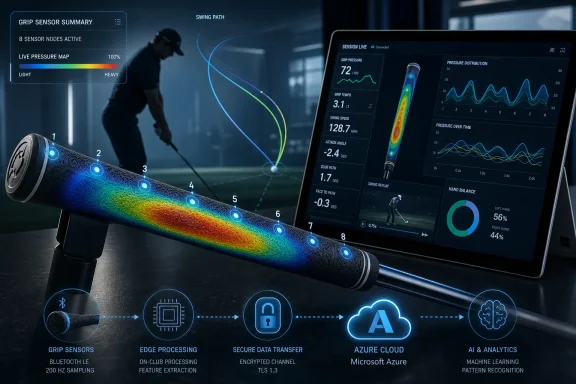
The prototype reportedly used eight embedded sensors to capture pressure data in real time. That information was passed through Microsoft Azure and rendered visually, showing how DeChambeau’s hands interacted with the club during a swing. In plain English, Microsoft was trying to turn “feel” into a chart.
That matters because golf has always had an uneasy relationship with measurement. Launch monitors, force plates, club-tracking systems, and high-speed cameras have made the modern lesson bay look more like an engineering lab than a driving range. But grip pressure has remained stubbornly tactile: a coach can describe it, a player can feel it, but neither can easily audit it.
DeChambeau was the obvious test subject. His single-length irons, physics background, oversized grips, and public obsession with variables made him the rare professional athlete whose brand could absorb a Microsoft technical case study without looking forced. The project did not make him less “Bryson.” It made Microsoft look more willing to chase data into places where spreadsheets had not previously gone.
Sensoria’s contribution came from the world of smart garments and embedded sensing. The company had already been working on connected apparel, smart footwear, and sensor modules that could measure force, motion, and biometric signals. In the DeChambeau project, that expertise was tucked inside an existing JumboMax grip rather than strapped awkwardly onto the outside of a club.
That distinction is important. The best wearable technology disappears into the object a person already uses. A golfer does not want to swing a science project; a runner does not want to think about the circuit board in a sock; a factory worker does not want safety gear that feels like an IT deployment. If the sensor changes the behavior it is meant to measure, the data is compromised before the cloud ever sees it.
The smart grip therefore belongs in the same family as connected shoes, smart textiles, and industrial IoT sensors. It took an analog interface — hands on rubber — and tried to make it machine-readable. The club remained the club. The grip became an input device.
That is why the Microsoft angle is more consequential than the Bryson angle. DeChambeau supplied the use case, but Azure supplied the thesis: if an action can be sensed, it can be stored; if it can be stored, it can be modeled; if it can be modeled, it can be optimized.
The point was not just to put a Surface in front of a golfer. The Surface was the pane of glass. Azure was the system of record and analysis.
That is the enterprise pattern Microsoft has repeated across industries. Sensors at the edge collect the messy signal. Cloud services ingest and structure it. Visualization tools turn it into something a human can act on. Over time, machine learning attempts to move the workflow from “what happened?” to “what should happen next?”
In the golf grip project, the input was hand pressure. In manufacturing, it might be vibration from a motor. In logistics, it might be package movement. In healthcare, it might be gait, range of motion, or adherence to physical therapy. The sport was unusual; the pipeline was not.
This is why the story still feels familiar a decade later. The industry has changed the branding from IoT to edge AI to digital twin and back again, but the premise remains consistent. Microsoft wants the physical world to emit telemetry that Azure can understand.
Grip pressure is a perfect example. Players talk constantly about tension, release, tempo, and hand action. Yet most golfers have no reliable way to know whether their grip pressure changed between the range and the first tee, between a driver and a wedge, or between Thursday morning and Sunday afternoon.
The Microsoft-Sensoria grip attacked exactly that blind spot. It could show whether DeChambeau was applying pressure consistently, whether certain clubs produced different hand behavior, and whether his motion changed under different conditions. The value was not in one swing. It was in comparison over time.
That is the difference between a gadget and a training system. A gadget gives you a number. A system lets you find patterns.
For a player like DeChambeau, the appeal is obvious. If he believes a particular grip-pressure profile produces better contact or more predictable ball flight, he can attempt to reproduce it. If the profile drifts, he has an objective indicator rather than a vague sense that something feels off.
Modern elite golf is saturated with measurement. Players and coaches routinely use launch monitors to evaluate ball speed, spin rate, launch angle, attack angle, club path, face angle, carry distance, descent angle, and dispersion. Equipment trucks build clubs to microscopic preferences. Putter testing increasingly revolves around face rotation, alignment bias, loft delivery, and impact consistency.
Against that backdrop, grip pressure is not a radical new frontier. It is one of the few remaining variables that had not been fully captured.
The more interesting tension is not feel versus data. It is which data deserves attention. Golfers can drown in metrics that describe a swing without improving it. A pressure-sensing grip becomes useful only if it identifies a variable the player can understand, repeat, and connect to performance.
That caveat matters for amateurs as much as professionals. A mid-handicap golfer does not need a dozen new dashboards to confirm that the ball is going right. But a coach might benefit from seeing that a player’s trail hand clamps down during transition, or that putting pressure changes dramatically on short putts. The insight must be actionable, or it is just telemetry theater.
This was the era when Microsoft wanted to show that Azure was not merely a place to host enterprise applications. It wanted Azure to look like a platform for real-time intelligence in messy, high-variance environments. Sports made that story easy to understand.
A live sporting event is an enterprise systems problem wearing a jersey. It has mobile users, unreliable conditions, high data volume, low tolerance for downtime, and immediate demand for visualization. If Microsoft could make Azure look useful there, it could make the same pitch to manufacturers, hospitals, logistics firms, and retailers.
The DeChambeau grip was tiny, but it condensed the pitch elegantly. A sensor produces data. Azure processes it. Microsoft tools render it. A human makes a better decision. That was the whole cloud strategy, miniaturized into a rubber sleeve.
The fact that the project involved a startup founded by former Microsoft employees also fit the pattern. Microsoft increasingly wanted to be the platform layer under other companies’ specialized hardware and domain expertise. Sensoria understood embedded wearables; DeChambeau understood what he needed from a golf grip; Microsoft supplied the cloud and development stack.
In a golf setting, that meant pressure visualizations could be shown in a portable, touch-friendly format. In a factory, it might mean a technician viewing machine health. In a hospital, it might mean a clinician reviewing patient telemetry. In a logistics yard, it might mean a supervisor checking exceptions.
That is the practical reason Microsoft kept pushing Surface into places where iPads had already become culturally dominant. The company did not need Surface to win every consumer comparison. It needed Surface to make Windows, Azure, Office, and line-of-business workflows feel coherent in the field.
The smart grip used that formula neatly. Azure handled the back end; Visual Studio and Microsoft’s development tools helped build the application; Surface displayed the result. If WindowsForum readers are looking for the operating-system story, it is here: Windows was no longer the entire universe, but it remained a key client surface for Microsoft’s cloud ambitions.
Golf adds its own complications. Equipment used in competition is governed by rules, and training aids face a different market than clubs or balls. A device that cannot be used during tournament play may still be valuable in practice, but that narrows its role. A device that requires careful setup, charging, syncing, and interpretation must justify the friction.
There is also the problem of repeatability across users. DeChambeau is unusually disciplined about equipment variables. He is the sort of player who might actually build a training process around pressure maps. Most golfers are not.
Even at the professional level, more data does not automatically mean better performance. Players differ in how much technical input they can tolerate. Some use launch-monitor data obsessively; others prefer coaches to filter it. A grip-pressure dashboard could be revelatory for one player and paralyzing for another.
That is the central paradox of wearable sports tech. The closer a sensor gets to the body, the more intimate and potentially valuable the data becomes. But the closer it gets to the body, the more it risks disrupting comfort, trust, and routine.
Launch monitors became desirable because they provide instant, legible numbers: carry distance, ball speed, spin, direction. GPS apps and rangefinders work because they answer a simple question: how far is it? A pressure-sensing grip asks the user to learn a new diagnostic language.
That does not make it useless. It makes the product design challenge much harder. The system would need to translate raw pressure maps into coaching cues that normal golfers understand. “Your trail hand pressure increased 18 percent during transition” is interesting. “You are squeezing the club at the top and leaving the face open” is useful.
This is where Microsoft’s machine-learning ambition mattered. The original idea reportedly included analyzing DeChambeau’s data over time to build new golf data streams around grip, club usage, speed, rhythm, plane, and other swing variables. That was the right direction: not just measurement, but interpretation.
The missing piece was scale. To make such a system broadly useful, it would need data from many golfers, many swings, many clubs, many skill levels, and many outcomes. One elite player can validate a prototype. A platform needs a population.
That shift has changed what IT professionals are asked to manage. The traditional endpoint was a PC: known operating system, known patching model, known identity stack, known network assumptions. The modern endpoint may be a sensor module embedded in a product nobody in IT originally purchased.
That creates familiar problems in unfamiliar packaging. How is the device authenticated? Where does the data live? Who owns the telemetry? How long is it retained? Can the firmware be updated? What happens when the vendor goes out of business? Can the system operate offline? Does the dashboard expose sensitive performance, health, or behavioral data?
A golf grip may seem harmless, but the pattern scales into higher-stakes domains. In sport, telemetry might reveal competitive secrets or injury risk. In the workplace, it might become worker surveillance. In healthcare, it might become regulated health information. In consumer fitness, it might become yet another stream of intimate behavioral data monetized by platforms users barely understand.
Microsoft’s role as the cloud layer gives it both opportunity and responsibility. Azure can make sensor ecosystems practical. It can also centralize data whose meaning may become more sensitive over time.
A pressure-sensing golf grip does not carry the same risk profile as an industrial controller, but the architecture rhymes. If the device transmits data, someone must protect the transmission. If the data is stored, someone must define access. If the model uses historical data, someone must govern training and retention. If the dashboard influences decisions, someone must understand the consequences of bad data.
For administrators, this is the hidden lesson behind sports-tech demos. The demo shows the heat map. The deployment inherits the lifecycle.
Microsoft has spent years building Azure services for IoT identity, device management, telemetry ingestion, analytics, and edge processing. But the success of any sensor project still depends on boring disciplines: inventory, patching, least privilege, logging, vendor management, and data classification. The cloud can provide the tools. It cannot make an organization care.
Tour golf is a laboratory because the margins are absurdly small. A player can change a putter neck because of face closure. A driver head can be replaced because its center of gravity produces the wrong reaction. A slightly shorter putter or a one-degree lie change can become a meaningful test. The sport already treats hardware as a variable system.
In that world, grip pressure is not mystical. It is another parameter waiting for instrumentation.
The same week’s equipment chatter around players like Jordan Spieth, Rickie Fowler, J.J. Spaun, Matt Fitzpatrick, Justin Rose, and Brandt Snedeker shows how normal experimentation has become. Pros switch putters after years of loyalty. They test driver heads because a cracked gamer cannot be replicated by model name alone. They chase weight distribution, face insert feel, lie angle, and visual alignment.
That culture makes DeChambeau look less like an outlier and more like the loudest expression of a broader trend. Every player is trying to make uncertainty smaller. DeChambeau simply says the engineering part out loud.
IT professionals know this problem well. A device can meet requirements and still fail in the field. A platform can satisfy a procurement checklist and still clash with user workflows. A dashboard can be accurate and still be ignored. The human response is part of the system.
That is the practical bridge between golf equipment and enterprise technology. DeChambeau’s smart grip was not valuable because sensors are cool. It was valuable only if the data changed how he trained, selected clubs, or monitored consistency. Likewise, an enterprise IoT deployment is not valuable because devices are connected. It is valuable only if the information improves decisions.
This is where many technology deployments stumble. They instrument a process without understanding the decision they are trying to improve. The result is more telemetry, more dashboards, and no operational advantage.
The smart grip at least began with a specific question: can grip pressure be measured consistently enough to help a player understand and reproduce performance? That is a better starting point than “let’s collect everything and see what happens.”
Today’s version would likely do more at the edge. A small embedded module could capture pressure and motion, preprocess the signal locally, sync selectively to the cloud, and use an app to provide near-instant coaching. A model might compare a golfer’s current swing to personal baselines, identify fatigue patterns, or flag tension spikes before impact.
That does not mean the 2016 project was primitive. It means it was early. The components were already there: sensors, cloud ingestion, visualization, and a plan to use accumulated data for smarter interpretation. The missing ingredients were lower-friction hardware, larger datasets, more mature mobile experiences, and the current market’s comfort with AI-generated coaching.
The AI boom also raises the stakes. A pressure map is one thing; a recommendation engine is another. Once a system tells a player what to change, it moves from measurement into instruction. That requires validation, context, and humility.
A bad golf tip is not a catastrophic failure, but the same pattern in medical rehabilitation, worker safety, or industrial maintenance can have serious consequences. The DeChambeau grip is a low-risk example of a much larger question: when does sensor-driven advice become trustworthy enough to act on?
Golf has not had to confront this as aggressively as team sports, where player-tracking systems and workload data can affect contracts, injury management, and competitive strategy. But the direction is clear. As sensors move closer to the athlete, the data becomes more personal and more valuable.
A pressure-sensing grip may reveal habits a player would not want rivals to know. It might expose injury compensation. It might show nerves under pressure. It might help a manufacturer design better grips, or help a coach diagnose flaws remotely. Each use case has a different privacy and ownership profile.
Microsoft’s cloud involvement makes the governance question unavoidable. The company can provide the infrastructure, but stakeholders must decide the rules. Data that begins as a training aid can become a scouting tool, a commercial asset, or a liability.
That is where the romance of sports tech meets the paperwork of modern computing. The sensor may be invisible. The contract should not be.
That is how many important technologies begin. They do not always arrive as finished products. Sometimes they arrive as proofs of concept that reveal where the next layer of measurement will go. The smart grip asked whether grip pressure could become a data stream. Once that question exists, the rest of the industry eventually works through whether the answer is useful, legal, affordable, and scalable.
For Microsoft, the project was a compact demonstration of its post-Windows identity. The company did not need to sell golf grips. It needed to show that Azure could turn niche sensor data into actionable intelligence. Sports gave the story glamour; the architecture gave it relevance.
For DeChambeau, the project fit a career-long pattern. He has often been mocked for overengineering golf, but the sport has steadily moved in his direction. The average tour truck now speaks a language of weight ports, loft sleeves, moment of inertia, launch windows, and face inserts. The scientist is not outside the game anymore. He is simply more literal about what the game has become.
The lessons are concrete:
 Microsoft Found Its Sports-Tech Metaphor in the Palm of a Golfer’s Hand
The pressure-sensing grip arrived at the perfect cultural moment for Microsoft. Satya Nadella’s company was moving away from the old Windows-first posture and toward a world in which Azure, data platforms, and cloud intelligence would be the company’s real connective tissue. A golf club grip, absurdly specific as it sounds, made that transition visible.The prototype reportedly used eight embedded sensors to capture pressure data in real time. That information was passed through Microsoft Azure and rendered visually, showing how DeChambeau’s hands interacted with the club during a swing. In plain English, Microsoft was trying to turn “feel” into a chart.
That matters because golf has always had an uneasy relationship with measurement. Launch monitors, force plates, club-tracking systems, and high-speed cameras have made the modern lesson bay look more like an engineering lab than a driving range. But grip pressure has remained stubbornly tactile: a coach can describe it, a player can feel it, but neither can easily audit it.
DeChambeau was the obvious test subject. His single-length irons, physics background, oversized grips, and public obsession with variables made him the rare professional athlete whose brand could absorb a Microsoft technical case study without looking forced. The project did not make him less “Bryson.” It made Microsoft look more willing to chase data into places where spreadsheets had not previously gone.
The Grip Was a Wearable, Not a Golf Club
The temptation is to file this under golf equipment, alongside a new driver head or a center-shafted putter. That misses the architecture. Microsoft and Sensoria were not redesigning the golf club so much as instrumenting a contact surface.Sensoria’s contribution came from the world of smart garments and embedded sensing. The company had already been working on connected apparel, smart footwear, and sensor modules that could measure force, motion, and biometric signals. In the DeChambeau project, that expertise was tucked inside an existing JumboMax grip rather than strapped awkwardly onto the outside of a club.
That distinction is important. The best wearable technology disappears into the object a person already uses. A golfer does not want to swing a science project; a runner does not want to think about the circuit board in a sock; a factory worker does not want safety gear that feels like an IT deployment. If the sensor changes the behavior it is meant to measure, the data is compromised before the cloud ever sees it.
The smart grip therefore belongs in the same family as connected shoes, smart textiles, and industrial IoT sensors. It took an analog interface — hands on rubber — and tried to make it machine-readable. The club remained the club. The grip became an input device.
That is why the Microsoft angle is more consequential than the Bryson angle. DeChambeau supplied the use case, but Azure supplied the thesis: if an action can be sensed, it can be stored; if it can be stored, it can be modeled; if it can be modeled, it can be optimized.
Azure Was the Real Product Demo
Microsoft’s sports partnerships in the mid-2010s often looked, to casual observers, like Surface marketing. Tablets on NFL sidelines, tablets in PGA Tour operations, tablets in broadcast booths — the hardware was visible, so the hardware got the attention. But the smart grip shows the more durable strategy underneath.The point was not just to put a Surface in front of a golfer. The Surface was the pane of glass. Azure was the system of record and analysis.
That is the enterprise pattern Microsoft has repeated across industries. Sensors at the edge collect the messy signal. Cloud services ingest and structure it. Visualization tools turn it into something a human can act on. Over time, machine learning attempts to move the workflow from “what happened?” to “what should happen next?”
In the golf grip project, the input was hand pressure. In manufacturing, it might be vibration from a motor. In logistics, it might be package movement. In healthcare, it might be gait, range of motion, or adherence to physical therapy. The sport was unusual; the pipeline was not.
This is why the story still feels familiar a decade later. The industry has changed the branding from IoT to edge AI to digital twin and back again, but the premise remains consistent. Microsoft wants the physical world to emit telemetry that Azure can understand.
DeChambeau Did Not Want More Data for Its Own Sake
The lazy reading of DeChambeau’s career is that he loves numbers because he is eccentric. The better reading is that he has repeatedly used data to reduce ambiguity in parts of golf that other players leave to instinct. That does not mean he eliminates feel. It means he tries to define the conditions under which feel can be trusted.Grip pressure is a perfect example. Players talk constantly about tension, release, tempo, and hand action. Yet most golfers have no reliable way to know whether their grip pressure changed between the range and the first tee, between a driver and a wedge, or between Thursday morning and Sunday afternoon.
The Microsoft-Sensoria grip attacked exactly that blind spot. It could show whether DeChambeau was applying pressure consistently, whether certain clubs produced different hand behavior, and whether his motion changed under different conditions. The value was not in one swing. It was in comparison over time.
That is the difference between a gadget and a training system. A gadget gives you a number. A system lets you find patterns.
For a player like DeChambeau, the appeal is obvious. If he believes a particular grip-pressure profile produces better contact or more predictable ball flight, he can attempt to reproduce it. If the profile drifts, he has an objective indicator rather than a vague sense that something feels off.
The Old Argument About Feel Was Already Lost
Golf traditionalists tend to frame technology as an invasion of the game’s artistry. There is some truth there. A player buried in metrics can become less adaptable, less instinctive, and more fragile when the numbers stop agreeing. But the broader argument has already been settled by the range bay.Modern elite golf is saturated with measurement. Players and coaches routinely use launch monitors to evaluate ball speed, spin rate, launch angle, attack angle, club path, face angle, carry distance, descent angle, and dispersion. Equipment trucks build clubs to microscopic preferences. Putter testing increasingly revolves around face rotation, alignment bias, loft delivery, and impact consistency.
Against that backdrop, grip pressure is not a radical new frontier. It is one of the few remaining variables that had not been fully captured.
The more interesting tension is not feel versus data. It is which data deserves attention. Golfers can drown in metrics that describe a swing without improving it. A pressure-sensing grip becomes useful only if it identifies a variable the player can understand, repeat, and connect to performance.
That caveat matters for amateurs as much as professionals. A mid-handicap golfer does not need a dozen new dashboards to confirm that the ball is going right. But a coach might benefit from seeing that a player’s trail hand clamps down during transition, or that putting pressure changes dramatically on short putts. The insight must be actionable, or it is just telemetry theater.
Microsoft’s Sports Push Was Really a Cloud Push
The smart grip did not appear in isolation. Microsoft had struck a PGA Tour partnership in 2015, becoming involved with the tour’s technology infrastructure and Surface usage around ShotLink, the tour’s shot-tracking system. The company was also experimenting with sports data projects beyond golf, including Sensoria-connected soccer concepts.This was the era when Microsoft wanted to show that Azure was not merely a place to host enterprise applications. It wanted Azure to look like a platform for real-time intelligence in messy, high-variance environments. Sports made that story easy to understand.
A live sporting event is an enterprise systems problem wearing a jersey. It has mobile users, unreliable conditions, high data volume, low tolerance for downtime, and immediate demand for visualization. If Microsoft could make Azure look useful there, it could make the same pitch to manufacturers, hospitals, logistics firms, and retailers.
The DeChambeau grip was tiny, but it condensed the pitch elegantly. A sensor produces data. Azure processes it. Microsoft tools render it. A human makes a better decision. That was the whole cloud strategy, miniaturized into a rubber sleeve.
The fact that the project involved a startup founded by former Microsoft employees also fit the pattern. Microsoft increasingly wanted to be the platform layer under other companies’ specialized hardware and domain expertise. Sensoria understood embedded wearables; DeChambeau understood what he needed from a golf grip; Microsoft supplied the cloud and development stack.
Surface Became the Clipboard for the Data Age
The Surface detail deserves more attention than it usually gets. Microsoft’s hardware ambitions have often been judged against Apple’s consumer polish, but in enterprise and field contexts Surface had another role: it was a modern clipboard attached to Microsoft services.In a golf setting, that meant pressure visualizations could be shown in a portable, touch-friendly format. In a factory, it might mean a technician viewing machine health. In a hospital, it might mean a clinician reviewing patient telemetry. In a logistics yard, it might mean a supervisor checking exceptions.
That is the practical reason Microsoft kept pushing Surface into places where iPads had already become culturally dominant. The company did not need Surface to win every consumer comparison. It needed Surface to make Windows, Azure, Office, and line-of-business workflows feel coherent in the field.
The smart grip used that formula neatly. Azure handled the back end; Visual Studio and Microsoft’s development tools helped build the application; Surface displayed the result. If WindowsForum readers are looking for the operating-system story, it is here: Windows was no longer the entire universe, but it remained a key client surface for Microsoft’s cloud ambitions.
The Prototype Exposed the Hard Part of Wearable Computing
The grip was technically plausible and conceptually persuasive. That does not mean it was destined to become a consumer product. Sports technology is full of prototypes that make sense in a lab, impress in a demo, and then vanish when confronted by cost, durability, battery life, rules, calibration, and user indifference.Golf adds its own complications. Equipment used in competition is governed by rules, and training aids face a different market than clubs or balls. A device that cannot be used during tournament play may still be valuable in practice, but that narrows its role. A device that requires careful setup, charging, syncing, and interpretation must justify the friction.
There is also the problem of repeatability across users. DeChambeau is unusually disciplined about equipment variables. He is the sort of player who might actually build a training process around pressure maps. Most golfers are not.
Even at the professional level, more data does not automatically mean better performance. Players differ in how much technical input they can tolerate. Some use launch-monitor data obsessively; others prefer coaches to filter it. A grip-pressure dashboard could be revelatory for one player and paralyzing for another.
That is the central paradox of wearable sports tech. The closer a sensor gets to the body, the more intimate and potentially valuable the data becomes. But the closer it gets to the body, the more it risks disrupting comfort, trust, and routine.
The Consumer Version Was Always the Harder Sell
The Golf Digest-style dream of the smart grip was obvious: imagine a weekend golfer getting immediate feedback on grip pressure, tempo, and hand placement through an app. In theory, that sounds transformative. In practice, consumer golf technology succeeds when it is either effortless or entertaining.Launch monitors became desirable because they provide instant, legible numbers: carry distance, ball speed, spin, direction. GPS apps and rangefinders work because they answer a simple question: how far is it? A pressure-sensing grip asks the user to learn a new diagnostic language.
That does not make it useless. It makes the product design challenge much harder. The system would need to translate raw pressure maps into coaching cues that normal golfers understand. “Your trail hand pressure increased 18 percent during transition” is interesting. “You are squeezing the club at the top and leaving the face open” is useful.
This is where Microsoft’s machine-learning ambition mattered. The original idea reportedly included analyzing DeChambeau’s data over time to build new golf data streams around grip, club usage, speed, rhythm, plane, and other swing variables. That was the right direction: not just measurement, but interpretation.
The missing piece was scale. To make such a system broadly useful, it would need data from many golfers, many swings, many clubs, many skill levels, and many outcomes. One elite player can validate a prototype. A platform needs a population.
The WindowsForum Angle Is Not Golf — It Is Edge Data
For this audience, the smart grip is less important as a DeChambeau footnote than as a case study in the long-running migration of computing away from the desk. A grip, a shoe, a shirt, a turbine, a truck, and a medical device all become endpoints once they can produce structured data.That shift has changed what IT professionals are asked to manage. The traditional endpoint was a PC: known operating system, known patching model, known identity stack, known network assumptions. The modern endpoint may be a sensor module embedded in a product nobody in IT originally purchased.
That creates familiar problems in unfamiliar packaging. How is the device authenticated? Where does the data live? Who owns the telemetry? How long is it retained? Can the firmware be updated? What happens when the vendor goes out of business? Can the system operate offline? Does the dashboard expose sensitive performance, health, or behavioral data?
A golf grip may seem harmless, but the pattern scales into higher-stakes domains. In sport, telemetry might reveal competitive secrets or injury risk. In the workplace, it might become worker surveillance. In healthcare, it might become regulated health information. In consumer fitness, it might become yet another stream of intimate behavioral data monetized by platforms users barely understand.
Microsoft’s role as the cloud layer gives it both opportunity and responsibility. Azure can make sensor ecosystems practical. It can also centralize data whose meaning may become more sensitive over time.
The Security Story Begins Before the Dashboard
The first instinct in connected-device security is to focus on the cloud service. That is necessary but incomplete. The security story begins at the sensor and continues through the full chain: embedded hardware, local radio, mobile device or gateway, cloud ingestion, storage, analytics, visualization, identity, and access control.A pressure-sensing golf grip does not carry the same risk profile as an industrial controller, but the architecture rhymes. If the device transmits data, someone must protect the transmission. If the data is stored, someone must define access. If the model uses historical data, someone must govern training and retention. If the dashboard influences decisions, someone must understand the consequences of bad data.
For administrators, this is the hidden lesson behind sports-tech demos. The demo shows the heat map. The deployment inherits the lifecycle.
Microsoft has spent years building Azure services for IoT identity, device management, telemetry ingestion, analytics, and edge processing. But the success of any sensor project still depends on boring disciplines: inventory, patching, least privilege, logging, vendor management, and data classification. The cloud can provide the tools. It cannot make an organization care.
Golf’s Equipment Obsession Makes the Technology Look Inevitable
The user-submitted material surrounding this story is full of equipment minutiae: putter switches, prototype drivers, center-shafted mallets, heel-weighted drivers, aluminum inserts, loft measurements, swingweights, and shaft tipping. That context is not noise. It explains why a pressure-sensing grip made sense in golf before it made sense to the average consumer.Tour golf is a laboratory because the margins are absurdly small. A player can change a putter neck because of face closure. A driver head can be replaced because its center of gravity produces the wrong reaction. A slightly shorter putter or a one-degree lie change can become a meaningful test. The sport already treats hardware as a variable system.
In that world, grip pressure is not mystical. It is another parameter waiting for instrumentation.
The same week’s equipment chatter around players like Jordan Spieth, Rickie Fowler, J.J. Spaun, Matt Fitzpatrick, Justin Rose, and Brandt Snedeker shows how normal experimentation has become. Pros switch putters after years of loyalty. They test driver heads because a cracked gamer cannot be replicated by model name alone. They chase weight distribution, face insert feel, lie angle, and visual alignment.
That culture makes DeChambeau look less like an outlier and more like the loudest expression of a broader trend. Every player is trying to make uncertainty smaller. DeChambeau simply says the engineering part out loud.
The Club Fitting Lesson Applies to IT
Matt Fitzpatrick’s driver comments from the Travelers context are instructive even outside golf. He described how two clubs that look similar on paper can produce radically different results because of how a player reacts to center of gravity, face presentation, and visual cues. In other words, specifications do not fully describe system behavior.IT professionals know this problem well. A device can meet requirements and still fail in the field. A platform can satisfy a procurement checklist and still clash with user workflows. A dashboard can be accurate and still be ignored. The human response is part of the system.
That is the practical bridge between golf equipment and enterprise technology. DeChambeau’s smart grip was not valuable because sensors are cool. It was valuable only if the data changed how he trained, selected clubs, or monitored consistency. Likewise, an enterprise IoT deployment is not valuable because devices are connected. It is valuable only if the information improves decisions.
This is where many technology deployments stumble. They instrument a process without understanding the decision they are trying to improve. The result is more telemetry, more dashboards, and no operational advantage.
The smart grip at least began with a specific question: can grip pressure be measured consistently enough to help a player understand and reproduce performance? That is a better starting point than “let’s collect everything and see what happens.”
The AI Boom Makes the Old Prototype Look Newly Relevant
In 2016, the language around the project leaned on cloud analytics and machine learning. In 2026, the same prototype would almost certainly be marketed as AI-powered swing intelligence. The vocabulary has changed faster than the underlying ambition.Today’s version would likely do more at the edge. A small embedded module could capture pressure and motion, preprocess the signal locally, sync selectively to the cloud, and use an app to provide near-instant coaching. A model might compare a golfer’s current swing to personal baselines, identify fatigue patterns, or flag tension spikes before impact.
That does not mean the 2016 project was primitive. It means it was early. The components were already there: sensors, cloud ingestion, visualization, and a plan to use accumulated data for smarter interpretation. The missing ingredients were lower-friction hardware, larger datasets, more mature mobile experiences, and the current market’s comfort with AI-generated coaching.
The AI boom also raises the stakes. A pressure map is one thing; a recommendation engine is another. Once a system tells a player what to change, it moves from measurement into instruction. That requires validation, context, and humility.
A bad golf tip is not a catastrophic failure, but the same pattern in medical rehabilitation, worker safety, or industrial maintenance can have serious consequences. The DeChambeau grip is a low-risk example of a much larger question: when does sensor-driven advice become trustworthy enough to act on?
Data Ownership Will Be the Next Rules Fight
Sports governing bodies have long regulated equipment, but data is becoming its own competitive asset. If a device captures an athlete’s biomechanical signature, who owns it? The player? The coach? The equipment company? The cloud provider? The league or tour if the data is collected in an official environment?Golf has not had to confront this as aggressively as team sports, where player-tracking systems and workload data can affect contracts, injury management, and competitive strategy. But the direction is clear. As sensors move closer to the athlete, the data becomes more personal and more valuable.
A pressure-sensing grip may reveal habits a player would not want rivals to know. It might expose injury compensation. It might show nerves under pressure. It might help a manufacturer design better grips, or help a coach diagnose flaws remotely. Each use case has a different privacy and ownership profile.
Microsoft’s cloud involvement makes the governance question unavoidable. The company can provide the infrastructure, but stakeholders must decide the rules. Data that begins as a training aid can become a scouting tool, a commercial asset, or a liability.
That is where the romance of sports tech meets the paperwork of modern computing. The sensor may be invisible. The contract should not be.
The Smart Grip’s Real Legacy Is the Question It Asked
The pressure-sensing grip did not become the iPhone of golf training aids, and that is probably the wrong standard anyway. Its significance is that it identified a poorly measured human variable and demonstrated how modern cloud infrastructure could make it visible.That is how many important technologies begin. They do not always arrive as finished products. Sometimes they arrive as proofs of concept that reveal where the next layer of measurement will go. The smart grip asked whether grip pressure could become a data stream. Once that question exists, the rest of the industry eventually works through whether the answer is useful, legal, affordable, and scalable.
For Microsoft, the project was a compact demonstration of its post-Windows identity. The company did not need to sell golf grips. It needed to show that Azure could turn niche sensor data into actionable intelligence. Sports gave the story glamour; the architecture gave it relevance.
For DeChambeau, the project fit a career-long pattern. He has often been mocked for overengineering golf, but the sport has steadily moved in his direction. The average tour truck now speaks a language of weight ports, loft sleeves, moment of inertia, launch windows, and face inserts. The scientist is not outside the game anymore. He is simply more literal about what the game has become.
The Numbers Only Matter If They Change the Swing
The best reading of the Microsoft-DeChambeau grip is neither hype nor dismissal. It was not a magic device that could solve golf. It was not a meaningless stunt. It was a serious prototype aimed at one of the sport’s most important and least quantified contact points.The lessons are concrete:
- The project showed how Microsoft wanted Azure to serve as the intelligence layer for sensor data from real-world objects.
- The grip mattered because it measured pressure at the point where the athlete and equipment physically meet.
- Sensoria’s embedded approach was more promising than an external add-on because it preserved the familiar feel of the club.
- The prototype’s biggest challenge was not data capture but translating pressure maps into useful coaching decisions.
- The same architecture that looks playful in golf becomes operationally serious in healthcare, manufacturing, logistics, and worker-safety settings.
- The long-term questions are less about whether sensors can measure performance and more about who owns, secures, interprets, and profits from the data.
References
- Primary source: GolfWRX
Published: 2026-06-26T15:30:08.884573
Loading…
golfwrx.com - Related coverage: golfdigest.com
Could this Microsoft smart grip be the solution to your swing problems? | Golf News and Tour Information | Golf Digest
Could this Microsoft smart grip -- tested by Bryson DeChambeau -- be the solution to your swing problems? www.golfdigest.com
- Related coverage: caddiehq.com
What Golf Grips Does Bryson DeChambeau Use?
Bryson DeChambeau, golf’s most prominent scientist, uses JumboMax JMX UltraLite XL grips on every single club in his bag. It’s a core component of his unique, power-focused approach to the game. This article will break down the exact grips he uses, the deep reasoning behind his choice, and...www.caddiehq.com - Related coverage: thediygolfer.com
Why Bryson uses Jumbo Golf Grips: Not for Distance!
Have you ever wondered why Bryson Dechambeau uses jumbo grips? Is it for consistency? Or generating power? Let's find out.www.thediygolfer.com
- Related coverage: golfguide.com
Loading…
www.golfguide.com - Related coverage: geekwire.com
Microsoft and Sensoria partner with PGA pro Bryson DeChambeau to create 'smart' golf grip – GeekWire
Embed from Getty Images The golf grip is getting geeky. PGA Tour golfer Bryson DeChambeau worked with Microsoft and Seattle-area startup Sensoria over thewww.geekwire.com
- Official source: learn.microsoft.com
Loading…
learn.microsoft.com - Related coverage: globenewswire.com
Loading…
www.globenewswire.com - Related coverage: crn.com
Loading…
www.crn.com - Official source: blogs.microsoft.com
Loading…
blogs.microsoft.com - Official source: microsoft.com
Loading…
www.microsoft.com - Related coverage: msdynamicsworld.com
Loading…
msdynamicsworld.com - Official source: cdn-dynmedia-1.microsoft.com
Loading…
cdn-dynmedia-1.microsoft.com