

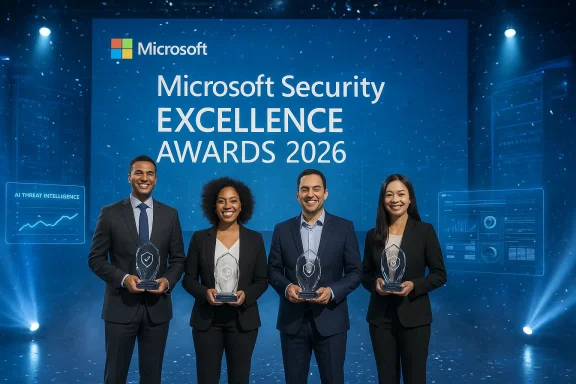
Microsoft’s security partner ecosystem just got a new set of headline recognitions: the winners of the 2026 Microsoft Security Excellence Awards were announced following an event in Redmond on January 26, 2026, spotlighting partners that have pushed the boundaries of AI‑enabled defense, Zero Trust implementation, and data governance across the Microsoft stack. The list includes Avertium for Security Trailblazer, BlueVoyant for Data Security and Compliance Trailblazer, Tata Consultancy Services for Secure Access Trailblazer, Illumio as Security Software Development Company of the Year, Invoke LLC as Security Services Partner of the Year, and Anna Bordioug (Protiviti) as Security Changemaker, among other winners and finalists. This year’s program — run by the Microsoft Intelligent Security Association (MISA) — is explicitly framed as a celebration of partnership, engineering discipline, and co‑innovation around Microsoft Defender, Entra, Purview, Intune, Sentinel, and Security Copilot. (microsoft.com)
The Microsoft Security Excellence Awards (now in their sixth year) are a MISA‑led recognition program that highlights partners integrating their solutions with Microsoft Security products and delivering measurable customer outcomes. Winners are chosen after a judging process that narrows submissions to five finalists per category, with winners selected by votes from Microsoft and MISA members. That selection model emphasizes peer recognition inside the Microsoft partner ecosystem rather than a purely external jury. The 2026 awards were presented during a Redmond gathering of MISA members, partners, finalists and Microsoft security leaders, with Vasu Jakkal and Maria Thomson among the public voices highlighting the collaborative spirit behind the program. (microsoft.com)
Why this matters now: Microsoft’s partner awards function as a co‑sell and GTM signal inside a hyperscaler‑centric market. Being named a finalist — and especially a winner — typically increases a partner’s visibility to Microsoft field teams and customers that prioritize Microsoft‑native integrations, which in turn can accelerate sales discussions and procurement shortlists. However, award recognition is a signal, not a procurement guarantee: organizations should still require operatiractually enforced SLAs before awarding large programs. This pragmatic view is echoed across partner community analysis and procurement guidance compiled within industry threads tracking Microsoft partner awards and trends.
Together, the winners and finalists show that Microsoft’s partner ecosystem is maturing from experimental AI pilots into governed, production‑grade security outcomes — a hopeful sign for defenders who need speed without sacrificing control. However, organizations pursuing these partners should bring a skeptical, evidence‑first mindset: ask for the operational artifacts, insist on human‑in‑the‑loop controls for AI actions, and design contracts that protect portability and cost transparency. The awards mark momentum; disciplined procurement turns momentum into durable security improvements.
Conclusion
Microsoft’s 2026 Security Excellence Awards offer a snapshot of where the vendor ecosystem is focusing its best engineering effort right now: data governance, identity and access, AI‑enabled detection and response, and repeatable services that convert platform capability into operational outcomes. The winners — from Avertium and BlueVoyant to Illumio and Invoke — represent distinct approaches to the same challenge: how to make Microsoft security primitives deliver measurable, repeatable protection at scale. For security leaders evaluating partners, the awards are a useful starting point — but the decisive work remains in the next steps: reference checks, pilot telemetry, contractual protections for portability and FinOps, and clear runbooks that bind the partner’s reputation to auditable production results. (microsoft.com)
Source: Microsoft Microsoft announces the 2026 Security Excellence Awards winners | Microsoft Security Blog
 Background / Overview
The Microsoft Security Excellence Awards (now in their sixth year) are a MISA‑led recognition program that highlights partners integrating their solutions with Microsoft Security products and delivering measurable customer outcomes. Winners are chosen after a judging process that narrows submissions to five finalists per category, with winners selected by votes from Microsoft and MISA members. That selection model emphasizes peer recognition inside the Microsoft partner ecosystem rather than a purely external jury. The 2026 awards were presented during a Redmond gathering of MISA members, partners, finalists and Microsoft security leaders, with Vasu Jakkal and Maria Thomson among the public voices highlighting the collaborative spirit behind the program. (microsoft.com)Why this matters now: Microsoft’s partner awards function as a co‑sell and GTM signal inside a hyperscaler‑centric market. Being named a finalist — and especially a winner — typically increases a partner’s visibility to Microsoft field teams and customers that prioritize Microsoft‑native integrations, which in turn can accelerate sales discussions and procurement shortlists. However, award recognition is a signal, not a procurement guarantee: organizations should still require operatiractually enforced SLAs before awarding large programs. This pragmatic view is echoed across partner community analysis and procurement guidance compiled within industry threads tracking Microsoft partner awards and trends.
The winners at a glance — what Microsoft announced
Microsoft published the official winners and finalists on the Microsoft Security Blog; the post lists winners by category and names the other finalists in each group. The primary winners for 2026 included: (microsoft.com)- Security Trailblazer: Avertium (winner) — finalists: Avanade, Bulletproof, ExtraHop, Ontinue. (microsoft.com)
- Data Security and Compliance Trailblazer: BlueVoyant (winner) — finalists: Invoke LLC, Netrix Global, Quorum Cyber, water IT Security GmbH. (microsoft.com)
- Secure Access Trailblazer: Tata Consultancy Services (winner) — finalists: Cayosoft, Devicie, IBM Consulting, Inspark. (microsoft.com)
- Security Changemaker (individual): Anna Bordioug, Protiviti (winner) — other finalists included Jon Kessler (Epiq), Justine Wolters (Cloud Life), Mario Espinoza (Illumio). (microsoft.com)
- Security Software Development Company of the Year: Illumio (winner) — finalists: ContraForce, Darktrace, inforcer, Tanium. (microsoft.com)
- Security Services Partner of the Year: Invoke LLC (winner) — finalists: BlueVoyant, Cloud4C, Shanghai Flyingnets, Quorum Cyber. (microsoft.com)
What the wins actually say about partner innovation
1. AI and co‑innovation are now table stakes
The 2026 winners signal that Microsoft and its partners consider AI integration and operationalization central to security value. Award descriptions repeatedly call out AI‑powered threat intelligence, integrations with Security Copilot, and AI‑driven observability — practical priorities for defenders who want automation and shorter detection‑to‑response cycles. Partners such as BlueVoyant explicitly position their Purview and Copilot integrations as core to the winning story, reinforcing that AI‑enabled data protection and governance are high‑value differentiators.2. Zero Trust and identity engineering remain decisive
The Secure Access Trailblazer category highlights identity and endpoint management as primary battlegrounds. Tata Consultancy Services’s win underlines that large systems integrators who can deliver end‑to‑end Entra/Intune/Zero Trust implementations — across global accounts and complex on‑prem/cloud hybrids — retain an important seat at Microsoft’s partner table. For buyers, this means identity engineering and lifecycle management remain among the most important technical criteria when shortlisting vendors. (microsoft.com)3. Services + IP = scale
Invoke LLC’s victory in Security Services Partner of the Year is a reminder that packaged services (repeatable runbooks, curated security engineering IP, and managed detection/response with Microsoft tech) can win alongside product innovation. When services are tightly coupled to Microsoft’s security primitives and incorporate automation for deployment and operations, they become attractive GTM assets focrosoft field teams. Invoke’s public statements around finalist status and their Microsoft Partner of the Year recognition the prior season also support the pattern that services powered by platform alignment can scale commercially.Strengths highlighted by the awards — what’s worth celebrating
- Winners show deep integration with Microsoft products — that reduces friction for customers already standardizing on Microsoft. This is a pragmatic benefit for enterprises looking to limit integration risk. (microsoft.com)
- Operational outcomes over experiments: The awards reward production‑grade outcomes (repeatable deployments, measurable KPIs) rather than one‑off reforcing the market’s shift from pilots to operational AI and security.
- Peer validation model: MISA‑led voting leverages the partner community’s perspective to surface credible engineering and implementation practices, whify partners with real field experience. (microsoft.com)
- Ecosystem efficiency: Winners who combine software and services show that packaged IP — accelerators, runbooks, prebuilt connectors — shortens time to value and reduces procurement complexity. This is a practical win for resource‑constrained security teams.
Risks, caveats and practical warnings for buyers
No awards program can replace operational diligence. The following risks merit attention when using award shortlists in procurement decisions:- Signal vs. delivery gap: Awards validate entries and submission artifacts; they don’t guarantee consistent delivery across every customer context. Buyers should treat the award as a starting filter, not the final procurement check. Request named references and production telemetry.
- Potential for vendor lock‑in: Deep platform integration expedites delivery but increases coupling to Microsoft services. Insist on data portability, API‑based exit pathways, and contract clauses for export of artifacts. (microsoft.com)
- Operational expense surprises with AI: AI‑driven features (model hosting, RAG vector stores, inference costs) can produce significant ongoing OPEX. Require FinOps visibility, predictable pricing scenarios, and throttles/quotas in proof‑of‑concepts.
- Oversold “AI” language: Marketing often bundles generic AI claims with technical accomplishments. Verify model governance, drift monitoring, and human‑in‑the‑loop controls rather than accepting high‑level AI statements.
Practical procurement checklist: convert award signal into operational confidence
- Request a short list of 2–3 reference customers with comparable regulatory and scale profiles and confirm measurable KPIs (time to detect/triage, mean time to remediation, reduction in false positives).
- Obtain Partner Center or Azure billing snapshots showing sustained usage consistent with production workloads.
- Validate security and compliance artifacts: SOC 2 Type II, ISO attestations, recent penetration test summaries, and a software‑supply‑chain audit where relevant.
- Require governance evidence for AI: model evaluation reports, drift detection, test suites and escalation procedures.
- Insist on contractual portability and exit criteria: export formats, timelines for data return, and migration runbooks.
- Build a time‑boxed pilot with measurable success criteria and budget controls; tie at least one milestone payment to the achievement of production telemetry goals.
Deeper look: selected winners and what they bring to the table
Avertium — Security Trailblazer (Winner)
Avertium’s win in the Security Trailblazer category recognizes its work in integrating AI into MXDR (managed XDR) workflows and delivering hardened operations at scale. The company’s own announcement and Microsoft’s blog note Avertium’s contribution to advanced detection, threat hunting, and tailored remediation tied to Microsoft Defender and Sentinel stacks. Avertium’s recognition is consistent with a market where MSSPs and MXDR providers who operationalize Microsoft tooling are prized by enterprise buyers seeking outsourced SOC capability.BlueVoyant — Data Security and Compliance Trailblazer (Winner)
BlueVoyant framed its win around Purview and data governance integration, citing enhancements in data discovery, classification and AI‑enabled detection that align with Purview’s policy and compliance controls. Their press coverage emphasizes programs that marry Purview with managed services to deliver compliance outcomes and data protection across cloud estates — a practical answer to mounting regulatory pressure and the need for AI‑ready data fabrics. For customers, that means BlueVoyant’s offering is positioned as a turnkey path to Purview‑anchored governance at scale.Tata Consultancy Services — Secure Access Trailblazer (Winner)
Tata Consultancy Services (TCS) won for secure access work that spans identity, device management, and Zero Trust engineering across large global estates. TCS’s strength in systems integration and industry programs makes their win logical in categories that reward scale, complex migrin identity remediations. Enterprises should view TCS as a partner for large modernization programs that require deep consulting, system re‑architecting, and multi‑region compliance choreography. (microsoft.com)Illumio — Security Software Development Company of the Year (Winner)
Illumio’s win recognizes a product‑centric approach — Zero Trust segmentation and containment that plugs into Microsoft Sentinel and Security Copilot to accelerate detection and containment. Illumio’s integration with Microsoft telemetry and focus on machine‑speed containment is consistent with the judges’ emphasis on product innovation that reduces breach blast radius and operational complexity. Buyers should evaluate Illumio for high‑value workloads where microsegmentation materially reduces lateral movement risk. (microsoft.com)Invoke LLC — Security Services Partner of the Year (Winner)
Invoke’s recognition as the top services partner underscores the continued commercial value of disciplined services engineering that packages Microsoft security tooling into repeatable outcome playbooks. Invoke has also been active in identity partner circles and Microsoft recognition programs, making its win part of a larger growth and platform alignment narrative. For many customers, Invoke represents the kind of services partner that can operationalize Microsoft security primitives quickly and sustainably.How organizations should use this awards news (short tactical guidance)
- Use the winners list as a refined short list for RFPs when your organization has chosen Microsoft as the primary security platform. Winners are likely to offer prebuilt integrations and co‑sell pathways that accelerate procurement and deployment. (microsoft.com)
- Don’t skip operational due diligence; require the artifacts listed in the procurement checklist above and validate them with named references and production telemetry.
- Expect to negotiate strong FinOps transparency and portability clauses if your plan uses AI‑heavy features or Copilot‑driven automation. Vendors should provide cost‑per‑seat/feature scenarios plus throttles or quotas to avoid runaway bills.
Final assessment — awards, momentum, and measured optimism
The 2026 Microsoft Security Excellence Awards reinforce several clear market trends: AI is now central to security differentiation, identity and data governance remain strategic priorities, and Microsoft‑aligned partners that can operationalize platform capabilities at scale get meaningful co‑sell leverage. The winners are credible signals of engineering focus and Microsoft alignment, and the partner press releases and community reports corroborate many of the narratives Microsoft highlighted. For security and IT leaders, awards like these are a helpful filter when scanning the market — but the usual procurement disciplines apply. Convert the accolade into contractual guarantees: measurable KPIs, auditable telemetry, compliance evidence, and exit/portability plans. (microsoft.com)Together, the winners and finalists show that Microsoft’s partner ecosystem is maturing from experimental AI pilots into governed, production‑grade security outcomes — a hopeful sign for defenders who need speed without sacrificing control. However, organizations pursuing these partners should bring a skeptical, evidence‑first mindset: ask for the operational artifacts, insist on human‑in‑the‑loop controls for AI actions, and design contracts that protect portability and cost transparency. The awards mark momentum; disciplined procurement turns momentum into durable security improvements.
Conclusion
Microsoft’s 2026 Security Excellence Awards offer a snapshot of where the vendor ecosystem is focusing its best engineering effort right now: data governance, identity and access, AI‑enabled detection and response, and repeatable services that convert platform capability into operational outcomes. The winners — from Avertium and BlueVoyant to Illumio and Invoke — represent distinct approaches to the same challenge: how to make Microsoft security primitives deliver measurable, repeatable protection at scale. For security leaders evaluating partners, the awards are a useful starting point — but the decisive work remains in the next steps: reference checks, pilot telemetry, contractual protections for portability and FinOps, and clear runbooks that bind the partner’s reputation to auditable production results. (microsoft.com)
Source: Microsoft Microsoft announces the 2026 Security Excellence Awards winners | Microsoft Security Blog
