

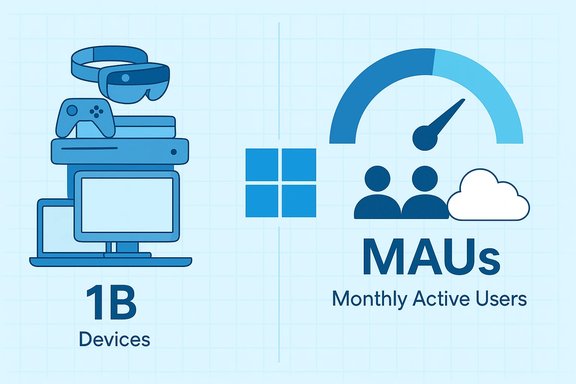
Microsoft’s decision to stop framing Windows adoption as a race to “one billion devices” and instead emphasize user‑centric metrics such as monthly active users marks a long‑running shift in both messaging and measurement — a change that resolves some historical counting problems but raises fresh questions about transparency, comparability, and the operational consequences for IT teams still wrestling with a massive Windows 10 installed base.
Background: the billion‑device ambition and why it mattered
When Windows 10 launched in 2015, Microsoft set a headline goal: one billion devices running the OS within two to three years. The target was an explicit developer and partner lure — a simple, press‑friendly number intended to convey scale and to accelerate upgrades from older Windows versions. That approach worked as marketing, but it also created measurement headaches because Microsoft’s device totals were broad by design: they included PCs, laptops, Xbox consoles, mixed‑reality hardware, Surface Hub units and selectedts — not only “traditional” desktop PCs.Over time the narrative evolved. Microsoft ultimately announced that Windows 10 had surpassed one billion active devices in March 2020, framing the milestone as “one billion monthly active devices.” That blog post — authored by Yusuf Mehdi — confirmed the milestone but also illustrated why the original two‑to‑three year timetable had slipped: adoption depends on OEM refresh cycles, enterprise migration schedules and real‑wor
Why counting methods matter
Counting “devices” versus counting “users” or “monthly active users” produces materially different narratives:- Device counts inflate totals when a single person uses multiple devices, or when non‑PC hardware (consoles, HoloLens, IoT) is included.
- User or monthly active user metrics can compress that spread and better reflect human reach, but they also depend on definitions (unique signed‑in accounts, device telemetry, or service sign‑ins).
- Corporate proclamations that mix “monthly active devices” and “users” create ambiguity for analysts, procurement teams and developers who need reproducible, audit‑grade numbers.
What Microsoft changed — from devices to monthly active users
Microsoft’s shift to tracking monthly active users (MAUs) or monthly active devices reflects three practical priorities:- Deliver a repeatable, comparable metric that aligns more closely with how cloud services measure reach.
- Reduce confusion caused by including disparate hardware classes in the same headline number.
- Give analysts and partners a cadence for updates that resembles web and service metrics rather than an irregular set of milestone press releases.
How the 2020 “one billion” announcement used activity‑based language
When Microsoft announced the one billion figure in March 2020, the copy was explicit: “over one billion people have chosen Windows 10 … resulting in more than one billion active Windows 10 devices.” The company’s phrasing combined people and devices in a way that reflee of its metric — active devices, reported in a way that emphasizes ongoing use rather than cumulative installs. That language shows the company had already moved toward activity‑based framing while retaining device‑level scale in its messaging.Why the change matters now: trust, comparability and the enterprise calendar
Switching to monthly active users is sensible from a measurement standpoint: MAUs are auditable, naturally time‑bounded, and aligned with how cloud services measure engagement. But the change also has consequences:- Comparability with historical claims degrades. A device milestone (e.g., 1B devices) and an MAU headline are not interchangeable. Historical device milestones — frequently used to claim platform dominance — can’t be compared directly to MAU numbers without careful definition.
- Analysts and IT buyers need transparent definitions. Saying “monthly active users” is only useful when Microsoft specifies the counting method: how are unique users identified (Microsoft account sign‑ins? device‑level telemetry?, how are multiple devices per person normalized, and w are included?
- Procurement and security teams care about per‑device counts. For licensing, endpoint management and vulnerability tracking, organizations must know how many physical endpoints need patching, not how many people signed into a service last month. That tension creates a necessary duality: Microsoft can sell scale with MAUs while IT still needs device‑level inventories.
The stubborn reality: Windows 10’s long tail and the migration problem
Microsoft’s measurement conversation is not merely academic. The operational reality — particularly around the Windows 11 transition an support — has real security and commercial implications.- Microsoft officially ended mainstream support for Windows 10 on October 14, 2025 and provided a one‑year consumer Extended Security Updates (ESU) bridge through October 13, 2026 for eligible devices. That lifecycle date is firm and documented on Microsoft’s support pages.
- Despite that deadline, OEM telemetry and public commentary indicate a very large Windows 10 installed base persisted through 2025, creating a refresh challenge. Dell publicly framed the installed‑base picture during its Q3 2025 earnings call, estimating roughly 1.5 billion PCs installed, with about 500 million machines capable of running Windows 11 but still on Windows 10 and another 500 million too old to meet Windows 11’s hardware baseline. Those numbers appear in multiple call transcripts and corroborating press coverage — they are vendor estimates, not an audited global census.
What blocks upgrades
The split Dell described — half of the long tail being upgrade‑capable but un‑upgraded, half ineligible — is explainable by Windows 11’s stricter hardware criteria:- TPM 2.0 and Secure Boot are mandatory in the Windows 11 baseline, and many older machines either lack the hardware or have TPe.
- Microsoft also requires CPUs from more recent families (and other platform features), further excluding a large swath of older hardware from official upgrade paths. Microsoft’s Windows 11 system requirements and guidance are the authoritative reference for those technical constraints.
Numbers you can verify — and numbers to treat cautiously
Good journalism separates verifiable facts from vendor estimates and marketing shorthand. Here’s the verification breakdown for the most load‑bearing claims:- Verifi):
- Microsoft’s March 16, 2020 blog announcing “more than one billion active Windows 10 devices.”
- Microsoft’s Windows 10 end‑of‑support date (October 14, 2025) and ESU window.
- Windows 11 minimum system requirements (TPM 2.0, UEFI Secure Boot, CPU family guidance).
- Vendor estimates and market commentary (treat cautiously but useful for planning):
- Dell’s installed‑base commentary (roughly 1.5 billion PCs, with the 500M/500M split) stems from an investor call and was repeated across press transcripts; it is a vendor estimate and should be used as directional telemetry rather than a census.
- Publicly reported figures that aggregate “Windows 10 still runs on ~1 billion PCs” combine OEM statements, web telemetry and rounding; they are plausible and consistent in shape but not precise device‑level audits.
The benefits of Microsoft’s reporting shift — clearer engagement metrics
Shifting to MAUs brings several clear benefits:- Better alignment with cloud and service KPIs. Monthly active users is the currency of web services and SaaS, making Windows’ engagement more comparable to other Microsoft services and market data.
- More frequent, predictable updates. Regular cadence helps developers and partners spot trends in user behavior and platform uptake earlier than irregular milestone announcements.
- Less ambiguity around multi‑device households. By focusing on people or accounts, Microsoft reduces the inflationary effect of counting every device that a user owns.
The downsides and risks: transparency, procurement friction, and the security cliff
But the switch is not a panacea. It introduces new frictions and risks:- Transparency risk. Without clear public definitions of the MAU metric, the change can look like a PR pivot rather than a rigorous methodological improvement. Analysts and customers will press Microsoft to publish counting rules (how it deduplicates signed‑in users, whether it counts guest sessions, which device classes are included).
- Procurement and security friction. License seats, patch programs and compliance regimes still operate at the device level. CIOs and security teams must reconcile Microsoft’s MAU messaging with the device inventories used for endpoint management and vulnerability remediation.
- Long‑tail security exposure. A large Windows 10 population lingering beyond end‑of‑support creates exploit and cost problems. ESU buys time, but it’s not a long‑term substitute for migration — and ESU enrollment itself can be operationally complex.
Practical guidance for IT leaders, OEMs and developers
The reporting change should not alter day‑to‑day priorities for IT teams. Here’s a pragmatic checklist:- Inventory first. Use endpoint detection and management tools to build an accurate per‑device tally — OS version, hardware specs, TPM status, and upgrade eligibility. Headlines won’t substitute for this.
- Prioritize by risk. Triage fleets by exposure (internet‑facing, critical apps, compliance profiles) and phase upgrades or ESU where necessary.
- Treat ESU as a bridge. Extended Security Updates are a stopgap; plan to migrate or replace rather than rely on ESU indefinitely.
- Communicate clearly. When presenting impact to stakeholders, present both Microsoft’s MAU story and your device‑level inventory; explain the differences.
- Factor sustainability. Large‑scale hardware refreshes have environmental and budgetary consequences; pursue refurbishment and trade‑in programs where practical.
Bigger picture: measurement, messaging and the future of Windows metrics
Microsoft’s move to activity‑based reporting mirrors a broader industry trend: platforms increasingly measure active users rather than shipped devices because engagement is a better predictor of value for cloud services. That evolution has upside: better product decisions, faster feedback loops and more predictable trend lines.But it also requires rigorous definition and openness. Public firms that trade on scale — and platforms that influence billions of endpoints — must make their metrics auditable or risk eroding trust. Industry players and IT buyers should insist that:
- Platform vendors publish clear counting definitions (unique‑user deduplication, inclusion/exclusion rules, minimum activity thresholds).
- Vendors provide both MAU‑style engagement metrics and device‑level telemetry for enterprise customers who must manage endpoints.
- Independent auditors or third‑party trackers maintain alternative panels so that public claims can be cross‑checked.
Conclusion: a necessary change, but not a substitute for hard inventory work
Microsoft’s decision to emphasize users over devices in public reporting solves a longstanding storytelling problem: it reduces the distortions created by counting consoles, VMs and multiple devices per person. That shift aligns Windows with modern cloud metrics and helps the company present a cleaner adoption narrative. However, the operational reality is stubborn. A large Windows 10 installed base, hardware eligibility constraints for Windows 11, and the October 14, 2025 end‑of‑support milestone mean organizations still face a complex, multi‑year migration and security challenge that MAUs do not address. Vendor estimates (such as Dell’s 1.5 billion installed base and the 500M/500M split) are valuable directional signals but not a substitute for fleet‑level telemetry and inventory work. The reporting change is therefore necessary and sensible — but it must be accompanied by clearer definitions from Microsoft and careful, device‑level planning by organizations. In the end, the most important numbers for IT teams remain the ones in their own asset databases, not the headlines.Source: BetaNews https://betanews.com/article/microsoft-moves-windows-10-goalposts/]
