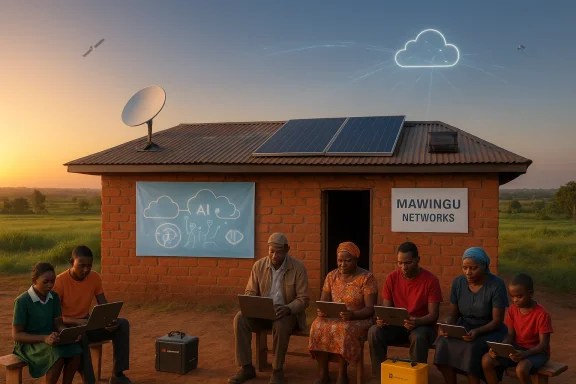
Microsoft’s new collaboration with Starlink marks the most explicit step yet in a long-running shift: cloud and AI vendors are no longer waiting for telcos to wire the world — they’re partnering to build the connectivity layer themselves, using satellites to reach places fiber never will. The announcement, revealed alongside Microsoft’s report that it has surpassed its digital‑access goal, promises to combine Starlink’s low‑Earth‑orbit (LEO) satellite network with Microsoft’s community‑first deployment model to connect hundreds of rural hubs in Kenya and to scale similar programs worldwide. This is both a practical push to bring more people online and a strategic move to create “AI‑ready” markets for Azure and Microsoft services — but it also raises hard questions about sovereignty, competition, space sustainability, and long‑term viability.
The digital divide is no longer only about getting a signal; it’s about making connectivity meaningful. Microsoft framed its latest step as part of an evolution from “coverage to adoption” — the company says it met and exceeded a 2022 commitment to extend internet access to 250 million people by the end of 2025, reporting coverage for roughly 299 million people worldwide. That milestone is a pause for planning: Microsoft now wants to ensure that connectivity converts into digital skills, reliable energy, affordable devices, and pathways into cloud and AI services.
At the same time, satellite internet has matured past hobbyist phases. Starlink’s constellation has entered the thousands‑of‑satellites era and regulators have authorized significant expansions of next‑generation satellites and spectrum use. Those technical upgrades promise lower latency, higher throughput, and new delivery modes such as direct‑to‑cell connections that can reach ordinary mobile phones without special hardware. For companies that sell cloud compute, analytics, and AI tools, the logic is clear: the cloud only matters where people can reach it reliably and at reasonable cost.
This partnership therefore sits at the intersection of three forces:
Microsoft framed the work as part of building AI‑ready communities, emphasizing that connectivity must be paired with energy, devices, cloud access, and digital skills to deliver meaningful outcomes for agriculture, education, healthcare, and small business.
Microsoft has emphasized a community‑first approach:
What the technical evolution means in practice:
Expect to see:
But the initiative also surfaces fundamental questions we must answer in parallel: who governs the data, who pays the ongoing bills, how do we avoid vendor lock‑in, and how do we preserve the long‑term safety of orbital commons? If governments, funders, and implementers insist on strong SLAs, transparent data governance, multivendor interoperability, and local capacity building, satellite‑backed programs like this can be a powerful complement to terrestrial infrastructure.
The next 24 months will be decisive. The partnership can either become a replicable blueprint for AI‑ready rural inclusion — pairing connectivity with skills, energy, and cloud tools — or it can expose the very dependencies that have slowed prior broadband initiatives. The difference will come down to governance, finance, and an honest accounting of the political and technical tradeoffs that accompany putting the cloud on the other end of a satellite link.
Source: Tech in Asia https://www.techinasia.com/news/microsoft-partners-starlink-expand-global-internet/
 Background: why this matters now
The digital divide is no longer only about getting a signal; it’s about making connectivity meaningful. Microsoft framed its latest step as part of an evolution from “coverage to adoption” — the company says it met and exceeded a 2022 commitment to extend internet access to 250 million people by the end of 2025, reporting coverage for roughly 299 million people worldwide. That milestone is a pause for planning: Microsoft now wants to ensure that connectivity converts into digital skills, reliable energy, affordable devices, and pathways into cloud and AI services.At the same time, satellite internet has matured past hobbyist phases. Starlink’s constellation has entered the thousands‑of‑satellites era and regulators have authorized significant expansions of next‑generation satellites and spectrum use. Those technical upgrades promise lower latency, higher throughput, and new delivery modes such as direct‑to‑cell connections that can reach ordinary mobile phones without special hardware. For companies that sell cloud compute, analytics, and AI tools, the logic is clear: the cloud only matters where people can reach it reliably and at reasonable cost.
This partnership therefore sits at the intersection of three forces:
- The commercial imperative to unlock new markets for cloud and AI;
- The technical readiness of LEO constellations to deliver practical, near‑real‑time broadband; and
- A policy environment wrestling with spectrum, space‑safety, and national‑security questions.
Overview of the Microsoft–Starlink collaboration
What Microsoft announced
Microsoft describes the collaboration as an expansion of its digital access toolkit, pairing low‑Earth‑orbit satellite connectivity from Starlink with Microsoft’s community‑first deployment model and local ecosystem partners. The announcement highlighted Kenya as an early example: Microsoft, Starlink, and local internet‑service partners (notably Mawingu Networks) will support connectivity for hundreds of community hubs — farmer co‑ops, aggregation centers, and digital hubs — with an initial target in the low hundreds of sites.Microsoft framed the work as part of building AI‑ready communities, emphasizing that connectivity must be paired with energy, devices, cloud access, and digital skills to deliver meaningful outcomes for agriculture, education, healthcare, and small business.
Why Starlink?
Starlink’s commercial LEO network offers characteristics that make it attractive for last‑mile coverage in rural and hard‑to‑reach places:- Wide geographic reach without the need to build fiber;
- Rapid deployability: satellite terminals can be installed quickly compared with multi‑year fiber projects;
- Improving performance as newer satellite generations and lower orbital altitudes reduce latency and increase capacity;
- Growing commercial maturity and partnerships with governments and enterprises.
How this fits Microsoft’s strategy
From coverage to adoption to AI participation
Microsoft’s connectivity work has for years been presented as part of a broader digital inclusion roadmap: connect communities, then enable adoption through skills, affordability, and locally relevant services. The new collaboration with Starlink is explicitly tied to that sequence: connectivity delivered by satellites is only the opening move; the objective is to catalyze use cases that generate measurable social and economic returns and drive demand for cloud and AI services.Microsoft has emphasized a community‑first approach:
- Partner with local ISPs and NGOs who understand last‑mile realities;
- Deploy hubs (schools, health centers, co‑ops) that already play community roles;
- Combine connectivity with digital skills and cloud tools so communities can adopt services like agricultural marketplaces, telehealth, and local e‑government.
Not Microsoft’s first move into space
This is not the first time Microsoft has worked with SpaceX/Starlink‑adjacent capabilities. The company launched Azure Space and Azure Orbital years ago to connect satellite operators and to enable cloud processing directly from space assets. In practical terms, Microsoft has positioned Azure as the cloud backend for space‑connected services — and the new partnership builds on that foundation by focusing on consumer and community connectivity rather than just satellite telemetry or enterprise links.The Kenya pilot: design, partners, and expected outcomes
Kenya is the headline early deployment for the collaboration. The model described combines:- Starlink satellite terminals for broadband connectivity at community hubs;
- Local partner Mawingu Networks to manage last‑mile logistics, local service delivery, and community relationships;
- Microsoft‑supported digital skills programs and cloud tools to enable services such as market access for farmers, precision agriculture pilots, telehealth links, and education content.
- Community hubs are prioritized (not merely households) to maximize shared impact and affordability.
- Deployments will combine connectivity with energy solutions, digital skills, and local ecosystem support.
- The aim is to pilot a financially sustainable model that can scale with local governments and donors.
Technical considerations and what’s new with Starlink
Satellite fleet size and capabilities
Starlink’s constellation has grown into the thousands of satellites; regulators have also cleared significant next‑generation deployments that enable improved performance and new services. The latest regulatory approvals expand Starlink’s authorized Gen‑2 fleet and provide frequency flexibility that helps deliver higher throughput and mobile‑adjacent services.What the technical evolution means in practice:
- Lower orbital altitudes and Gen‑2 designs reduce round‑trip latency, making interactive applications and many AI‑assisted services more usable.
- Expanded spectrum authorizations allow higher symmetrical speeds and broader simultaneous connections per hub.
- Direct‑to‑cell capabilities (beaming to ordinary mobile handsets) are gaining traction as a way to reach users without dedicated satellite dishes.
Integration with Azure and edge infrastructure
Microsoft’s pitch is to integrate satellite links with Azure’s edge services:- Satellite bandwidth terminates into Azure regions or modular datacenters that can be deployed near the last mile.
- Workloads that require low latency or local processing (AI inferencing, telemedicine, agricultural analytics) can run either at the edge or in Azure, depending on appetite and regulatory rules.
- Microsoft’s modular datacenter concepts (portable, self‑contained cloud infrastructure) pair naturally with satellite backhaul for resilient deployments in remote sites.
Strengths of the partnership
- Rapid reach: satellite connectivity can be deployed orders of magnitude faster than undersea cables or rural fiber builds, lowering time‑to‑impact for social programs.
- Holistic deployment model: pairing connectivity with local partners, energy, and skills reduces the historical risk of low digital adoption.
- Scalable enterprise anchor: Microsoft provides a credible buyer for cloud services; Starlink gains large, contractable enterprise demand to justify continued investment.
- Technical momentum: next‑generation satellite approvals and network upgrades are improving speed and latency, enabling richer services.
- Competitive complement: for governments and NGOs, having multiple infrastructure suppliers (fiber, terrestrial wireless, satellite) increases resilience and bargaining power.
Risks and unknowns — what critics should watch
While the benefits are tangible, several risks and challenges must be acknowledged and actively managed.1. Sovereignty, regulation, and data flows
When a private, foreign satellite company becomes the primary transport provider for public services, consumers and governments must carefully manage data sovereignty and regulatory oversight. Questions include:- Where does traffic terminate, and under which jurisdiction does it pass?
- Which legal frameworks govern lawful intercept and data retention?
- How do local governments ensure accountability and compliance for services delivered over international satellite links?
2. Vendor lock‑in and market contestability
Tying community connectivity and cloud adoption closely to a single vendor stack can risk lock‑in:- If Microsoft services plus Starlink connectivity become the de‑facto bundle for a region, local operators and governments may face limited alternative suppliers.
- Competition matters for price, innovation, and long‑term sustainability. Public procurement and open interoperability standards must be part of any large deployment.
3. Affordability and operating costs
Satellite broadband has historically been costlier than terrestrial alternatives. Even with price reductions, sustainability depends on:- How costs are shared (governments, donors, communities, private sector);
- Whether community hubs have ongoing financing models (subscriptions, public funding, micro‑payments);
- Maintenance and replacement cycles for terminals and energy systems.
4. Space‑safety and orbital congestion
The scale of megaconstellations has sparked genuine concerns about orbital congestion, collision risk, and space‑debris creation. Regulators have already flagged these issues during recent approvals of next‑generation satellites. The more we rely on LEO as critical infrastructure, the more national space policies and international coordination must evolve.5. Geopolitical tensions and commercial friction
The partnership is also politically sensitive: Microsoft is a major partner of some AI organizations and governments, while Starlink’s ownership, contractual obligations, and founder behavior are under intense public and legal scrutiny. Notably, high‑profile legal actions involving executives or companies in adjacent spaces (such as litigation among major AI players) can create reputational and operational pressure on partnerships.6. Cybersecurity and resilience
Last‑mile connectivity is often the weakest link for security. Satellite endpoints and community hubs must be hardened against cyber threats. Microsoft’s cloud services provide security controls, but operating environments in rural hubs often lack trained personnel to apply and maintain them.Practical lessons from the field: design principles that matter
From prior connectivity efforts and what Microsoft proposes, several practical design rules emerge for any satellite‑backed community program:- Prioritize shared‑use community anchors (schools, clinics, co‑ops) rather than individual household installs in the initial phase.
- Combine connectivity with durable energy solutions and local maintenance capacity to avoid equipment downtime.
- Embed training and localized content to drive adoption fast — connectivity alone is not sufficient.
- Use blended financing: donor seed funding plus affordable user fees or government subsidies can create longevity.
- Insist on multivendor technical standards and interoperability to preserve competition and avoid lock‑in.
What governments, telcos, and NGOs should require
If a public agency evaluates Microsoft–Starlink‑style programs, they should require:- Clear service‑level agreements (SLAs) that define uptime, latency targets, and repair times.
- Transparency on data flows and localization, with contractual protections for citizen privacy and lawful access.
- Local partner engagement and capacity‑building commitments to avoid external dependency.
- Open technical interfaces and portability clauses to prevent being locked into a single vendor for both connectivity and cloud services.
- Environmental and space‑safety commitments, including plans for end‑of‑life deorbiting and debris mitigation.
Competition and market dynamics: why rivals are watching
Microsoft’s move also reframes competition. Amazon’s Project Kuiper and other satellite operators are racing to offer similar enterprise and wholesale services. Telecom incumbents are exploring hybrid models that combine fiber, cellular, and satellite. For cloud vendors, being the company that enables the “last mile” is a powerful position: whoever controls reliable distribution points can shape where data and compute workloads land.Expect to see:
- More cloud–satellite tie‑ups and distribution partnerships;
- Telcos pursuing “neutral host” models or forming consortiums with satellite providers;
- Regulators scrutinizing large vertical integrations for antitrust and national‑security implications.
Measuring success: KPIs that matter for the first 24 months
To judge whether the Microsoft–Starlink partnership delivers, trackable KPIs should include:- Connectivity uptime at community hubs (percentage of time meeting minimum bandwidth/latency);
- User adoption rates for digital services (registered users, transactions, telehealth consults, market listings);
- Economic outcomes (increased market prices received by farmers, time saved, new business production);
- Sustainability metrics (local revenue generation, equipment availability, maintenance response time);
- Security incidents and data governance compliance.
Conclusion: an infrastructural pivot with caveats
Microsoft’s partnership with Starlink represents a consequential pivot: it treats last‑mile connectivity as a direct lever to grow cloud and AI adoption, and it operationalizes the idea that closing the digital divide requires more than satellite bandwidth. The collaboration’s strengths are real — speed of deployment, integration with Azure, and a community‑first design — and it can accelerate meaningful outcomes in education, health, and agriculture.But the initiative also surfaces fundamental questions we must answer in parallel: who governs the data, who pays the ongoing bills, how do we avoid vendor lock‑in, and how do we preserve the long‑term safety of orbital commons? If governments, funders, and implementers insist on strong SLAs, transparent data governance, multivendor interoperability, and local capacity building, satellite‑backed programs like this can be a powerful complement to terrestrial infrastructure.
The next 24 months will be decisive. The partnership can either become a replicable blueprint for AI‑ready rural inclusion — pairing connectivity with skills, energy, and cloud tools — or it can expose the very dependencies that have slowed prior broadband initiatives. The difference will come down to governance, finance, and an honest accounting of the political and technical tradeoffs that accompany putting the cloud on the other end of a satellite link.
Source: Tech in Asia https://www.techinasia.com/news/microsoft-partners-starlink-expand-global-internet/