

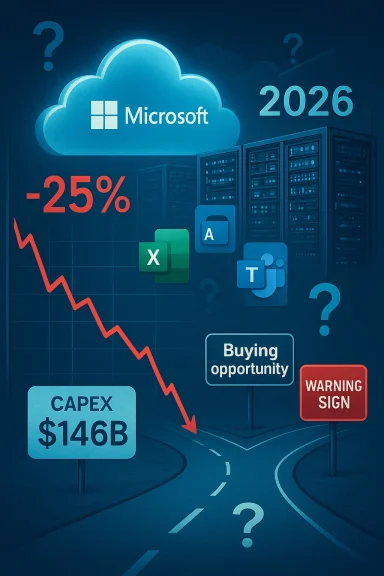
Microsoft’s rough start to 2026 has done more than dent the stock price; it has reopened a familiar but uncomfortable debate about how much investors should pay for quality, dominance, and AI optionality when the near-term evidence is messy. The company’s shares have suffered one of their sharpest quarterly drawdowns in roughly two decades, even as Microsoft keeps spending aggressively on AI infrastructure and embedding Copilot across its product stack. That mismatch between massive investment and slower-than-hoped monetization is now the core of the story, and it is forcing the market to decide whether this is a buying opportunity or a warning sign.
Microsoft’s current predicament did not appear overnight. It is the product of a multi-year transformation in which the company moved from a classic software licensing giant to a cloud-first, AI-heavy platform business. Azure, Microsoft 365, GitHub, and Copilot have become the company’s strategic center of gravity, while Windows remains an important anchor rather than the main growth engine.
That shift looked straightforward when cloud demand was rising and interest rates were lower. Microsoft could spend heavily, show strong growth, and still command a premium multiple because the market believed the company’s scale, distribution, and enterprise relationships would turn every new technology cycle into another margin-expanding runway. In many ways, that thesis has not changed. What has changed is the market’s patience.
The latest concern is not that Microsoft is weak. It is that the company is too strong to fail in the eyes of many investors, which creates a high bar for every quarter. If Azure grows a little less quickly, if Copilot adoption looks slower than planned, or if capex spikes without a matching near-term revenue payoff, the market reacts harshly because expectations were already so elevated.
That is why the present debate feels bigger than a single quarter. It is about whether Microsoft’s AI strategy is still the cleanest expression of enterprise software leadership, or whether the company is entering a period where it must prove that infrastructure spending can be translated into durable monetization. The market is no longer rewarding narrative alone. It wants evidence.
Microsoft’s recent commentary and investor attention reflect that tension. The company has been portrayed as both a beneficiary of the AI boom and a victim of its own ambition, with capex plans and Azure constraints drawing as much scrutiny as product launches. Even inside the company’s ecosystem, the question is becoming sharper: can Copilot, Azure AI, and the broader Microsoft stack deliver the kind of revenue acceleration that justifies the scale of investment? nly 2026
The sell-off has been severe enough to feel out of character for a company of Microsoft’s size. In the forum materials, Microsoft is described as suffering a roughly 25% drop in the first quarter of 2026, which would put it on track for its worst quarterly decline since the global financial crisis era. That kind of move matters because megacap software names are usually valued for stability as much as growth. When they swing this hard, it changes the way institutions think about risk.
The immediate cause is not a scandal or a product failure. It is a convergence of worries that have been building for months. Investors worry that AI spending is rising faster than AI revenue, that Azure growth is no longer accelerating as cleanly as before, and that Microsoft’s distribution advantage may not be enough if customers begin buying more directly from model providers or niche AI vendors. The market is pricing in uncertainty rather than collapse.
That is why the current decline feels more consequential than a routine re-rating. The sell-off suggests that investors are no longer willing to pay a high multiple for certainty that arrives later. They now want clarity on when AI spending pays off, not just whether it eventually will.
The problem is not spending itself. In cloud and AI, you often have to build ahead of demand. The issue is that investors cannot easily see the payback curve. Massive capex can be justified if it produces a durable jump in cloud usage, higher seat pricing, or a meaningful increase in AI attach rates. If those outcomes lag, the spending starts to look like a burden rather than an investment.
This is where the current mood turns skeptical. Microsoft is being judged through a narrower lens because the company has framed AI as a major growth vector. That framing sets up a binary question: does the infrastructure bet create a moat, or does it simply inflate costs before revenue catches up?
That means the near-term financial optics can look worse than the strategic logic. A company may spend billions on data centers, GPUs, networking, and power capacity before the market is convinced the workloads will justify it. In theory, that is a rational buildout. In practice, it is a test of management credibility.
That is especially true because Azure is not just a cloud product. It is the backbone of Microsoft’s broader AI strategy, from model hosting and inference to enterprise application modernization. If Azure growth looks softer, it becomes harder to argue that every other AI product in the stack will compound naturally from it.
The recent slowdown does not mean Azure is weak in any absolute sense. It means the bar has moved. A business that once impressed by growing rapidly now has to impress by growing rapidly and proving that AI is not merely consuming capacity but converting into profit.
Still, Copilot’s commercial story has been uneven. The company has promoted it heavily, but broad adoption across the hundreds of millions of Microsoft 365 users has reportedly lagged some expectations. That does not make Copilot a failure. It makes it a normal enterprise product trying to win in a market where enthusiasm, budget cycles, and practical utility do not always line up.
The harder question is not whether Copilot is interesting. It is whether it is indispensable enough to drive meaningful incremental revenue. Enterprises will pay for tools that save time, improve workflows, or create measurable outcomes. If Copilot remains a novelty rather than a necessity, Microsoft will struggle to turn AI excitement into sustained financial upside.
The enterprise case is stronger because Microsoft already owns the workflow layer. But enterprise buyers are disciplined. They compare AI features with cost, governance, and actual output quality. If the product does not improve decision-making or throughput, they cut back. That is why adoption metrics, retention, and usage depth matter more than launch-day buzz.
This concern is not hypothetical. A platform company always has to worry that new behavior will migrate to the layer above or below it. Microsoft has historically benefited from being the operating system, the productivity suite, the identity provider, and the cloud host. AI introduces a new layer where the customer relationship might shift elsewhere.
The market is essentially asking whether Microsoft will remain the default platform for enterprise AI, or whether it will become one of several infrastructure providers in a more fragmented market. That is a profound strategic distinction. A default platform earns premium economics. A commodity host does not.
This is why distribution advantage is not the same as distribution certainty. Microsoft can place AI everywhere in its ecosystem, but customers still have a choice. If the standalone tools feel better, cheaper, or more specialized, the company may be forced into a harder competitive posture than Wall Street expected.
A lower multiple does not automatically make a stock cheap. It does, however, change the burden of proof. When a company like Microsoft trades closer to market levels than to its own historical premium, investors must decide whether the downside is already priced in. If the answer is yes, the stock can become a powerful long-term compounder from a lower entry point. If not, the reset may still be incomplete.
That said, valuation should not be confused with a guarantee. Cheap stocks can be cheap for a reason, and Microsoft’s reason is clear: the market wants proof that AI spending will create durable operating leverage. Without that proof, even a “reasonable” multiple may not feel cheap enough.
Competitively, the stakes are huge. AWS and Google Cloud are watching for any sign that Microsoft’s AI and cloud momentum is stalling. Independent AI vendors are watching for openings to sell directly into enterprise budgets. Even within productivity software, Microsoft has to defend the idea that integrated AI is worth paying for when standalone tools are improving fast.
The opportunity is that the current skepticism may be too focused on the next few quarters and not enough on the next few years. If the company can convert infrastructure spending into higher Azure utilization, stronger Copilot attach rates, and deeper enterprise lock-in, today’s lower valuation could look like a gift in hindsight.
There is also a real risk that the market is underestimating how much direct AI competition could reshape enterprise budgets. If customers start treating AI as a separate category rather than a Microsoft feature, the company could face a slower path to monetization than bulls assume. That would especially hurt if capex remains elevated.
The company’s leadership also matters. Microsoft will need to reassure the market that it can balance innovation with discipline. That is especially important because the current debate is no longer just about AI capability. It is about capital allocation, product adoption, and the pace at which Microsoft can convert strategic ambition into financial proof.
Microsoft is still one of the most powerful companies in technology, but power and stock performance are not the same thing. The market is asking for proof that the AI era will produce not just strategic relevance, but also clean financial returns. If Microsoft delivers that proof, today’s skepticism may look like one of those rare moments when a great franchise went on sale. If it does not, the current caution will have been the market’s way of noticing a harder truth early.
Source: AOL.com Microsoft May Have Its Worst Showing in 20 Years. Is It Too Cheap to Ignore?
 Background
Microsoft’s current predicament did not appear overnight. It is the product of a multi-year transformation in which the company moved from a classic software licensing giant to a cloud-first, AI-heavy platform business. Azure, Microsoft 365, GitHub, and Copilot have become the company’s strategic center of gravity, while Windows remains an important anchor rather than the main growth engine.That shift looked straightforward when cloud demand was rising and interest rates were lower. Microsoft could spend heavily, show strong growth, and still command a premium multiple because the market believed the company’s scale, distribution, and enterprise relationships would turn every new technology cycle into another margin-expanding runway. In many ways, that thesis has not changed. What has changed is the market’s patience.
The latest concern is not that Microsoft is weak. It is that the company is too strong to fail in the eyes of many investors, which creates a high bar for every quarter. If Azure grows a little less quickly, if Copilot adoption looks slower than planned, or if capex spikes without a matching near-term revenue payoff, the market reacts harshly because expectations were already so elevated.
That is why the present debate feels bigger than a single quarter. It is about whether Microsoft’s AI strategy is still the cleanest expression of enterprise software leadership, or whether the company is entering a period where it must prove that infrastructure spending can be translated into durable monetization. The market is no longer rewarding narrative alone. It wants evidence.
Microsoft’s recent commentary and investor attention reflect that tension. The company has been portrayed as both a beneficiary of the AI boom and a victim of its own ambition, with capex plans and Azure constraints drawing as much scrutiny as product launches. Even inside the company’s ecosystem, the question is becoming sharper: can Copilot, Azure AI, and the broader Microsoft stack deliver the kind of revenue acceleration that justifies the scale of investment? nly 2026
The sell-off has been severe enough to feel out of character for a company of Microsoft’s size. In the forum materials, Microsoft is described as suffering a roughly 25% drop in the first quarter of 2026, which would put it on track for its worst quarterly decline since the global financial crisis era. That kind of move matters because megacap software names are usually valued for stability as much as growth. When they swing this hard, it changes the way institutions think about risk.
The immediate cause is not a scandal or a product failure. It is a convergence of worries that have been building for months. Investors worry that AI spending is rising faster than AI revenue, that Azure growth is no longer accelerating as cleanly as before, and that Microsoft’s distribution advantage may not be enough if customers begin buying more directly from model providers or niche AI vendors. The market is pricing in uncertainty rather than collapse.
Why the decline is so unsettling
A company like Microsoft is often treated as a “bond proxy” for tech investors in bad times: a huge installed base, recurring revenue, and formidable cash generation. When the stock sells off this aggressively, it signals that the market is questioning not just the next quarter but the durability of the long-term compounding story.That is why the current decline feels more consequential than a routine re-rating. The sell-off suggests that investors are no longer willing to pay a high multiple for certainty that arrives later. They now want clarity on when AI spending pays off, not just whether it eventually will.
- The decline is large enough to reset valuation expectations.
- It reflects doubt about timing, not necessarily about Microsoft’s survival.
- It has forced comparisons with the last major market stress period.
- It highlights the difference between platform strength and stock performance.
- It shows how quickly sentiment can change when capex rises faster than monetization.
The Capex Shock
The central number haunting the debate is Microsoft’s capital expenditure outlook. The company’s spending on AI infrastructure, including leases, is expected to reach around $146 billion in fiscal 2026, with analysts projecting even higher figures in the years that follow. That is a staggering sum, even for a company with Microsoft’s balance sheet and cash flow. It tells investors the company is serious about owning the AI layer, not just renting it from others.The problem is not spending itself. In cloud and AI, you often have to build ahead of demand. The issue is that investors cannot easily see the payback curve. Massive capex can be justified if it produces a durable jump in cloud usage, higher seat pricing, or a meaningful increase in AI attach rates. If those outcomes lag, the spending starts to look like a burden rather than an investment.
This is where the current mood turns skeptical. Microsoft is being judged through a narrower lens because the company has framed AI as a major growth vector. That framing sets up a binary question: does the infrastructure bet create a moat, or does it simply inflate costs before revenue catches up?
The economics behind AI infrastructure
AI infrastructure is unusual because it can support multiple monetization layers at once. It can power Azure compute demand, support enterprise Copilot subscriptions, and create ecosystem lock-in through integration with Microsoft 365 and developer tools. But those benefits do not arrive evenly, and they often require product maturity, customer education, and a period of trial-and-error adoption.That means the near-term financial optics can look worse than the strategic logic. A company may spend billions on data centers, GPUs, networking, and power capacity before the market is convinced the workloads will justify it. In theory, that is a rational buildout. In practice, it is a test of management credibility.
- Capex is a strategic moat only if utilization follows.
- AI infrastructure spending has long lead times.
- Enterprise customers move slower than consumer hype cycles.
- Power, chip supply, and data-center availability can all limit execution.
- Overbuilding too early can pressure free cash flow and margins.
Azure: Still Strong, but Less Effortlessly So
Azure remains Microsoft’s most important growth engine, but the market has become more sensitive to the shape of that growth. The recent results reportedly showed a modest deceleration in Azure’s growth rate, which may not sound dramatic in isolation, but in the context of Microsoft’s valuation it matters a great deal. When a mega-franchise slows even slightly, investors read it as an early warning.That is especially true because Azure is not just a cloud product. It is the backbone of Microsoft’s broader AI strategy, from model hosting and inference to enterprise application modernization. If Azure growth looks softer, it becomes harder to argue that every other AI product in the stack will compound naturally from it.
Why Azure matters beyond cloud revenue
Azure is where Microsoft’s strategic story, financial story, and infrastructure story meet. It is the place where enterprise demand, AI workloads, and platform leverage can all reinforce each other. If Azure scales, the rest of the ecosystem looks more valuable. If Azure stalls, the whole AI thesis becomes harder to price.The recent slowdown does not mean Azure is weak in any absolute sense. It means the bar has moved. A business that once impressed by growing rapidly now has to impress by growing rapidly and proving that AI is not merely consuming capacity but converting into profit.
- Azure is the main bridge between AI demand and revenue.
- Slower growth can still be strong growth, but not strong enough for a premium.
- Investors are watching mix, not just headline expansion.
- Capacity constraints can be read as demand problems or supply problems.
- The market wants reacceleration, not just resilience.
Copilot and the Monetization Question
No product sits closer to the center of Microsoft’s AI ambition than Copilot. It is the company’s attempt to make generative AI a daily habit inside Word, Excel, PowerPoint, Teams, and the broader Microsoft 365 environment. That is a powerful distribution strategy because it places AI inside tools people already use rather than asking them to learn a separate interface.Still, Copilot’s commercial story has been uneven. The company has promoted it heavily, but broad adoption across the hundreds of millions of Microsoft 365 users has reportedly lagged some expectations. That does not make Copilot a failure. It makes it a normal enterprise product trying to win in a market where enthusiasm, budget cycles, and practical utility do not always line up.
The harder question is not whether Copilot is interesting. It is whether it is indispensable enough to drive meaningful incremental revenue. Enterprises will pay for tools that save time, improve workflows, or create measurable outcomes. If Copilot remains a novelty rather than a necessity, Microsoft will struggle to turn AI excitement into sustained financial upside.
Enterprise adoption versus consumer curiosity
Consumer AI usage tends to be broad but shallow. Enterprise AI adoption tends to be narrower but more durable if it works. Microsoft is trying to bridge those two realities by embedding Copilot into existing business workflows. That approach is sensible, but it also means Microsoft must deliver tangible productivity gains, not just impressive demos.The enterprise case is stronger because Microsoft already owns the workflow layer. But enterprise buyers are disciplined. They compare AI features with cost, governance, and actual output quality. If the product does not improve decision-making or throughput, they cut back. That is why adoption metrics, retention, and usage depth matter more than launch-day buzz.
- Copilot’s strength is distribution.
- Copilot’s weakness is proof of indispensable value.
- Enterprises buy outcomes, not slogans.
- Consumer interest can inflate expectations without changing revenue quickly.
- Usage depth will matter more than seat counts.
The Risk of Disintermediation
One of the most important fears in the market is that Microsoft could be bypassed by the very AI ecosystem it helped accelerate. In plain terms, if enterprises decide they would rather buy models, inference, or agentic tools directly from OpenAI, Anthropic, or other specialist vendors, Microsoft’s role as a middle layer becomes less valuable. That would not destroy the company, but it could squeeze margins and weaken the logic of its integrated stack.This concern is not hypothetical. A platform company always has to worry that new behavior will migrate to the layer above or below it. Microsoft has historically benefited from being the operating system, the productivity suite, the identity provider, and the cloud host. AI introduces a new layer where the customer relationship might shift elsewhere.
The market is essentially asking whether Microsoft will remain the default platform for enterprise AI, or whether it will become one of several infrastructure providers in a more fragmented market. That is a profound strategic distinction. A default platform earns premium economics. A commodity host does not.
What bypassing Microsoft would look like
If customers go direct to AI vendors, several things could happen. Microsoft could lose part of the pricing leverage it hoped to gain from bundling AI into its own suite. It could also face a weaker attach rate for Copilot and related services if organizations decide to mix and match best-of-breed tools. Even if Azure retains workload growth, the economics may be less attractive.This is why distribution advantage is not the same as distribution certainty. Microsoft can place AI everywhere in its ecosystem, but customers still have a choice. If the standalone tools feel better, cheaper, or more specialized, the company may be forced into a harder competitive posture than Wall Street expected.
- Direct AI purchasing could weaken Microsoft’s intermediary role.
- Bundling only works if customers see clear value.
- Specialized vendors can win on speed and model quality.
- The AI market may fragment before it consolidates.
- Microsoft must defend both infrastructure and application layers.
Valuation Reset
The biggest change for investors may be the valuation itself. Microsoft’s forward price-to-earnings multiple has compressed to below 20 times in the materials provided, which would be the lowest level in nearly a decade. At moments, the stock has even traded below the broader S&P 500 multiple, a striking inversion for a company long considered a premium compounder. That kind of compression usually only happens when growth fear overwhelms quality premium.A lower multiple does not automatically make a stock cheap. It does, however, change the burden of proof. When a company like Microsoft trades closer to market levels than to its own historical premium, investors must decide whether the downside is already priced in. If the answer is yes, the stock can become a powerful long-term compounder from a lower entry point. If not, the reset may still be incomplete.
Why valuation matters more now
Valuation matters more when uncertainty rises because it influences how much bad news the stock can absorb. Microsoft still has the cash generation, scale, and franchise quality that long-term investors admire. But if the market is no longer willing to pay a full premium for those attributes, then every near-term disappointment hits harder.That said, valuation should not be confused with a guarantee. Cheap stocks can be cheap for a reason, and Microsoft’s reason is clear: the market wants proof that AI spending will create durable operating leverage. Without that proof, even a “reasonable” multiple may not feel cheap enough.
- Lower valuation improves long-term return potential.
- It also signals reduced confidence in near-term execution.
- Premium software names often re-rate quickly, both up and down.
- The market is discounting uncertainty around AI payback.
- Historical valuation matters, but so does future growth quality.
Enterprise, Consumer, and Competitive Implications
Microsoft’s situation means different things to different audiences. For enterprises, the message is that Microsoft is still deeply embedded in the software stack, but the company is pushing them toward a new spending cycle built around AI tools, cloud consumption, and productivity upgrades. For consumers, the effect is more subtle: more Copilot-like features across Windows and Microsoft 365, but also more questions about usefulness, pricing, and privacy.Competitively, the stakes are huge. AWS and Google Cloud are watching for any sign that Microsoft’s AI and cloud momentum is stalling. Independent AI vendors are watching for openings to sell directly into enterprise budgets. Even within productivity software, Microsoft has to defend the idea that integrated AI is worth paying for when standalone tools are improving fast.
The enterprise lens
Enterprises care about governance, support, and long-term vendor stability. Microsoft scores well on all three. That is why the company still has a real advantage, even in a more skeptical market. But enterprise customers also dislike wasted spend, and AI projects are increasingly expected to show measurable productivity returns.The consumer lens
Consumers are more sensitive to friction. If Copilot feels intrusive, redundant, or confusing, adoption will lag. If AI features are useful but not essential, they may not drive meaningful new monetization. In consumer software, convenience is necessary but not sufficient.- Enterprise buyers want compliance and measurable ROI.
- Consumer users want simplicity and low friction.
- Competitors can win on specialization or price.
- Microsoft wins when integration beats fragmentation.
- AI feature sprawl can confuse both audiences.
Strengths and Opportunities
Microsoft still has several structural advantages that make the stock interesting even after the sell-off. The company’s balance sheet, cash generation, and distribution power are rare, and they become more valuable when the market is nervous. More importantly, Microsoft has multiple paths to monetize AI rather than relying on one product or one customer segment.The opportunity is that the current skepticism may be too focused on the next few quarters and not enough on the next few years. If the company can convert infrastructure spending into higher Azure utilization, stronger Copilot attach rates, and deeper enterprise lock-in, today’s lower valuation could look like a gift in hindsight.
- Global enterprise reach gives Microsoft unmatched distribution.
- Azure remains a strategic cloud and AI platform.
- Copilot can scale across already-installed workflows.
- Recurring revenue offers resilience in choppy markets.
- Cash flow gives the company room to keep investing.
- Ecosystem lock-in remains one of Microsoft’s strongest moats.
- Cross-selling between cloud, productivity, and security is still powerful.
Risks and Concerns
The bear case is not trivial. Microsoft’s AI investment cycle could last longer than investors expect, and if revenue ramps slowly, the stock may remain under pressure even if the business stays fundamentally healthy. In that scenario, the company would be penalized for being too early, too expensive, or too ambitious all at once.There is also a real risk that the market is underestimating how much direct AI competition could reshape enterprise budgets. If customers start treating AI as a separate category rather than a Microsoft feature, the company could face a slower path to monetization than bulls assume. That would especially hurt if capex remains elevated.
- Capex overhang could pressure margins and free cash flow.
- Azure deceleration may signal slower-than-expected demand.
- Copilot adoption may not scale as fast as investors want.
- Direct AI vendors could intercept customer spending.
- Competitive pricing pressure could reduce Microsoft’s leverage.
- Execution risk rises when multiple product layers must move together.
- Sentiment risk can keep the stock cheap longer than expected.
Looking Ahead
The next phase of this story will hinge on whether Microsoft can show that its AI investments are producing visible commercial returns. Investors do not need perfection, but they do need progression. That means better Azure commentary, clearer Copilot traction, and some evidence that capex is turning into revenue growth rather than just higher spending.The company’s leadership also matters. Microsoft will need to reassure the market that it can balance innovation with discipline. That is especially important because the current debate is no longer just about AI capability. It is about capital allocation, product adoption, and the pace at which Microsoft can convert strategic ambition into financial proof.
What to watch next
- Azure growth trends in the next earnings cycle.
- Copilot seat expansion and retention data.
- Any change in capex guidance or data-center build pace.
- Signs of pricing pressure from AI competitors.
- Commentary on enterprise AI budgets and deployment cycles.
- Whether Microsoft broadens monetization beyond bundling.
- Any shift in management tone around return on investment.
Microsoft is still one of the most powerful companies in technology, but power and stock performance are not the same thing. The market is asking for proof that the AI era will produce not just strategic relevance, but also clean financial returns. If Microsoft delivers that proof, today’s skepticism may look like one of those rare moments when a great franchise went on sale. If it does not, the current caution will have been the market’s way of noticing a harder truth early.
Source: AOL.com Microsoft May Have Its Worst Showing in 20 Years. Is It Too Cheap to Ignore?
Last edited:
