

Microsoft’s latest slide in the market is less about a bad quarter than about a better-than-expected quarter that still failed to calm investors. The company posted solid revenue growth, strong Azure expansion, and a fresh buy rating from Bank of America, yet the stock continued to drift lower as traders fixated on a bigger question: how much of Microsoft’s AI story is now tied to OpenAI, and how expensive is that bet becoming?
The answer matters because Microsoft is no longer being valued only as a durable cloud platform and software giant. It is also being judged as one of the market’s most visible AI infrastructure financiers, with capital spending rising sharply and OpenAI-linked accounting effects increasingly shaping reported results. That combination has turned a strong operating company into a far more complicated investment case.
What makes the moment more delicate is that the skepticism is not coming from a single weak metric. Instead, investors are weighing capex intensity, OpenAI exposure, and the possibility that some of the current earnings support is less repeatable than the headline numbers suggest. In other words, Microsoft may still be executing well, but the market is asking whether it is executing in a way that can sustain clean earnings growth.
Microsoft entered 2026 in a position that most companies would envy. Its cloud business was still expanding at a brisk pace, its enterprise software franchises remained resilient, and its AI strategy continued to dominate executive discussion and investor attention. Yet precisely because Microsoft is so large and so central to the AI trade, even a routine earnings release can trigger a much deeper debate about valuation, dependency, and future margins.
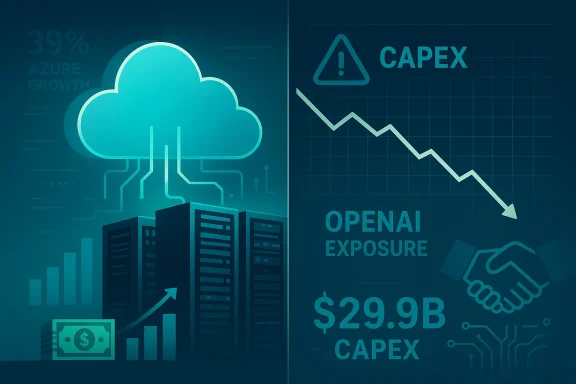
The latest results underscore that tension. Microsoft reported fiscal second-quarter revenue of $81.27 billion and Azure and other cloud services growth of 39% year over year, according to the company’s investor materials. The company also said its commercial remaining performance obligations reached $625 billion, which is an enormous indicator of future contracted revenue. Those are not the numbers of a business losing momentum; they are the numbers of a business trying to build a much bigger platform.
But investors are no longer looking only at growth. They are also looking at what growth costs. Microsoft disclosed that capital expenditures, including finance leases, were $29.9 billion in the quarter, while free cash flow fell sequentially as spending surged. That is the classic AI paradox: the faster the infrastructure expands, the harder it becomes to ignore the cash burden attached to it.
The OpenAI relationship sits at the center of that paradox. Microsoft’s revised partnership leaves it with a roughly 27% stake in OpenAI’s restructured for-profit entity, valued around $135 billion, while OpenAI has also committed to buy an incremental $250 billion of Azure services under the new arrangement. That sounds like a strategic moat, but it also creates a visible concentration risk around a single partner that is itself warning investors about its dependence on Microsoft.
That shift reflects a simple investor instinct: when a trade becomes crowded, great execution is no longer enough. Markets begin demanding evidence that the model can scale profitably without leaning on accounting gains, opaque partner economics, or permanently elevated infrastructure spending. Microsoft is now squarely in that phase.
The reason is that earnings quality matters more when a company is in the middle of a capital-intensive platform shift. Microsoft’s Q2 GAAP net income benefited from a large net gain tied to OpenAI investments, while the prior year had been hit by losses. Non-GAAP reporting removes some of that noise, but traders know that not every quarter will get the same accounting tailwind. In that sense, the debate is not whether the numbers are real; it is whether the mix of those numbers is flattering the story.
Another issue is sequencing. Microsoft can point to a huge backlog and robust Azure demand, but those commitments do not eliminate the pressure of near-term spending. Investors are effectively being asked to finance today’s infrastructure buildout on the promise of tomorrow’s consumption. That is a reasonable proposition for a company of Microsoft’s scale, but reasonable is not the same as cheap.
That combination produces a split-screen effect for investors. On one side is strong commercial demand and a highly visible pipeline. On the other is the reality that the infrastructure needed to satisfy that demand is becoming more expensive and more capital intensive.
That is especially important for a company like Microsoft, where valuation has long depended on the assumption that top-tier growth can coexist with elite profitability. If the AI era alters that balance for too long, the market will become more selective about how it rewards future growth.
OpenAI has warned investors that it relies heavily on Microsoft for financing and computing resources, and that any disruption in the relationship could damage its business. That disclosure makes obvious what the market already suspected: Microsoft is not just a beneficiary of OpenAI’s success, but also one of the key enablers of its future capacity.
For Microsoft, that creates a paradox. The partnership strengthens the company’s AI narrative and boosts Azure usage, yet it also concentrates attention on one external relationship that could become more complicated as OpenAI evolves. Microsoft’s roughly 27% stake in the restructured OpenAI entity and the reported $250 billion Azure commitment make the connection financially material, not symbolic.
That matters because public-market sentiment often punishes crowded dependency chains. If one company’s growth story depends too visibly on another company’s roadmap, customers, investors, and competitors all begin asking what happens if that link weakens. Microsoft is now living with that question more visibly than ever.
The market problem is not that the relationship exists. The market problem is that the relationship is becoming the shorthand for Microsoft’s AI strategy, rather than one part of a broader technology portfolio.
That may ultimately be correct. But investors are still deciding whether the payback horizon is attractive enough. A nearly $30 billion quarterly capex run rate is not just a line item; it is a statement about confidence. It says Microsoft believes the current AI cycle will require persistent overbuilding before utilization catches up.
This is where the market becomes more skeptical. In earlier phases of cloud investment, capital spending could be justified by broad enterprise migration. AI infra is different because demand is more volatile, model economics are less mature, and customer adoption can shift quickly between providers and architectures. Microsoft is betting that its scale and distribution solve that problem. Investors are asking whether scale alone is enough.
The upside is obvious: if AI usage keeps expanding, the company that owns the infrastructure wins multiple layers of monetization. The downside is also obvious: if growth slows or shifts elsewhere, the same infrastructure becomes a drag on returns.
Microsoft’s investor materials show Azure and other cloud services growth at 39% year over year, and management guided for roughly 37% to 38% growth next quarter. That is not the profile of a slowing business. It is the profile of a platform that still has room to monetize demand at scale.
The backlog also matters. A commercial RPO figure of $625 billion is not just a marketing statistic. It signals that enterprises are still committing deeply to the Microsoft stack, and that the company has visibility into future revenue that many peers would envy. The challenge is converting that visibility into cleaner margin expansion.
At the same time, the market will expect Azure to carry more of the load if OpenAI-related sentiment continues to wobble. Microsoft’s cloud business has to prove that it can stand as a durable platform franchise, not just a distribution channel for partner demand.
Bank of America’s reinstated Buy rating and $500 target are consistent with the broader analyst camp, which still views Microsoft as one of the most durable beneficiaries of enterprise AI adoption. The stock’s year-to-date decline, however, shows that valuation and sentiment can move independently of research opinions. Analysts can like the company while the market waits for proof.
That is a common pattern in megacap technology. When a company’s narrative is strong enough, analysts often focus on the destination. Traders, by contrast, focus on the path. Right now, the path for Microsoft includes heavier capex, more OpenAI-related scrutiny, and a market that is no longer willing to pay for every AI promise without proof points.
The bulls also note that Microsoft’s scale gives it advantages smaller AI players cannot match. It can finance infrastructure, integrate software, and cross-sell at a level that few competitors can replicate.
OpenAI once gave Microsoft a clean narrative advantage. Now the competitive picture is more fragmented. Microsoft has reportedly deepened relationships with other AI infrastructure players even as it manages the OpenAI connection, which suggests a broader hedging strategy. That is sensible, but it also signals that the company knows concentration risk is real.
The broader competitive issue is that AI compute is no longer a simple moat. It is a strategic battlefield. Companies are using multiple clouds, spreading workloads, and avoiding overly exclusive commitments where they can. That makes Microsoft’s long-term upside real, but less automatic than the early AI hype implied.
That is why Azure’s growth matters so much. It is the best evidence that Microsoft is still gaining leverage in a crowded field. But as competition widens, the company will need to prove that its AI stack can preserve differentiation beyond the OpenAI halo.
Microsoft has a strong position here, but it cannot assume buyers will stay loyal simply because Copilot and Azure are convenient. The company has to keep showing that convenience translates into measurable business value.
The company also has the luxury of patience. Unlike smaller AI firms, Microsoft can keep investing through market skepticism. That does not guarantee success, but it does mean the company can outlast weaker competitors if the category takes longer to mature.
That would be especially painful for a stock that is often treated as a benchmark for the AI trade. When the benchmark wobbles, the rest of the sector can reprice quickly.
The most important signal will be whether Azure growth stays strong while capex begins to normalize relative to revenue. Investors will also watch for clearer disclosure around OpenAI-related effects, because the more the market has to infer, the more cautious it will become. If Microsoft can show that AI is scaling through its broader platform rather than through a single relationship, the current skepticism may fade.
Source: AOL.com Microsoft Slips as OpenAI Bet Starts to Worry Investors
The answer matters because Microsoft is no longer being valued only as a durable cloud platform and software giant. It is also being judged as one of the market’s most visible AI infrastructure financiers, with capital spending rising sharply and OpenAI-linked accounting effects increasingly shaping reported results. That combination has turned a strong operating company into a far more complicated investment case.
What makes the moment more delicate is that the skepticism is not coming from a single weak metric. Instead, investors are weighing capex intensity, OpenAI exposure, and the possibility that some of the current earnings support is less repeatable than the headline numbers suggest. In other words, Microsoft may still be executing well, but the market is asking whether it is executing in a way that can sustain clean earnings growth.
 Overview
Microsoft entered 2026 in a position that most companies would envy. Its cloud business was still expanding at a brisk pace, its enterprise software franchises remained resilient, and its AI strategy continued to dominate executive discussion and investor attention. Yet precisely because Microsoft is so large and so central to the AI trade, even a routine earnings release can trigger a much deeper debate about valuation, dependency, and future margins.The latest results underscore that tension. Microsoft reported fiscal second-quarter revenue of $81.27 billion and Azure and other cloud services growth of 39% year over year, according to the company’s investor materials. The company also said its commercial remaining performance obligations reached $625 billion, which is an enormous indicator of future contracted revenue. Those are not the numbers of a business losing momentum; they are the numbers of a business trying to build a much bigger platform.
But investors are no longer looking only at growth. They are also looking at what growth costs. Microsoft disclosed that capital expenditures, including finance leases, were $29.9 billion in the quarter, while free cash flow fell sequentially as spending surged. That is the classic AI paradox: the faster the infrastructure expands, the harder it becomes to ignore the cash burden attached to it.
The OpenAI relationship sits at the center of that paradox. Microsoft’s revised partnership leaves it with a roughly 27% stake in OpenAI’s restructured for-profit entity, valued around $135 billion, while OpenAI has also committed to buy an incremental $250 billion of Azure services under the new arrangement. That sounds like a strategic moat, but it also creates a visible concentration risk around a single partner that is itself warning investors about its dependence on Microsoft.
Why the market is reacting now
The timing of the stock move matters. Microsoft’s shares were falling even as a major Wall Street house reinstated a Buy rating and set a $500 target, a reminder that short-term price action and long-term fundamentals often diverge in mega-cap tech. The broad market backdrop is also less forgiving now, with software and AI names getting treated more carefully than they were during the earlier phase of the generative AI boom.That shift reflects a simple investor instinct: when a trade becomes crowded, great execution is no longer enough. Markets begin demanding evidence that the model can scale profitably without leaning on accounting gains, opaque partner economics, or permanently elevated infrastructure spending. Microsoft is now squarely in that phase.
- Growth remains strong, but expectations are stronger
- AI leadership is still a premium asset
- Capital intensity is drawing sharper scrutiny
- OpenAI is now both an opportunity and a source of risk
- Investors want recurring earnings, not just narrative momentum
The Earnings That Didn’t Fully Reassure
Microsoft’s reported numbers were objectively strong. Revenue beat consensus, Azure outpaced expectations, and the company’s commercial backlog remained massive. On a traditional scorecard, that would normally be enough to quiet concerns for at least a quarter. Instead, the market’s reaction suggested that investors are now grading Microsoft on a different rubric.The reason is that earnings quality matters more when a company is in the middle of a capital-intensive platform shift. Microsoft’s Q2 GAAP net income benefited from a large net gain tied to OpenAI investments, while the prior year had been hit by losses. Non-GAAP reporting removes some of that noise, but traders know that not every quarter will get the same accounting tailwind. In that sense, the debate is not whether the numbers are real; it is whether the mix of those numbers is flattering the story.
Another issue is sequencing. Microsoft can point to a huge backlog and robust Azure demand, but those commitments do not eliminate the pressure of near-term spending. Investors are effectively being asked to finance today’s infrastructure buildout on the promise of tomorrow’s consumption. That is a reasonable proposition for a company of Microsoft’s scale, but reasonable is not the same as cheap.
What the quarter actually showed
The earnings release and conference call point to a company still running hot. Azure and other cloud services grew 39%, Microsoft Cloud margins were pressured by AI infrastructure investment, and management continued to emphasize demand across workloads. At the same time, free cash flow softened because the company was spending aggressively to stay ahead in AI infrastructure.That combination produces a split-screen effect for investors. On one side is strong commercial demand and a highly visible pipeline. On the other is the reality that the infrastructure needed to satisfy that demand is becoming more expensive and more capital intensive.
- Revenue growth is intact
- Azure demand is still accelerating
- Margins are being shaped by AI buildout
- Cash generation is temporarily less impressive
- Reported earnings include OpenAI-related noise
Why investors care about earnings quality
Earnings quality is about consistency, not just magnitude. If a quarter looks strong because of one-time investment gains or accounting marks, analysts will usually discount it. Microsoft’s current challenge is that the AI story is powerful enough to justify large investments, but those same investments are making it harder for investors to isolate the underlying operating trend.That is especially important for a company like Microsoft, where valuation has long depended on the assumption that top-tier growth can coexist with elite profitability. If the AI era alters that balance for too long, the market will become more selective about how it rewards future growth.
OpenAI Is the Story Inside the Story
OpenAI is no longer just a Microsoft partner. It has become the emotional and financial center of the market’s debate about Microsoft itself. That is true because Microsoft’s AI strategy has become inseparable from the success of OpenAI’s models, products, and infrastructure needs. It is also true because the two companies’ relationship now raises questions about dependence in both directions.OpenAI has warned investors that it relies heavily on Microsoft for financing and computing resources, and that any disruption in the relationship could damage its business. That disclosure makes obvious what the market already suspected: Microsoft is not just a beneficiary of OpenAI’s success, but also one of the key enablers of its future capacity.
For Microsoft, that creates a paradox. The partnership strengthens the company’s AI narrative and boosts Azure usage, yet it also concentrates attention on one external relationship that could become more complicated as OpenAI evolves. Microsoft’s roughly 27% stake in the restructured OpenAI entity and the reported $250 billion Azure commitment make the connection financially material, not symbolic.
Dependence cuts both ways
The usual interpretation is that OpenAI depends on Microsoft more than Microsoft depends on OpenAI. That is broadly true in operational terms. But the reverse is now true in narrative terms: Microsoft’s AI premium is heavily anchored to the idea that OpenAI remains a gravitational force in the market.That matters because public-market sentiment often punishes crowded dependency chains. If one company’s growth story depends too visibly on another company’s roadmap, customers, investors, and competitors all begin asking what happens if that link weakens. Microsoft is now living with that question more visibly than ever.
The strategic upside
It would be a mistake to treat the relationship as purely a liability. Microsoft gains massive Azure demand, deepens its role in frontier AI infrastructure, and strengthens the value proposition for enterprise customers who want access to the ecosystem. The company also keeps itself inside the most important AI platform cycle of the decade.The market problem is not that the relationship exists. The market problem is that the relationship is becoming the shorthand for Microsoft’s AI strategy, rather than one part of a broader technology portfolio.
- Azure benefits from OpenAI’s compute demand
- Microsoft gains strategic relevance in frontier AI
- The partnership strengthens enterprise credibility
- Dependence introduces concentration risk
- Narrative risk grows when one partner dominates the story
Capex Is the New Margin Debate
If the OpenAI relationship is the strategic story, capital expenditure is the financial one. Microsoft’s spending on data centers, GPUs, networking, and power infrastructure is now so large that it has become a defining feature of the investment case. The company is effectively saying that AI demand is real enough to justify massive upfront investment.That may ultimately be correct. But investors are still deciding whether the payback horizon is attractive enough. A nearly $30 billion quarterly capex run rate is not just a line item; it is a statement about confidence. It says Microsoft believes the current AI cycle will require persistent overbuilding before utilization catches up.
This is where the market becomes more skeptical. In earlier phases of cloud investment, capital spending could be justified by broad enterprise migration. AI infra is different because demand is more volatile, model economics are less mature, and customer adoption can shift quickly between providers and architectures. Microsoft is betting that its scale and distribution solve that problem. Investors are asking whether scale alone is enough.
The infrastructure logic
AI workloads are expensive because they require specialized chips, dense networking, cooling, and power-heavy data centers. That means the winners are often the companies that can build capacity faster than competitors and keep that capacity busy. Microsoft has chosen to play that game aggressively, which helps explain both Azure’s momentum and the pressure on near-term free cash flow.The upside is obvious: if AI usage keeps expanding, the company that owns the infrastructure wins multiple layers of monetization. The downside is also obvious: if growth slows or shifts elsewhere, the same infrastructure becomes a drag on returns.
Why capex now feels different
What makes this moment tricky is that investors no longer see capex as a temporary bridge to a cloud migration wave. They see it as the permanent price of participating in the AI economy. That changes the math. If spending becomes structurally elevated, then margin expansion may arrive later than bulls hoped, even if revenue growth remains healthy.- AI infrastructure requires heavy upfront investment
- Free cash flow can compress even when revenue rises
- Utilization risk is higher than in earlier cloud cycles
- The payback period is uncertain
- Scale helps, but scale is not a guarantee
Azure Remains the Core Bull Case
Despite the stock pressure, Azure is still the cleanest reason to stay constructive on Microsoft. The cloud platform is growing quickly, expanding across workloads, and benefiting from both general enterprise migration and AI-specific demand. In an environment where many software names are struggling to justify premium multiples, Azure continues to supply a legitimate growth engine.Microsoft’s investor materials show Azure and other cloud services growth at 39% year over year, and management guided for roughly 37% to 38% growth next quarter. That is not the profile of a slowing business. It is the profile of a platform that still has room to monetize demand at scale.
The backlog also matters. A commercial RPO figure of $625 billion is not just a marketing statistic. It signals that enterprises are still committing deeply to the Microsoft stack, and that the company has visibility into future revenue that many peers would envy. The challenge is converting that visibility into cleaner margin expansion.
Azure’s market position
Azure’s strength comes from more than AI. It remains embedded in hybrid enterprise IT, modernization projects, database migrations, and Microsoft’s broader commercial ecosystem. That creates resilience that pure-play AI stories often lack. It also means Azure can continue to grow even if the generative AI hype cycle cools somewhat.At the same time, the market will expect Azure to carry more of the load if OpenAI-related sentiment continues to wobble. Microsoft’s cloud business has to prove that it can stand as a durable platform franchise, not just a distribution channel for partner demand.
The commercial backlog signal
A giant backlog can be read in two ways. Bulls see it as future revenue already effectively spoken for. Bears see it as evidence that the company has to keep delivering at scale to avoid disappointing expectations. Both readings are valid. The important thing is that the backlog reduces uncertainty only if execution stays near perfect.- Azure remains the primary growth engine
- Enterprise demand is still broad-based
- Backlog visibility is unusually strong
- Hybrid and AI workloads both help
- Execution must remain consistent to sustain confidence
The Analyst View Is Still Constructive
Wall Street has not turned against Microsoft. In fact, the analyst consensus remains firmly positive, with dozens of buy or strong-buy ratings and a price target that sits well above the current share price. That disconnect between analyst optimism and market hesitation tells you something important: the long-term thesis is still intact, but the near-term mood has turned more cautious.Bank of America’s reinstated Buy rating and $500 target are consistent with the broader analyst camp, which still views Microsoft as one of the most durable beneficiaries of enterprise AI adoption. The stock’s year-to-date decline, however, shows that valuation and sentiment can move independently of research opinions. Analysts can like the company while the market waits for proof.
That is a common pattern in megacap technology. When a company’s narrative is strong enough, analysts often focus on the destination. Traders, by contrast, focus on the path. Right now, the path for Microsoft includes heavier capex, more OpenAI-related scrutiny, and a market that is no longer willing to pay for every AI promise without proof points.
What the bulls emphasize
Bullish analysts generally highlight three things: Azure growth, commercial backlog, and Microsoft’s ability to blend AI into existing enterprise products. Those are powerful arguments because they rely on an already proven distribution machine rather than speculative consumer adoption.The bulls also note that Microsoft’s scale gives it advantages smaller AI players cannot match. It can finance infrastructure, integrate software, and cross-sell at a level that few competitors can replicate.
What the market is questioning
The market is less concerned with whether Microsoft will remain important and more concerned with how much capital it will need to stay important. That is a subtle but crucial distinction. Investors are not rejecting the AI thesis; they are asking whether the thesis has become too expensive to own at the current pace.- Analyst sentiment remains bullish
- Price targets still imply significant upside
- The market is demanding better timing
- Execution quality is not the same as investor patience
- Valuation depends on how efficiently AI revenue scales
Competitive Pressure Is Getting Sharper
Microsoft’s AI push does not exist in a vacuum. Every major cloud and platform company is chasing the same enterprise budgets, the same developer attention, and the same GPU supply. That means Microsoft’s edge cannot come only from being early; it has to come from being better integrated, better financed, and better aligned with customer needs.OpenAI once gave Microsoft a clean narrative advantage. Now the competitive picture is more fragmented. Microsoft has reportedly deepened relationships with other AI infrastructure players even as it manages the OpenAI connection, which suggests a broader hedging strategy. That is sensible, but it also signals that the company knows concentration risk is real.
The broader competitive issue is that AI compute is no longer a simple moat. It is a strategic battlefield. Companies are using multiple clouds, spreading workloads, and avoiding overly exclusive commitments where they can. That makes Microsoft’s long-term upside real, but less automatic than the early AI hype implied.
Rivals are adapting
Amazon, Google, Oracle, and a growing group of specialized AI infrastructure firms are all pressing for share of the same market. Some compete on price, others on integrated ecosystem, and others on niche performance. Microsoft has to win in enough of those dimensions to protect its premium.That is why Azure’s growth matters so much. It is the best evidence that Microsoft is still gaining leverage in a crowded field. But as competition widens, the company will need to prove that its AI stack can preserve differentiation beyond the OpenAI halo.
Enterprise customers are becoming more sophisticated
Enterprise buyers are no longer treating AI as a novelty. They are measuring cost per workload, governance, compliance, and long-term flexibility. That is a more demanding market than the early pilot phase, and it favors vendors that can deliver reliability without forcing hard lock-in decisions.Microsoft has a strong position here, but it cannot assume buyers will stay loyal simply because Copilot and Azure are convenient. The company has to keep showing that convenience translates into measurable business value.
- Competition is broadening across the AI stack
- Enterprise buyers are more selective than before
- Microsoft’s integration remains a real advantage
- OpenAI no longer defines the whole market
- Differentiation must be operational, not just rhetorical
Strengths and Opportunities
Microsoft still has a formidable set of strengths, and they are easy to overlook when the market is focused on one quarter’s volatility. The company has scale, cash generation, enterprise trust, and a cloud franchise that remains one of the best in the business. The opportunity is to convert AI leadership into recurring, high-quality revenue without allowing capex to swamp returns.- Azure growth remains exceptionally strong
- Commercial backlog provides rare revenue visibility
- Microsoft’s enterprise footprint supports cross-selling
- AI integration can deepen customer stickiness
- The balance sheet can absorb heavy investment
- Copilot and adjacent AI products create monetization paths
- The company can still compound over a long horizon
Strategic optionality
One of Microsoft’s biggest advantages is that it has multiple ways to win. It can monetize infrastructure, software subscriptions, enterprise productivity, developer tooling, and AI services at once. That optionality is valuable because it reduces dependence on any one product cycle.The company also has the luxury of patience. Unlike smaller AI firms, Microsoft can keep investing through market skepticism. That does not guarantee success, but it does mean the company can outlast weaker competitors if the category takes longer to mature.
Risks and Concerns
The risks are equally clear, and they are what the stock is telling you to take seriously. Microsoft may be one of the best businesses in the world, but great businesses can still be poor short-term investments if capital intensity rises faster than returns. The OpenAI relationship adds strategic upside, but it also creates unusual dependency and accounting complexity.- Capex may remain elevated longer than expected
- OpenAI-related accounting gains may prove volatile
- Dependence on one partner can distort the narrative
- Free cash flow could lag revenue growth
- Margin pressure may persist during the buildout phase
- Investor patience may erode if execution slips
- A broad AI sentiment reset could hit the multiple
The earnings-quality concern
The biggest concern is not whether Microsoft can grow. It is whether it can grow in a way that keeps earnings clean and repeatable. If too much of the story depends on non-recurring gains, partner-specific demand, or unusually heavy infrastructure investment, then the market may stop granting the same premium.That would be especially painful for a stock that is often treated as a benchmark for the AI trade. When the benchmark wobbles, the rest of the sector can reprice quickly.
What to Watch Next
The next few quarters will tell investors whether this is just a sentiment reset or the start of a more serious re-rating. Microsoft does not need to prove that AI matters; it already has. What it does need to prove is that AI can become a consistently profitable growth engine without forcing investors to absorb endless capex escalation and partner concentration anxiety.The most important signal will be whether Azure growth stays strong while capex begins to normalize relative to revenue. Investors will also watch for clearer disclosure around OpenAI-related effects, because the more the market has to infer, the more cautious it will become. If Microsoft can show that AI is scaling through its broader platform rather than through a single relationship, the current skepticism may fade.
Key things to monitor
- Azure growth rate and whether it remains near current levels.
- Capital expenditures and whether they continue to accelerate.
- Free cash flow conversion as AI spending matures.
- OpenAI-related accounting impact on net income and EPS.
- Commercial backlog trends as a signal of enterprise commitment.
- Gross margin pressure in Microsoft Cloud.
- Management commentary on AI capacity, demand, and utilization.
Source: AOL.com Microsoft Slips as OpenAI Bet Starts to Worry Investors
