

Telecom’s control plane is shifting from spreadsheets and email threads into a single, governed collaboration fabric — and that fabric increasingly looks like Microsoft Teams for Telecom, a platform that now sits at the centre of partner orchestration, sales enablement, and customer lifecycle operations for many service providers.
Telecom has always been about connections, but the shape of those connections has changed. Where once success was measured in fiber miles, spectrum holdings, and hardware, today success is also measured by how well an operator organizes its partner network: resellers, systems integrators, device vendors, managed service providers, and specialist software houses. Modern telco growth depends as much on partner velocity and coordinated operations as it does on raw network capacity.
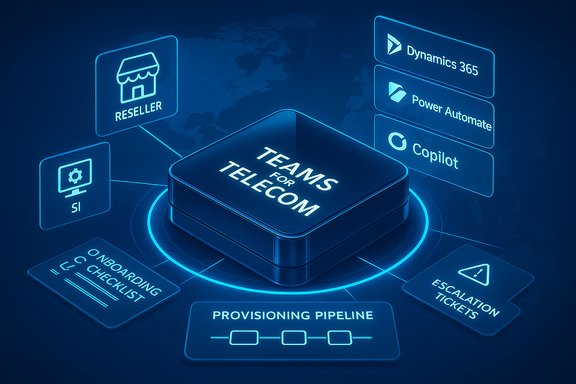
Into that gap has stepped Microsoft Teams for Telecom — not just as a meeting app, but as a platform that combines calling, messaging, shared workspaces, and integrations with business systems and AI. Teams now offers telcos a toolkit forPartner Onboarding, joint selling, co-managed customer support, and secure cross-tenant collaboration: features such as Operator Connect, Teams Phone Mobile, shared channels (Teams Connect), direct integration with Dynamics 365, automation via Power Platform, and AI assistance using Copilot turn Teams into a control centre for ecosystem operations.
The headline numbers matter: Microsoft’s updates across FY24 and into 2024–2025 put Teams among the largest collaboration networks globally, a reach that makes it an attractive place to centralize partner workflows. The combination of scale, telephony extensions and AI has begun to change how telcos think about onboarding, escalation management and joint-account orchestration.
Traditional onboarding is a multi-week, multi-portal obstacle course: legal, number assignment, SIM logistics, credentialing, training, and first-test calls. Bringing a partner through that path wastes momentum and often costs the telco deals.
Teams enables a different model:
Teams enables:
That potential, however, arrives with clear responsibilities: a telco-grade governance model, measured pilots, and careful AI governance are necessities, not optional extras. For operators that get the balance right, Teams becomes more than a meeting place: it becomes the nervous system of their partner ecosystem, where collaboration is audited, decisions are visible, and partners become reliable extensions of the business rather than unpredictable variables.
The future of telecom partnerships will be decided less by who owns the pipes and more by who can orchestrate an ecosystem with clarity — and Teams for Telecom is already the platform many are using to try to do exactly that.
Source: UC Today Telecom Has a New Control Centre — And It’s Microsoft Teams!
 Background / Overview
Telecom has always been about connections, but the shape of those connections has changed. Where once success was measured in fiber miles, spectrum holdings, and hardware, today success is also measured by how well an operator organizes its partner network: resellers, systems integrators, device vendors, managed service providers, and specialist software houses. Modern telco growth depends as much on partner velocity and coordinated operations as it does on raw network capacity.Into that gap has stepped Microsoft Teams for Telecom — not just as a meeting app, but as a platform that combines calling, messaging, shared workspaces, and integrations with business systems and AI. Teams now offers telcos a toolkit forPartner Onboarding, joint selling, co-managed customer support, and secure cross-tenant collaboration: features such as Operator Connect, Teams Phone Mobile, shared channels (Teams Connect), direct integration with Dynamics 365, automation via Power Platform, and AI assistance using Copilot turn Teams into a control centre for ecosystem operations.
The headline numbers matter: Microsoft’s updates across FY24 and into 2024–2025 put Teams among the largest collaboration networks globally, a reach that makes it an attractive place to centralize partner workflows. The combination of scale, telephony extensions and AI has begun to change how telcos think about onboarding, escalation management and joint-account orchestration.
Why partner ecosystems matter — again
The economics of telecom have shifted. Growth increasingly comes from indirect channels and ecosystem relationships: resellers, MSPs, and white-label partners that extend service reach and deliver vertical solutions. Consultancy and strategy voices across the industry have been saying the same thing in different words: telcos now compete on their ability to orchestrate partners and integrate those partners into a seamless customer experience.- Ecosystem-first telcos multiply revenue potential without proportionally increasing fixed cost.
- Partner enablement — fast onboarding, transparent SLAs, and clear co-selling models — determines whether a new service reaches market first.
- Fragmented collaboration (email + PDFs + ticketing portals) slows deals and hides risk.
The partner collaboration problem: what breaks and why
In practice, partner orchestration breaks in predictable ways.- Onboarding friction: account provisioning, number and trunk assignments, training and entitlement paperwork are spread across portals and vendor consoles. The result: delays, lost momentum, and cancelled rollouts.
- Information silos: product updates, pricing changes, and technical notes sit in different storage locations. Sales and field engineers lack the single pane of truth.
- Escalation chaos: support incidents bounce between partner and provider with poor visibility; customers see poor handoffs and brand damage ensues.
- Measurement gaps: operators cannot easily quantify partner engagement, pipeline health, or the operational cost of partner-enabled deals.
Microsoft Teams for Telecom: platform capabilities telcos can use now
Teams has evolved into a platform companies can use to coordinate external participants at scale. For telcos, the most relevant capabilities are:- Operator Connect and Teams Phone Mobile: let operators and carriers provision PSTN connectivity and mobile services directly into the Teams admin centre, shortening time-to-voice and enabling Teams as the phone system for users and partners.
- Shared channels (Teams Connect): allow cross-tenant collaboration without tenant switching, creating secure joint workspaces for co-selling, project delivery, and escalations.
- Dynamics 365 integration: brings CRM context into a Teams meeting or channel so partner and provider reps see the same opportunity, account notes, and actions in real time.
- Power Platform (Power Apps / Power Automate): automates handoffs — for example, form submissions in a partner workspace can trigger provisioning workflows and CRM updates.
- Copilot and generative AI: summarise meetings, draft enablement materials, and surface next-best actions for partner managers; Copilot can reduce rote work and accelerate decision-making.
- Governance controls: guest access policies, sensitivity labels, retention rules, and audit logs support the compliance needs of telcos operating across regulated markets.
- Analytics and insights: Power BI and Viva Insights reveal partner engagement patterns, bottlenecks, and collaboration health.
How Teams changes partner onboarding
Onboarding is one of the clearest places the platform delivers measurable value.Traditional onboarding is a multi-week, multi-portal obstacle course: legal, number assignment, SIM logistics, credentialing, training, and first-test calls. Bringing a partner through that path wastes momentum and often costs the telco deals.
Teams enables a different model:
- Create a dedicated partner onboarding hub as a shared channel or tenant for the new partner.
- Include structured lists (Tasks/Planner), a training catalogue (Viva Learning), and a provisioning pipeline (Power Automate → Dynamics 365).
- Use Operator Connect or Teams Phone Mobile to surface phone number provisioning and enable voice in a few clicks.
- Embed pre-validated forms that trigger automated checks and approvals so credentialing and number assignments happen as part of the onboarding flow.
Managing partner-to-customer lifecycle inside Teams
The true test of partnering is whether the customer sees a single, seamless experience. That requires bringing partners, providers, and customers into one continuous workspace where opportunities, installations and support are tracked together.Teams enables:
- “Joint Sales Rooms”: shared channels where partner and provider reps update opportunity notes, insert pricing decisions, and host customer demos from the same context.
- Co-managed support channels: create an escalation channel where partner engineers and telco NOC staff can triage incidents together and share diagnostic artifacts such as packet traces or device logs.
- Live handoffs: when a sales conversation becomes an implementation request, the same Teams workspace becomes the project hub; tasks, change orders and acceptance signoffs are visible to all stakeholders.
- Customer-facing hubs: invite customers into a controlled shared channel so they see timelines and owners without exposing unnecessary internal details.
Operating an ecosystem at scale: governance, compliance and measurement
Collaboration only scales when it's governed.- Access controls: shared channels and guest access can be limited by expiry policies, role-based access, and sensitivity labels to prevent long-lived, unmonitored connections.
- Auditability: advanced audit logs and retention policies create an evidentiary trail for compliance or incident investigation.
- Data residency: configuration of SharePoint and Teams sites by region supports telcos operating under cross-border data rules.
- Measurement: Power BI dashboards and Viva Insights show which partners are active, revenue correlated to engagement, and where onboarding or delivery stalls.
The AI layer: Copilot, agents and intelligent orchestration
Where Teams becomes truly transformative is when AI is layered on top of the collaboration fabric.- Copilot for productivity: meeting summaries, action-item extraction, and concise opportunity briefs let partner managers and sellers reclaim hours each week.
- Sales preparation automation: AI can summarise past interactions, surface account signals and suggest next steps — shrinking preparation time from hours to minutes.
- Escalation triage: chatbots and AI agents can collect incident context, pre-fill ticket templates, and surface relevant runbooks to reduce time-to-resolution.
- Voice-based agents: low-latency voice agent pipelines combine speech recognition, domain LLM logic, and TTS to enable voice-first partner support or on-field self-service.
Case studies and what they illustrate
Several recent operator stories show practical outcomes when telcos adopt Teams as an operating fabric. These are indicative rather than universal.- Enreach (Europe): implemented Operator Connect integrations and used vendor accelerators (SBC/express-route patterns) to reduce time-to-market for Teams voice. The key takeaway is that Operator Connect combined with certified gateway platforms can compress technical onboarding timelines and reduce the manual engineering burden on service teams.
- Lumen Technologies (example of AI-in-sales): reorganised sales-prep workflows around Copilot-driven summaries and insight generation, turning a traditionally hours-long prep process into minutes and projecting large annual time savings. This demonstrates how deep integration of Copilot into CRM and communications workflows can directly reallocate seller time from administration into relationship building.
- Reported NTT East examples (as circulated in industry commentary): describe pilot work combining Teams and AI chatbots for escalation visibility. However, the public detail on scope and measured outcomes for some NTT East deployments is limited; where vendor claims aren’t accompanied by audited numbers, treat them as pilot-stage evidence rather than proof of scale.
Risks, operational caveats and governance realities
The platform approach is powerful, but it comes with real risks telcos must manage:- Vendor concentration and lock-in: centering partner workflows inside a single hyperscaler ecosystem raises strategic dependency questions. Telcos must weigh speed vs. long-term bargaining leverage.
- Data residency and regulatory risk: collaboration spaces can carry sensitive customer or network telemetry; telcos must configure geo-located storage, sensitivity labels, and legal hold policies to remain compliant with local telecom regulations.
- Security surface area: guest access and cross-tenant collaboration increase attack vectors. Proper lifecycle management, conditional access, and expiry policies are mandatory.
- Governance drift: informal shared channels proliferate. Without lifecycle and naming policies, the environment fragments and becomes as opaque as the legacy systems it replaced.
- Over-automation: AI can automate repetitive tasks, but over-delegating decision-making to agents without human oversight creates operational and reputational risk.
- Partner experience design: partners are not internal employees. A Teams strategy that assumes uniform access and appetite for change will fail. Provide partner-friendly UX, lightweight onboarding paths, and clear documentation.
A practical roadmap for telco leaders (six steps)
- Define the pilot use case: pick a bounded scenario — partner onboarding for a single product or a joint sales room for a specific vertical — and measure baseline metrics (time-to-onboard, time-to-first-sale, escalations).
- Build a standards kit: templates for partner shared channels, naming conventions, sensitivity labels, and lifecycle expiry rules.
- Integrate systems: connect Dynamics 365 (or your CRM), Power Automate provisioning flows, and Teams Phone Mobile / Operator Connect for voice where relevant.
- Harden governance: conditional access, guest expiry, audit logging, and data residency settings must be enforced from day one.
- Add AI cautiously: deploy Copilot for summaries and request generation, but require human approval for customer-facing or billing actions; track AI-driven recommendations and outcomes.
- Scale and measure: build Power BI dashboards to show partner activity, conversion rates, and time-savings; iterate the process and expand to adjacent partner segments.
Strategic takeaways for operators and partners
- Move beyond tactical collaboration: Teams is not just an app — it can be an ecosystem control plane that shortens sales cycles and improves delivery quality.
- Treat partner workflows as productised experiences: onboarding, co-selling and escalation belong in a product mindset with SLAs and KPIs rather than ad-hoc processes.
- Balance speed with governance: the same features that unlock velocity (shared channels, external access) also open compliance and data risks. Invest in policy automation.
- Use AI to rewire work, not just to automate it: Copilot shines when workflows are redesigned for AI assistance; don’t bolt AI onto broken processes and expect dramatic gains.
- Validate vendor-provided ROI claims: vendor case studies are helpful, but replicate key metrics in your environment before committing to organizational change based on a single story.
Conclusion
Microsoft Teams for Telecom represents a practical, available path to make partner ecosystems operationally tractable and visible. By combining telephony extensions (Operator Connect, Teams Phone Mobile), cross-tenant collaboration (shared channels), CRM and automation integration (Dynamics 365, Power Platform), and an AI layer (Copilot and chatbots), operators can compress onboarding, reduce seller admin, and make escalations visible and accountable.That potential, however, arrives with clear responsibilities: a telco-grade governance model, measured pilots, and careful AI governance are necessities, not optional extras. For operators that get the balance right, Teams becomes more than a meeting place: it becomes the nervous system of their partner ecosystem, where collaboration is audited, decisions are visible, and partners become reliable extensions of the business rather than unpredictable variables.
The future of telecom partnerships will be decided less by who owns the pipes and more by who can orchestrate an ecosystem with clarity — and Teams for Telecom is already the platform many are using to try to do exactly that.
Source: UC Today Telecom Has a New Control Centre — And It’s Microsoft Teams!
