

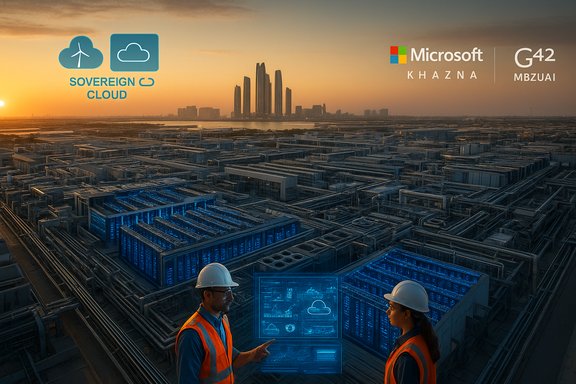
Microsoft’s announcement of a $15.2 billion investment in the United Arab Emirates — coupled with a 200‑megawatt datacentre expansion through G42’s Khazna Data Centres and new responsible‑AI initiatives — marks one of the largest regional commitments to cloud, AI infrastructure, and talent development in the Middle East, and it materially changes the technical and geopolitical landscape for hyperscale AI delivery in the Gulf.
Background and overview
Microsoft’s public breakdown frames the commitment as a multi‑year program of capital and operating expenditure that began in 2023 and runs through 2029, with roughly $7.3 billion already spent and $7.9 billion allocated for 2026–2029. The package includes the previously disclosed $1.5 billion equity stake in Abu Dhabi‑based G42 and significant Azure infrastructure investment aimed at expanding AI compute, cloud services, and local product residency in the UAE. As part of the announcement, Microsoft and G42 (through Khazna Data Centres) committed to a 200‑megawatt datacentre expansion that the partners say will begin coming online before the end of 2026. The same set of announcements also formalised a joint Responsible AI Future Foundation — created with MBZUAI — and the expansion of Microsoft’s AI for Good Lab in Abu Dhabi. These moves are not just capacity plays. They are an integrated strategy to combine local compute capacity, data residency, responsible‑AI governance, and a talent pipeline — elements that matter to regulated industries and governments wanting to run advanced AI services inside national borders.Why the announcement matters: technical and commercial implications
Scaling AI compute in‑region
The addition of 200 MW of datacentre power is a material increase in available rack capacity for GPU‑dense AI clusters. Modern reasoning‑class AI hardware is power‑hungry and density‑sensitive; 200 MW allocated to GPU farms supports many thousands of high‑performance accelerator racks once cooling, power distribution and pod‑level networking are provisioned. Microsoft’s broader program also includes authorized shipments of frontier accelerators (GB300 / Blackwell‑class systems) into UAE data centres under U.S. export licenses, effectively enabling a leap in in‑region inference and training performance. Key near‑term operational benefits for UAE enterprises and public bodies will include:- Lower latency for interactive AI services and Copilot‑style features when inference is hosted locally.
- Reduced legal and procurement friction for regulated sectors (finance, energy, healthcare) that require onshore data processing and auditable controls.
- Better economics for large‑context, memory‑heavy models because rack‑scale architectures (e.g., GB300 NVL72 racks) provide pooled memory and topology advantages that improve inference quality and cost.
Product residency and Microsoft 365 Copilot
Microsoft explicitly tied part of the investment to product‑level residency commitments: enabling in‑country processing for Microsoft 365 Copilot interactions for qualified UAE organisations. That promise matters because it converts abstract infrastructure into concrete enterprise enablement — governments and banks can adopt generative productivity tools with clearer assurances about where prompts and derived data are processed and stored. However, the operational details (which features are day‑one, eligibility rules, and contractual exceptions for emergency support or telemetry) will determine how broadly and quickly organisations can rely on these guarantees.The Responsible AI dimension and talent commitments
Responsible AI Future Foundation and MBZUAI
Microsoft and G42 launched the Responsible AI Future Foundation, with MBZUAI as research partner, to institutionalise governance, safety research, and regional standards for ethical AI. This foundation and the regional AI for Good Lab are positioned as anchors for both policy work and applied research addressing bias mitigation, explainability, and domain‑specific safe deployment (energy, health, finance). The foundations are meant to signal an intent to pair capability growth with governance frameworks.Skills and local engineering
Microsoft also reiterated plans to scale local skilling and engineering, including centres such as the Global Engineering Development Centre and the Abu Dhabi AI for Good Lab. The company set ambitious targets (for example, commitments to train large numbers of local workers by 2027) tied to the broader investment narrative. These components aim to translate capital and compute into human capital and product development capacity inside the UAE.Technical anatomy: what the new capacity will enable
AI infrastructure: GB300 / Blackwell and rack‑first architectures
Recent public disclosures indicate the UAE build‑out will be matched with shipments of high‑end AI accelerators — NVIDIA GB300 (Blackwell Ultra) class systems — that Microsoft says will arrive under export licenses with “stringent safeguards.” These racks (often described in vendor materials as NVL72 or similar) combine dozens of Blackwell GPUs with Grace‑family CPUs and high‑bandwidth fabrics, producing a rack‑level accelerator unit with tens of terabytes of pooled fast memory. For inference and long‑context LLM workloads, that topology delivers lower latency and larger effective context windows than older architectures. Practical outcomes include:- Better on‑premise or in‑region hosting of large models for enterprise assistants and vertical AI systems.
- Support for reasoning‑class workloads (multi‑step agents, extensive KV caches) that improve Copilot‑style analytics and automation.
- New VM families at cloud providers designed for GB300 racks (e.g., ND GB300‑v6‑type instances) that change cost and orchestration patterns for cloud architects.
Energy, cooling and site engineering
Large AI clusters require robust, low‑latency power and advanced cooling (often liquid or immersion cooling) to operate efficiently. The Microsoft‑G42 package ties into UAE energy partners (e.g., Masdar and ADNOC in some related agreements) to explore renewable and firming solutions for baseload and flexible capacity. This is crucial: datacentre availability at hyperscale is gated not by servers alone but by substation capacity, PPAs, storage, and permitting. Announcements signal intent; delivering continuous high‑quality power at scale is the engineering and commercial challenge that determines commissioning timelines.Strategic and geopolitical context
Why Washington and Abu Dhabi matter
The shipments of frontier AI hardware outside the contiguous U.S. and the sizeable Microsoft investment are enabled by intergovernmental assurances and export licences. That creates a template for balancing technology export controls with allied commercial activity; public reporting notes U.S. Commerce Department approvals were conditioned on safeguards and oversight. This is geopolitically significant: it demonstrates how complex tech transfers can proceed when paired with bilateral accountability frameworks and large diplomatic/economic packages. The investment also deepens the U.S.–UAE technology relationship: for the UAE, it accelerates the national AI strategy and positions the country as a regional AI hub. For Microsoft, it secures low‑latency product delivery, a growing regional customer base, and strategic access to government and regulated sector workloads. The trade‑off is deeper vendor concentration inside national capabilities and a shift in where frontier compute resides globally.Sovereignty, sovereign cloud overlays, and Core42/Khazna
G42’s sovereign offerings (Core42, Khazna and related units) are being coupled with Azure to create “sovereign public cloud” environments: local governance overlays, cleared staff, and attested controls layered on hyperscaler stacks. This model aims to give regulators and sensitive customers the illusion — and contractual reality — of sovereignty while retaining hyperscaler scale for advanced AI services. It’s commercially pragmatic but raises questions about operational independence and vendor concentration.Risks, blind spots and governance challenges
While the investment promises modernization and capability, several material risks and unresolved questions must be emphasised.1) Verification gaps around export safeguards
Public statements stress “stringent safeguards” and intergovernmental assurances tied to export licences for high‑end GPUs. But the public record on how those safeguards are enforced — who has access to hardware, what audit rights independent parties hold, and how model and data exfiltration risks are mitigated — remains limited. Independent auditors and international oversight bodies will need access to detailed compliance evidence to verify claims. Until such audits are visible, the description of licences should be treated cautiously.2) Concentration and vendor lock‑in
Relying on a single hyperscaler plus a small set of local partners for sovereign cloud services concentrates risk. The commercial convenience of a combined Azure + Core42 + Khazna stack reduces friction for customers but raises migration, portability and resilience concerns. Organisations adopting these services should insist on contractual SLAs, data export/portability clauses, and runbooks for vendor failure scenarios.3) Energy and delivery timelines
Announcing 200 MW of datacentre capacity is meaningful; delivering it is a multi‑year engineering and permitting process. Grid upgrades, PPAs, storage, and behind‑the‑meter arrangements are required to guarantee the uptime hyperscalers expect. Delays in these areas can push back commercial availability even when hardware arrives. Readers should treat target dates (e.g., “coming online before end of 2026”) as dependent on complex infrastructure delivery schedules.4) Dual‑use and proliferation concerns
High‑end accelerators are dual‑use by design: they accelerate civilian R&D and can also speed the development of surveillance, autonomous weapons research, or other sensitive dual‑use applications. Export licensing tries to balance innovation with national‑security protections, but once large compute capacity is available, controlling the downstream code and models becomes harder. Governance must couple hardware controls with oversight of software, model provenance and deployment constraints.What organisations and IT leaders should plan for
- Audit procurement and contract language now: insist on clear residency definitions, explicit exceptions, and robust data portability clauses.
- Validate day‑one service inventories: confirm which Copilot features and AI SKUs will be supported in‑country at launch and map feature gaps to business risk.
- Design for hybrid resilience: architect multi‑region failover and maintain disaster recovery plans that don’t assume single‑vendor availability.
- Engage in governance: demand independent attestations for confidentiality, data separation, and personnel access controls if operating in regulated sectors.
- Reassess cloud economics: GPU‑dense, rack‑scale instances change TCO dynamics — model long‑term costs versus performance gains for large inference workloads.
Strengths of the Microsoft–G42 strategy
- Scale + Locality: The combination of hyperscaler engineering and a local delivery operator (G42 / Khazna) is operationally powerful; it provides both global product ecosystems and in‑country controls that regulated customers require.
- Product tie‑ins: Enabling in‑country Copilot processing turns infrastructure into a product advantage for enterprise and public customers seeking lower latency and legal clarity.
- Skills and research investment: The Responsible AI Future Foundation and AI for Good Lab commitments create a structured route to build local R&D capacity and talent pipelines.
- Energy partnership potential: Tying data centre build‑out to local renewable and firming projects (Masdar/ADNOC) signals an attempt to pair compute with sustainable power — a pragmatic approach for long‑term datacentre viability.
Limitations and lingering questions
- Public transparency about export‑license conditions and auditability remains limited; independent verification is necessary before accepting claims about security safeguards and operational controls.
- The actual timeline for bringing 200 MW online is contingent on grid, cooling and procurement realities; target dates should be viewed as aspirational until supporting infrastructure contracts, substation builds and power firming arrangements are publicly documented.
- Vendor concentration introduces systemic risk; the faster public bodies and enterprises embrace sovereign‑overlay models, the more important contractual escape hatches and multi‑vendor strategies become.
How the region changes if delivery succeeds
If Microsoft and G42 deliver the promised compute, power, and governance packages at scale, the UAE will become a practical AI development hub for the Middle East, North Africa, and parts of South Asia and Africa — regions that have been seeking latency‑friendly, sovereign‑enabled environments for data‑sensitive AI workloads. This would:- Attract AI‑native ISVs and startups that prefer local product residency and lower latency.
- Enable allied nations and multinationals to run regulated AI services without cross‑border data transfer friction.
- Cement Abu Dhabi and Dubai as nodes in a global AI compute topology distinct from on‑shore U.S. clouds.
Conclusion
Microsoft’s $15.2 billion programme and the 200 MW datacentre expansion with G42 represent a strategic, high‑stakes bet on the UAE as a regional AI hub: the announcement combines frontier hardware, local product residency, responsible‑AI institutions, and skilling commitments into an integrated commercial pitch. The plan promises immediate benefits — lower latency, in‑region Copilot processing, and large‑scale AI infrastructure — while raising legitimate questions about verification of export safeguards, vendor concentration, and delivery timelines for power and cooling.For organisations, the near term is about carefully validating day‑one capabilities and contractual protections; for the region, success depends on translating headline commitments into audited, resilient infrastructure and a governance model that balances openness, sovereignty, and safety. The stakes are high: if the partners execute, the UAE will become a practical production environment for next‑generation AI services; if not, the announcement will likely be cited as an ambitious plan that under‑delivered on technical and governance promises.
Source: OneArabia Microsoft And G42 Expand Data Centre Capacity To Boost UAE's Digital Transformation Efforts
