Microsoft is reorganizing Copilot again, and this time the signal is unmistakable: the company wants consumer and commercial AI to behave less like separate experiments and more like one coherent product system. That shift matters because Copilot has become one of Microsoft’s most visible bets in the AI market, yet it has also accumulated the kind of fragmentation that can slow adoption, confuse customers, and dilute product focus.
Microsoft’s Copilot story has moved in waves rather than in a straight line. The company first expanded the assistant broadly across personal and workplace scenarios, then layered in premium subscriptions, enterprise licensing, mobile apps, and deeper Microsoft 365 integration. In early 2024, Microsoft described Copilot Pro for individuals and expanded Copilot for Microsoft 365 to businesses of all sizes, framing the assistant as a single AI experience that could span devices and apps while serving both consumers and organizations. (blogs.microsoft.com)
That expansion created reach, but it also created complexity. Microsoft now sells Copilot in multiple forms, across multiple surfaces, with different audiences, pricing models, and governance expectations. The company has also been re-architecting the underlying AI stack in parallel, creating CoreAI – Platform and Tools in January 2025 to build the end-to-end Copilot and AI stack for first-party and third-party customers. (blogs.microsoft.com)
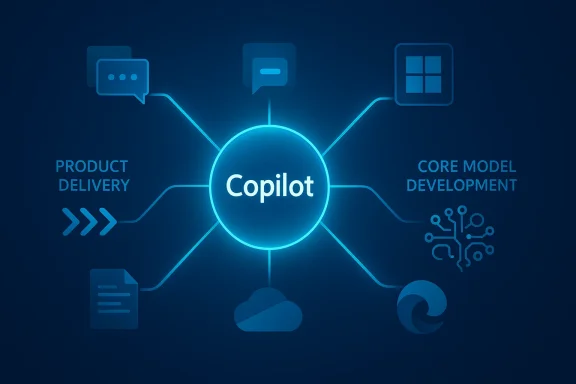
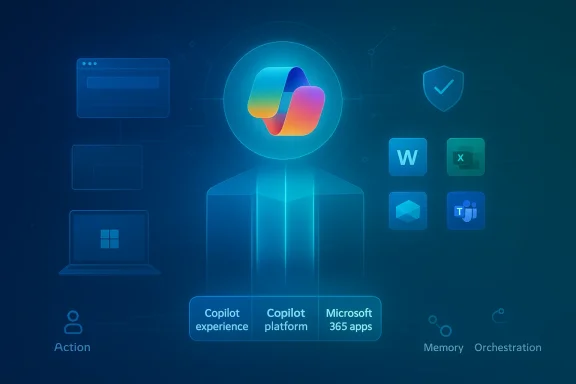
The latest reorganization appears to be the product-side answer to that platform work. StartupHub.ai’s report says Microsoft is consolidating consumer and commercial Copilot efforts under a unified organization, with the work organized around four pillars: Copilot experience, Copilot platform, Microsoft 365 apps, and AI models. The stated goal is to reduce handoffs, simplify development, and make the product feel like a single system rather than a cluster of overlapping offerings. The company’s recent Microsoft blogs strongly support that direction: Microsoft has been moving toward a more integrated AI stack, richer agentic workflows, and tighter app-platform coupling throughout 2025 and into 2026. (blogs.microsoft.com)
The practical reason is obvious. Microsoft has spent the last two years steadily turning Copilot from a chat product into an operating layer across Windows and Microsoft 365. It added features such as actions, memory, search, vision, voice, and deeper app integration, while also expanding Copilot into Word, Excel, PowerPoint, Outlook, OneNote, Teams, and OneDrive-related workflows. Microsoft’s own language has increasingly framed Copilot as an “AI companion” and an agentic system, not just a chatbot. (blogs.microsoft.com)
That broader vision naturally creates pressure to unify the organization around shared building blocks. If the same assistant is supposed to serve consumers, professionals, and enterprise tenants, then product roadmaps, model selection, telemetry, safety policy, and UX decisions all begin to overlap. The reported four-pillar structure suggests Microsoft wants those shared components managed as a platform, not reinvented repeatedly across business units.
A unified structure can bring several benefits:
That is a much more ambitious claim than “we added AI to Office.” It is a claim about a system of record for work. The organization behind it has to match that ambition.
If that split is accurate, it reveals a deliberate division of labor: one leader owns the productized assistant experience, while the other concentrates on the model frontier and the long-term intelligence layer. That maps neatly onto the way Microsoft has described its AI stack elsewhere. CoreAI was created to build the infrastructure and tools layer, while Microsoft 365 Copilot and its surrounding experiences continue to evolve as the user-facing product line. (blogs.microsoft.com)
This is strategically sound for a company of Microsoft’s scale. Product execution and model research are both hard problems, but they are not the same problem. One requires shipping reliable experiences at commercial scale. The other requires cost-efficient frontier progress, model diversity, and technical leverage. Separating them can reduce organizational drag and prevent the product team from being constantly pulled into research priorities, or vice versa.
Still, a reorg only works if the handoff lines are clear. Consolidating consumer and commercial efforts can improve focus, but it can also create tension over which customers drive the roadmap. Consumer products often reward speed, polish, and virality. Enterprise products reward governance, integration, and control. Microsoft will have to avoid letting one side dominate the other.
But Copilot cannot win on personality alone. Microsoft’s enterprise customers increasingly care about admin controls, policy enforcement, model choice, and the ability to measure real business value. If Andreou’s role becomes too heavily weighted toward front-end polish, Microsoft could risk repeating a familiar Silicon Valley mistake: making the experience delightful while underinvesting in the controls that make large-scale deployment safe.
That approach makes sense because Copilot has already evolved into layers, whether Microsoft named them that way or not:
That is a major strategic evolution. It means Microsoft is no longer positioning Copilot as one chatbot with a few plugins. It is positioning Copilot as an AI operating system for work.
The downside is that centralization can also slow experimentation if too many teams must align before shipping. Microsoft will need to keep enough autonomy at the product edge to avoid turning Copilot into a rigid enterprise platform that lags behind the market.
The March 2026 Frontier Suite announcement is especially revealing. Microsoft said that Microsoft 365 E7, the Frontier Suite, unifies Microsoft 365 E5, Microsoft 365 Copilot, and Agent 365 into a single solution powered by Work IQ and integrated with existing apps and security tooling. It also stressed that customers do not want stitched-together tools; they want one trusted solution. (blogs.microsoft.com)
That is the same language now reflected in the reported Copilot reorg. Microsoft is pursuing a consistent thesis:
That dual-track approach is increasingly common in AI, but Microsoft’s scale gives it unusual leverage. It can fund frontier model work, platform engineering, and customer-facing packaging simultaneously. The challenge is ensuring the model team does not drift away from the realities of deployment cost, latency, safety, and business usability.
A strong model team can make Copilot smarter. A strong product team can make Copilot useful. Microsoft needs both.
Another opportunity is execution speed. Microsoft has been in the awkward middle stage of AI product evolution: moving fast enough to stay relevant, but slowly enough to meet enterprise expectations. A merged organization may reduce internal friction and shorten the path from research to shipping product.
The third opportunity is ecosystem coherence. If Copilot experience, platform, apps, and models are managed together, Microsoft can more easily extend the system across Windows, Microsoft 365, security, and agent tooling. That is the kind of coherence that enterprise customers value.
A second risk is product confusion. Microsoft already has a crowded AI lineup, including Copilot Pro-style consumer offerings, Microsoft 365 Copilot variants, enterprise bundles, and newer agentic layers. Even with a stronger org chart, customers can still struggle to understand what they need, what it costs, and what features are included.
A third risk is governance overload. The more Microsoft centralizes Copilot, the more pressure it places on policy, compliance, reliability, and safety teams. That is especially true as Copilot becomes more agentic and begins taking more actions across user data and enterprise systems. If governance becomes too heavy, innovation slows. If it is too light, trust erodes.
For Microsoft 365 customers, the reorganization suggests a future in which Copilot becomes more tightly linked to the apps they already pay for, with a clearer platform underneath. That may eventually mean more consistent agent behavior, better admin tooling, and fewer odd seams between consumer and enterprise experiences.
It also suggests Microsoft will keep pushing toward an integrated purchasing story. The company has already used bundling to simplify adoption in other areas, and its recent Frontier Suite framing shows that it wants enterprise buyers to think in terms of complete solutions rather than piecemeal AI licenses. (blogs.microsoft.com)
That matters because Microsoft is not merely trying to build a better chatbot. It is trying to build the default AI layer for work and personal productivity. The company’s official language increasingly points to a future where the assistant knows context, understands relationships, can take actions, and can be governed like infrastructure. (blogs.microsoft.com)
If the reorganization succeeds, users may see fewer confusing Copilot variants, more consistent experiences across devices and apps, and better integration between the assistant and the Microsoft 365 ecosystem. If it fails, Microsoft risks adding structural complexity to an already complicated AI portfolio.
Either way, the direction is clear. Microsoft is no longer treating Copilot as a side project. It is treating Copilot as the company’s next operating system for knowledge work.
Source: StartupHub.ai Microsoft Consolidates Copilot Efforts
 Background
Microsoft’s Copilot story has moved in waves rather than in a straight line. The company first expanded the assistant broadly across personal and workplace scenarios, then layered in premium subscriptions, enterprise licensing, mobile apps, and deeper Microsoft 365 integration. In early 2024, Microsoft described Copilot Pro for individuals and expanded Copilot for Microsoft 365 to businesses of all sizes, framing the assistant as a single AI experience that could span devices and apps while serving both consumers and organizations. (blogs.microsoft.com)That expansion created reach, but it also created complexity. Microsoft now sells Copilot in multiple forms, across multiple surfaces, with different audiences, pricing models, and governance expectations. The company has also been re-architecting the underlying AI stack in parallel, creating CoreAI – Platform and Tools in January 2025 to build the end-to-end Copilot and AI stack for first-party and third-party customers. (blogs.microsoft.com)
The latest reorganization appears to be the product-side answer to that platform work. StartupHub.ai’s report says Microsoft is consolidating consumer and commercial Copilot efforts under a unified organization, with the work organized around four pillars: Copilot experience, Copilot platform, Microsoft 365 apps, and AI models. The stated goal is to reduce handoffs, simplify development, and make the product feel like a single system rather than a cluster of overlapping offerings. The company’s recent Microsoft blogs strongly support that direction: Microsoft has been moving toward a more integrated AI stack, richer agentic workflows, and tighter app-platform coupling throughout 2025 and into 2026. (blogs.microsoft.com)
What Microsoft is changing
At the center of the reported shake-up is a structural merge: consumer Copilot and commercial Copilot are no longer being treated as separate tracks with separate centers of gravity. Instead, Microsoft is pushing them into a shared organization designed to align product shape with system architecture. That is a classic Microsoft move in the AI era: if the company believes the same core model, platform, and UX layers can serve both personal and enterprise use cases, it will eventually organize the business to reflect that belief.The practical reason is obvious. Microsoft has spent the last two years steadily turning Copilot from a chat product into an operating layer across Windows and Microsoft 365. It added features such as actions, memory, search, vision, voice, and deeper app integration, while also expanding Copilot into Word, Excel, PowerPoint, Outlook, OneNote, Teams, and OneDrive-related workflows. Microsoft’s own language has increasingly framed Copilot as an “AI companion” and an agentic system, not just a chatbot. (blogs.microsoft.com)
That broader vision naturally creates pressure to unify the organization around shared building blocks. If the same assistant is supposed to serve consumers, professionals, and enterprise tenants, then product roadmaps, model selection, telemetry, safety policy, and UX decisions all begin to overlap. The reported four-pillar structure suggests Microsoft wants those shared components managed as a platform, not reinvented repeatedly across business units.
Why the reorg matters
This kind of consolidation is not just bureaucratic housekeeping. It can determine whether Microsoft Copilot becomes a durable platform or remains a set of loosely connected features.A unified structure can bring several benefits:
- Faster shipping cycles by reducing duplicated work across consumer and commercial teams.
- More consistent UX across Windows, web, mobile, and Microsoft 365 surfaces.
- Cleaner model governance as Microsoft balances OpenAI, Anthropic, and internal model work.
- Better pricing and packaging because product tiers can be designed from a common technical base.
- More coherent enterprise adoption if IT admins see one control plane instead of scattered AI products.
That is a much more ambitious claim than “we added AI to Office.” It is a claim about a system of record for work. The organization behind it has to match that ambition.
Leadership shuffle and what it signals
The reported leadership changes are just as important as the structural merge. StartupHub.ai says Jacob Andreou has been appointed EVP of Copilot, with responsibility for consumer and commercial experiences, product, growth, and engineering. Mustafa Suleyman, meanwhile, remains focused on Microsoft’s frontier-model and “superintelligence” mission.If that split is accurate, it reveals a deliberate division of labor: one leader owns the productized assistant experience, while the other concentrates on the model frontier and the long-term intelligence layer. That maps neatly onto the way Microsoft has described its AI stack elsewhere. CoreAI was created to build the infrastructure and tools layer, while Microsoft 365 Copilot and its surrounding experiences continue to evolve as the user-facing product line. (blogs.microsoft.com)
This is strategically sound for a company of Microsoft’s scale. Product execution and model research are both hard problems, but they are not the same problem. One requires shipping reliable experiences at commercial scale. The other requires cost-efficient frontier progress, model diversity, and technical leverage. Separating them can reduce organizational drag and prevent the product team from being constantly pulled into research priorities, or vice versa.
Still, a reorg only works if the handoff lines are clear. Consolidating consumer and commercial efforts can improve focus, but it can also create tension over which customers drive the roadmap. Consumer products often reward speed, polish, and virality. Enterprise products reward governance, integration, and control. Microsoft will have to avoid letting one side dominate the other.
The Andreou factor
Andreou’s appointment is especially telling if the company wants Copilot to feel more like a single consumer brand. Microsoft’s recent AI releases have leaned heavily on user experience, personality, and accessibility, including updates that make Copilot feel more conversational, more visual, and more present across daily workflows. A leader with product-growth instincts makes sense in that context.But Copilot cannot win on personality alone. Microsoft’s enterprise customers increasingly care about admin controls, policy enforcement, model choice, and the ability to measure real business value. If Andreou’s role becomes too heavily weighted toward front-end polish, Microsoft could risk repeating a familiar Silicon Valley mistake: making the experience delightful while underinvesting in the controls that make large-scale deployment safe.
The new architecture: four pillars, one system
The reported four pillars — Copilot experience, Copilot platform, Microsoft 365 apps, and AI models — are the clearest sign yet that Microsoft wants to turn Copilot into a layered system.That approach makes sense because Copilot has already evolved into layers, whether Microsoft named them that way or not:
- Experience layer: the UI people interact with in Windows, Microsoft 365, Edge, mobile, and the web.
- Platform layer: the plumbing for actions, agents, memory, connectors, and orchestration.
- App layer: Word, Excel, Outlook, PowerPoint, OneNote, Teams, SharePoint, and related services.
- Model layer: OpenAI, Anthropic, and Microsoft’s own frontier model efforts.
That is a major strategic evolution. It means Microsoft is no longer positioning Copilot as one chatbot with a few plugins. It is positioning Copilot as an AI operating system for work.
The upside of a platform mindset
A platform mindset could deliver several long-term advantages:- Less product sprawl across overlapping Copilot variants.
- Better enterprise trust through unified policy and governance.
- Easier agent development because teams can build on common components.
- Stronger cost control if model routing and workload allocation are centralized.
- More predictable roadmaps for customers who want to deploy AI broadly.
The downside is that centralization can also slow experimentation if too many teams must align before shipping. Microsoft will need to keep enough autonomy at the product edge to avoid turning Copilot into a rigid enterprise platform that lags behind the market.
How this fits Microsoft’s broader AI strategy
The reorganization is not happening in a vacuum. Microsoft has been layering product announcements on top of one another to push Copilot from helper to infrastructure.The March 2026 Frontier Suite announcement is especially revealing. Microsoft said that Microsoft 365 E7, the Frontier Suite, unifies Microsoft 365 E5, Microsoft 365 Copilot, and Agent 365 into a single solution powered by Work IQ and integrated with existing apps and security tooling. It also stressed that customers do not want stitched-together tools; they want one trusted solution. (blogs.microsoft.com)
That is the same language now reflected in the reported Copilot reorg. Microsoft is pursuing a consistent thesis:
- AI should be embedded in the apps people already use.
- AI should be agentic, not merely conversational.
- AI should be model-diverse, not locked to one provider.
- AI should be governed, especially for enterprise workloads.
- AI should be packaged as a system, not a scattered collection of add-ons.
Why “superintelligence” still matters here
The report says Suleyman will remain focused on Microsoft’s “superintelligence” mission. Even if that terminology is still more aspirational than formal product branding, it is strategically important. Microsoft needs a team pushing the frontier while another team converts those advances into durable products.That dual-track approach is increasingly common in AI, but Microsoft’s scale gives it unusual leverage. It can fund frontier model work, platform engineering, and customer-facing packaging simultaneously. The challenge is ensuring the model team does not drift away from the realities of deployment cost, latency, safety, and business usability.
A strong model team can make Copilot smarter. A strong product team can make Copilot useful. Microsoft needs both.
Opportunities and risks
Microsoft’s consolidation has real upside, but it is not without risk.Opportunities
The strongest opportunity is clarity. Buyers want to know what Copilot is, who it is for, and how it fits into their workflows. A unified organization can sharpen that answer.Another opportunity is execution speed. Microsoft has been in the awkward middle stage of AI product evolution: moving fast enough to stay relevant, but slowly enough to meet enterprise expectations. A merged organization may reduce internal friction and shorten the path from research to shipping product.
The third opportunity is ecosystem coherence. If Copilot experience, platform, apps, and models are managed together, Microsoft can more easily extend the system across Windows, Microsoft 365, security, and agent tooling. That is the kind of coherence that enterprise customers value.
Risks
The biggest risk is false uniformity. Consumer and commercial AI may share underlying technology, but they do not share the same success criteria. A single organization can still end up serving neither audience well if it averages too many requirements together.A second risk is product confusion. Microsoft already has a crowded AI lineup, including Copilot Pro-style consumer offerings, Microsoft 365 Copilot variants, enterprise bundles, and newer agentic layers. Even with a stronger org chart, customers can still struggle to understand what they need, what it costs, and what features are included.
A third risk is governance overload. The more Microsoft centralizes Copilot, the more pressure it places on policy, compliance, reliability, and safety teams. That is especially true as Copilot becomes more agentic and begins taking more actions across user data and enterprise systems. If governance becomes too heavy, innovation slows. If it is too light, trust erodes.
What this means for Windows and Microsoft 365 users
For Windows enthusiasts, the bigger takeaway is that Copilot is moving deeper into Microsoft’s core products, not just into a standalone assistant app. Microsoft has already been expanding Copilot into Windows experiences, voice and vision features, and AI companion scenarios across devices. The company is clearly betting that the future of Windows and Microsoft 365 will be shaped by AI-native workflows rather than by traditional app-by-app interactions. (blogs.microsoft.com)For Microsoft 365 customers, the reorganization suggests a future in which Copilot becomes more tightly linked to the apps they already pay for, with a clearer platform underneath. That may eventually mean more consistent agent behavior, better admin tooling, and fewer odd seams between consumer and enterprise experiences.
It also suggests Microsoft will keep pushing toward an integrated purchasing story. The company has already used bundling to simplify adoption in other areas, and its recent Frontier Suite framing shows that it wants enterprise buyers to think in terms of complete solutions rather than piecemeal AI licenses. (blogs.microsoft.com)
The bigger picture
Microsoft’s Copilot consolidation is best understood as the next stage of a long campaign to turn AI into Microsoft’s primary interface strategy. The company started by embedding Copilot into products. Then it broadened access, added premium and enterprise tiers, created platform teams, and began tying the assistant to agents, security, and data-layer intelligence. Now it is aligning the org chart with that vision.That matters because Microsoft is not merely trying to build a better chatbot. It is trying to build the default AI layer for work and personal productivity. The company’s official language increasingly points to a future where the assistant knows context, understands relationships, can take actions, and can be governed like infrastructure. (blogs.microsoft.com)
If the reorganization succeeds, users may see fewer confusing Copilot variants, more consistent experiences across devices and apps, and better integration between the assistant and the Microsoft 365 ecosystem. If it fails, Microsoft risks adding structural complexity to an already complicated AI portfolio.
Either way, the direction is clear. Microsoft is no longer treating Copilot as a side project. It is treating Copilot as the company’s next operating system for knowledge work.
Source: StartupHub.ai Microsoft Consolidates Copilot Efforts