

Microsoft and Meta are the two AI-heavy megacap stocks being pitched on May 18, 2026, as likely to show investor-visible returns from enormous data-center and model spending sooner than skeptics expect, thanks to Azure growth, Copilot adoption, advertising gains, and Meta AI rollout. That is the clean version of the bull case. The messier version is that Wall Street is being asked to value an infrastructure boom before the depreciation bill, power constraints, and product winners are fully visible. The wager is no longer whether AI is impressive; it is whether AI can become mundane enough to pay rent.
The first phase of the generative AI cycle rewarded anything close to the furnace. NVIDIA, memory suppliers, networking vendors, and server makers became the cleanest expression of demand because they sold the picks, shovels, and power tools. Microsoft and Meta sit in a less comfortable part of the chain: they are buying the equipment, building the campuses, and telling investors that the bill will eventually become an operating advantage.
That is why the valuation conversation has turned. A company can be both a beneficiary of AI and a victim of AI spending if its shareholders believe too much cash is being converted into concrete, GPUs, and depreciation before enough revenue shows up. The anxiety is not irrational. History is full of infrastructure cycles in which demand was real, the technology was transformative, and equity holders still overpaid for the timing.
But Microsoft and Meta are not pre-revenue infrastructure dreamers. They are cash machines attempting to bolt a new compute layer onto already dominant businesses. That distinction matters because the payoff does not have to arrive as a single dazzling new product. It can arrive through better cloud utilization, higher ad prices, more automated software seats, more engagement, and a widening moat around services people already use.
The skeptical case says investors should wait for clearer proof. The bullish case says the proof is already arriving in pieces, and the market is underpricing how quickly those pieces can add up.
Azure matters because it converts AI from an abstract model race into a platform business. If customers build agents, retrieval systems, analytics pipelines, or custom models on Azure, Microsoft gets paid across compute, storage, databases, identity, networking, and software subscriptions. The question is not only whether Copilot sells. The question is whether AI makes Azure a more necessary place to run the modern enterprise stack.
That is why the phrase Copilot monetization can sound both overused and underappreciated. Microsoft 365 Copilot is not merely a chatbot attached to Word and Outlook. It is Microsoft’s attempt to turn the productivity suite into a higher-priced, AI-mediated work surface where the company can charge more per user while making switching costs more painful.
The early tension is that Microsoft must spend before it can collect. AI infrastructure is expensive, and the most useful enterprise AI workloads often require low-latency access to proprietary data, secure identity controls, compliance tooling, and heavy inference capacity. Microsoft has those pieces, but stitching them together at global scale requires capital outlays that can look alarming even for a company of its size.
Still, Microsoft’s position is unusually strong because the company owns both the customer relationship and the infrastructure layer. Many AI start-ups must rent compute, acquire users, and invent distribution at the same time. Microsoft already has the distribution, and it is using capital spending to deepen the compute moat underneath it.
That sounds modest until it is multiplied across tens of millions of paid seats. A tool that saves a few minutes a day can still support a meaningful subscription price if it becomes embedded in workflow and governance. Microsoft does not need every user to adore Copilot; it needs enough organizations to decide that AI assistance is now part of the standard productivity bundle.
The same logic applies to GitHub Copilot, which has become one of the clearest examples of paid AI adoption inside real work. Developers are expensive, software backlogs are endless, and code assistance has an obvious economic buyer. If AI improves developer throughput even unevenly, the willingness to pay is easier to defend than in many consumer AI categories.
There is also a defensive angle. If Microsoft did not push AI deeply into Office, Windows, GitHub, Dynamics, and Azure, someone else would try to wedge AI between Microsoft and its users. Spending heavily is not just a growth decision. It is an insurance policy against disintermediation.
That is where the bear case can become too tidy. It sees capital expenditure as a discretionary bet that management could simply slow. In practice, Microsoft is spending because the cost of underbuilding may be worse than the cost of overbuilding.
AI is different because it is already inside the advertising engine. Meta does not need to invent a new revenue model before AI helps the business. Better ranking, targeting, creative generation, recommendation, translation, and automation can all feed the same machine that produces the overwhelming majority of Meta’s revenue.
That makes Meta’s Q1 2026 ad performance especially important. Strong revenue growth, higher ad impressions, and higher average pricing suggest that AI is not merely a laboratory expense. It is improving the company’s ability to match users, content, advertisers, and commercial intent across Facebook, Instagram, WhatsApp, Messenger, and Threads.
The market’s concern is that the spending curve may be rising faster than the proof curve. Meta’s 2026 capital expenditure guidance, lifted into a range that would have seemed almost absurd a few years ago, forces investors to ask whether management is building for visible demand or for a speculative race toward superintelligence. That question is fair. It is also incomplete.
Meta’s advantage is that small improvements in ad relevance can be monetized almost immediately. If a model makes Reels more engaging, increases time spent, improves ad conversion, or lowers friction for small businesses creating campaigns, Meta can see the benefit in the current business rather than waiting for an entirely new category to mature.
Most AI products must fight for user attention. Meta can inject AI into places where users already spend time. That does not guarantee success, but it lowers the customer-acquisition burden and allows the company to test features at a scale few competitors can match.
WhatsApp is especially interesting because it has historically been under-monetized relative to its global reach. If AI turns messaging into a richer interface for business discovery, customer service, payments, recommendations, or commerce, Meta could unlock revenue without needing to dramatically change the social feed. That is the kind of payoff investors are hoping for: not a science-fiction leap, but a practical layer of monetization on top of existing behavior.
The risk is that Meta overreaches. Users may not want every chat, search bar, and feed surface mediated by an assistant. Regulators may scrutinize how personal data powers AI systems. Advertisers may embrace automated creative tools while still demanding transparency about performance and brand safety.
But Meta has an unusual tolerance for product iteration in public. It can launch, measure, adjust, and repeat across billions of users. In consumer AI, that may be as valuable as any single model benchmark.
Investors remember the dot-com era because the analogy contains a useful warning. The internet was real, demand did arrive, and yet many companies destroyed capital by building too early, too expensively, or with the wrong business model. Transformative technology does not repeal the laws of return on invested capital.
But the analogy can also mislead. Microsoft and Meta are not speculative telecom carriers laying fiber for hypothetical customers. They have existing revenue streams, existing customers, and measurable places to apply AI. Their spending is aggressive, but it is attached to products with distribution and cash flow.
The accounting lag is the problem. Capital spending hits investor psychology immediately, while productivity gains, pricing power, and platform lock-in appear gradually. This creates a period in which the companies look more reckless than they may actually be.
That is the window the bullish argument is trying to exploit. If investors demand perfect proof before paying up, the rerating may happen before the proof feels complete. Markets often move when uncertainty narrows, not when it disappears.
This is where Microsoft and Meta deserve a more disciplined analysis than the usual “AI winners” label. Microsoft’s strength is enterprise trust, but enterprise adoption can be slow, political, and budget-constrained. Meta’s strength is consumer scale, but consumer AI behavior is still fluid, and social platforms can misread user tolerance for automation.
The better question is not whether AI will pay off. It is where the payoff accrues. Chip vendors have captured the first wave because demand for compute was immediate. Cloud providers and platform owners are trying to capture the second wave by turning that compute into recurring software and services revenue. Application companies, advertisers, and end users will fight over the third wave, where productivity gains become bargaining power.
Microsoft and Meta are both trying to occupy multiple layers of that stack. Microsoft sells the infrastructure, the developer platform, and the business application. Meta controls the consumer surface, the recommendation engine, and the ad marketplace. That vertical position is why their AI spending may be more defensible than the headline numbers suggest.
Still, defensible does not mean risk-free. If model costs fall rapidly, some infrastructure advantage may commoditize. If open models become good enough for most uses, pricing power could weaken. If regulators force changes to data use, the ad and assistant models could become less effective.
The payoff may come sooner than skeptics expect, but the durability of that payoff remains the harder question.
But Ackman’s presence should not be mistaken for proof. A famous buyer can validate a debate; he cannot settle it. Microsoft and Meta will still have to show that AI capital spending creates revenue, margin resilience, and strategic control.
What the purchases do suggest is that the “AI spenders are uninvestable until CapEx falls” argument may be too blunt. There is a price at which even heavy spending becomes attractive if the underlying franchise is strong enough. For Microsoft, that franchise is enterprise software and cloud. For Meta, it is attention, advertising, and social distribution.
The irony is that investors may be applying the harshest scrutiny to companies best able to survive it. Smaller AI firms often depend on outside capital, rented infrastructure, and uncertain monetization. Microsoft and Meta can fund their ambitions from operating cash flow, even if doing so pressures free cash flow in the near term.
That does not make them bargains automatically. It does mean the correct comparison is not between AI spending and no AI spending. It is between spending from a position of strength and spending from a position of desperation.
The most obvious consequence is that Windows will continue to become less of a standalone operating system and more of a client for cloud-backed intelligence. Copilot features, Recall-style experiences, enterprise search, device management, and security tooling all point in the same direction. The PC remains important, but the value increasingly lives in the service layer wrapped around it.
Sysadmins should expect both opportunity and irritation. AI can improve ticket triage, policy analysis, log summarization, threat hunting, and documentation. It can also create new governance problems around data exposure, licensing complexity, shadow AI usage, and auditability.
Developers face a similar trade. AI coding assistants can accelerate routine work, but they also change expectations around velocity and code review. The organization that buys AI tooling may expect faster delivery long before it has rebuilt its processes to safely absorb AI-generated output.
Microsoft’s payoff, then, may partly come from making AI feel unavoidable in the enterprise stack. Once a feature becomes a default expectation in Microsoft 365, GitHub, Defender, or Azure, customers may debate the price but rarely escape the ecosystem.
That has practical consequences. Businesses may use Meta’s AI tools to create ads, answer customers, generate product imagery, localize campaigns, and manage messaging at scale. Users may encounter AI in search, recommendations, group chats, and customer support without consciously choosing an “AI product.”
This is likely where Meta can monetize fastest. The company does not need to persuade every user to pay for a chatbot subscription. It can make advertisers pay for better outcomes, more automation, and access to AI-enhanced formats.
The concern is trust. Meta’s history with privacy and platform governance gives skeptics plenty of ammunition. An AI assistant inside intimate communication channels such as WhatsApp will be judged differently from an AI recommendation system inside a public feed.
If Meta gets the balance right, AI could make its platforms more useful and more profitable. If it gets the balance wrong, AI could become another reason for users and regulators to distrust the company’s appetite for data.
Microsoft wants AI to become part of the enterprise bill. Meta wants AI to become part of the attention and advertising loop. Both strategies depend less on novelty than on repetition. The same user, the same company, the same advertiser, and the same developer must find enough value to keep using the system after the initial fascination fades.
That is also why the infrastructure boom may not be as reckless as it looks from a distance. If AI becomes a default layer across cloud software and consumer platforms, underbuilding would be strategically dangerous. Capacity shortages would mean lost customers, slower products, and weaker models.
Yet the companies still have to prove discipline. Spending because demand exists is different from spending because rivals are spending. The market will eventually punish any company that cannot explain the link between capital intensity and economic return.
Microsoft has the cleaner path because enterprise AI spending can be tracked through seats, Azure consumption, and software attach rates. Meta has the more explosive path because consumer distribution and advertising improvements can scale quickly. Both have enough evidence to keep the bull case alive.
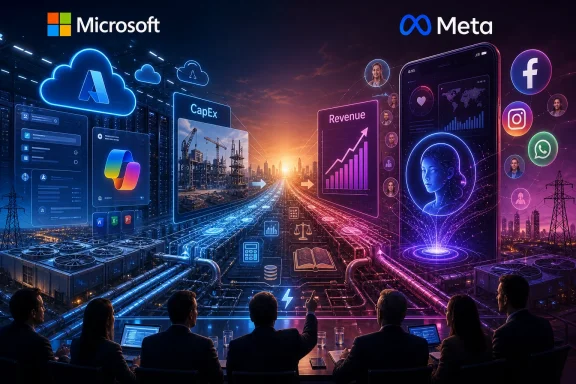 The AI Trade Has Moved From Wonder to Accounting
The first phase of the generative AI cycle rewarded anything close to the furnace. NVIDIA, memory suppliers, networking vendors, and server makers became the cleanest expression of demand because they sold the picks, shovels, and power tools. Microsoft and Meta sit in a less comfortable part of the chain: they are buying the equipment, building the campuses, and telling investors that the bill will eventually become an operating advantage.That is why the valuation conversation has turned. A company can be both a beneficiary of AI and a victim of AI spending if its shareholders believe too much cash is being converted into concrete, GPUs, and depreciation before enough revenue shows up. The anxiety is not irrational. History is full of infrastructure cycles in which demand was real, the technology was transformative, and equity holders still overpaid for the timing.
But Microsoft and Meta are not pre-revenue infrastructure dreamers. They are cash machines attempting to bolt a new compute layer onto already dominant businesses. That distinction matters because the payoff does not have to arrive as a single dazzling new product. It can arrive through better cloud utilization, higher ad prices, more automated software seats, more engagement, and a widening moat around services people already use.
The skeptical case says investors should wait for clearer proof. The bullish case says the proof is already arriving in pieces, and the market is underpricing how quickly those pieces can add up.
Microsoft’s AI Story Is Becoming a Cloud Utilization Story
Microsoft is the easier of the two cases to understand because it sells AI in a way enterprise buyers already recognize: as cloud capacity, developer tooling, security, productivity software, and managed services. Azure’s reported 40 percent growth in Microsoft’s fiscal third quarter is not a side note. It is the central evidence that demand is no longer confined to demos, pilots, and conference-stage optimism.Azure matters because it converts AI from an abstract model race into a platform business. If customers build agents, retrieval systems, analytics pipelines, or custom models on Azure, Microsoft gets paid across compute, storage, databases, identity, networking, and software subscriptions. The question is not only whether Copilot sells. The question is whether AI makes Azure a more necessary place to run the modern enterprise stack.
That is why the phrase Copilot monetization can sound both overused and underappreciated. Microsoft 365 Copilot is not merely a chatbot attached to Word and Outlook. It is Microsoft’s attempt to turn the productivity suite into a higher-priced, AI-mediated work surface where the company can charge more per user while making switching costs more painful.
The early tension is that Microsoft must spend before it can collect. AI infrastructure is expensive, and the most useful enterprise AI workloads often require low-latency access to proprietary data, secure identity controls, compliance tooling, and heavy inference capacity. Microsoft has those pieces, but stitching them together at global scale requires capital outlays that can look alarming even for a company of its size.
Still, Microsoft’s position is unusually strong because the company owns both the customer relationship and the infrastructure layer. Many AI start-ups must rent compute, acquire users, and invent distribution at the same time. Microsoft already has the distribution, and it is using capital spending to deepen the compute moat underneath it.
Copilot Does Not Need to Be Perfect to Be Profitable
One mistake in the AI debate is treating Copilot as if it must instantly transform every worker into a superhuman knowledge engine to justify its existence. Enterprise software rarely works that way. The more plausible path is incremental: a little less time spent summarizing meetings, drafting emails, searching documents, generating code, triaging tickets, or building presentations.That sounds modest until it is multiplied across tens of millions of paid seats. A tool that saves a few minutes a day can still support a meaningful subscription price if it becomes embedded in workflow and governance. Microsoft does not need every user to adore Copilot; it needs enough organizations to decide that AI assistance is now part of the standard productivity bundle.
The same logic applies to GitHub Copilot, which has become one of the clearest examples of paid AI adoption inside real work. Developers are expensive, software backlogs are endless, and code assistance has an obvious economic buyer. If AI improves developer throughput even unevenly, the willingness to pay is easier to defend than in many consumer AI categories.
There is also a defensive angle. If Microsoft did not push AI deeply into Office, Windows, GitHub, Dynamics, and Azure, someone else would try to wedge AI between Microsoft and its users. Spending heavily is not just a growth decision. It is an insurance policy against disintermediation.
That is where the bear case can become too tidy. It sees capital expenditure as a discretionary bet that management could simply slow. In practice, Microsoft is spending because the cost of underbuilding may be worse than the cost of overbuilding.
Meta’s Payoff Is Hiding in the Ad Machine
Meta’s AI story is more controversial because the company has a long record of expensive future-facing bets. Reality Labs trained investors to look at Mark Zuckerberg’s strategic visions with one hand on the sell button. The metaverse episode did not destroy Meta, but it did teach shareholders that even a brilliant core business can subsidize ambitions whose timelines are hostile to public-market patience.AI is different because it is already inside the advertising engine. Meta does not need to invent a new revenue model before AI helps the business. Better ranking, targeting, creative generation, recommendation, translation, and automation can all feed the same machine that produces the overwhelming majority of Meta’s revenue.
That makes Meta’s Q1 2026 ad performance especially important. Strong revenue growth, higher ad impressions, and higher average pricing suggest that AI is not merely a laboratory expense. It is improving the company’s ability to match users, content, advertisers, and commercial intent across Facebook, Instagram, WhatsApp, Messenger, and Threads.
The market’s concern is that the spending curve may be rising faster than the proof curve. Meta’s 2026 capital expenditure guidance, lifted into a range that would have seemed almost absurd a few years ago, forces investors to ask whether management is building for visible demand or for a speculative race toward superintelligence. That question is fair. It is also incomplete.
Meta’s advantage is that small improvements in ad relevance can be monetized almost immediately. If a model makes Reels more engaging, increases time spent, improves ad conversion, or lowers friction for small businesses creating campaigns, Meta can see the benefit in the current business rather than waiting for an entirely new category to mature.
Muse Spark Makes Meta’s AI Bet Less Abstract
The arrival of Muse Spark gives Meta a more concrete story than “we are spending because AI is the future.” The model is being positioned across Meta AI and the company’s major social and messaging surfaces, including WhatsApp, Instagram, Facebook, Messenger, Threads, and AI glasses. That distribution is enormous, and it changes the economics of experimentation.Most AI products must fight for user attention. Meta can inject AI into places where users already spend time. That does not guarantee success, but it lowers the customer-acquisition burden and allows the company to test features at a scale few competitors can match.
WhatsApp is especially interesting because it has historically been under-monetized relative to its global reach. If AI turns messaging into a richer interface for business discovery, customer service, payments, recommendations, or commerce, Meta could unlock revenue without needing to dramatically change the social feed. That is the kind of payoff investors are hoping for: not a science-fiction leap, but a practical layer of monetization on top of existing behavior.
The risk is that Meta overreaches. Users may not want every chat, search bar, and feed surface mediated by an assistant. Regulators may scrutinize how personal data powers AI systems. Advertisers may embrace automated creative tools while still demanding transparency about performance and brand safety.
But Meta has an unusual tolerance for product iteration in public. It can launch, measure, adjust, and repeat across billions of users. In consumer AI, that may be as valuable as any single model benchmark.
The CapEx Panic Is Rational, but It Is Not the Whole Story
The fear of an AI bubble is not some crankish rejection of technology. It is the natural response to a cycle in which capital spending has begun to look like a geopolitical arms race. Data centers require chips, land, energy, water, networking equipment, and long-term commitments that are not easily reversed if demand disappoints.Investors remember the dot-com era because the analogy contains a useful warning. The internet was real, demand did arrive, and yet many companies destroyed capital by building too early, too expensively, or with the wrong business model. Transformative technology does not repeal the laws of return on invested capital.
But the analogy can also mislead. Microsoft and Meta are not speculative telecom carriers laying fiber for hypothetical customers. They have existing revenue streams, existing customers, and measurable places to apply AI. Their spending is aggressive, but it is attached to products with distribution and cash flow.
The accounting lag is the problem. Capital spending hits investor psychology immediately, while productivity gains, pricing power, and platform lock-in appear gradually. This creates a period in which the companies look more reckless than they may actually be.
That is the window the bullish argument is trying to exploit. If investors demand perfect proof before paying up, the rerating may happen before the proof feels complete. Markets often move when uncertainty narrows, not when it disappears.
The Real Bubble May Be in Expectations, Not Infrastructure
There is another possibility: the spending is necessary, the products are real, and valuations still overshoot because investors extrapolate too much. AI can be economically powerful without making every deployment profitable. It can lift revenue while also compressing margins. It can increase productivity while intensifying competition.This is where Microsoft and Meta deserve a more disciplined analysis than the usual “AI winners” label. Microsoft’s strength is enterprise trust, but enterprise adoption can be slow, political, and budget-constrained. Meta’s strength is consumer scale, but consumer AI behavior is still fluid, and social platforms can misread user tolerance for automation.
The better question is not whether AI will pay off. It is where the payoff accrues. Chip vendors have captured the first wave because demand for compute was immediate. Cloud providers and platform owners are trying to capture the second wave by turning that compute into recurring software and services revenue. Application companies, advertisers, and end users will fight over the third wave, where productivity gains become bargaining power.
Microsoft and Meta are both trying to occupy multiple layers of that stack. Microsoft sells the infrastructure, the developer platform, and the business application. Meta controls the consumer surface, the recommendation engine, and the ad marketplace. That vertical position is why their AI spending may be more defensible than the headline numbers suggest.
Still, defensible does not mean risk-free. If model costs fall rapidly, some infrastructure advantage may commoditize. If open models become good enough for most uses, pricing power could weaken. If regulators force changes to data use, the ad and assistant models could become less effective.
The payoff may come sooner than skeptics expect, but the durability of that payoff remains the harder question.
Bill Ackman’s Purchases Are a Signal, Not a Verdict
The 24/7 Wall St. piece leans on a timely detail: Bill Ackman’s Pershing Square has recently been associated with both Meta and Microsoft. That matters because high-profile investors can reframe a stock narrative, particularly when they argue that a dominant company has become too cheap because the market is obsessing over the wrong risk.But Ackman’s presence should not be mistaken for proof. A famous buyer can validate a debate; he cannot settle it. Microsoft and Meta will still have to show that AI capital spending creates revenue, margin resilience, and strategic control.
What the purchases do suggest is that the “AI spenders are uninvestable until CapEx falls” argument may be too blunt. There is a price at which even heavy spending becomes attractive if the underlying franchise is strong enough. For Microsoft, that franchise is enterprise software and cloud. For Meta, it is attention, advertising, and social distribution.
The irony is that investors may be applying the harshest scrutiny to companies best able to survive it. Smaller AI firms often depend on outside capital, rented infrastructure, and uncertain monetization. Microsoft and Meta can fund their ambitions from operating cash flow, even if doing so pressures free cash flow in the near term.
That does not make them bargains automatically. It does mean the correct comparison is not between AI spending and no AI spending. It is between spending from a position of strength and spending from a position of desperation.
Windows Users Should Watch the Platform Consequences
For WindowsForum readers, Microsoft’s AI spending is not just a stock-market story. It is a platform story that will shape Windows, Microsoft 365, Azure, developer tools, endpoint management, and security operations. When Microsoft builds AI infrastructure, it is also deciding how much of the next decade of computing flows through its cloud and identity systems.The most obvious consequence is that Windows will continue to become less of a standalone operating system and more of a client for cloud-backed intelligence. Copilot features, Recall-style experiences, enterprise search, device management, and security tooling all point in the same direction. The PC remains important, but the value increasingly lives in the service layer wrapped around it.
Sysadmins should expect both opportunity and irritation. AI can improve ticket triage, policy analysis, log summarization, threat hunting, and documentation. It can also create new governance problems around data exposure, licensing complexity, shadow AI usage, and auditability.
Developers face a similar trade. AI coding assistants can accelerate routine work, but they also change expectations around velocity and code review. The organization that buys AI tooling may expect faster delivery long before it has rebuilt its processes to safely absorb AI-generated output.
Microsoft’s payoff, then, may partly come from making AI feel unavoidable in the enterprise stack. Once a feature becomes a default expectation in Microsoft 365, GitHub, Defender, or Azure, customers may debate the price but rarely escape the ecosystem.
Meta’s Consumer AI Push Will Test the Limits of Ambient Assistance
Meta’s payoff matters to Windows users in a different way. It is less about enterprise administration and more about how AI becomes part of everyday communication, commerce, and media consumption. If Muse Spark and Meta AI become common inside WhatsApp, Instagram, Facebook, Messenger, and smart glasses, AI will feel less like a separate destination and more like an ambient layer.That has practical consequences. Businesses may use Meta’s AI tools to create ads, answer customers, generate product imagery, localize campaigns, and manage messaging at scale. Users may encounter AI in search, recommendations, group chats, and customer support without consciously choosing an “AI product.”
This is likely where Meta can monetize fastest. The company does not need to persuade every user to pay for a chatbot subscription. It can make advertisers pay for better outcomes, more automation, and access to AI-enhanced formats.
The concern is trust. Meta’s history with privacy and platform governance gives skeptics plenty of ammunition. An AI assistant inside intimate communication channels such as WhatsApp will be judged differently from an AI recommendation system inside a public feed.
If Meta gets the balance right, AI could make its platforms more useful and more profitable. If it gets the balance wrong, AI could become another reason for users and regulators to distrust the company’s appetite for data.
The Winners Will Be the Companies That Make AI Boring
The next stage of AI monetization will not be won by the loudest demo. It will be won by the companies that make AI reliable, governed, priced, and embedded. That is why Microsoft and Meta are more interesting than many purer AI stories.Microsoft wants AI to become part of the enterprise bill. Meta wants AI to become part of the attention and advertising loop. Both strategies depend less on novelty than on repetition. The same user, the same company, the same advertiser, and the same developer must find enough value to keep using the system after the initial fascination fades.
That is also why the infrastructure boom may not be as reckless as it looks from a distance. If AI becomes a default layer across cloud software and consumer platforms, underbuilding would be strategically dangerous. Capacity shortages would mean lost customers, slower products, and weaker models.
Yet the companies still have to prove discipline. Spending because demand exists is different from spending because rivals are spending. The market will eventually punish any company that cannot explain the link between capital intensity and economic return.
Microsoft has the cleaner path because enterprise AI spending can be tracked through seats, Azure consumption, and software attach rates. Meta has the more explosive path because consumer distribution and advertising improvements can scale quickly. Both have enough evidence to keep the bull case alive.
The Payoff Will Arrive Unevenly Before It Arrives Obviously
The most concrete lesson from Microsoft and Meta is that AI returns are unlikely to appear as one dramatic line item labeled “AI profit.” They will show up as faster cloud growth, higher ad prices, better engagement, more paid seats, improved automation, and perhaps slower customer churn. That makes the story harder to model but easier to miss.- Microsoft’s Azure growth shows that AI infrastructure demand is already translating into cloud consumption rather than remaining a purely speculative buildout.
- Copilot’s importance lies in its ability to raise the value of Microsoft’s existing productivity and developer ecosystems, not in whether every user treats it as revolutionary on day one.
- Meta’s strongest near-term AI monetization path runs through advertising improvements, where better targeting, ranking, and creative tools can quickly affect revenue.
- Meta’s Muse Spark rollout matters because it gives the company a distribution advantage across messaging, social feeds, search surfaces, and smart glasses.
- The biggest risk for both companies is not that AI is useless, but that capital spending, depreciation, power constraints, and competitive pricing consume more of the upside than investors expect.
- For IT pros, the practical consequence is a more cloud-tethered, AI-mediated software stack in which governance, licensing, security, and data controls become central operational concerns.
References
- Primary source: 24/7 Wall St.
Published: 2026-05-18T11:53:08.073375
2 Big AI Spenders Poised to Actually Get the Payoff — Perhaps Sooner Rather Than Later - 24/7 Wall St.
With big tech’s CapEx in the hundreds of billions and the potential for them to test the $1 trillion in the next year, investors, many of whom are starting to get just a little bit worried about a potential bubble forming in AI or AI chips, are going to want to see more in the ... 2 Big AI...247wallst.com - Related coverage: fool.com
Bill Ackman Explained Why He Just Bought Microsoft. But There Are Even More Reasons to Buy This "Magnificent Seven" Stalwart | The Motley Fool
Microsoft became very cheap in the first quarter. It still is.www.fool.com
