

Satya Nadella opened 2026 with a short, intentionally provocative personal post that reframes the industry conversation around generative AI — urging people to stop debating “slop versus sophistication,” to treat AI as a cognitive amplifier, and to accelerate the move from isolated models to engineered, agent-centric systems that shape product design, governance, and business strategy.
Since 2022, Microsoft has publicly reoriented itself around a broad Copilot and Azure-led AI thesis: embedding generative intelligence across Microsoft 365, Windows, GitHub, and Azure, while investing heavily in datacenter capacity and model engineering. That shift has produced an aggressive product roadmap — from Copilot integrations in Word, Excel and Teams to device-first features in Copilot+ PCs and early in‑house foundation models — and it now appears to be entering a new rhetorical phase where the company argues the hard work must be systems-level engineering rather than model benchmark competition. Nadella’s blog post — posted on a personal site branded “sn scratchpad” and titled “Looking Ahead to 2026” — distills three linked priorities: rethink product design around human amplification, move from single models to orchestrated systems (agents plus scaffolding), and be deliberate about where scarce compute, energy, and talent are applied to earn “societal permission.”
However, the memo also functions as strategic narrative management. Several operational gaps remain:
For Windows users, IT leaders, and creative professionals, the coming year will be about scrutiny and preparation: demand measurable pilot results, insist on provenance and entitlements, and treat agent deployments as organizational change programs — not just feature toggles. If Microsoft and the industry can translate cognitive-amplifier rhetoric into safe, auditable, and economically sustainable systems, Nadella’s hoped-for pivot could become the next major wave of productivity software. If not, the language of “agents” risks becoming another layer of expensive complexity.
Source: PhotoNews Pakistan Satya Nadella Blogs on AI Future as Microsoft Shifts Toward AI Agents
 Background
Since 2022, Microsoft has publicly reoriented itself around a broad Copilot and Azure-led AI thesis: embedding generative intelligence across Microsoft 365, Windows, GitHub, and Azure, while investing heavily in datacenter capacity and model engineering. That shift has produced an aggressive product roadmap — from Copilot integrations in Word, Excel and Teams to device-first features in Copilot+ PCs and early in‑house foundation models — and it now appears to be entering a new rhetorical phase where the company argues the hard work must be systems-level engineering rather than model benchmark competition. Nadella’s blog post — posted on a personal site branded “sn scratchpad” and titled “Looking Ahead to 2026” — distills three linked priorities: rethink product design around human amplification, move from single models to orchestrated systems (agents plus scaffolding), and be deliberate about where scarce compute, energy, and talent are applied to earn “societal permission.” What Nadella Actually Wrote — Key Takeaways
A new product framing: AI as a cognitive amplifier
Nadella asks the industry to replace the shorthand fight over low-quality generative outputs (“slop”) with a design-first equilibrium: a “theory of mind” that recognizes people will routinely be interacting with powerful AI tools that amplify cognition. In his words, AI should be treated as a set of tools that augment human thinking and productivity rather than an end in itself.From models to systems
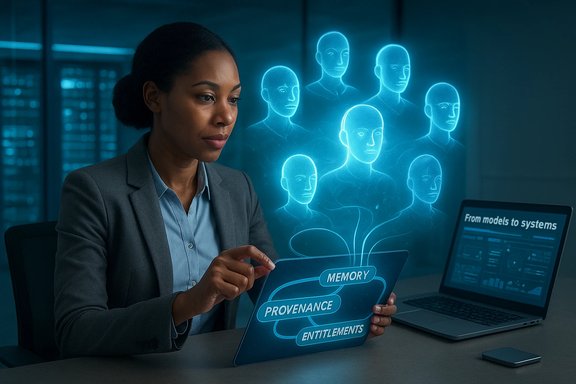
He argues the real engineering work is building systems — orchestration layers that provide memory, entitlements, provenance, and safe tools use — rather than hyping single giant models. That means composing multiple models and agents into reliable, auditable workflows that can run in production at scale.Societal permission and scarce resources
Nadella explicitly flagged the political and material constraints around scaling AI: energy, compute and talent are finite, and therefore choices about where to deploy the technology have social implications. He framed 2026 as a pivotal year to prove practical, measurable benefit.Why this matters: corporate strategy and the agent-first pivot
Microsoft’s bet on agents and Copilot
What Nadella wrote is consistent with a larger Microsoft playbook: Copilot is being pushed as the “UI of AI” across Microsoft 365, Windows and developer tools; Copilot Studio, agent APIs, and Copilot+ device features aim to make agents the default way people get work done. That is a strategic pivot away — in emphasis, if not in outright abandonment — from the classic Windows/Office product narratives toward an agent-led productivity platform.- The company has broadened Copilot’s role from an in-app assistant to an ecosystem-level orchestration layer for workflows.
- Copilot Studio and enterprise tuning features let organizations build domain-specialized agents and pin entitlements and data access policies to them.
- Hardware moves (Copilot+ PCs with on-device NPUs) reflect a plan to deliver lower-latency agent experiences with stronger privacy and offline capability.
Business model and capitalization
The agent-first thesis carries clear monetization plans: subscription and consumption billing for Copilot seats and agent usage, Azure consumption for model hosting, and an increase in services revenue for custom agent deployments. Microsoft is simultaneously investing heavily in datacenters and model infrastructure, betting that platform control and integrated experiences will secure longer-term customer lock-in. Windows and Office remain core distribution channels, but the value driver Microsoft emphasizes is the agent and cloud stack around them.Technical implications: models → systems (what it really means)
Orchestration, memory, entitlements
Designing agentic systems at production scale requires more than a larger LLM:- Orchestration: routing queries to the right mix of specialized models, ensuring latency and cost constraints are respected.
- Memory: reliable, contextual state that agents can rely on without leaking sensitive data.
- Entitlements & provenance: strict access controls and traceable data lineage so outputs can be audited and attributed.
On-device agents and Copilot+ PCs
Microsoft’s agent announcements for Windows show a split strategy: keep latency-sensitive or private workloads on-device (Copilot+ hardware with NPUs) while routing heavy inference or cross-company orchestration to Azure. The hybrid design lowers friction for day-to-day help (tuning a Windows setting, automating a multi-step business action) and reduces cold-call cloud costs — but it increases engineering complexity and fragmentation across device types.In-house models and performance claims
Microsoft has disclosed purpose-built models (MAI family) intended for consumer-facing companions and multimodal tasks, including claims like very high audio-generation throughput for MAI‑Voice‑1. These corporate benchmarks are plausible but should be treated as vendor-supplied claims until independent engineering validation is available. Vendor claims require independent verification.The creative economy and the legal overlay
Why creatives feel threatened
Generative models can reproduce stylistic elements and produce derivative works at scale. Artists and photographers have brought legal challenges and public protests against image generators that were trained on scraped works, arguing both economic dilution and unauthorized use of copyrighted material. That pushback is a salient, ongoing socio-legal risk to widescale adoption of agent-driven creative workflows.Technical mitigation is imperfect
Tools intended to protect artists — watermarking, perturbation-based “poisoning” like Glaze and NightShade — have been shown to be bypassable by research methods (LightShed), leaving creators vulnerable despite defensive measures. The policy and legal regimes are still evolving; courts and regulators are wrestling with whether style and market dilution are protectable harms under current copyright frameworks. This creates substantial uncertainty for any product strategy that depends on copyrighted creative inputs.Practical consequence for Microsoft
If enterprise and consumer use-cases rely on stylized outputs (marketing, media generation, branded content), Microsoft must build tooling for provenance, attribution, and licensing within Copilot and agent workflows — or face litigation, customer churn, and reputational damage. Nadella’s call for “societal permission” concedes this governance imperative.Risks and open questions
1) Product reliability vs. expectation
Many early agent and Copilot experiences still show brittleness: hallucinations, fragile multi-step flows, regressions across releases, and inconsistent integrations across mail, calendar, and file systems. Public-facing rhetoric about an “agent-first” era must be matched by demonstrable reliability improvements. Internal and third-party tests will determine whether users adopt agents beyond novelty.2) Concentration of compute and centralization
Large datacenter investments and proprietary model stacks favor hyperscalers. Centralization raises geopolitical, economic, and market-power concerns: which companies control the agents that steer workflows, and what are the implications for competition, data portability, and pricing? Nadella acknowledges scarce compute and talent; how those resource constraints are allocated will be a political and commercial battleground.3) Environmental and cost footprint
Agentic systems, when composed of many submodels and persistent memory, can multiply inference and storage costs — increasing electricity consumption and cloud spend. Fiscal discipline and engineering innovation will be required to make agent experiences economically sustainable at consumer scale. Nadella’s post notes these limits as a major consideration.4) Legal and creative rights
As noted, the copyright landscape remains unsettled. Businesses embedding agentic content generation into workflows must adopt defensive strategies: licensing, provenance metadata, content origin labeling, and fallback policies for contested outputs. Absent these, Microsoft and customers face litigation, regulatory action, and creative industry backlash.5) Social trust and governance
Nadella’s “societal permission” formulation is a recognition that technical fixes alone won’t suffice: firms must demonstrate real-world eval impact, auditable safety, and clear accountability structures. Without credible third-party metrics and transparent governance, public skepticism may curtail adoption despite technical progress.Strengths and strategic advantages Microsoft brings
- Distribution: Microsoft controls Office, Windows, Teams, GitHub, and enterprise channels — a uniquely broad pipeline for rolling out agents across millions of productive workflows.
- Cloud scale: Azure and enterprise relationships provide both the compute backbone and the commercial hooks for monetizing agent workloads.
- Integrated engineering: Investments in model IP (MAI family), Copilot experiences, and device-level NPUs allow hybrid deployment options that competitors may find hard to match quickly.
- Commercial footprints: Role-based copilots across Dynamics, Microsoft 365 and industry copilots provide early verticalized revenue paths.
Practical guidance for Windows admins, IT leaders, and power users
Enterprises and Windows professionals should treat the agent roll-out as a strategic program, not an ad-hoc feature flip. Recommended actions:- Establish governance and pilot metrics
- Define success metrics (time saved, accuracy, error rate) and run measured pilots before broad deployment.
- Data governance & entitlements
- Map what data agents may access; enforce least-privilege entitlements and provenance logging for outputs consumed by downstream processes.
- Cost monitoring
- Track inference and storage spend per agent; use budgeting and throttling to prevent runaway cloud costs.
- Security & compliance testing
- Subject agent workflows to penetration and privacy testing; understand how agent state and memory are stored and who can access it.
- Licensing & creative rights
- For content-generation workflows, require rights clearance: implement model provenance tags and content-licensing negotiation where needed.
- Rollout design
- Start with value-first automations (meeting summaries, repetitive reporting, system configuration tasks), then expand to higher-stakes workflows with clear escalation policies.
What to watch in 2026 — measurable signals
- Adoption metrics for Copilot and Copilot Studio: active seats, agent usage per MAU, and retention trends.
- Evidence of reliability gains: third-party benchmark tests and enterprise case studies showing measurable productivity improvements.
- Legal rulings and regulatory frameworks: court decisions on training data and style protection, plus new rules from copyright offices and consumer-protection agencies.
- Infrastructure economics: Microsoft’s Azure-capex cadence and any disclosures on inference cost optimization or energy-efficiency improvements.
- Independent audits or third-party “real-world eval” metrics that measure agent impact beyond demos.
Critical assessment — strengths, risks, and where the rhetoric may outpace reality
Satya Nadella’s note is a thoughtful repositioning: it reframes the debate toward human-centered product design, system engineering and societal trade-offs — all useful corrective emphases for an industry that has largely chased capability headlines. The strengths of the argument are clear: design-first thinking, attention to governance, and the call to build systems that are auditable and instrumented rather than one-off model demos.However, the memo also functions as strategic narrative management. Several operational gaps remain:
- Many agentic workflows are still brittle in day-to-day use; scaling them to enterprise reliability is non-trivial.
- Vendor performance claims (model throughput, cost per inference, on-device latency) need independent engineering verification; corporate numbers are useful but not a substitute for reproducible evaluation.
- Legal and creative-rights uncertainty is material and can slow adoption in high-value creative and media workflows unless licensing and provenance features are robustly implemented.
- The socio-political question of who controls agentic systems — and how they are audited and contested — is still unresolved and will shape regulatory and market outcomes.
Final thoughts
Nadella’s personal “sn scratchpad” note is less a product roadmap and more a strategic orientation: treat 2026 as the year to shift from flashy demos to measurable real‑world impact, build orchestration and governance around agents, and make deliberate choices about where to invest scarce resources. Microsoft’s scale, distribution, and capital give it the best chance to make that transition; the company’s credibility will depend on demonstrable reliability, third‑party evaluation, legal clarity on creative inputs, and transparent governance.For Windows users, IT leaders, and creative professionals, the coming year will be about scrutiny and preparation: demand measurable pilot results, insist on provenance and entitlements, and treat agent deployments as organizational change programs — not just feature toggles. If Microsoft and the industry can translate cognitive-amplifier rhetoric into safe, auditable, and economically sustainable systems, Nadella’s hoped-for pivot could become the next major wave of productivity software. If not, the language of “agents” risks becoming another layer of expensive complexity.
Source: PhotoNews Pakistan Satya Nadella Blogs on AI Future as Microsoft Shifts Toward AI Agents
