

Microsoft’s latest results underline a familiar paradox: the company is winning the AI arms race in market share and mindshare, yet its soaring investments and razor-thin margin optics are enough to make investors question whether the payoff will match the cost. (news.microsoft.com)
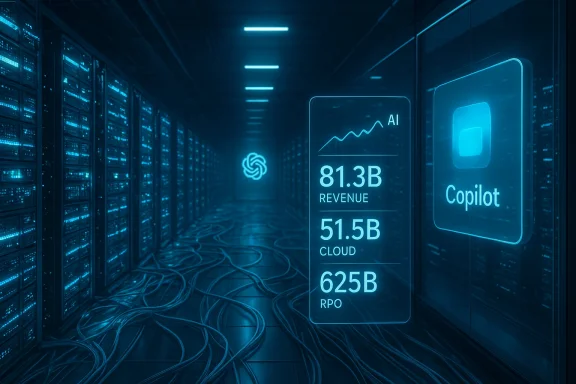
Microsoft reported fiscal second-quarter results (quarter ended December 31, 2025) that showed robust top-line growth driven by cloud and AI demand, even as capital spending and AI-related accounting moves reshaped the headlines. Revenue came in at about $81.3 billion, up roughly 17% year‑over‑year, and Microsoft Cloud revenue crossed the $50 billion mark, reaching approximately $51.5 billion for the quarter. Azure and other cloud services again led the pack with roughly 39% year‑over‑year growth. (news.microsoft.com)
Yet the narrative beyond headline growth is more nuanced. Microsoft recorded a large GAAP net income number—boosted by gains tied to its OpenAI investment—but the market fixated on the company’s ballooning capital expenditures and near‑term margin impact, sending shares lower in after‑hours trading. Reuters‑syndicated reporting flagged investor unease about whether Microsoft’s multibillion‑dollar AI push is translating into proportionate returns.
Analysts note two implications:
That concentration is a double‑edged sword:
But buying capacity and writing checks is only one half of the equation. The other half is turning that capacity into profitable recurring revenue through differentiated products customers will pay for repeatedly. That requires pricing discipline, product execution, and successful navigation of competitive and regulatory headwinds.
Microsoft’s latest quarter shows both sides: a cloud and AI business growing at scale, and a cost and execution puzzle that investors are still pricing into the stock. For WindowsForum readers, the practical implication is straightforward: expect faster, more capable AI features to arrive in Windows and Microsoft 365, but also expect Microsoft to refine how it charges for them as the market matures. (news.microsoft.com)
Watch the next several quarters for evidence that heavy CapEx is being efficiently monetized, that gross margins stabilize, and that OpenAI‑related accounting and contracts clarify the company’s recurring economics. Until Microsoft proves those payoffs in recurring revenue and rising free cash flow, investor skepticism will remain a meaningful counterbalance to the company’s undeniable technical leadership and market reach. (news.microsoft.com)
Source: Reuters https://www.reuters.com/business/re...es-past-cloud-growth-expectations-2026-01-28/
 Background
Microsoft reported fiscal second-quarter results (quarter ended December 31, 2025) that showed robust top-line growth driven by cloud and AI demand, even as capital spending and AI-related accounting moves reshaped the headlines. Revenue came in at about $81.3 billion, up roughly 17% year‑over‑year, and Microsoft Cloud revenue crossed the $50 billion mark, reaching approximately $51.5 billion for the quarter. Azure and other cloud services again led the pack with roughly 39% year‑over‑year growth. (news.microsoft.com)Yet the narrative beyond headline growth is more nuanced. Microsoft recorded a large GAAP net income number—boosted by gains tied to its OpenAI investment—but the market fixated on the company’s ballooning capital expenditures and near‑term margin impact, sending shares lower in after‑hours trading. Reuters‑syndicated reporting flagged investor unease about whether Microsoft’s multibillion‑dollar AI push is translating into proportionate returns.
Results snapshot: the numbers that matter
- Revenue: $81.3 billion, +17% year‑over‑year. (news.microsoft.com)
- Microsoft Cloud revenue: $51.5 billion, +26% year‑over‑year; Azure & other cloud services: +39%. (news.microsoft.com)
- GAAP net income: $38.5 billion; non‑GAAP net income: $30.9 billion. Microsoft disclosed an accounting gain of roughly $7.6 billion tied to its OpenAI investment that materially affected GAAP results. (news.microsoft.com)
- Capital expenditures (CapEx): reported at approximately $37.5 billion for the quarter—up markedly year‑over‑year and well above consensus estimates—reflecting large purchases of short‑lived compute (GPUs/CPUs) and long‑lived datacenter investments.
- Remaining performance obligations (RPO) / contracted backlog: reported commercial RPO expanded to about $625 billion, roughly doubling year‑over‑year and heavily weighted toward multi‑year commitments, with a significant portion attributed to OpenAI. (news.microsoft.com)
Why the market cheered the cloud — then immediately worried
The upside: demand is real and scale is powerful
Microsoft’s core proposition—combining a planet‑scale cloud with integrated AI offerings across the productivity stack—continues to attract enterprise customers upgrading to AI‑enabled solutions. Azure’s near‑40% growth rate shows ongoing corporate migration and new AI workloads; Microsoft 365 commercial and consumer cloud revenue both expanded, and Dynamics/LinkedIn segments ticked up. Scale matters in cloud economics: once you can amortize datacenter and networking costs across millions of users and high‑value AI workloads, the margin improvements can be significant. (news.microsoft.com)- Enterprises continue to buy capacity and platform services rather than build everything in‑house.
- Microsoft’s early strategic relationship with OpenAI gives it exclusive distribution rights for some OpenAI IP and early mover advantages for Copilot/AI in Microsoft 365, which feeds Azure usage. (news.microsoft.com)
The downside: spending and accounting obscure returns
Investors’ nervousness had two clear origins. First, Microsoft’s CapEx for the quarter jumped into the high tens of billions (reports converged around $37.5 billion) as the company bulked up GPU and CPU capacity to handle enterprise AI workloads. That spending lifts short‑term cash demand and reduces free‑cash‑flow metrics that some investors use to value the business. Second, the company’s linkage to OpenAI created an accounting gain this quarter (a GAAP boost) but raises questions about future earnings quality and the extent to which Microsoft will absorb OpenAI’s costs or enjoy durable economics from that partnership. Reuters framed the result as a "marginal beat" that nevertheless fanned worries about AI payoff.The spending story: what Microsoft is buying — and why it matters
Microsoft’s CapEx increase is not generic. Public filings and management commentary make clear what the bulk of those dollars buy:- Short‑lived compute inventory: GPUs and CPUs used to train and serve large language models and generative AI systems. These are intentionally treated as shorter‑lived due to rapid obsolescence and heavy utilization. (news.microsoft.com)
- Long‑lived datacenter real estate and finance leases: site buildouts, long‑term power and facility investments, and large finance leases that appear on the balance sheet distinct from cash paid for property, plant & equipment. Microsoft flagged finance leases in prior quarters as a meaningful portion of CapEx.
Analysts note two implications:
- Margins can compress in the near term as the mix shifts to GPU‑heavy workloads (which lower gross margin) even while top‑line growth accelerates. Microsoft itself pointed to a slight gross margin impact from AI investments.
- The company is committing to a multi‑year technology cycle; returns depend on sustained enterprise monetization and pricing power for AI features like Copilot. If customers use AI heavily but vendors struggle to monetize incremental usage, the payback timeline could extend. (news.microsoft.com)
OpenAI: the blessing, the accounting, and the conditional risk
Microsoft’s expanded investment in OpenAI continues to shape the narrative. Management disclosed a sizeable GAAP gain tied to OpenAI that boosted the quarter’s headline profit, while non‑GAAP figures adjust for that impact to show operational trends. Microsoft’s financial materials and analyst commentary also emphasized that roughly 45% of its RPO growth is attributed to OpenAI commitments, underscoring a concentrated source of contracted future revenue. (news.microsoft.com)That concentration is a double‑edged sword:
- The blessing: having the leading generative AI provider as a cornerstone customer—and partner—gives Microsoft sticky, high‑value Azure consumption and competitive differentiation for productivity AI features.
- The risk: because OpenAI’s business model and future margin profile remain fluid, any sustained losses at OpenAI could translate into financial volatility for Microsoft, depending on how investments, warrants, and contractual arrangements are accounted for and whether Microsoft absorbs or shares operating risk. Reuters and other outlets flagged the possibility that mounting OpenAI losses could weigh on Microsoft’s expenses if recognized over time.
Competitive landscape: Google, Amazon, Anthropic and the fight for AI customers
Microsoft’s cloud and AI advantage is real, but it’s contestable. Key dynamics shaping competition:- Google Cloud/Gemini: Google’s large language model and Gemini family are being rapidly integrated into its cloud offerings and productivity features, making Google a product and infrastructure competitor for enterprise AI workloads. Early positive reception to Gemini models was highlighted by market commentators as a competitive pressure point.
- Amazon Web Services: AWS remains the dominant enterprise cloud by market share and has its own suite of ML and generative AI services; Amazon has also signed significant commercial arrangements with AI model developers. AWS is focused on monetizing inference workloads and offering custom silicon/service bundles.
- Anthropic and other AGI challengers: Anthropic’s partnerships and product launches (including agent‑style tools) are creating additional enterprise options that could siphon model or compute spend away from any single cloud provider. Microsoft’s strategic investments in Anthropic and other startups may hedge some of that risk but also add complexity.
What the numbers mean for Windows and Office users
For WindowsForum readers interested in the direct product impact:- Expect deeper AI integration across Microsoft 365 and Windows features. The momentum in Azure and Microsoft 365 revenue suggests continued investment in Copilot‑style experiences that will be rolled into both consumer and enterprise editions. That means more contextual AI features in Office apps, faster document summarization, and expanded assistant tooling for Windows users. (news.microsoft.com)
- Consumer pricing and packaging: Microsoft called out ARPU growth in M365 consumer revenue. That hints at pricing levers for premium AI features in subscription tiers; users should watch licensing terms and any new consumption‑based pricing models for AI features. (news.microsoft.com)
- Hardware and gaming: More Personal Computing revenue was slightly down year‑over‑year, reflecting softness in hardware categories and gaming content shifts. Investment in cloud/GPU capacity is less likely to directly accelerate Surface product innovation in the near term; instead, expect cloud‑first AI experiences layered on the Windows ecosystem. (news.microsoft.com)
Risks and red flags — short to medium term
- Capital intensity and cash flow pressure: CapEx spiked into the tens of billions in a single quarter. While Microsoft’s balance sheet is strong, repeated quarters of heavy spending can compress free cash flow and test investor patience if monetization of AI features lags.
- Margin dilution from AI workloads: AI training and inference are compute‑heavy and can lower gross margins compared with classic SaaS subscription economics. Microsoft already flagged a modest gross margin impact from AI investments. This could be exacerbated if customers consume inference at scale without pricing that compensates for the underlying compute.
- Concentration risk in RPO and OpenAI dependence: With a large portion of Microsoft’s RPO tied to OpenAI, any operational or strategic shift at OpenAI could materially alter future revenue visibility. That concentration also complicates earnings quality analysis because large one‑time accounting gains can mask underlying operational trends. (news.microsoft.com)
- Competitive model parity and pricing pressure: If Google, AWS, or others match Microsoft’s AI feature set while undercutting on price or offering more flexible model access, Microsoft may need to defend both revenue and margin with additional investments or pricing concessions.
- Regulatory and policy risk: As AI features scale, governments and regulators continue to scrutinize data practices, model safety, and competition issues. Microsoft’s global footprint means compliance and potential restrictions could influence deployment speed or cost. Companies in the AI ecosystem are subject to new regulatory regimes or antitrust hotspots that could alter competitive dynamics. (news.microsoft.com)
Opportunities and strength indicators
Despite the risks, Microsoft’s strategic position offers clear levers for long‑term value creation:- Platform stickiness: Enterprises that embed AI into workflows are less likely to switch providers mid‑contract; Microsoft’s large installed base and integration across Office, Teams, Dynamics, and Azure create multiple touchpoints to monetize AI. (news.microsoft.com)
- RPO backlog as visibility: The $625 billion of commercial RPO provides multiyear visibility (if realized as expected) and a predictable flow of consumable cloud revenue. That level of contracted demand is rare and speaks to long contract durations and scale. (news.microsoft.com)
- First‑mover product advantages: Early integration of large language models into everyday productivity (e.g., M365 Copilot) can create durable ARPU expansion if Microsoft prices logically and continues product leadership. (news.microsoft.com)
- Hardware‑agnostic monetization: By focusing on cloud‑delivered AI features, Microsoft shifts away from hardware dependency and toward high-margin recurring services if consumption pricing is effective. This could, over time, recapture margin lost to compute investments.
Practical guidance for enterprise IT leaders and Windows power users
If you manage corporate IT or are a power user deciding how to adopt Microsoft’s AI features:- Evaluate Copilot/AI features on business outcomes, not hype. Run pilot projects with measurable productivity KPIs.
- Watch pricing models carefully. Consumption‑based inference fees can escalate quickly if not capped with governance and monitoring.
- Negotiate contract terms that include capacity guarantees and predictable pricing for heavy AI workloads. Microsoft’s supply constraints—documented as demand outpacing supply—make capacity commitments valuable.
- Institute governance for data and model usage to meet compliance and privacy requirements; ask vendors how models are trained and whether proprietary data will be used in broader training corpora.
- Plan for hybrid deployments. Consider where to keep latency‑sensitive or regulated workloads on premises and use Azure for scale training/inference where feasible.
Analyst takeaways: valuation, timeline, and what to watch next
- Valuation: Microsoft’s current market valuation needs to price both the near‑term CapEx cycle and the long‑term recurring revenue locked in by RPO. Investors will judge Microsoft’s ability to convert CapEx into durable, high‑margin AI revenue growth. (news.microsoft.com)
- Timeline: The AI infrastructure race has multi‑year timelines. Expect quarters of heavy spending followed by incremental margin improvement only when monetization catches up with capacity. Microsoft’s executives emphasize early phases of AI diffusion—a prudent reminder that value realization will not be instantaneous. (news.microsoft.com)
- What to watch in the next quarters:
- Gross margin trends and whether Microsoft can re‑leverage fixed investments as utilization rises.
- CapEx cadence and whether spending normalizes or accelerates.
- The composition and realization of RPO: does OpenAI remain the same share of contracted backlog or does diversification occur? (news.microsoft.com)
- Competitive model performance and enterprise win rates against Google and AWS, particularly in regulated industries.
The longer view: is Microsoft building an AI factory or just buying capacity?
Microsoft’s investment pattern resembles an industrial playbook: buy capacity early, secure long‑term customer commitments, and integrate proprietary offerings to capture downstream monetization. The company’s strength is the breadth of its portfolio—platform, productivity, developer tooling, and enterprise services—coupled with its scale in procurement and operations.But buying capacity and writing checks is only one half of the equation. The other half is turning that capacity into profitable recurring revenue through differentiated products customers will pay for repeatedly. That requires pricing discipline, product execution, and successful navigation of competitive and regulatory headwinds.
Microsoft’s latest quarter shows both sides: a cloud and AI business growing at scale, and a cost and execution puzzle that investors are still pricing into the stock. For WindowsForum readers, the practical implication is straightforward: expect faster, more capable AI features to arrive in Windows and Microsoft 365, but also expect Microsoft to refine how it charges for them as the market matures. (news.microsoft.com)
Conclusion
Microsoft’s results for the quarter ending December 31, 2025, confirm that AI is real demand, not just marketing. Azure growth and Microsoft Cloud’s crossing the $50 billion threshold validate Microsoft’s strategy and market position. Yet the very investments that fuel future competitive advantage—massive datacenter builds, GPU fleets, strategic commitments to AI partners—introduce measurable near‑term trade‑offs: heavier capex, margin pressure, and concentrated contractual exposure. The quarter is therefore both a demonstration of Microsoft’s depth in cloud and AI and a reminder that scale requires patience from investors and precise execution from management.Watch the next several quarters for evidence that heavy CapEx is being efficiently monetized, that gross margins stabilize, and that OpenAI‑related accounting and contracts clarify the company’s recurring economics. Until Microsoft proves those payoffs in recurring revenue and rising free cash flow, investor skepticism will remain a meaningful counterbalance to the company’s undeniable technical leadership and market reach. (news.microsoft.com)
Source: Reuters https://www.reuters.com/business/re...es-past-cloud-growth-expectations-2026-01-28/
