

Microsoft’s post‑earnings rout last week was not a failure of growth — it was a market verdict on execution risk and capital intensity in the company’s AI pivot. Investors punished the stock not because revenue missed, but because Microsoft shifted the debate from “how fast can AI drive revenue?” to “how much capital must be burned to build the AI stack, and who bears concentration risk?” The result: a sharp sell‑off that erased hundreds of billions of market value overnight and forced a re‑assessment of Microsoft’s risk profile even as the company continues to report record top‑line results.
Microsoft reported strong second‑quarter fiscal 2026 results: roughly $81.3 billion in revenue and non‑GAAP earnings per share of $4.14, both beating common expectations and continuing an extended streak of profitable quarters. Azure and related cloud services still grew at a brisk rate — in the high‑30s percentage range — and Microsoft Cloud revenue topped $50 billion for the quarter. At face value, the quarter looked like another data point in Microsoft’s multi‑year transformation into a cloud‑and‑AI company.
Yet the management commentary and the footnotes changed the market’s tone. Corporate disclosures and subsequent analyst readouts revealed several items that altered the risk/reward calculus: massive, front‑loaded infrastructure spending; higher depreciation and cost pressure on gross margins; evidence of capacity constraints limiting revenue acceleration; and a heavy concentration of commercial backlog tied to a single partner. Those revelations turned a beat on earnings into a sell signal — and that is the investor takeaway we need to unpack.
This arrangement has three consequences:
Key takeaways on capex:
At the same time, competition is intense:
That structural shift changes valuation paradigms. The earlier multiple expansion was premised on software‑like margins and recurring growth. Now, investors must judge both software monetization and hardware capital efficiency. That’s a more complex, binary assessment: either Microsoft proves it can monetize AI at software‑like margins, or it settles into a hybrid profile that commands a different multiple.
Put another way: the next several quarters are less about whether AI drives revenue (it almost certainly will) and more about whether Microsoft can convert that revenue into free cash flow at a pace that justifies its premium valuation.
If Microsoft proves it can convert front‑loaded capex into high‑utilization infrastructure and then into software‑like recurring revenue (through Copilot, enterprise AI contracts, and upgraded commercial subscriptions), the valuation gap will likely close. If instead capex remains persistent, margins compress and concentration risks materialize, the market will demand a lower multiple for the new hybrid business.
For technologists, customers and IT leaders, the practical conclusion is unchanged: Microsoft is doubling down on AI across its stack, and that will shape cloud procurement, contract negotiations and product roadmaps for the next several years. For investors, the path forward is data: watch the next guidance, capex cadence, utilization metrics and commercial adoption of AI‑charged software. Those datapoints will decide whether last week’s sell‑off becomes a buying opportunity or the start of a longer re‑rating.
Source: Seeking Alpha https://seekingalpha.com/news/4545892-sa-asks-whats-next-for-microsoft-after-last-weeks-sell-off/
 Background / Overview
Microsoft reported strong second‑quarter fiscal 2026 results: roughly $81.3 billion in revenue and non‑GAAP earnings per share of $4.14, both beating common expectations and continuing an extended streak of profitable quarters. Azure and related cloud services still grew at a brisk rate — in the high‑30s percentage range — and Microsoft Cloud revenue topped $50 billion for the quarter. At face value, the quarter looked like another data point in Microsoft’s multi‑year transformation into a cloud‑and‑AI company.Yet the management commentary and the footnotes changed the market’s tone. Corporate disclosures and subsequent analyst readouts revealed several items that altered the risk/reward calculus: massive, front‑loaded infrastructure spending; higher depreciation and cost pressure on gross margins; evidence of capacity constraints limiting revenue acceleration; and a heavy concentration of commercial backlog tied to a single partner. Those revelations turned a beat on earnings into a sell signal — and that is the investor takeaway we need to unpack.
The numbers that mattered
Microsoft’s headline figures for the quarter show scale and momentum: total revenue north of $81 billion, operating income strongly positive, and cloud revenue continuing to represent the engine of growth. But the most market‑moving elements were the secondary figures and the narrative managers used on the call.- Microsoft Cloud revenue: just over $50 billion for the quarter — a milestone measuring the monetization of cloud and AI services.
- Azure and related cloud services growth: roughly +38–39% year‑over‑year — still rapid, but down slightly from the prior quarter.
- Reported net income (GAAP) and non‑GAAP adjustments: GAAP net income benefited from large, one‑time accounting impacts tied to equity investments; management disclosed a sizable $7.6 billion swing in net income related to investments in a major AI partner, which materially altered GAAP vs. non‑GAAP presentation.
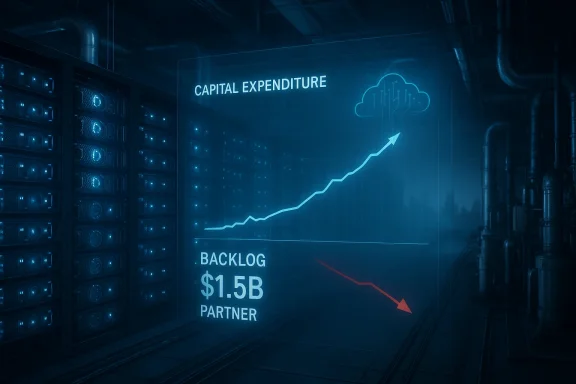
- Remaining Performance Obligations (commercial backlog): surged to a very large number — the company reported a dramatic increase in contracted backlog, with a large share tied to a single external partner.
- Additions to property and equipment (the company’s cash‑flow line for capital investment): were unusually large for the quarter, making clear that Microsoft is building physical AI capacity at scale.
Why investors sold first and asked questions later
Several mechanics explain the intensity of the sell‑off despite the quarter being profitable and revenue‑positive.1) Capital intensity shifted the conversation from growth to returns
Investors are comfortable paying up for durable, margin‑rich, recurring revenue streams. They are less tolerant of multi‑year, front‑loaded capital programs unless there is a clear path to high incremental returns. Microsoft’s disclosed level of infrastructure spending — unprecedented for a company of its scale — forced investors to recalculate expected future free cash flow. The question became: will this spending translate to higher long‑run margins and revenue, or will Microsoft simply be a capital‑heavy infrastructure operator in a low‑margin portion of the stack?2) Cloud growth is still strong — but the rate matters
Azure growth in the high‑30s remains strong compared with most enterprise software peers, but the market had priced Microsoft for sustained acceleration tied to AI demand. A one‑ or two‑percentage‑point deceleration in Azure’s growth rate, even on a large base, is meaningful. When a company on a multi‑hundred‑billion‑dollar revenue base slows a percentage point, that difference compounds valuation expectations materially.3) Concentration risk in backlog
When a company discloses a backlog where a very large share is linked to one counterparty, investors re‑examine counterparty credit, contract terms, and the potential for renegotiation or cash‑flow timing risk. High concentration can also crystallize regulatory or reputational risk if that counterparty’s fortunes wobble.4) Supply constraints and allocation choices
Management’s notes about being unable to build capacity fast enough — not because demand is weak, but because supply of critical GPUs and datacenter components is constrained — added a new wrinkle. Scarcity introduces allocation risk: which workloads get the limited capacity? Internal projects (Copilot, first‑party AI initiatives) versus third‑party customers? That’s an operational question with margin and revenue allocation consequences.The OpenAI question: amplification or concentration?
Microsoft’s strategic relationship with a leading AI company has been the single largest differentiator in its AI story. That integration has already generated significant commercial pipeline: Microsoft disclosed that a large portion of its commercial backlog is associated with that partner, and the company recorded a material accounting gain/loss effect tied to the investment.This arrangement has three consequences:
- It amplifies Microsoft’s AI positioning, creating a moat for cloud‑plus‑AI bundles that combine compute, models and distribution.
- It creates concentration risk: if that partner faces funding stress, competitive setbacks, or regulatory challenges, Microsoft’s revenue backlog and future monetization could be disrupted.
- It complicates accounting: investments and restructurings at the partner can swing Microsoft’s GAAP numbers materially from quarter to quarter, introducing volatility that investors must price.
CapEx: headline numbers and the math behind the worry
The quarter’s capital spending was unusually high. The company’s financial statements show large “additions to property and equipment,” and analysts extrapolated the first‑half capex run‑rate to an annualized figure that surprised many investors. Heavy capex increases depreciation expense and changes the character of the company’s cash generation in the near term.Key takeaways on capex:
- Heavy capex is expected for AI infrastructure: GPUs, systems integration, specialized racks, cooling and power upgrades.
- The near‑term impact is margin compression: hardware costs and depreciation increase cost of revenue and operating expense percentages.
- Annualizing partial‑year capex produces very large headline numbers; but investors should be cautious: one‑time, front‑loaded spending is not the same as permanent structural capex. The company can slow or modulate investment if returns or allocations dictate.
Competitors and market dynamics: is Microsoft winning or overcommitting?
Microsoft’s AI investments position it to capture several monetization pathways: higher Azure usage, premium AI features inside Microsoft 365 (Copilot), large enterprise contracts for hosted model inferencing, and distribution of third‑party models via its platform.At the same time, competition is intense:
- Other cloud providers are raising capacity and productizing inferencing to win enterprise workloads.
- Model providers are proliferating, offering lower‑cost, competitive or specialized solutions.
- New approaches to model training and inference (optimizations, custom silicon, more efficient architectures) could change the cost curve and reduce the edge Microsoft gains from a large, global data‑center footprint.
Short‑term scenarios: what could happen in the next 3–12 months
Investors and customers should watch for a few clear outcomes that will determine whether the sell‑off proves temporary or a longer re‑rating:- Capacity relief and Azure acceleration
- If Microsoft secures more hardware supply and ramps utilization quickly, Azure growth could re‑accelerate and unit economics would improve. Heavy capex would look like a forward investment that pays off.
- Margin pressure persists
- If hardware prices remain elevated and utilization lags, gross margins in the cloud segment could compress, depressing free cash flow and justifying a lower multiple.
- Contract concentration clarifies
- If the partner driving backlog stabilizes with clear funding and commercial terms, concentration concerns ease. Conversely, any sign of strain or renegotiation would be material.
- Monetization of AI features
- Adoption of Copilot and premium AI bundles at scale (including planned commercial price adjustments) could raise recurring revenue per user and offset infrastructure cost growth. Microsoft’s announced price updates to commercial Microsoft 365 suites, timed for mid‑2026 renewals, give the company a leverset to recapture revenue.
- Investor sentiment shifts
- Much of the immediate price action is sentiment‑driven. Demonstrable progress on capacity, clearer guidance about capex cadence, or evidence of enterprise adoption could flip the narrative quickly.
What Microsoft can — and likely will — do next
Management has several levers to safeguard margins and shore up investor confidence without abandoning the AI push:- Prioritize capacity allocation for commercial customers with higher margin profiles, and reallocate internal workloads if incremental revenue is higher from external demand.
- Provide clearer capex guidance and timeline: investors crave cadence — a planned tapering, milestone‑linked investment schedule, or explicit utilization targets would reduce uncertainty.
- Accelerate monetization of software and services that carry higher gross margins, such as Microsoft 365 Copilot bundles and premium enterprise features, including price increases timed to renewals.
- Explore capital partnerships to share infrastructure costs with hyperscale customers or strategic partners, thereby derisking the balance sheet.
- Improve transparency on partner exposure: granular disclosures on contract duration, payment schedules and termination clauses would reduce headline concentration risk.
Investor checklist — what to watch this quarter
For readers focused on Microsoft as an investment, these are the most material, near‑term signals to monitor:- Management guidance on Azure growth for the coming quarter and how it compares to the prior rate.
- Updated capex guidance or commentary on the cadence of data‑center builds and hardware procurement.
- Free cash flow and investments breakout: how much of total investing is property and equipment versus securities and other purchases?
- Backlog/RPO composition: whether the company discloses how concentrated RPO is by customer or price tier.
- Monetization metrics for Copilot and enterprise AI offerings: adoption metrics, contract sizes, and any large enterprise deals disclosed.
- Shareholder returns cadence: buybacks and dividend policy adjustments can offset valuation pressure even if growth temporarily softens.
The structural case: why this is not another “software growth” story — and why that matters
One reason Microsoft’s sell‑off feels different from past quarters is structural: the company is shifting from a software‑centric margin profile into a hybrid model that includes significant infrastructure ownership. Historically, Microsoft’s core franchises have enjoyed high incremental margins: Office and Windows generate subscription‑like economics with low marginal cost. Data centers and inferencing at scale are capital‑heavy, lower‑margin at the unit level until utilization scales.That structural shift changes valuation paradigms. The earlier multiple expansion was premised on software‑like margins and recurring growth. Now, investors must judge both software monetization and hardware capital efficiency. That’s a more complex, binary assessment: either Microsoft proves it can monetize AI at software‑like margins, or it settles into a hybrid profile that commands a different multiple.
Put another way: the next several quarters are less about whether AI drives revenue (it almost certainly will) and more about whether Microsoft can convert that revenue into free cash flow at a pace that justifies its premium valuation.
Risks and uncertainties to keep in mind
- Accounting volatility from equity investments: swings in the valuation of strategic investments can create large GAAP fluctuations quarter to quarter.
- Capacity and supply chain risk: constrained GPU supply, logistics bottlenecks, or geopolitical restrictions on hardware could slow ramp‑up.
- Customer concentration and counterparty risk: a large share of backlog tied to one partner is a potential point of failure if that counterparty’s access to capital or ability to pay is impaired.
- Competitive substitution: cheaper or more efficient model architectures, or alternative cloud competitors, can compress growth assumptions.
- Regulatory and antitrust scrutiny: as Microsoft monetizes AI and integrates model access into productivity suites, regulators may scrutinize bundling and competitive practices — a headline risk that can impact adoption or deal terms.
Bottom line: gradations of a correction, not an existential crisis
Microsoft’s sell‑off is a market correction in the face of a changed risk profile, not evidence that the AI thesis is wrong. The company remains a dominant platform with deep enterprise integrations, distribution channels, and product franchises that can embed AI widely. The sell‑off reflects the timing and capital intensity of that embedding.If Microsoft proves it can convert front‑loaded capex into high‑utilization infrastructure and then into software‑like recurring revenue (through Copilot, enterprise AI contracts, and upgraded commercial subscriptions), the valuation gap will likely close. If instead capex remains persistent, margins compress and concentration risks materialize, the market will demand a lower multiple for the new hybrid business.
For technologists, customers and IT leaders, the practical conclusion is unchanged: Microsoft is doubling down on AI across its stack, and that will shape cloud procurement, contract negotiations and product roadmaps for the next several years. For investors, the path forward is data: watch the next guidance, capex cadence, utilization metrics and commercial adoption of AI‑charged software. Those datapoints will decide whether last week’s sell‑off becomes a buying opportunity or the start of a longer re‑rating.
What to watch next (quick summary)
- Guidance: Azure growth and capex cadence on the next call.
- Utilization: metrics showing whether new data centers and GPU farms are being used at scale.
- Backlog clarity: how much of RPO is deliverable, and what’s the concentration by counterparty?
- Monetization: adoption and pricing trends for Copilot and upgraded M365 suites with bundled AI.
- Cash flow: free cash flow trajectory once heavy capex quarters normalize.
Source: Seeking Alpha https://seekingalpha.com/news/4545892-sa-asks-whats-next-for-microsoft-after-last-weeks-sell-off/
