

Microsoft’s latest Copilot reorganization is less a housekeeping exercise than a signal that the company is trying to force its AI strategy into a single, coherent shape. By folding consumer and commercial efforts into one structure, Microsoft is betting that the next phase of its AI business will be won not by disconnected products, but by a more tightly integrated system spanning the Copilot experience, Copilot platform, Microsoft 365 apps, and underlying AI models. That strategic reset matters because it affects how Microsoft sells AI, how it builds AI, and how it competes with faster-moving rivals in a market where scale, simplicity, and model quality all increasingly matter. ve comes at a moment when Microsoft’s Copilot brand is both broadly visible and still somewhat fragmented. The company has spent the past two years threading Copilot through consumer apps, enterprise subscriptions, Windows, Edge, and Microsoft 365, while also expanding the model stack behind the scenes. In its 2025 annual report, Microsoft said it surpassed 100 million monthly active users across commercial and consumer Copilot usage, and it highlighted a more unified consumer experience across Bing, Edge, GroupMe, MSN, Windows, and Xbox.
That kind of footprint would normally suggest a product line with strong momentum. Yet the very breadth of Microsoft’s AI touchpoints is part of the problem. Consumer Copilot, Microsoft 365 Copilot, Copilot Studio, and the platform work behind them have all grown quickly, but not always in lockstep. A reorganization that brings those pieces under one umbrella is a recognition that product sprawl can b a company as large as Microsoft.
The company’s public framing is classic Microsoft: simplify the experience, unify the stack, and let the platform become the product. Satya Nadella’s message about moving from “a collection of great products” to “a truly integrated system” captures that ambition neatly. The significance is not just rhetorical. Microsoft appears to be aligning its organization to treat Copilot less like a set of adjacent features and more like a full AI operating layeersonal use.
The first reason is competition. Microsoft has spent heavily to make Copilot the default AI companion in the Windows and Microsoft 365 universe, but rivals are moving aggressively too. The company’s own annual report noted more than 100 million monthly active users across Copilot usage, but the same report also underscores how broad the surface area has become, from consumer apps to enterprise workflows. That breadth is a strength, but it also creates the risk that users encounter multiple Copilot experiences that do not feel fully connected.
The second reason is commercial friction. Microsoft’s enterprise Copilot business has sold into a massive customer base, yet adoption remains below the scale of Microsoft 365 itself. Microsoft said it had sold 15 million Microsoft 365 Copilot seats, while Microsoft 365 has more than 450 million paid seats overall. That gap suggests enormous runwahow much work remains to turn awareness into widespread paid usage.
The consumer side presents a similar challenge. Microsoft has seen strong usage inside its own first-party properties, but consumer AI is a scale game, and competitors with highly visible standalone apps have set a brutal pace. A more unified internal structure gives Microsoft a better chance to ship one product direction across consumeexts instead of juggling competing priorities.
The third reason is technical. Microsoft has been steadily moving away from a single-model mindset toward a multi-model, orchestration-first approach. In September 2025, Microsoft added Anthropic’s Claude models to Microsoft 365 Copilot and Copilot Studio, signaling that the company wants model choice and model routing to be strategic advantages rather than afterthoughts. The broader reorganization makes that direction easier to execute because platform, app experience, and model work can be managed as a single system.
Andreou’s expanded role suggests Microsoft wants product velocity and coherent user experience to outrank internal boundaries. In practical terms, that may help reduce the lag between model advances, product packaging, and consumer-facing polish. It also creates a clearer accountability structure, which is often what big reorganizations are really about: less ambiguity over who owns the customart to finish.
The difference now is that Microsoft has more real-world usage data, more customer feedback, and more pressure to prove that Copilot can function as a durable platform rather than a collection of overlapping experiences. The new org chart appears designed to turn that ambition into shipping discipline.
Microsoft’s recent enterprise messaging suggests it knows this. In March 2026, the company introduced the Frontier Suite and the next wave of Microsoft 365 Copilot capabilities, emphasizing integration, governance, and model diversity. Microsoft also said that Copilot is moving toward a more “model diverse” system rather than a single-model dependency. That direction fits neatly with the new Copilot structure, which should help the company package AI more cleanly for business buyers.
That matters because users increasingly expect AI to feel native, not bolted on. If Copilot is going to justify premium pricing and stickiness, it cannot behave like a set that happen to share a name. It has to feel like one assistant that understands the context of work, the context of the user, and the context of the application. Microsoft’s reorganization is an attempt to make that consistency more likely.
That integration strategy is useful, but it also exposes a weakness: distribution alone does not guarantee daily habit formation. Consumer AI is increasingly dfrequency, and emotional familiarity, not just access. Microsoft needs Copilot to be not merely available, but indispensable. A unified leadership model could help the company push for that by reducing the product drift that often happens when consumer and enterprise teams compete for attention.
There is also a branding risk. Copilot has become a catch-all label for several different experiences, which can blur the ll assistant, a productivity tool, and a commercial platform. If Microsoft is not careful, the brand could become too expansive to mean anything specific. A unified structure helps, but only if it produces clearer messaging and cleaner product boundaries.
Microsoft has already shown that it is willing to diversify model sources rather than depend entirely on one partner. The addition of Anthropic’s Claude models inside Microsoft 365 Copilot and Copilot Studio demonstrated that the company is comfortable with a heterogeneous architecture when it serves product performance and customer flexibility. The new org structure should make it easier to keep that multi-model strategy aligned with product goals.
Another risk is over-centralization. Bringing consumer and commercial efforts together , but it can also create a single bottleneck for decisions that require very different product instincts. Consumer AI and enterprise AI share underlying technology, but they do not live or die by the same metrics. Microsoft will need to preserve enough flexibility to avoid forcing one market’s logic onto the other.
The point is not that Microsoft is behind in every dimension. It is that the company cannot afford slow product coordination when rivals are iterating so quickly. That is exactly why unifying the Copilot organization may matter more than the headlines suggest.
That is important because a more integrated Copilot strategy increases both power and responsibility. The more the assistant can see, do, and coordinate, the more damage can result from misuse, prompt injection, identity compromise, or policy gaps. A unified organization may help Microsoft respond faster, but the risks will scale right alongside the product ambitions.
That ambition is bold, but it is also logical. The winners in the next stage of AI may not be the companies with the flashiest demos; they may be the ones that make AI feel unavoidable because it is deeply woven into the products people already use every day. Microsoft has distribution, enterprise credibility, and a vast installed base. The reorg is an attempt to turn those assets into a cleaner execution engine.
Success would also mean that Microsoft can convert distribution into engagement. Copilot is already everywhere. The harder task is making it matter everywhere. The new structure is Microsoft’s best attempt so far to solve that problem at the organizational level rather than through piecemeal product tweaks.
Still, the reorg is only a starting point. Microsoft now has to prove that a unified Copilot organization can produce a more consistent consumer assistant, a stronger enterprise platform, and a more competitive model strategy without losing focus or creating new bottlenecks. If it succeeds, Copilot could evolve from a portfolio of AI features into one of the defining AI systems of the Windows and Microsoft ecosystem. If it doesn’t, the company may simply have rearranged the labels on a product family that still feels more fragmented than unified.
Source: PYMNTS.com Microsoft Combining Commercial and Consumer AI Efforts | PYMNTS.com
That kind of footprint would normally suggest a product line with strong momentum. Yet the very breadth of Microsoft’s AI touchpoints is part of the problem. Consumer Copilot, Microsoft 365 Copilot, Copilot Studio, and the platform work behind them have all grown quickly, but not always in lockstep. A reorganization that brings those pieces under one umbrella is a recognition that product sprawl can b a company as large as Microsoft.
The company’s public framing is classic Microsoft: simplify the experience, unify the stack, and let the platform become the product. Satya Nadella’s message about moving from “a collection of great products” to “a truly integrated system” captures that ambition neatly. The significance is not just rhetorical. Microsoft appears to be aligning its organization to treat Copilot less like a set of adjacent features and more like a full AI operating layeersonal use.
 Why Microsoft is doing this now
The first reason is competition. Microsoft has spent heavily to make Copilot the default AI companion in the Windows and Microsoft 365 universe, but rivals are moving aggressively too. The company’s own annual report noted more than 100 million monthly active users across Copilot usage, but the same report also underscores how broad the surface area has become, from consumer apps to enterprise workflows. That breadth is a strength, but it also creates the risk that users encounter multiple Copilot experiences that do not feel fully connected.The second reason is commercial friction. Microsoft’s enterprise Copilot business has sold into a massive customer base, yet adoption remains below the scale of Microsoft 365 itself. Microsoft said it had sold 15 million Microsoft 365 Copilot seats, while Microsoft 365 has more than 450 million paid seats overall. That gap suggests enormous runwahow much work remains to turn awareness into widespread paid usage.
The consumer side presents a similar challenge. Microsoft has seen strong usage inside its own first-party properties, but consumer AI is a scale game, and competitors with highly visible standalone apps have set a brutal pace. A more unified internal structure gives Microsoft a better chance to ship one product direction across consumeexts instead of juggling competing priorities.
The third reason is technical. Microsoft has been steadily moving away from a single-model mindset toward a multi-model, orchestration-first approach. In September 2025, Microsoft added Anthropic’s Claude models to Microsoft 365 Copilot and Copilot Studio, signaling that the company wants model choice and model routing to be strategic advantages rather than afterthoughts. The broader reorganization makes that direction easier to execute because platform, app experience, and model work can be managed as a single system.
The new Copilot structure
Four connected pillars
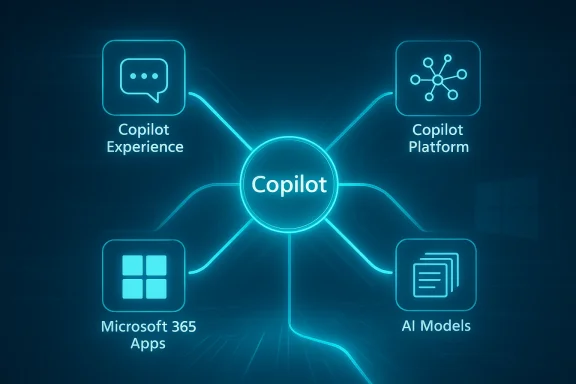
Nadella said Microsoft’s new approach will be built around four connected pillars: Copilot experience, Copilot platform, Microsoft 365 apps, and AI models. That is an important detail because it tells us where Microsoft believes value is created. The company is not merely tweaking product packaging; it is defining the AI stack as an interdependent set of layers that must ev structure is especially telling in the context of Microsoft 365. The company has already been moving Copilot deeper into Office apps through richer agentic workflows and tighter app integration. The annual report describes a major update to Microsoft 365 Copilot that brought together chat, search, create, notebooks, and role-specific agents such as Analyst and Researcher into a single experience. This is exactly the sort of convergence the reorg seems intended to accelerate.Jacob Andreou’s expanded role
The leadership change is equally significant. Jacob Andreou, the former Snap executive who already led product and growth for Microsoft AI, will become executive vice president of Copilot and oversee design, product, growth, and engineering. That consolidation matters because it aligns decision-making around one ofategically important product lines.Andreou’s expanded role suggests Microsoft wants product velocity and coherent user experience to outrank internal boundaries. In practical terms, that may help reduce the lag between model advances, product packaging, and consumer-facing polish. It also creates a clearer accountability structure, which is often what big reorganizations are really about: less ambiguity over who owns the customart to finish.
A broader platform mindset
This is not the first time Microsoft has reorganized around AI as a platform opportunity. In January 2025, the company launched CoreAI – Platform and Tools to build an end-to-end Copilot and AI stack for both first-party and third-party customers. That earlier move was a strong indication that Microsoft viewed platform unification as essential. The current Copilot reorg looks like the consumer-commercial version of the same logic.The difference now is that Microsoft has more real-world usage data, more customer feedback, and more pressure to prove that Copilot can function as a durable platform rather than a collection of overlapping experiences. The new org chart appears designed to turn that ambition into shipping discipline.
What this means for Microsoft 365 Copilot
Commercial adoption still has room to grow
Microsoft 365 Copilot is still the centerpiece of Microsoft’s enterprise AI pitch. But commercial adoption has not yet reached anything like ubiquity inside Microsoft 365’s massive installed base. The company’s own numbers make that clear: 15 million seats sold versus more than 450 million paid Microsoft 365 seats. That is a respectable start, but e company is still in the early innings of monetizing AI at scale.Microsoft’s recent enterprise messaging suggests it knows this. In March 2026, the company introduced the Frontier Suite and the next wave of Microsoft 365 Copilot capabilities, emphasizing integration, governance, and model diversity. Microsoft also said that Copilot is moving toward a more “model diverse” system rather than a single-model dependency. That direction fits neatly with the new Copilot structure, which should help the company package AI more cleanly for business buyers.
A more integrated office experience
The biggest near-term benefit of the reorg may be product coherence. Microsoft 365 Copilot has already grown from a simple chat assistant into a broader work system involving search, content creation, agents, and app-specific workflows. Bringing the commercial and consumer pieces together should make it easier for Microsoft to keep the Office apps, the Copilot interface, and the underlying AI models moving in the same direction.That matters because users increasingly expect AI to feel native, not bolted on. If Copilot is going to justify premium pricing and stickiness, it cannot behave like a set that happen to share a name. It has to feel like one assistant that understands the context of work, the context of the user, and the context of the application. Microsoft’s reorganization is an attempt to make that consistency more likely.
Consumer Copilot and the AI app battle
Microsoft wants a more competitive consumer story
The consumer side of Copilot is just as important. Microsoft has made Copilot available across Windows, Edge, Bing, and other surfaces, and it refreshed the consumer app to feel more personal and conversational. The annual report notes that Copilot is now integrated across Bing, Edge, GroupMe, MSN, Windows, and Xbox, and it highlights features such as Copilot Mode in Edge.That integration strategy is useful, but it also exposes a weakness: distribution alone does not guarantee daily habit formation. Consumer AI is increasingly dfrequency, and emotional familiarity, not just access. Microsoft needs Copilot to be not merely available, but indispensable. A unified leadership model could help the company push for that by reducing the product drift that often happens when consumer and enterprise teams compete for attention.
The challenge of coherence
Microsoft’s biggest challenge on the consumer side is coherence across devices and contexts. A user may encounter Copilot inside or in a standalone app and still not feel that they are using a single, evolving system. That problem is not unique to Microsoft, but it is especially visible because the company’s ecosystem is so broad. The new Copilot organization is likely intended to reduce those seams.There is also a branding risk. Copilot has become a catch-all label for several different experiences, which can blur the ll assistant, a productivity tool, and a commercial platform. If Microsoft is not careful, the brand could become too expansive to mean anything specific. A unified structure helps, but only if it produces clearer messaging and cleaner product boundaries.
The AI model layer becomes more important
Microsoft is treating models as strategic assets
Nadella’s comments make one point especially clear: Microsoft believes tl be increasingly important to its success over the next decade. That is not a throwaway remark. It reflects a reality in which model quality, model choice, model orchestration, and model cost directly affect product competitiveness.Microsoft has already shown that it is willing to diversify model sources rather than depend entirely on one partner. The addition of Anthropic’s Claude models inside Microsoft 365 Copilot and Copilot Studio demonstrated that the company is comfortable with a heterogeneous architecture when it serves product performance and customer flexibility. The new org structure should make it easier to keep that multi-model strategy aligned with product goals.
Why model choice matters
Model choice matters for three reasons:- Performance: Different tasks benefit from different strengths, whether that is reasoning, drafting, or workflow execution.
- Cost: Model routing can affect the economics of serving large user bases.
- Customer trust: Enterprise buyers want control, visibility, and governance over how AI is used.
Risks and trade-offs
Reorganization does not guarantee execution
The obvious risk is that structure changes alone do not fix product confusion or growth problems. Microsoft has reorganized before, and like most large companies, it knows that org charts are easier to change than customer behavior. If the company does not follow through with clearer packaging, better onboarding, and more consistent AI behavior across products, the reorg could amount to little more than internal housekeeping.Another risk is over-centralization. Bringing consumer and commercial efforts together , but it can also create a single bottleneck for decisions that require very different product instincts. Consumer AI and enterprise AI share underlying technology, but they do not live or die by the same metrics. Microsoft will need to preserve enough flexibility to avoid forcing one market’s logic onto the other.
The competitive pressure is not easing
Microsoft is reorganizing in a market that remains brutally competitive. OpenAI continues to pull enormous usage, Google remains a formidable challenger, and the AI race is shifting toward agents, workflow integration, and real-world utility. Microsoft’s own comparisons in the PYMNTS report underscore the scale gap: more than 150 million monthly active t-party platforms versus roughly 650 million monthly users for Gemini and about 900 million weekly active users for ChatGPT, according to the report. Those numbers should be treated as context rather than settled truth, but they illustrate the scale of the challeng to meet.The point is not that Microsoft is behind in every dimension. It is that the company cannot afford slow product coordination when rivals are iterating so quickly. That is exactly why unifying the Copilot organization may matter more than the headlines suggest.
Security and governance will only get harder
There is also a security dimension. As Copilot becomes more capable and more embedded, it becomes more attractive as an attack surface. Identity systems, business workflows, and agent-driven actions all create opportunities for abuse if controls are weak. Microsoft’s broader push toward governance-heavy products like Agent 365 and the Frontier Suite suggests it sees this clearly.That is important because a more integrated Copilot strategy increases both power and responsibility. The more the assistant can see, do, and coordinate, the more damage can result from misuse, prompt injection, identity compromise, or policy gaps. A unified organization may help Microsoft respond faster, but the risks will scale right alongside the product ambitions.
The bigger strategic picture
From products to systems
Microsoft’s Copilot reorganization should be understood as part of a broader shift across the company: away from standalone AI features and toward system-level AI. The Frontier Suite announcement, the move to multi-model Copilot experiences, the growth of agentic workflows, and the internal consolidation of commercial and consumer teams all point in the same direction. Microsoft is trying to build an AI system that can span work, home, apps, and infrastructure without feeling like a patchwork.That ambition is bold, but it is also logical. The winners in the next stage of AI may not be the companies with the flashiest demos; they may be the ones that make AI feel unavoidable because it is deeply woven into the products people already use every day. Microsoft has distribution, enterprise credibility, and a vast installed base. The reorg is an attempt to turn those assets into a cleaner execution engine.
What success would look like
If Microsoft gets this right, users should notice fewer seams between the consumer and commercial sides of Copilot, more predictable behavior across apps, and a clearer distinction between free, paid, and enterprise capabilities. The company should also become faster at translating model improvements into visible product gains. That would be the real payoff: not just a tidier org chart, but a faster innovation loop.Success would also mean that Microsoft can convert distribution into engagement. Copilot is already everywhere. The harder task is making it matter everywhere. The new structure is Microsoft’s best attempt so far to solve that problem at the organizational level rather than through piecemeal product tweaks.
Conclusion
Microsoft’s decision to merge its commercial and consumer Copilot efforts is a strategic admission that the company’s AI future depends on integration, not just reach. The move reflects a belief that the real competitive advantage will come from connecting the user experience, the platform layer, Microsoft 365, and the models underneath into one coordinated system. That is a sensible response to a market defined by fast-moving rivals, rising customer expectations, and increasingly agentic AI products.Still, the reorg is only a starting point. Microsoft now has to prove that a unified Copilot organization can produce a more consistent consumer assistant, a stronger enterprise platform, and a more competitive model strategy without losing focus or creating new bottlenecks. If it succeeds, Copilot could evolve from a portfolio of AI features into one of the defining AI systems of the Windows and Microsoft ecosystem. If it doesn’t, the company may simply have rearranged the labels on a product family that still feels more fragmented than unified.
Source: PYMNTS.com Microsoft Combining Commercial and Consumer AI Efforts | PYMNTS.com