

Microsoft is moving deeper into a more ambitious AI strategy, and this week’s Copilot shake-up makes that direction clearer than ever. The company’s reported hire of Ali Farhadi as Corporate Vice President, working under Mustafa Suleyman, is not just another executive move; it is a signal that Microsoft wants stronger in-house model expertise and a tighter grip on its AI future. Combined with the company’s recent reorganization of Copilot into four pillars and its growing talk of superintelligence, the message is hard to miss: Microsoft is trying to turn AI from a feature into a foundational platform.
Microsoft’s current AI strategy did not emerge overnight. It has been built in layers, starting with a partnership-led approach and gradually evolving into something much more vertically integrated. In March 2024, Microsoft brought Mustafa Suleyman into the company to lead a new consumer AI organization, while still emphasizing its strategic partnership with OpenAI and the broader infrastructure work supporting that relationship. The company framed that moment as a move to “double down” on innovation and product development across Copilot and consumer AI. (blogs.microsoft.com)
That was followed by a more structural turn in January 2025, when Satya Nadella announced CoreAI – Platform and Tools. The purpose of that move was to unify the company’s AI platform, tools, and infrastructure into a more cohesive engineering layer for both first-party and third-party customers. Microsoft described the shift as building the “end-to-end Copilot & AI stack,” underscoring that the company was no longer content to treat AI as a surface-level feature bolted onto existing software. (blogs.microsoft.com)
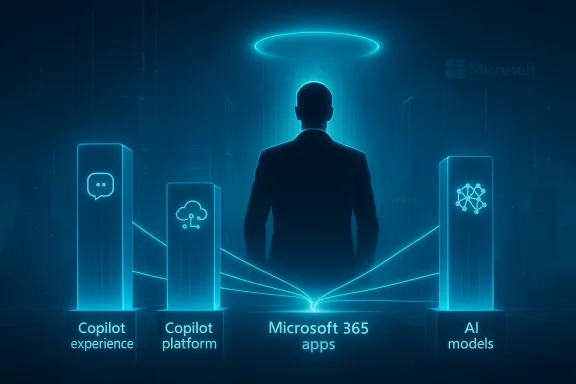
The latest Copilot changes sit squarely on top of those earlier decisions. Windows Report’s March 24, 2026 article says Microsoft has hired Ali Farhadi as Corporate Vice President and placed him under Suleyman as part of a broader AI leadership expansion. It also says Copilot has been split into four pillars: Copilot experience, Copilot platform, Microsoft 365 apps, and AI models. Those details fit a pattern Microsoft has been building for more than two years: separate the product layer from the platform layer, then bring them back together under a tighter executive chain. (windowsreport.com)
At the same time, Microsoft’s organizational changes also reveal something subtler: AI is being split into specialized domains so execution can speed up without losing central control. That is a classic move for a company at scale, but it also reflects how quickly AI product cycles have compressed. The old model of slow platform planning no longer fits the pace of generative AI competition. Speed now matters almost as much as capability. (blogs.microsoft.com)
Microsoft’s reported decision to place him directly under Suleyman suggests more than a routine senior hire. It implies that Microsoft wants a leadership bench that can bridge model science and product execution without forcing every decision through a sprawling bureaucracy. That is significant because the company’s AI ambitions are now wide enough that a single executive can no longer own everything cleanly. Farhadi looks like a reinforcement hire for a more demanding phase, not a symbolic headline grab. (windowsreport.com)
This is a meaningful shift from the early Copilot era, when the user-facing idea of a “personal AI companion” was doing most of the marketing work. Now Microsoft is moving toward a more segmented operating model. That is likely a response to complexity, but it is also a sign of maturity: the company is realizing that a successful AI stack needs separate teams for the front end, the middle platform, and the model core. (blogs.microsoft.com)
The split also reflects a mature commercial strategy. Microsoft 365 apps remain a major monetization engine, while the Copilot platform matters for extensibility and developer adoption. Meanwhile, the AI models pillar gives the company a way to invest in its own core capability without pretending every product team needs to own that research directly. That separation is strategic, not cosmetic. (windowsreport.com)
The most eye-catching phrase in the reporting is superintelligence. Microsoft reportedly sees this as a long-term goal, with Suleyman describing world-class AI models as a five-year ambition. That may sound lofty, but in the current AI market, such ambition is no longer unusual. The real question is whether the company can convert the language of frontier aspiration into repeatable product and infrastructure gains. (windowsreport.com)
There is also a philosophical angle here. Microsoft has been explicit that human control, agency, and economic opportunity should remain central to its AI work. That language matters because “superintelligence” can sound destabilizing if it is framed purely as a capability race. Microsoft is trying to preempt that concern by blending frontier rhetoric with governance language.
This does not necessarily mean Microsoft is abandoning partners. More likely, it is hedging. In a market where model quality, cost, latency, and policy constraints can shift quickly, having in-house leverage is a strategic necessity. A company of Microsoft’s size cannot afford to be merely a passenger in someone else’s model roadmap. (blogs.microsoft.com)
There is a second-order benefit too. If Microsoft can develop stronger internal model talent, it may be able to move faster when external ecosystem dynamics become unstable. The AI market is still full of shifting alliances, pricing pressure, and capability jumps. Owning more of the stack is a way to stay flexible when the industry changes under your feet. That flexibility may turn out to be more valuable than any single model release. (blogs.microsoft.com)
That would be a notable shift. Early AI product strategy often leaned on maximum visibility, with features placed everywhere to encourage discovery. But the current direction suggests Microsoft may prefer more deliberate placement, especially if users perceive some integrations as clutter. In other words, the company may be moving from AI ubiquity to AI relevance. (windowsreport.com)
For enterprises, the calculation is different. Businesses care less about decorative presence and more about control, governance, and measurable productivity gains. Microsoft 365 Copilot, platform extensibility, and admin visibility all matter more than splashy UI placement. That is why the internal reorganization seems aimed at making the enterprise story cleaner and more scalable. (blogs.microsoft.com)
That matters because AI value is increasingly accruing to whoever owns the relationship between model, workflow, and distribution. Microsoft already has strong distribution through Windows and Microsoft 365, but distribution alone is not enough if model quality is not competitive. The Farhadi hire suggests Microsoft understands that talent and technical depth are now strategic assets, not just support functions. (windowsreport.com)
Another consequence is that the bar for Copilot will keep rising. Once a company says it is pursuing superintelligence and world-class model leadership, users and enterprises start expecting genuinely better reasoning, lower hallucination rates, and more trustworthy behavior. That can be a blessing or a burden, depending on how quickly the product evolves. Frontier ambition is easy to announce and hard to sustain. (windowsreport.com)
There is also the integration risk. Copilot lives across Windows, Microsoft 365, and enterprise platforms, which means poor design choices can scale quickly. A confusing assistant, a noisy interface, or an underwhelming business case can spread just as fast as a strong one. That makes product discipline essential, not optional. (windowsreport.com)
That means the most important signals to watch are not just headlines about hires or restructures. They will be product quality, enterprise adoption, pricing models, and how Microsoft balances distribution with restraint. If the company can make Copilot more capable while making it feel less intrusive, it will have solved one of the hardest problems in consumer and enterprise AI. If it can do that, the market will notice quickly. (windowsreport.com)
Source: https://windowsreport.com/microsoft...e-focuses-on-ai-models-and-superintelligence/
 Background
Microsoft’s current AI strategy did not emerge overnight. It has been built in layers, starting with a partnership-led approach and gradually evolving into something much more vertically integrated. In March 2024, Microsoft brought Mustafa Suleyman into the company to lead a new consumer AI organization, while still emphasizing its strategic partnership with OpenAI and the broader infrastructure work supporting that relationship. The company framed that moment as a move to “double down” on innovation and product development across Copilot and consumer AI. (blogs.microsoft.com)That was followed by a more structural turn in January 2025, when Satya Nadella announced CoreAI – Platform and Tools. The purpose of that move was to unify the company’s AI platform, tools, and infrastructure into a more cohesive engineering layer for both first-party and third-party customers. Microsoft described the shift as building the “end-to-end Copilot & AI stack,” underscoring that the company was no longer content to treat AI as a surface-level feature bolted onto existing software. (blogs.microsoft.com)
The latest Copilot changes sit squarely on top of those earlier decisions. Windows Report’s March 24, 2026 article says Microsoft has hired Ali Farhadi as Corporate Vice President and placed him under Suleyman as part of a broader AI leadership expansion. It also says Copilot has been split into four pillars: Copilot experience, Copilot platform, Microsoft 365 apps, and AI models. Those details fit a pattern Microsoft has been building for more than two years: separate the product layer from the platform layer, then bring them back together under a tighter executive chain. (windowsreport.com)
Why this matters now
The timing is especially important because Microsoft is no longer just trying to “add AI” to its products. It is trying to decide how much of the AI stack it wants to own. That means models, inference, interfaces, enterprise controls, and the user experience are all becoming strategic battlegrounds at once. In practical terms, this is a bet that the next durable software advantage will come from controlling the model layer, not merely consuming it. (blogs.microsoft.com)At the same time, Microsoft’s organizational changes also reveal something subtler: AI is being split into specialized domains so execution can speed up without losing central control. That is a classic move for a company at scale, but it also reflects how quickly AI product cycles have compressed. The old model of slow platform planning no longer fits the pace of generative AI competition. Speed now matters almost as much as capability. (blogs.microsoft.com)
The Farhadi Hire and What It Signals
Ali Farhadi is an important name to bring into any AI organization. Windows Report says he previously led the Allen Institute for AI and co-founded Xnor.ai, which was known for efficient on-device AI and later acquired by Apple. Even without reading too much into the title alone, that background points to exactly the kind of talent Microsoft appears to want right now: research credibility, product pragmatism, and experience working on efficient model systems. (windowsreport.com)Microsoft’s reported decision to place him directly under Suleyman suggests more than a routine senior hire. It implies that Microsoft wants a leadership bench that can bridge model science and product execution without forcing every decision through a sprawling bureaucracy. That is significant because the company’s AI ambitions are now wide enough that a single executive can no longer own everything cleanly. Farhadi looks like a reinforcement hire for a more demanding phase, not a symbolic headline grab. (windowsreport.com)
Why his background fits Microsoft’s needs
Farhadi’s experience matters because Microsoft is working across several different AI problems at once. Consumer assistants, enterprise copilots, and backend AI models each demand different tradeoffs around efficiency, safety, cost, and latency. Someone with a research-and-systems background can help keep those tradeoffs aligned instead of treating them as isolated product concerns. (windowsreport.com)- He adds deep model expertise to a leadership group that is already product-heavy.
- His background supports Microsoft’s push toward in-house AI capability.
- He may help connect research, product, and deployment more tightly.
- His appointment suggests Microsoft values efficient model engineering, not only raw scale.
- The hire reinforces the idea that Copilot is becoming a platform strategy, not a single app.
Copilot Becomes a Four-Pillar System
One of the most revealing elements in the reporting is the four-pillar Copilot structure: Copilot experience, Copilot platform, Microsoft 365 apps, and AI models. That breakdown tells us Microsoft is treating AI as a layered system rather than a single assistant persona. It also indicates that the company wants clearer ownership for where value is created and where value is delivered. (windowsreport.com)This is a meaningful shift from the early Copilot era, when the user-facing idea of a “personal AI companion” was doing most of the marketing work. Now Microsoft is moving toward a more segmented operating model. That is likely a response to complexity, but it is also a sign of maturity: the company is realizing that a successful AI stack needs separate teams for the front end, the middle platform, and the model core. (blogs.microsoft.com)
The logic behind the split
The logic is straightforward. Different parts of Copilot solve different business problems, and they do not all need the same speed, governance, or investment profile. Product teams building the user experience should not be constrained by the same priorities as the researchers tuning model behavior or the platform teams responsible for enterprise integration. Microsoft is trying to create fewer bottlenecks and more specialized accountability. (blogs.microsoft.com)The split also reflects a mature commercial strategy. Microsoft 365 apps remain a major monetization engine, while the Copilot platform matters for extensibility and developer adoption. Meanwhile, the AI models pillar gives the company a way to invest in its own core capability without pretending every product team needs to own that research directly. That separation is strategic, not cosmetic. (windowsreport.com)
- Copilot experience likely shapes what users actually see and feel.
- Copilot platform handles extensibility and integration.
- Microsoft 365 apps anchor the productivity monetization story.
- AI models are the core bet on long-term differentiation.
Suleyman’s Role and the Superintelligence Ambition
Mustafa Suleyman’s presence remains central to Microsoft’s AI direction. Since his arrival in 2024, the company has repeatedly linked him with consumer AI innovation, product vision, and a willingness to think beyond the immediate product cycle. The latest reporting says his remit is now narrowing toward model science, which is exactly what a company does when it wants its best executive minds focused on the hardest technical problem. (blogs.microsoft.com)The most eye-catching phrase in the reporting is superintelligence. Microsoft reportedly sees this as a long-term goal, with Suleyman describing world-class AI models as a five-year ambition. That may sound lofty, but in the current AI market, such ambition is no longer unusual. The real question is whether the company can convert the language of frontier aspiration into repeatable product and infrastructure gains. (windowsreport.com)
From consumer assistant to model frontier
This matters because it changes the meaning of Copilot. If Copilot was once primarily a productivity assistant, it is now being reframed as the product surface for a much bigger model strategy. That makes the assistant less of an endpoint and more of a distribution layer for Microsoft’s broader AI stack. In that sense, Copilot is becoming the showcase for model progress rather than the model itself. (windowsreport.com)There is also a philosophical angle here. Microsoft has been explicit that human control, agency, and economic opportunity should remain central to its AI work. That language matters because “superintelligence” can sound destabilizing if it is framed purely as a capability race. Microsoft is trying to preempt that concern by blending frontier rhetoric with governance language.
- The goal is long-term model leadership, not just feature parity.
- Human oversight remains part of the public narrative.
- Copilot may increasingly serve as a distribution point for advanced models.
- The company is trying to balance frontier ambition with enterprise trust.
Microsoft’s In-House AI Push
The clearest strategic shift in this story is Microsoft’s desire to own more of the AI stack. The company has long benefited from external partnerships, especially with OpenAI, but the reporting and Microsoft’s own organizational changes point to a more diversified future. CoreAI, the Copilot restructuring, and the Farhadi hire all suggest Microsoft wants stronger internal capability rather than dependency on a single external source. (blogs.microsoft.com)This does not necessarily mean Microsoft is abandoning partners. More likely, it is hedging. In a market where model quality, cost, latency, and policy constraints can shift quickly, having in-house leverage is a strategic necessity. A company of Microsoft’s size cannot afford to be merely a passenger in someone else’s model roadmap. (blogs.microsoft.com)
Why vertical integration matters
Vertical integration gives Microsoft more control over product timing, model behavior, and enterprise packaging. It also improves its ability to optimize across Azure, GitHub, Office, and Windows, rather than treating each layer as a separate commercial decision. That kind of optimization can improve margins, user experience, and strategic coherence all at once. (blogs.microsoft.com)There is a second-order benefit too. If Microsoft can develop stronger internal model talent, it may be able to move faster when external ecosystem dynamics become unstable. The AI market is still full of shifting alliances, pricing pressure, and capability jumps. Owning more of the stack is a way to stay flexible when the industry changes under your feet. That flexibility may turn out to be more valuable than any single model release. (blogs.microsoft.com)
- Better cost control across inference and deployment.
- More product differentiation if models are tuned in-house.
- Stronger enterprise trust through tighter governance.
- Reduced dependency risk on external vendors.
- Greater cross-product consistency across Microsoft’s ecosystem.
Copilot Across Windows and Microsoft 365
The Windows and Microsoft 365 dimensions of this story are especially important for everyday users. Copilot is not just an AI brand; it is becoming a recurring layer across the operating system and productivity suite. Yet recent reporting suggests Microsoft may also be becoming more selective about where Copilot appears, rather than forcing it into every corner of Windows 11. (windowsreport.com)That would be a notable shift. Early AI product strategy often leaned on maximum visibility, with features placed everywhere to encourage discovery. But the current direction suggests Microsoft may prefer more deliberate placement, especially if users perceive some integrations as clutter. In other words, the company may be moving from AI ubiquity to AI relevance. (windowsreport.com)
Consumer versus enterprise realities
For consumers, this matters because Windows still acts as the most visible showcase for Microsoft’s platform ambitions. If Copilot appears too often, it risks feeling like bloat; if it appears too little, it risks fading into the background. Microsoft has to strike a very narrow balance between visibility and usefulness. (windowsreport.com)For enterprises, the calculation is different. Businesses care less about decorative presence and more about control, governance, and measurable productivity gains. Microsoft 365 Copilot, platform extensibility, and admin visibility all matter more than splashy UI placement. That is why the internal reorganization seems aimed at making the enterprise story cleaner and more scalable. (blogs.microsoft.com)
- Consumers want Copilot to feel helpful, not intrusive.
- Enterprises want Copilot to be governable and measurable.
- Windows needs to avoid becoming an AI clutter zone.
- Microsoft 365 needs to prove clear ROI to justify premium pricing.
The Competitive Implications
Microsoft’s moves should be read in the context of a much wider market battle. The company is competing not just with other productivity suites, but with model labs, cloud platforms, and operating system ecosystems. By reorganizing Copilot and deepening model leadership, Microsoft is trying to make sure it does not get boxed into a role as a mere app distributor for other people’s AI. (blogs.microsoft.com)That matters because AI value is increasingly accruing to whoever owns the relationship between model, workflow, and distribution. Microsoft already has strong distribution through Windows and Microsoft 365, but distribution alone is not enough if model quality is not competitive. The Farhadi hire suggests Microsoft understands that talent and technical depth are now strategic assets, not just support functions. (windowsreport.com)
How rivals may respond
Competitors will likely respond in one of three ways. Some will double down on foundation model scale; others will emphasize specialized enterprise use cases; and a third group will try to outmaneuver Microsoft on openness and interoperability. Microsoft’s challenge is that it must defend all three fronts at once, which makes its internal coherence especially valuable. (blogs.microsoft.com)Another consequence is that the bar for Copilot will keep rising. Once a company says it is pursuing superintelligence and world-class model leadership, users and enterprises start expecting genuinely better reasoning, lower hallucination rates, and more trustworthy behavior. That can be a blessing or a burden, depending on how quickly the product evolves. Frontier ambition is easy to announce and hard to sustain. (windowsreport.com)
- Rival AI assistants may face stronger distribution pressure.
- Model labs will have to compete with Microsoft’s enterprise funnel.
- Productivity software vendors may need deeper AI differentiation.
- Cloud rivals must account for Microsoft’s stack integration advantage.
- The enterprise market may increasingly reward platform coherence over novelty.
Strengths and Opportunities
Microsoft’s strategy has real strengths, and the latest moves highlight why the company remains one of the most formidable players in AI. It has the capital to hire elite talent, the distribution to put AI in front of hundreds of millions of users, and the platform depth to connect models to actual workflows. That combination is hard to match, especially when the company aligns leadership, product, and infrastructure around a single direction. (blogs.microsoft.com)- Deep distribution through Windows, Microsoft 365, Azure, and GitHub.
- Executive focus from Satya Nadella and Mustafa Suleyman on AI.
- Stronger model talent through hires like Ali Farhadi.
- Clearer organizational ownership with the four-pillar Copilot structure.
- Enterprise credibility that can support regulated adoption.
- Platform integration that can make Copilot feel more useful over time.
- Long-term optionality if Microsoft reduces dependency on external model providers.
Risks and Concerns
There are also serious risks. The most obvious is that Microsoft may be overcomplicating its own AI structure just as the market is demanding simplicity from customers. Reorganizations can create clarity at the top while creating confusion in execution, and AI teams are especially vulnerable to that problem because the field moves so quickly. (blogs.microsoft.com)- Organizational complexity could slow execution.
- Superintelligence messaging may create unrealistic expectations.
- Copilot fatigue could set in if users see too much AI everywhere.
- Enterprise skepticism could grow if ROI is unclear.
- Model investment costs may rise faster than product returns.
- Dependency shifts could create tension with existing partners.
- Safety and governance concerns remain central to any frontier AI plan.
There is also the integration risk. Copilot lives across Windows, Microsoft 365, and enterprise platforms, which means poor design choices can scale quickly. A confusing assistant, a noisy interface, or an underwhelming business case can spread just as fast as a strong one. That makes product discipline essential, not optional. (windowsreport.com)
Looking Ahead
The next phase of Microsoft’s AI strategy will likely be defined by execution rather than announcements. The company has already laid the organizational groundwork: new leadership, sharper model focus, a structured Copilot stack, and a clearer internal AI platform story. What comes next is whether those pieces turn into better products, clearer monetization, and more dependable AI behavior. (blogs.microsoft.com)That means the most important signals to watch are not just headlines about hires or restructures. They will be product quality, enterprise adoption, pricing models, and how Microsoft balances distribution with restraint. If the company can make Copilot more capable while making it feel less intrusive, it will have solved one of the hardest problems in consumer and enterprise AI. If it can do that, the market will notice quickly. (windowsreport.com)
- Watch for new model announcements tied to Copilot.
- Watch for changes in Windows 11 AI placement and visibility.
- Watch for enterprise Copilot pricing and packaging adjustments.
- Watch for more executive reporting lines that centralize AI oversight.
- Watch for productivity metrics that show whether Copilot is truly delivering value.
- Watch for partner strategy shifts that reveal how independent Microsoft wants to become.
Source: https://windowsreport.com/microsoft...e-focuses-on-ai-models-and-superintelligence/
