

Microsoft has flipped the switch on a purpose-built Fairwater datacenter near Atlanta — a second, operational node Microsoft now says is joined with its original Wisconsin site to form what the company calls the world’s first planet‑scale AI superfactory.
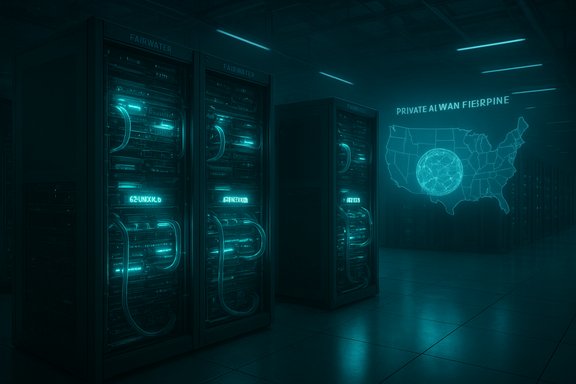
Microsoft’s public engineering post and accompanying press coverage describe the new Atlanta‑area Fairwater facility as a deliberate re‑imagining of cloud infrastructure for frontier AI — workloads that demand synchronized, ultra‑dense GPU clusters for training and reasoning at multi‑trillion‑parameter scale. The company says the Atlanta site began operating in October and is linked by a dedicated, optimized optical backbone to the Wisconsin Fairwater campus, creating a distributed compute fabric that behaves like a single, vastly scaled supercomputer. The Atlanta installation sits on or adjacent to a massive QTS campus near Fayetteville that was permitted in 2025; public records and local reporting place Microsoft’s Fairwater equipment on that QTS development, which spans hundreds of acres and was originally marketed as Project Excalibur. Local coverage highlights both the scale of the campus and the community debate around water and power impacts that big server farms bring. Why this matters now: AI model sizes, training data volumes and per‑step communication overhead have made conventional server‑by‑server scale-outs inefficient for the cutting edge. Microsoft’s Fairwater shifts engineering tradeoffs — rack as accelerator, liquid cooling, two‑story halls and a private “AI WAN” — to reduce latency, maximize GPU utilization and permit synchronous training across distant sites. Those are architectural choices that change how cloud vendors compete for the top end of AI compute.
To support extreme rack‑level power envelopes, Fairwater relies on closed‑loop direct liquid cooling. Microsoft emphasizes a design that minimizes ongoing water consumption — characterizing the operational loop as near‑zero consumptive water use after an initial fill — and uses external heat rejection systems to move heat out of the site. Independent vendor materials and Microsoft’s engineering posts align on these cooling choices as essential to sustain per‑rack power densities an order of magnitude higher than legacy air‑cooled racks. That said, claims about exact water savings and makeup requirements should be read as company‑reported and are sensitive to operational detail.
Readers should treat headline capacity and performance claims as company‑reported and watch for audited benchmarks, regulatory filings and independent telemetry in the months ahead. The era of AI superfactories has begun in earnest — and the real test will be whether these distributed, rack‑scale fabrics deliver predictable, portable, and sustainable compute for the broad ecosystem that will depend on them.
Source: AJC.com Microsoft’s newest AI ‘superfactory’ opens at sprawling Fayetteville campus
 Background: what Microsoft announced and why it matters
Microsoft’s public engineering post and accompanying press coverage describe the new Atlanta‑area Fairwater facility as a deliberate re‑imagining of cloud infrastructure for frontier AI — workloads that demand synchronized, ultra‑dense GPU clusters for training and reasoning at multi‑trillion‑parameter scale. The company says the Atlanta site began operating in October and is linked by a dedicated, optimized optical backbone to the Wisconsin Fairwater campus, creating a distributed compute fabric that behaves like a single, vastly scaled supercomputer. The Atlanta installation sits on or adjacent to a massive QTS campus near Fayetteville that was permitted in 2025; public records and local reporting place Microsoft’s Fairwater equipment on that QTS development, which spans hundreds of acres and was originally marketed as Project Excalibur. Local coverage highlights both the scale of the campus and the community debate around water and power impacts that big server farms bring. Why this matters now: AI model sizes, training data volumes and per‑step communication overhead have made conventional server‑by‑server scale-outs inefficient for the cutting edge. Microsoft’s Fairwater shifts engineering tradeoffs — rack as accelerator, liquid cooling, two‑story halls and a private “AI WAN” — to reduce latency, maximize GPU utilization and permit synchronous training across distant sites. Those are architectural choices that change how cloud vendors compete for the top end of AI compute. Overview of the Fairwater design and the “AI superfactory” concept
The rack-as-accelerator
At the heart of Fairwater is the NVL72 rack concept: a single rack houses up to 72 NVIDIA Blackwell family GPUs coupled with NVIDIA Grace‑class host CPUs and NVLink/NVSwitch fabrics, effectively presenting the entire rack as a single, pooled accelerator to schedulers and runtimes. NVIDIA’s own NVL72 datasheets corroborate the 72‑GPU rack design and advertise very high intra‑rack NVLink bandwidth and tens of terabytes of pooled fast memory per rack. Microsoft and industry reporting both emphasize this as the practical atomic unit for large‑model placements. Why that matters: gradient exchange, activation shuffling and model‑parallel synchronization are extremely communication‑heavy. Keeping more of that traffic inside an NVLink‑rich rack domain reduces cross‑host sharding overhead and improves tokens‑per‑second throughput for large LLM pretraining and inference. The Fairwater architecture therefore trades floor space and mechanical complexity for far higher per‑square‑foot compute density and predictable, synchronized performance.Two-story halls, liquid cooling, and facility engineering
Fairwater’s building design deviates from conventional single‑story hyperscale halls. Microsoft’s Fairwater sites use a two‑story layout that shortens cable runs and reduces propagation latency between racks, enabling tighter NVLink/NVSwitch topologies and denser rack placement. These two‑story halls also require heavier structural floors, sophisticated coolant piping and more complex mechanical systems.To support extreme rack‑level power envelopes, Fairwater relies on closed‑loop direct liquid cooling. Microsoft emphasizes a design that minimizes ongoing water consumption — characterizing the operational loop as near‑zero consumptive water use after an initial fill — and uses external heat rejection systems to move heat out of the site. Independent vendor materials and Microsoft’s engineering posts align on these cooling choices as essential to sustain per‑rack power densities an order of magnitude higher than legacy air‑cooled racks. That said, claims about exact water savings and makeup requirements should be read as company‑reported and are sensitive to operational detail.
The AI WAN: linking sites into a coherent fabric
Microsoft describes an “AI WAN” — a dedicated, high‑capacity fiber backbone and an optimized transport stack — that links Fairwater sites so multi‑site jobs can proceed with minimal congestion. Microsoft has reported a rapid expansion in fiber mileage supporting this fabric, and independent technical coverage describes proprietary protocol optimizations (referred to publicly as Multi‑Path Reliable Connected or “MRC” in some reporting) designed to improve route control, congestion handling and retransmission behavior for collective operations such as AllReduce. The AI WAN is the systems‑level change that allows a geographically distributed cluster to approximate the behavior of a single, tightly coupled supercomputer.Technical deep dive: hardware, networking, and the software stack
NVIDIA GB200 / GB300 NVL72 racks — what they bring
NVIDIA’s GB200 and GB300 NVL72 rack designs are the primary hardware building blocks being cited for Fairwater. Key vendor‑published figures include:- 72 Blackwell GPUs and 36 Grace CPUs in GB200 NVL72 configurations.
- Very high intra‑rack NVLink bandwidth (vendor figures show NVLink aggregates up to ~130 TB/s for some NVL72 configurations).
- Pooled fast memory per rack measured in the tens of terabytes (GB300 pages cite ~37–40 TB ranges depending on configuration).
Network fabric: spine/leaf, InfiniBand/Spectrum‑X and deterministic traffic
Inside sites, Fairwater designs layer NVLink within racks with high‑speed RDMA fabrics between racks and pods (800 Gbps‑class links and InfiniBand/Quantum‑class switching are referenced in vendor/press materials). For cross‑site scale‑out, Microsoft’s AI WAN aims to provide a deterministic, low‑congestion path and telemetry to keep synchronous collective operations from stalling. SDxCentral and Microsoft’s technical posts describe protocol and route optimizations intended to deliver smoother, more predictable cross‑site communication for training workloads. These networking investments are as significant as the compute investments because GPU‑to‑GPU synchronization times scale badly with network jitter and packet loss.Orchestration, APIs and customer-facing SKUs
On the software side, Microsoft is exposing Fairwater compute via Azure’s ND/NC/NDv‑style VM families, with ND GB300 v6 (example naming) and other specialized SKUs optimized for large‑model training and inference. The orchestration stack must know the rack‑as‑accelerator semantics, schedule whole‑rack placements, and manage cross‑site bandwidth reservations for synchronous jobs — all nontrivial extensions over general‑purpose cloud schedulers. Microsoft publicly frames these as productized offerings for internal AI teams, strategic partners and enterprise customers needing short iteration cycles on very large models.Cross‑checking key claims: what is verified, what remains aspirational
Microsoft and partners have made high‑visibility claims about Fairwater. Cross‑checking those claims against vendor materials, independent trade reporting and local records yields a clearer picture.- Atlanta site operational timing: Microsoft and local reporting place the Atlanta Fairwater site into operation in October 2025. That timing appears consistent in Microsoft’s engineering posts and AJC coverage.
- Rack architecture and GPU counts per rack: NVIDIA’s NVL72 datasheets confirm the 72‑GPU rack architecture and the GB200/GB300 technical envelopes Microsoft cites. Those vendor specs substantiate Microsoft’s rack‑scale claims.
- AI WAN and fiber expansion: Microsoft reports significant fiber additions and describes an AI‑optimized WAN; independent trade reporting corroborates the AI WAN concept and describes protocol optimizations. Exact fiber mileage (figures like ~120,000 miles) are company‑reported and have been repeated in industry coverage, but independent audit‑level verification of that aggregate mileage requires telco‑level disclosure or regulatory filings not publicly available in full. Treat mileage figures as plausible and company‑reported.
- “Hundreds of thousands” of GPUs and hyperbolic performance multipliers: Microsoft has described multi‑site capacity goals (phrases like “hundreds of thousands” of GPUs) and comparative performance claims versus legacy supercomputers. These are strategic capacity and benchmarking claims that depend heavily on configuration, workload, and which comparative baseline is used — they should be treated as aspirational program targets or promotional engineering envelopes unless independently audited. Concrete inventory and sustained performance figures require third‑party telemetry or audit.
Local impacts and controversies: Fayetteville, power and water concerns
The AJC reporting places Microsoft’s Fairwater equipment on a QTS campus near Fayetteville that spans hundreds of acres and was permitted for large data center occupancy; that community context matters for local planners and residents. Data center growth in Georgia has provoked debate over grid capacity, water use, tax incentives and land use, and Fairwater adds a high‑profile, high‑power consumer to that conversation. Microsoft emphasizes closed‑loop liquid cooling and reduced operational water use, but independent analysts caution that even closed‑loop systems require significant electrical power for chillers and heat rejection and carry infrastructure impacts (heavy piping, larger electrical feeds, potential for on‑site energy storage or grid‑interaction systems). The environmental and municipal consequences depend on site‑level details: how much grid‑connected renewable power is contracted, whether energy storage is used for smoothing, and how much mechanical cooling energy is required. Those are the levers that determine whether a high‑density site is a net win for sustainability or a local burden.Commercial and competitive implications for cloud customers and partners
Microsoft’s Fairwater initiative signals a few practical shifts for enterprises, AI labs and hyperscaler competitors:- For frontier model developers, the superfactory model promises lower wall‑clock training time for very large models and higher predictability for synchronous runs — a competitive advantage if pricing and contractual access are favorable.
- For typical enterprise workloads or multi‑tenant applications, Fairwater’s specialized topology is less relevant; the infrastructure is optimized for synchronized, throughput‑centric AI rather than millions of small, isolated VMs. Enterprises should map workloads to proper Azure SKUs and avoid paying a frontier price for conventional compute.
- For competitors, Fairwater raises the bar on co‑design of hardware, racks and networks. Vendors that can match rack‑scale NVLink fabrics and deploy similar AI WAN capabilities will be better positioned to attract large model training customers. Expect rapid vendor responses and more NVL72‑style rollout announcements across specialist cloud providers and AI‑native hosts.
Risks, governance and geopolitics: lock‑in, supply chains and resilience
Vendor and procurement risk
Fairwater’s reliance on NVIDIA GB‑family racks and Grace host CPUs tightly couples the compute fabric to a small set of suppliers. That dependency creates supply‑chain concentration risk and potential commercial leverage for GPU suppliers. Enterprises and national policymakers should weigh the tradeoff between immediate performance gains and long‑term strategic diversification.Lock‑in and portability
Treating a rack as a single accelerator and exposing it via specialized ND‑style SKUs can improve performance but also magnify lock‑in: large models engineered, benchmarked and checkpointed against Fairwater’s rack‑scale NVLink fabric may not port efficiently to different topologies. Customers should negotiate portability clauses, open model checkpoint formats and clear exit terms when their production lifeblood depends on a particular superfactory.Resilience and operational risk
The planet‑scale superfactory idea distributes risk across sites, but synchronous multi‑site training amplifies the impact of transient WAN outages, fiber cuts or regulatory actions. High‑performance WANs reduce these risks but do not eliminate them; operational runbooks, cross‑region failover and multi‑cloud strategies remain important for critical workloads. Regulators will scrutinize how large compute concentrations affect regional grids and market resilience.Geopolitical considerations
Gigascale AI infrastructure is increasingly a strategic asset. Governments may view concentrated AI compute capacity through national security and economic competitiveness lenses, which could result in new export controls, tax incentives or localized regulatory requirements. Providers and customers operating at superfactory scale will need to engage proactively with policymakers to manage these risks.Practical checklist for IT leaders and procurement teams
- Inventory which workloads genuinely require rack‑scale, synchronized training versus conventional cloud VMs.
- Seek contractual transparency: inventory of underlying accelerator types, porting guarantees for model checkpoints, and audited uptime/latency SLAs for multi‑site synchronous jobs.
- Demand measurable sustainability commitments: energy procurement plans, storage and demand‑response contracts, and granular reporting on water and cooling resource usage.
- Test multi‑region failover and degraded‑mode operations with simulated WAN jitter and partial site outages.
- Negotiate portability and exit clauses for long‑running model assets to avoid costly refactoring if infrastructure choices change.
What this means for WindowsForum readers: developer, sysadmin and ops takeaways
- Developers working on large models will benefit from the lower time‑to‑train that rack‑scale NVL72 clusters promise. Expect new ND‑family VM types and SDK updates that map model parallelism onto rack‑as‑accelerator semantics.
- System administrators and datacenter ops professionals should study liquid cooling maintenance, closed‑loop chemistry management and rack‑level power provisioning; these are now critical skills for AI‑optimized facilities.
- IT leaders should review cloud procurement strategies: access to Fairwater capacity will be valuable but also specialized; plan for hybrid strategies and vendor diversification where model portability is a requirement.
Assessment: strengths, tradeoffs and the road ahead
Microsoft’s Fairwater initiative is a credible and technically consistent answer to a real industry problem: how to economically train and serve frontier AI models whose scale breaks legacy cloud topologies. The company has matched architectural choices — NVL72 racks, closed‑loop liquid cooling, dense two‑story halls and a dedicated AI WAN — with partner hardware (NVIDIA GB200/GB300) and a productization path through Azure. Those are notable strengths and demonstrate a clear engineering thesis. At the same time, several tradeoffs and risks are inherent:- Concentration of supplier and architectural choices increases procurement and geopolitical risk.
- Aggregate capacity claims and marketing multipliers should be read with caution; independent audit and benchmarking will be needed to turn promotional figures into procurement‑grade expectations.
- Local environmental and grid impacts remain real considerations for communities hosting these campuses; closed‑loop cooling mitigates some water concerns but raises electrical load and mechanical complexity issues.
Conclusion
Microsoft’s Fairwater Atlanta marks a physics‑driven pivot in hyperscale infrastructure: when model scale and communication patterns dominate economics, the cloud must change from many small servers to fewer, denser, tightly‑coupled accelerators stitched across geography. The technical building blocks — NVL72 rack‑scale units documented by NVIDIA, closed‑loop liquid cooling, two‑story hall designs and a dedicated AI WAN — are real and presentable to customers today, and local reporting confirms a major QTS campus near Fayetteville hosts the new Fairwater equipment. For enterprises and practitioners, Fairwater promises faster iteration on the very largest models and a new class of Azure SKUs tuned for frontier workloads. For communities and policymakers, it raises familiar but sharpened questions about grid capacity, environmental tradeoffs and how to ensure competitive, resilient access to strategic compute resources.Readers should treat headline capacity and performance claims as company‑reported and watch for audited benchmarks, regulatory filings and independent telemetry in the months ahead. The era of AI superfactories has begun in earnest — and the real test will be whether these distributed, rack‑scale fabrics deliver predictable, portable, and sustainable compute for the broad ecosystem that will depend on them.
Source: AJC.com Microsoft’s newest AI ‘superfactory’ opens at sprawling Fayetteville campus
