

Microsoft’s infrastructure teams now talk about a “happy problem”: demand for cloud and AI services is surging faster than the physical capacity to run them, and solving that problem is reshaping how the company designs, powers and sites its data centres. This is no ordinary construction challenge — it’s a systems problem that combines power systems engineering, cooling innovation, land and permitting politics, supply‑chain choreography and long‑term energy contracting. Microsoft has responded with a multi‑pronged playbook that mixes radical engineering (chip‑level closed‑loop cooling), huge capital outlays, strategic power purchase and generation deals, and tighter operational discipline — but every option carries trade‑offs and new risks for communities, grids and customers.
Strengths of the strategy include a clear emphasis on water stewardship through closed‑loop chip‑level cooling, aggressive energy contracting to firm supply for AI‑grade workloads, and the use of modular designs to shorten time to commission. But each strength creates new dependencies: higher PUE trade‑offs, the political and regulatory complexity of nuclear and fusion PPAs, and a continued reliance on a concentrated accelerator supply chain.
For customers and communities, the promise is mostly positive: more resilient, lower‑water data centres and a long‑term commitment to decarbonisation. For policymakers and utilities, the signal is urgent: accelerating transmission upgrades, clearer permitting pathways and modernised grid planning will be essential if hyperscale cloud and AI demand continues to climb.
Finally, a note on headline risk: reports of lease cancellations and tactical pauses generated understandable market noise, but they are best understood as part of an active re‑prioritisation rather than a strategic retreat. Microsoft is balancing pace with sustainability and grid realities — a difficult but necessary calculus if data centre expansion is to be both performant and socially responsible.
Source: Business Post How Microsoft is trying to solve the ‘happy problem’ of meeting the demand for data centres
 Background
Why Microsoft is facing a “happy problem”
Over the last three years Microsoft has driven an aggressive expansion of Azure and AI infrastructure to support cloud services and foundation‑model workloads. Those workloads — training and inference for large language models, multimodal systems and 24/7 enterprise AI — concentrate sustained, high‑power draw into racks and campuses in a way that legacy web workloads did not. That creates a mismatch: orders and customer commitments are abundant, but siting constraints, grid limitations, specialized hardware lead times and environmental commitments slow the ability to turn those orders into operating capacity. The result is a classic “happy problem” — profitable demand that’s also hard to fulfill.What’s changed since the last hyperscale build‑out
Three dynamics are now dominant:- Power intensity: AI clusters require far more continuous electricity per rack than older cloud workloads.
- Thermal density: GPUs and accelerator‑heavy racks produce concentrated heat that demands new cooling approaches.
- Local grid limits and permitting: sites with available land frequently face power constraints or lengthy approvals.
Microsoft’s engineering response: cooling and density
Chip-level closed‑loop cooling: a game changer
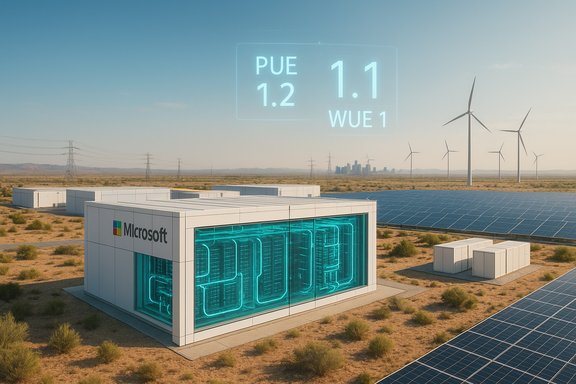
Microsoft has publicly rolled out a next‑generation datacentre design that eliminates evaporative water use for server cooling by shifting to closed‑loop, chip‑level liquid cooling. Rather than relying on evaporative towers or open cooling loops that consume municipal water, the systems fill coolant loops during construction and then circulate that fluid between server cold plates and high‑efficiency chillers — the loop is sealed and, in theory, needs no top‑up water for cooling purposes. Microsoft says the design can avoid more than 125 million litres of water per datacentre per year compared with prior evaporative systems and has set pilots in Phoenix and Mount Pleasant for 2026. This is both a sustainability and local‑resource strategy: it reduces freshwater dependency and shrinks the environmental footprint in water‑stressed regions.- Strengths:
- Dramatically reduces local water consumption.
- Improves thermal control at chip and rack level, supporting higher sustained power per rack.
- Facilitates higher operating temperatures that improve component lifespan and can reduce some energy overheads.
- Trade‑offs:
- Closed‑loop liquid cooling tends to increase mechanical energy use (PUE) compared with evaporative cooling in some climates, because mechanical chillers replace evaporative cooling’s energy‑cheap thermal lift.
- Adoption requires significant redesign of rack and server packaging and has implications for maintenance and spare‑parts logistics.
- Retrofits of existing campuses are more complex and costly than applying the approach to new builds.
Other thermal innovations
Microsoft is also piloting and deploying a broader set of thermal options that include direct‑to‑chip cold plates, immersion cooling trials in suitable contexts, more aggressive heat reuse and dynamic thermal management that ties server power profiles to cooling availability. These options are complementary; chip‑level closed‑loop is the scalable baseline for many new sites, while immersion or direct liquid cooling may be optimal for specific high‑density halls.Powering the build: contracts, nuclear, fusion and grid strategy
Massive capex and hedging: the $80 billion commitment
To close the capacity gap, Microsoft planned (and has publicly discussed) a very large capital program: roughly $80 billion in fiscal 2025 to expand AI‑enabled datacentre capacity and supporting infrastructure. That number is a statement of scale — it reflects purchases of specialized compute (GPUs and accelerators), data‑centre build‑outs and long‑term power commitments. But scale alone doesn’t solve regional power constraints. Microsoft has paired capex with a more deliberate energy strategy.Baselining firm power: Three Mile Island and the case for nuclear
Microsoft has signed long‑term power arrangements that go beyond conventional off‑site renewables. One headline example is a 20‑year arrangement linked to restarting the Three Mile Island Unit 1 reactor in Pennsylvania; Constellation Energy plans to upgrade and restart the unit and market the output, with Microsoft contracted to buy power over multi‑decade terms. These firm, low‑carbon baseload commitments matter because they provide predictable, dispatchable energy for round‑the‑clock AI clusters — capacity that intermittent wind or solar alone cannot guarantee. Reporting on that arrangement appeared in major outlets and drew immediate regulatory and community scrutiny because of the plant’s history and the scale of the PPA. Microsoft frames such deals as necessary to meet AI’s baseload needs while decarbonising.Long‑shots and moonshots: fusion with Helion
Microsoft is also part of a small group of corporations that have made forward‑leaning bets on fusion developers. In 2023 Microsoft signed an offtake agreement to purchase a tranche of power from Helion Energy’s planned fusion demonstrations (commonly cited as ~50 MWe beginning around 2028 in Helion’s public materials). This is an early commercial commitment to an experimental technology; it’s intended to accelerate developer finance and offer the company a potential future source of firm, low‑carbon baseload power. But fusion timelines are uncertain and technically risky; these contracts are hedges and signaling mechanisms, not immediate capacity fixes. Any concrete power contribution from fusion remains contingent on Helion meeting technical and permitting milestones. Readers should treat fusion timelines as aspirational rather than guaranteed.Hybrid energy architecture and grid integration
In practice Microsoft uses a portfolio approach to energy:- Long‑term PPAs with wind and solar to match annual energy consumption.
- Behind‑the‑meter generation and battery storage to firm renewables and provide on‑site resilience.
- Strategic investments or offtakes in dispatchable low‑carbon sources (nuclear and, in the future, fusion).
- Grid modernization partnerships and transmission investments in key regions.
Capacity strategy: leases, cancellations and reallocation
Reported lease cancellations and what they mean
In early 2025 analysts reported that Microsoft had cancelled or allowed to lapse leases and preliminary agreements equivalent to “a couple of hundred megawatts,” and had paused or slowed conversion of statements of qualification into firm leases in some markets. Industry channel checks from investment banks raised the spectre of an “oversupply” position, or else a simple regionally targeted reallocation of spend from international sites back to the U.S. Microsoft publicly refuted claims of any retreat from its long‑term strategy, emphasising that it is continually re‑forecasting where capacity is most needed. These developments are best read as tactical pacing rather than abandonment of AI ambitions.Why cancel or reallocate?
Reasons behind selective cancellations or pauses include:- Power and facility delays at partner sites (some sites lacked timely grid upgrades or construction progress).
- Tactical reallocation to regions where Microsoft can better guarantee low‑carbon firm power or faster commissioning.
- Efficiency gains in software and model servers that may temporarily reduce immediate marginal capacity needs.
- A desire to build more of the capacity itself (Microsoft‑owned) rather than rely solely on leased third‑party wholesale space.
Supply chain, construction and timeline realities
The time‑to‑service problem
Even with unlimited capital, a data centre takes months to permit, build and commission — and dedicated, high‑density AI halls require substation upgrades and sometimes new transmission lines. Supply‑chain constraints for specialized racks, GPUs, power conversion equipment and transformers add further lead time. That mismatch between demand signals and physical delivery is a major reason Microsoft is shifting strategy from “build everything fast” to a more mixed model of owned campuses, partner capacity and strategic leasing.Standardization and modular methods
To shorten timelines Microsoft is accelerating modular construction techniques and standardised designs so that repeatable elements can be factory‑assembled and shipped. That lowers variability and allows faster commissioning, but it still requires local grid capacity and siting clearance. Modularization is a partial hedge — it reduces construction risk but does not eliminate the need for transmission and distribution upgrades.Community, environmental and regulatory impacts
Local impacts and the “community pledge”
Microsoft has framed parts of its data‑centre strategy around a Datacenter Community Pledge that promises attention to local resources — especially water — and commitments to reuse and circularity (refurbishing servers, reducing hardware waste). The zero‑water cooling shift is explicitly positioned as part of that pledge, reducing water stress on local communities. But large campuses still demand land, local jobs and infrastructure upgrades, and those impacts draw scrutiny and sometimes opposition. Community engagement and transparent environmental assessment are now first‑order requirements for siting.Carbon accounting: PPAs vs instantaneous cleanliness
Corporate renewables commitments typically rely on long‑term PPAs and additionality to claim lower lifecycle emissions. Those annual matches do not automatically equate to minute‑by‑minute clean power; when datacentres need continuous baseload, firms must layer storage, firming resources or dispatchable low‑carbon generation (e.g., nuclear). Regulators and NGOs are increasingly asking for more granular accounting and for investments that actually change local grid emission profiles. Microsoft’s mix (PPAs + firm nuclear offtakes + storage) is an attempt to square those circles, but execution complexity and transmission limits remain.Risks, unknowns and where caution is required
1) Grid bottlenecks and regional risk
No amount of on‑site cooling innovation solves a lack of transmission capacity. In many U.S. and global markets, winning the right to build a high‑power data centre depends on utility upgrades that can take years and require coordination across multiple stakeholders. If multiple hyperscalers target the same regions, local grid stress and permitting delays will compound.2) Energy‑sourcing and reputational risk
Deals to buy nuclear output or to participate in fusion pilots can be effective for decarbonisation, but they carry reputational and operational risk. Nuclear restarts — like the Three Mile Island plan — must pass heavy regulatory scrutiny and face community concern; fusion remains technically uncertain and timelines are optimistic. Corporate commitments to novel energy technologies should therefore be read as strategic hedges, not immediate solutions. Microsoft’s Helion offtake, for example, is best seen as a forward‑looking industrial bet with clear caveats.3) Cost, efficiency and PUE trade‑offs
Closed‑loop liquid cooling and higher data‑hall temperatures can increase server efficiency at the chip level but may raise mechanical cooling energy use overall in some climates. That means Microsoft must balance water savings against PUE and lifecycle energy consumption. Transparent metric reporting (PUE, WUE and scope 1/2/3 emissions) will be essential to judge net environmental benefit.4) Supply‑chain concentration for accelerators
The market for high‑end GPUs and AI accelerators remains concentrated. Sudden demand spikes, geopolitical supply issues, or vendor bottlenecks can delay capacity expansion regardless of Microsoft’s capital commitment. That’s one reason Microsoft mixes owned capacity with leased partner space and third‑party suppliers.What Microsoft’s customers and partners should expect
Short term (months)
- Tighter regional capacity and occasional prioritisation of enterprise or strategic workloads.
- Continued use of partner‑supplied wholesale space to get frontier GPUs online quickly.
- Service availability may vary by region as Microsoft prioritises capacity allocation for major enterprise and AI customers.
Medium term (1–3 years)
- More new Microsoft‑owned campuses designed with zero‑water closed‑loop cooling and higher rack power densities coming online.
- A shifting mix of renewables, storage and firming contracts (including nuclear PPA volumes) to stabilise round‑the‑clock energy supply.
- Gradual easing of reported capacity constraints as modular methods, standardized designs and supply‑chain pacing close the gap.
Longer term (3–10 years)
- If fusion developers succeed, novel power sources could materially change baseload supply options — but this remains speculative.
- Continued pressure for more granular, minute‑level clean power accounting from regulators and customers.
- A more mature circular hardware ecosystem (refurbish, reuse) that reduces the environmental costs of expansion.
Conclusion: engineering the future while minding the trade‑offs
Microsoft’s response to the “happy problem” is comprehensive: redesign equipment and cooling, promise vast capex, secure diversified energy portfolios, and lean into modular construction and partner models to accelerate delivery. That approach recognises that the bottleneck is systemic — it’s not only about more servers but about where you put them, how you cool them, and what powers them.Strengths of the strategy include a clear emphasis on water stewardship through closed‑loop chip‑level cooling, aggressive energy contracting to firm supply for AI‑grade workloads, and the use of modular designs to shorten time to commission. But each strength creates new dependencies: higher PUE trade‑offs, the political and regulatory complexity of nuclear and fusion PPAs, and a continued reliance on a concentrated accelerator supply chain.
For customers and communities, the promise is mostly positive: more resilient, lower‑water data centres and a long‑term commitment to decarbonisation. For policymakers and utilities, the signal is urgent: accelerating transmission upgrades, clearer permitting pathways and modernised grid planning will be essential if hyperscale cloud and AI demand continues to climb.
Finally, a note on headline risk: reports of lease cancellations and tactical pauses generated understandable market noise, but they are best understood as part of an active re‑prioritisation rather than a strategic retreat. Microsoft is balancing pace with sustainability and grid realities — a difficult but necessary calculus if data centre expansion is to be both performant and socially responsible.
Quick summary (what to watch next)
- Execution of pilot zero‑water datacentres (Phoenix, Mt. Pleasant) and their real‑world PUE/WUE metrics.
- Progress on firming generation projects (Three Mile Island upgrades) and any regulatory milestones.
- Microsoft’s quarterly disclosures on capex and regional capacity guidance versus observed lease activity.
- Market availability and shipment schedules for AI accelerators and high‑density racks.
Source: Business Post How Microsoft is trying to solve the ‘happy problem’ of meeting the demand for data centres
