

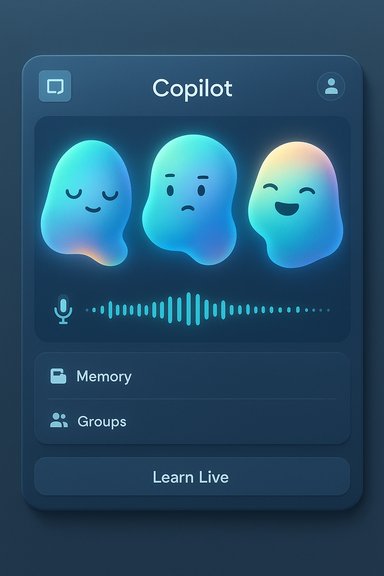
Microsoft’s attempt to put a friendlier face on Copilot landed in late October with the arrival of Mico, a deliberately non‑human, animated avatar designed to make voice interactions more natural — and to avoid the interruption and annoyance that turned the Office Assistant “Clippy” into a UX cautionary tale.
Background
Microsoft’s experiments with embodied assistants have been a long arc from Microsoft Bob and Clippy in the 1990s through Cortana and more recent chat-based Copilot iterations. Those earlier efforts taught a blunt lesson: personality without purpose or control becomes a liability, not a feature. The new Copilot “Fall” updates reframe that lineage around a central thesis: personality must be purpose‑bound, opt‑in, and transparent if it is to be useful rather than intrusive.Mico is the most visible surface change in a broader Copilot pivot that also introduces long‑term memory controls, shared Copilot Groups, a “Real Talk” conversational mode, Learn Live tutoring flows, and permissioned Edge actions. The combined package shifts Copilot from single‑session Q&A toward a persistent, social assistant that can remember context and act on behalf of users with explicit consent.
What Mico is — design, appearance and role
A deliberately abstract persona
Mico is an animated, blob‑like avatar that changes color, shape and micro‑expressions to indicate conversational state — listening, thinking, acknowledging — while intentionally avoiding photoreal human features. The non‑human, emoji‑like design is meant to lower emotional over‑attachment and sidestep the “uncanny valley” problem that can accompany lifelike faces. In Microsoft’s framing, Mico is an expressive UI layer on top of Copilot’s reasoning engine, not a separate intelligence.Where it appears and how it behaves
- Mico surfaces primarily in Copilot voice mode, on the Copilot home surface, and during dedicated Learn Live tutoring flows. It is scoped to these roles rather than being an always‑on helper that pops into unrelated apps.
- The avatar provides micro‑feedback — small visual cues that help users know when Copilot is listening, thinking, or has completed an action. These nonverbal signals are intended to reduce social friction in voice sessions and make the assistant feel more collaborative.
- Mico supports simple tactile animations (e.g., tapping for playful responses), and preview builds reportedly include a small Easter‑egg that briefly morphs it into a Clippy‑style paperclip after repeated taps; Microsoft presents that as a cultural wink rather than a return to an intrusive model. Treat the easter‑egg’s permanence as provisional.
The product context: features that matter
Mico is not just a mascot — it arrives bundled with several functional changes that materially alter what Copilot can do and how it can interact with people and data.Key elements of the Copilot Fall release
- Long‑term memory: user‑managed memory that retains preferences, project context and session history to enable continuity across interactions. Memory controls let users view, edit or delete what Copilot remembers.
- Copilot Groups: shareable sessions that allow a single Copilot instance (with Mico as the visible face) to participate in planning or study sessions with dozens of participants, summarizing threads, tallying votes and proposing action items. Preview reports place participant caps around the low‑30s, but exact limits vary by preview.
- Real Talk: an optional conversational mode that encourages the assistant to challenge assumptions, show more of its reasoning, and be less reflexively agreeable. This mode aims to reduce sycophancy and improve critical engagement.
- Learn Live: a voice‑led Socratic tutoring flow that uses guided questioning, visual whiteboards and scaffolded prompts rather than simply delivering answers — a context where a visible, reactive avatar can help pacing and turn‑taking.
- Edge Actions & Journeys: permissioned, agentic web behaviors where Copilot can see open tabs, summarize content and perform multi‑step tasks when explicitly authorized. These actions are gated by explicit confirmation and connector permissions.
How Mico attempts to learn from Clippy’s mistakes
Clippy’s core failure was not friendliness per se but context‑insensitive intrusions: it interrupted workflows and surfaced unsolicited help. Microsoft’s new approach addresses that history in three concrete design choices:- Scope — Mico appears only in voice, tutoring or group contexts rather than across every app.
- Optionality — users can disable the avatar and control what Copilot remembers; memory is explicitly user‑managed.
- Non‑human appearance — the abstract, blob design reduces the risk of emotional over‑attachment that can arise with humanoid or photorealistic faces.
Privacy, safety and governance — where the risks live
Giving an assistant personality amplifies traditional AI risks. Mico’s launch coincides with Copilot gaining persistent memory, deeper connectors, and agentic browser actions — all of which raise new surface area for privacy, safety and compliance problems.Privacy and data control
- Memory persistence means Copilot can store personal facts, project context and conversation history. While Microsoft exposes controls to view and delete memories, the default configuration and discoverability of those controls are decisive factors in real‑world exposure. Admins and users must be able to find and manage memories easily.
- Connectors to email, drives and calendars increase utility but also increase risk: misconceived permissions or overbroad connector scopes could let Copilot access sensitive information. Enterprise governance should apply least‑privilege policies and restrict connectors by policy.
Safety and accuracy
- Embodied assistants can be more persuasive by virtue of their personality. That persuasiveness raises stakes when Copilot is wrong, offers medical or legal guidance, or when minors and vulnerable users are involved. Conservative defaults and explicit safety gating in sensitive domains are necessary mitigations.
Regulatory and legal exposure
- The growing regulatory scrutiny around AI companions — including consumer protection and child safety concerns — means the avatar and associated memory/connectors will be reviewed by privacy and consumer agencies. Transparent provenance, clear consent flows and auditable logs matter more than the avatar animations.
Unverified or provisional claims (flagged)
- Reports of the Clippy morphed Easter‑egg and exact participant caps for Copilot Groups are derived from previews and early reporting; these behaviors were observed in preview builds and should be treated as provisional until Microsoft documents them in official release notes.
Enterprise and IT admin implications
Mico’s success in corporate environments hinges on administration, policy and observability rather than charm.Early actions for IT teams
- Pilot with a small user group to collect telemetry and user feedback before broad rollout.
- Restrict connectors by policy and enforce least‑privilege access for email, drives and calendars.
- Configure SIEM alerts and ensure audit trails are generated for any agentic Actions performed by Copilot. Require explicit confirmation for critical browser or account operations.
- Validate eDiscovery, retention semantics and voice transcript handling before enabling Copilot memory in regulated contexts.
Governance checklist for admins
- Ensure memory defaults are conservative — prefer “off” or “ask” state for enterprise deployments.
- Provide training and clear UI documentation for users to inspect and delete memories.
- Document acceptable use cases for Real Talk and agentic Edge Actions; policy must cover what Copilot may and may not do for users.
- Require accessible fallbacks and test Copilot behavior with screen readers and keyboard navigation to ensure parity for assistive tech users.
Design and UX analysis — strengths and weak points
Strengths
- Purpose‑first personality: Mico demonstrates a disciplined UX philosophy: tie personality to specific tasks (voice, tutoring, groups) rather than broad, ill‑scoped charm. That reduces the chance of unwanted interruptions.
- Visible controls: Microsoft’s emphasis on user‑facing memory controls and opt‑in connectors addresses a core deficiency from earlier assistant experiments.
- Multimodal fit: In voice and tutoring contexts, nonverbal cues (a visual avatar that signals listening or thinking) are genuinely useful for pacing and turn‑taking.
Weaknesses and open questions
- Default settings matter: If Mico or memory features are enabled by default in consumer builds, many users may never notice how to disable them — creating exposure. The rollout configuration will shape outcomes far more than the design alone.
- Emotional persuasiveness: Even abstract avatars can exert social influence; measuring how Mico affects user trust and reliance on Copilot’s outputs is essential. There is a nontrivial risk that a friendly face could make users accept incorrect or unsafe advice more readily.
- Execution complexity: The animation itself is trivial compared with the operational requirements for provenance, auditing, accessibility and reliable agentic behavior. If those scaffolds are weak, Mico’s warm face may mask harder reliability and compliance problems.
Recommendations — what users, educators and Microsoft should do next
For everyday users
- Review Copilot settings and memory controls; delete any stored items you don’t want persisted.
- If the avatar is distracting, disable Mico in Copilot preferences and use a text‑only or voice‑only workflow.
For educators and parents
- Treat Learn Live as a classroom tool to be piloted, not deployed universally. Validate its outputs, ensure assignments require process documentation, and monitor for over‑reliance on AI‑generated answers. Place conservative limits on memory and connectors in student accounts.
For IT and security teams
- Pilot Copilot features with a controlled cohort.
- Set connector policies and require explicit consent for each service.
- Ensure SIEM and eDiscovery readiness for memory and voice logs.
- Demand robust admin UIs that let teams view, export and audit Copilot interactions.
For Microsoft (recommendations to increase odds of success)
- Make conservative defaults the default: memory off or ask; Mico disabled in enterprise tenants until explicitly enabled.
- Publish detailed provenance and confidence UI for outputs, especially in Real Talk and agentic modes.
- Commit to accessibility guarantees and make Mico’s visual cues available in non‑visual modalities (e.g., audio cues, haptic/sonic signals) for assistive tech parity.
- Track and publish metrics about misuse, user opt‑outs and false positives/negatives for agentic actions so the community can evaluate safety over time.
Verdict — can Mico succeed where Clippy failed?
Mico’s design and the surrounding product controls represent an informed, measured attempt to revive friendly interface cues without repeating the 1990s mistakes. The company is building on far richer foundations: large multimodal models, on‑device speech, persistent memory primitives and explicit connector permissions. Those technical improvements matter.However, the technical foundation alone does not guarantee success. The crucial determinants will be defaults, governance, transparency and execution. If Mico ships with conservative settings, robust admin tooling and clear provenance for outputs, the avatar could meaningfully improve voice and collaborative workflows. If Microsoft prioritizes engagement or novelty over governance, the industry risks relearning Clippy’s lesson with modern consequences: privacy lapses, misleading outputs, or emotional over‑attachment layered atop persistent memory and agentic web actions.
Final thoughts
Mico is a low‑stakes, high‑visibility experiment: small, playful animations front a consequential shift in how Copilot remembers, collaborates and acts. The visible avatar is the easiest part — the invisible scaffolding of controls, audit trails and conservative policy will determine whether the feature becomes a helpful productivity anchor or a nostalgic footnote. Watch the staged rollout, test before you enable it broadly, and treat personality in AI as a design decision that must be paired with governance, not a substitute for it.Source: Longview Daily News Microsoft hopes Mico succeeds where Clippy failed as tech companies give AI personality
